PUBLISHER: Mordor Intelligence | PRODUCT CODE: 2065430

PUBLISHER: Mordor Intelligence | PRODUCT CODE: 2065430
Asia-Pacific Benefits Technology - Market Share Analysis, Industry Trends & Statistics, Growth Forecasts (2026 - 2031)
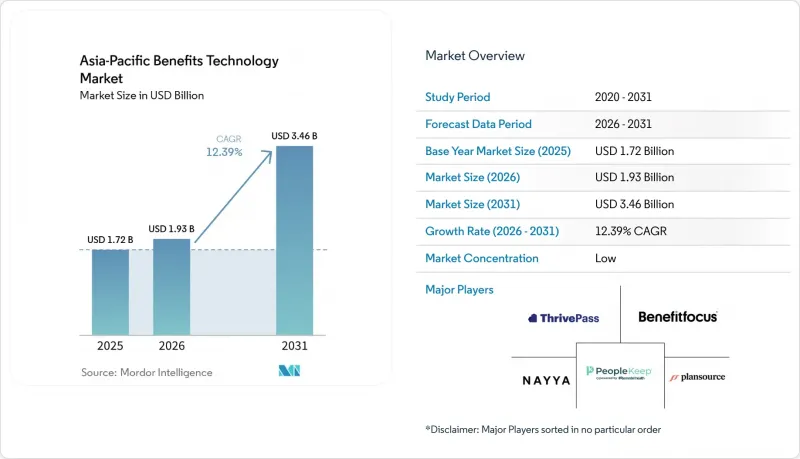
According to Mordor Intelligence, the asia-Pacific benefits technology market size is expected to grow from USD 1.72 billion in 2025 to USD 1.93 billion in 2026 and is forecast to reach USD 3.46 billion by 2031 at 12.39% CAGR over 2026-2031.
This report is Segmented by Component (Software, and Services), Application (Benefits Administration, and More), Deployment Mode (Cloud-Based, On-Premises, and Hybrid), Organization Size (Large Enterprises, and Small and Medium-Sized Enterprises), End-User Industry (Banking, Financial Services, and Insurance, and More), and Geography. The Market Forecasts are Provided in Terms of Value (USD).
Asia-Pacific Benefits Technology Market Trends and Insights
Cloud-Based HR and Benefits Stack Modernization
Cloud migration has moved from a long-range plan to an operating need for many employers in the Asia-Pacific benefits technology market. Employers are trying to bring HR, payroll, and benefits functions onto unified systems that can support multi-country configurations without repeated custom builds. That shift matters because cloud platforms give benefit teams a single view of usage patterns, plan uptake, and administrative exceptions across different markets. The Asia-Pacific benefits technology market is also moving faster than older HR software cycles because many mobile-native workforces are accessing benefits digitally as their main channel rather than as a secondary desktop option. A clear example came when Sumitomo Metal Mining selected Works Human Intelligence's integrated COMPANY platform to unify around 7,000 group employees on a single HR foundation, replacing fragmented legacy arrangements.
Automation of Enrollment, Compliance, and Payroll Connectivity
Automation has become a major growth engine for the Asia-Pacific benefits technology market because statutory rules differ widely across the region and change on separate timelines. Employers often need one connected process for enrollment, eligibility, payroll calculation, and reporting, but many still run those tasks through disconnected systems or manual handoffs. That operating model becomes difficult when wage ceilings, contribution rules, and local filing requirements differ by country and are updated at different times of year. The Asia-Pacific benefits technology market is therefore seeing stronger demand for platforms that embed local statutory logic into the product, rather than leaving reconciliation work to internal teams. Ramco Systems highlighted that multi-country payroll operations and AI-supported verification are becoming more important as employers try to reduce manual effort and move toward connected payroll and benefits workflows. The market is expected to continue evolving as organizations increasingly prioritize automation and efficiency in compliance.
Data Privacy and Cybersecurity Exposure in Health and Payroll Data
Data privacy is a meaningful drag on the Asia-Pacific benefits technology market because health and payroll data move through systems that are often shared across employers, insurers, and payroll operators. The region does not operate under a single privacy framework, so vendors must adjust their data-handling, storage, notification, and transfer practices country by country. That raises the minimum product standard for encryption, access control, residency design, and audit readiness before a platform can scale across borders. Smaller SaaS vendors face a harder path because localization and security investment rise before revenue reaches regional scale. For multinational employers, the result is a slower buying cycle because privacy reviews now affect architectural decisions as much as contract terms.
Other drivers and restraints analyzed in the detailed report include:
- Mobile-First Self-Service and Benefits Experience Demand
- SME Adoption of Low-Cost SaaS Benefits Platforms
- Legacy HRIS and Payroll Integration Complexity
For complete list of drivers and restraints, kindly check the Table Of Contents.
Segment Analysis
Software held 62.45% of the Asia-Pacific benefits technology market share in 2025, indicating that platform licenses still accounted for the largest revenue base in the region. That leadership reflects the strong role of software-led delivery models for enrollment, compliance management, employee access, and payroll connectivity. At the same time, the commercial center of gravity is shifting as customers increasingly need platforms that can be implemented and localized without lengthy internal projects. The Asia-Pacific benefits technology market is now rewarding vendors that can pair software with deployment depth across languages, currencies, and statutory frameworks.
Services are projected to expand at a 15.02% CAGR through 2031, faster than the software component, underscoring the value now in implementation, integration, advisory, and support work. The shift does not reflect weak software demand; it reflects the fact that many employers already have product options and instead struggle with execution across multiple countries. That is why implementation and integration services have become a core demand driver for the Asia-Pacific benefits technology industry, especially where payroll and benefits data must be reconciled across separate systems. Regional changes to statutory rules have added urgency, as employers have had to update payroll-benefit logic rather than leave older links in place. Ramco Systems' work around multi-country payroll and AI-based verification reflects this broader service demand, where the product alone is not enough without strong integration capability.
Benefits administration accounted for 28.16% of the Asia-Pacific benefits technology market in 2025, making it the largest application layer. That position is logical because enrollment, eligibility checks, and carrier or provider connectivity remain the foundation for every employer deployment. Employers usually digitize those workflows before they move into more specialized modules. This gives the administration layer a broad installed base, even when employers are still early in wider benefits modernization.
Flexible benefits and personalization platforms are projected to grow at a 14.28% CAGR through 2031 as employers move away from one-size-fits-all programs and toward employee-choice models. The shift is being reinforced by rising demand for decision support, health navigation, and more targeted benefit communication. A 2025 Aon research study found that many employees in multinational firms would trade their current arrangements for greater personalization, which helps explain why choice architecture is moving to the center of platform roadmaps. The Asia-Pacific benefits technology market is also seeing convergence among benefits selection, wellbeing, and communication tools, which is why many vendors now bundle recognition and engagement functions rather than sell isolated modules. CDP Group's C-Benefits platform exemplifies this direction by combining commercial insurance, health management, flexible benefits, and recognition services for more than 1,000 enterprises and 800,000 employees in 2025. The growing emphasis on personalization and integration is expected to drive further innovation in the benefits technology market.
List of Companies Covered in this Report:
- Benefitfocus.com, Inc.
- Businessolver
- PlanSource Benefits Administration, Inc.
- bswift LLC
- Benefex Limited
- Employee Navigator
- PeopleKeep, Inc.
- ThrivePass, Inc.
- Darwinbox Digital Solutions Pvt. Ltd.
- Employment Hero Pty Ltd
- Bargain Technologies Private Limited
- Mednefits Singapore Pte. Ltd.
- Nayya Health, Inc.
- Forma Inc.
- League, Inc.
- Thanks Ben LTD
- SME HCI Limited
- Yu Life Ltd.
- Plum Benefits Insurance Brokers Pvt Ltd
- Invoq Loop Insurance Brokers Pvt Ltd
- Get Paz Insurance Brokers Pvt Ltd
Additional Benefits:
- The market estimate (ME) sheet in Excel format
- 3 months of analyst support
TABLE OF CONTENTS
1 INTRODUCTION
- 1.1 Study Assumptions and Market Definition
- 1.2 Scope of the Study
2 RESEARCH METHODOLOGY
3 EXECUTIVE SUMMARY
4 MARKET LANDSCAPE
- 4.1 Market Overview
- 4.2 Market Drivers
- 4.2.1 Cloud-Based HR and Benefits Stack Modernization
- 4.2.2 Automation of Enrollment, Compliance, and Payroll Connectivity
- 4.2.3 Mobile-First Self-Service and Benefits Experience Demand
- 4.2.4 SME Adoption of Low-Cost SaaS Benefits Platforms
- 4.2.5 Medical Inflation-Led Benefits Cost Optimization
- 4.2.6 Cross-Border Statutory Benefits Fragmentation Across Asia-Pacific
- 4.3 Market Restraints
- 4.3.1 Data Privacy and Cybersecurity Exposure in Health and Payroll Data
- 4.3.2 Legacy HRIS and Payroll Integration Complexity
- 4.3.3 Budget Rebalancing Delaying Net-New Module Purchases
- 4.3.4 Low Utilization Signal Quality in Wellbeing and Mental Health Benefits
- 4.4 Industry Value Chain Analysis
- 4.5 Regulatory Landscape
- 4.6 Technological Outlook
- 4.7 Impact of Macroeconomic Factors on the Market
- 4.8 Porter's Five Forces Analysis
- 4.8.1 Threat of New Entrants
- 4.8.2 Bargaining Power of Suppliers
- 4.8.3 Bargaining Power of Buyers
- 4.8.4 Threat of Substitutes
- 4.8.5 Intensity of Competitive Rivalry
5 MARKET SIZE AND GROWTH FORECASTS (VALUE)
- 5.1 By Component
- 5.1.1 Software
- 5.1.2 Services
- 5.1.2.1 Implementation and Integration Services
- 5.1.2.2 Consulting and Advisory Services
- 5.1.2.3 Support and Maintenance Services
- 5.2 By Application
- 5.2.1 Benefits Administration
- 5.2.2 Compensation and Rewards Management
- 5.2.3 Employee Recognition and Engagement Platforms
- 5.2.4 Benefits Communication and Employee Portals
- 5.2.5 Flexible Benefits / Personalization Platforms
- 5.2.6 Other Applications
- 5.3 By Deployment Mode
- 5.3.1 Cloud-Based
- 5.3.2 On-Premises
- 5.3.3 Hybrid
- 5.4 By Organization Size
- 5.4.1 Large Enterprises
- 5.4.2 Small and Medium-Sized Enterprises
- 5.5 By End-User Industry
- 5.5.1 Banking, Financial Services, and Insurance
- 5.5.2 IT and Telecommunications
- 5.5.3 Healthcare and Life Sciences
- 5.5.4 Manufacturing
- 5.5.5 Retail and E-Commerce
- 5.5.6 Public Sector and Education
- 5.5.7 Other End-User Industries
- 5.6 By Geography
- 5.6.1 China
- 5.6.2 Japan
- 5.6.3 India
- 5.6.4 South Korea
- 5.6.5 Australia and New Zealand
- 5.6.6 Southeast Asia
- 5.6.7 Rest of Asia-Pacific
6 COMPETITIVE LANDSCAPE
- 6.1 Market Concentration
- 6.2 Strategic Moves
- 6.3 Market Share Analysis
- 6.4 Company Profiles (includes Global Level Overview, Market Level Overview, Core Segments, Financials as available, Strategic Information, Market Rank/Share, Products and Services, Recent Developments)
- 6.4.1 Benefitfocus.com, Inc.
- 6.4.2 Businessolver
- 6.4.3 PlanSource Benefits Administration, Inc.
- 6.4.4 bswift LLC
- 6.4.5 Benefex Limited
- 6.4.6 Employee Navigator
- 6.4.7 PeopleKeep, Inc.
- 6.4.8 ThrivePass, Inc.
- 6.4.9 Darwinbox Digital Solutions Pvt. Ltd.
- 6.4.10 Employment Hero Pty Ltd
- 6.4.11 Bargain Technologies Private Limited
- 6.4.12 Mednefits Singapore Pte. Ltd.
- 6.4.13 Nayya Health, Inc.
- 6.4.14 Forma Inc.
- 6.4.15 League, Inc.
- 6.4.16 Thanks Ben LTD
- 6.4.17 SME HCI Limited
- 6.4.18 Yu Life Ltd.
- 6.4.19 Plum Benefits Insurance Brokers Pvt Ltd
- 6.4.20 Invoq Loop Insurance Brokers Pvt Ltd
- 6.4.21 Get Paz Insurance Brokers Pvt Ltd
7 MARKET OPPORTUNITIES AND FUTURE OUTLOOK
- 7.1 White-Space and Unmet-Need Assessment

