
PUBLISHER: Mordor Intelligence | PRODUCT CODE: 2065444

PUBLISHER: Mordor Intelligence | PRODUCT CODE: 2065444
U.S. Electrotherapy - Market Share Analysis, Industry Trends & Statistics, Growth Forecasts (2026 - 2031)
According to Mordor Intelligence, the u.S. electrotherapy market size is expected to increase from USD 0.41 billion in 2025 to USD 0.43 billion in 2026 and reach USD 0.56 billion by 2031, growing at a CAGR of 5.20% over 2026-2031.
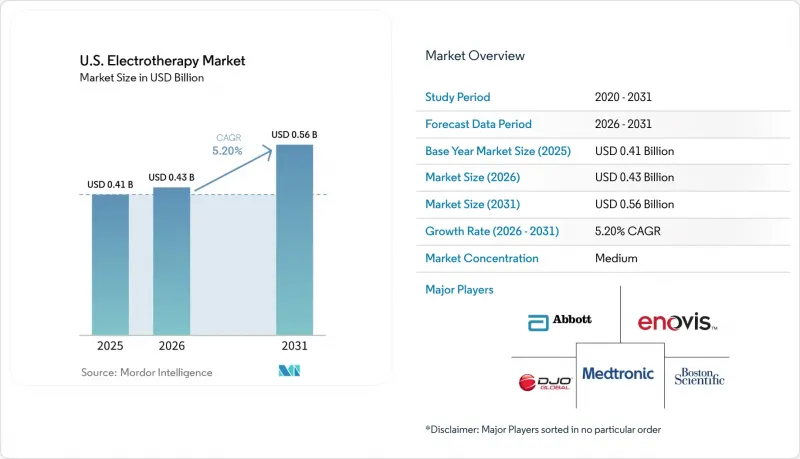
This report is Segmented by Therapy Type (TENS, IFT, NMES/FES, and More), Application (Pain Management, Neuromuscular Dysfunction, and More), End User (Hospitals, Pain Clinics, PT Centers, Ascs, and More), and Prescription Type (Prescription, OTC, and Hybrid Direct-To-Home). The Market Forecasts are Provided in Terms of Value (USD).
U.S. Electrotherapy Market Trends and Insights
Chronic Pain Burden and Aging-Related Pain Incidence
Chronic pain remains a significant driver for the United States electrotherapy market, with 24.3% of adults, approximately 60 million people, experiencing chronic pain in 2025. Among them, 8.9% faced high-impact chronic pain that disrupted daily activities. Older adults were most affected, with a 36.0% prevalence among those aged 65 and above, compared to 12.3% to 28.7% in younger groups. Conditions like osteoarthritis and spinal degeneration highlight the role of electrotherapy in drug-sparing pain management. The market benefits from a stable demand base across outpatient rehabilitation, homecare, and chronic disease management settings.
Opioid-Sparing Treatment Preference Across Pain Care Pathways
The shift toward non-opioid pain treatments is strengthening the United States electrotherapy market across hospitals, outpatient facilities, and specialist channels. The NOPAIN Act supports Medicare payments for non-opioid treatments through 2027, enhancing the financial case for device-based pain management. The Alternatives to PAIN Act reduces prior authorization barriers under Medicare Part D, favoring non-drug therapies. Specialist endorsements for peripheral nerve stimulation in chronic back pain further drive adoption, with higher-value prescription systems gaining traction over consumer devices.
Reimbursement Friction, Prior Authorization, and LCD Limits
Reimbursement complexities remain a key short-term challenge for the United States electrotherapy market. The WISeR Model, effective January 1, 2026, in states like Arizona, New Jersey, and Texas, introduces AI-assisted prior authorization for electrical nerve stimulators, increasing operational burdens and extending sales cycles. Stricter compliance requirements, such as the CMS LCD L33802 for TENS implemented in January 2024, have already added to suppliers' challenges. Larger manufacturers manage these changes more effectively due to scale and resources, while smaller suppliers face significant administrative hurdles. Texas, a critical Medicare-heavy market, amplifies the revenue impact of these added reviews.
Other drivers and restraints analyzed in the detailed report include:
- Home-Based Rehabilitation and Portable Device Adoption
- Higher Outpatient Musculoskeletal and Post-Surgical Rehab Volume
- Mixed Clinical Evidence Across Some Indications and Modalities
For complete list of drivers and restraints, kindly check the Table Of Contents.
Segment Analysis
In 2025, TENS therapy devices held a 32.55% share of the therapy type mix, leading the United States electrotherapy market. Their dominance was driven by broad availability across prescription and over-the-counter channels, enhancing access through clinics, pharmacies, retail outlets, and direct purchases. The FDA's 510(k) pathway remained active, with clearances like the OTC 4-Channel Rechargeable TENS Unit and Zynex Medical's TensWave expanding the prescription TENS portfolio. Interferential and microcurrent therapies retained their roles in physiotherapy, while PENS and bone growth stimulation remained specialized.
Neuromuscular electrical stimulation (NMES) is projected to grow at a 6.80% CAGR through 2031, making it the fastest-growing therapy type. Its adoption is increasing in stroke rehabilitation, spinal cord injury recovery, and post-surgical muscle re-education, supported by home-use clearances. High-value implantables like spinal cord stimulation and sacral neuromodulation continue to dominate revenue, while surface devices drive higher unit sales.
Pain management accounted for 42.88% of the application mix in 2025, leading the United States electrotherapy market. This reflects the concentration of prescription TENS, peripheral nerve stimulation, and spinal cord stimulation in outpatient pain clinics and spine practices. Bone healing and spinal fusion support maintained stable demand, driven by clinical necessity in high-risk cases, while wound care and dermatological applications remained limited due to reimbursement challenges.
The market for neuromuscular dysfunction and rehabilitation is forecast to grow at a 6.35% CAGR through 2031, driven by rising incidences of stroke, spinal cord injuries, and traumatic brain injuries. Boston Scientific's acquisition of Axonics strengthened its position in pelvic dysfunction therapy, adding a high-growth segment to the application mix. Pain management remains the anchor, while rehabilitation and pelvic neuromodulation are gaining traction.
List of Companies Covered in this Report:
- Abbott Laboratories
- Axonics, Inc.
- BioWave Corporation
- Boston Scientific
- BTL Industries, Inc.
- DJO Global
- Electronic Waveform Lab, Inc. (H-Wave)
- EMS Physio Ltd.
- Enovis Corporation
- Gymna Group NV
- Medtronic
- Mettler Electronics
- NeuroMetrix
- OMRON Healthcare, Inc.
- Orthofix
- Richmar
- RS Medical, Inc.
- TensCare Ltd.
- Utah Medical Products
- Zynex, Inc.
Additional Benefits:
- The market estimate (ME) sheet in Excel format
- 3 months of analyst support
TABLE OF CONTENTS
1 Introduction
- 1.1 Study Assumptions & Market Definition
- 1.2 Scope of the Study
2 Research Methodology
3 Executive Summary
4 Market Landscape
- 4.1 Market Overview
- 4.2 Market Drivers
- 4.2.1 Chronic Pain Burden and Aging-Related Pain Incidence
- 4.2.2 Opioid-Sparing Treatment Preference Across Pain Care Pathways
- 4.2.3 Home-Based Rehabilitation and Portable Device Adoption
- 4.2.4 Higher Outpatient Musculoskeletal and Post-Surgical Rehab Volumes
- 4.2.5 Faster Coverage Visibility for Breakthrough Stimulation Platforms
- 4.2.6 Remote Programming and Adherence Analytics Improving Home-Use Scalability
- 4.3 Market Restraints
- 4.3.1 Mixed Clinical Evidence Across Some Indications and Modalities
- 4.3.2 Reimbursement Friction, Prior Authorization, and LCD Limits
- 4.3.3 Competition From Physical Therapy, Drugs, Injections, Surgery, and Other Modalities
- 4.3.4 Crowded Low-End Device Supply and Compliance Burden
- 4.4 Value/Supply Chain Analysis
- 4.5 Regulatory Landscape
- 4.6 Technological Outlook
- 4.7 Porter's Five Forces Analysis
- 4.7.1 Threat of new entrants
- 4.7.2 Bargaining power of suppliers
- 4.7.3 Bargaining power of buyers
- 4.7.4 Threat of substitutes
- 4.7.5 Intensity of rivalry
5 Market Size & Growth Forecasts (Value, USD)
- 5.1 By Therapy Type
- 5.1.1 Transcutaneous Electrical Nerve Stimulation (TENS)
- 5.1.2 Interferential Therapy (IFT)
- 5.1.3 Neuromuscular Electrical Stimulation (NMES) / Functional Electrical Stimulation (FES)
- 5.1.4 Microcurrent Therapy
- 5.1.5 Percutaneous Electrical Nerve Stimulation (PENS)
- 5.1.6 Spinal Cord Stimulation (SCS)
- 5.1.7 Peripheral Nerve Stimulation (PNS)
- 5.1.8 Sacral Neuromodulation (SNM)
- 5.1.9 Bone Growth Stimulation
- 5.2 By Application
- 5.2.1 Pain Management
- 5.2.2 Neuromuscular Dysfunction and Rehabilitation
- 5.2.3 Bone Healing and Spinal Fusion Adjunct Therapy
- 5.2.4 Urinary and Fecal Incontinence / Pelvic Floor Dysfunction
- 5.2.5 Other Indications
- 5.3 By End User
- 5.3.1 Hospitals and Health Systems
- 5.3.2 Pain Management and Spine Clinics
- 5.3.3 Physical Therapy and Rehabilitation Centers
- 5.3.4 Ambulatory Surgery Centers and Outpatient Orthopedic Clinics
- 5.3.5 Homecare and Self-Administered Care
- 5.3.6 Others
- 5.4 By Prescription Type
- 5.4.1 Prescription Devices
- 5.4.2 Over-the-Counter Devices
- 5.4.3 Hybrid Physician-Enabled Direct-to-Home Devices
6 Competitive Landscape
- 6.1 Market Concentration
- 6.2 Market Share Analysis
- 6.3 Company Profiles (includes Global level Overview, Market level overview, Core Segments, Financials as available, Strategic Information, Market Rank/Share for key companies, Products & Services, and Recent Developments)
- 6.3.1 Abbott Laboratories
- 6.3.2 Axonics, Inc.
- 6.3.3 BioWave Corporation
- 6.3.4 Boston Scientific Corporation
- 6.3.5 BTL Industries, Inc.
- 6.3.6 DJO, LLC
- 6.3.7 Electronic Waveform Lab, Inc. (H-Wave)
- 6.3.8 EMS Physio Ltd.
- 6.3.9 Enovis Corporation
- 6.3.10 Gymna Group NV
- 6.3.11 Medtronic plc
- 6.3.12 Mettler Electronics Corp.
- 6.3.13 NeuroMetrix, Inc.
- 6.3.14 OMRON Healthcare, Inc.
- 6.3.15 Orthofix Medical Inc.
- 6.3.16 Richmar
- 6.3.17 RS Medical, Inc.
- 6.3.18 TensCare Ltd.
- 6.3.19 Utah Medical Products, Inc.
- 6.3.20 Zynex, Inc.
7 Market Opportunities & Future Outlook
- 7.1 White-space & Unmet-need Assessment

