
PUBLISHER: Mordor Intelligence | PRODUCT CODE: 2065527

PUBLISHER: Mordor Intelligence | PRODUCT CODE: 2065527
U.S. Cardiovascular & Soft Tissue Repair Patch - Market Share Analysis, Industry Trends & Statistics, Growth Forecasts (2026 - 2031)
According to Mordor Intelligence, the u.S. cardiovascular & soft tissue repair patch market size is expected to increase from USD 1.38 billion in 2025 to USD 1.49 billion in 2026 and reach USD 2.18 billion by 2031, growing at a CAGR of 7.90% over 2026-2031.
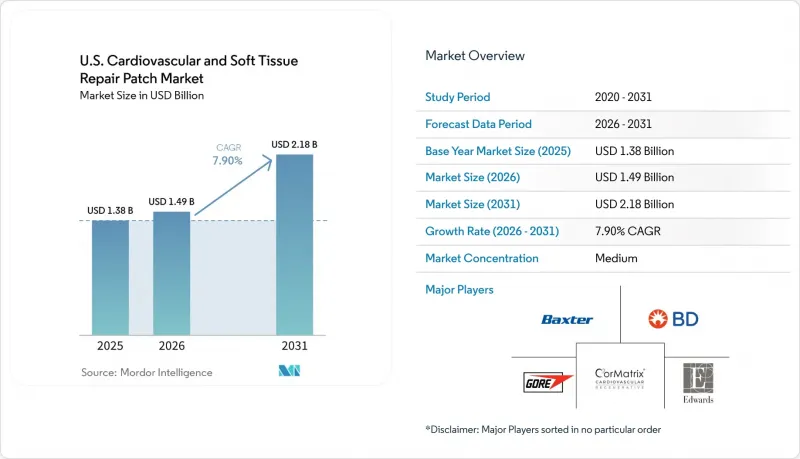
This report is Segmented by Material (Synthetic, Biologic, Tissue-Engineered/Composite), Application (Cardiac Repair, Vascular Repair and Reconstruction, Pericardial Repair, Dural Repair, Soft Tissue Repair), and End User (Hospitals, Ambulatory Surgical Centers, Specialty Cardiovascular and Specialty Surgical Centers). The Market Forecasts are Provided in Terms of Value (USD).
U.S. Cardiovascular & Soft Tissue Repair Patch Market Trends and Insights
Rising Carotid Endarterectomy and Open Peripheral Reconstruction Volumes
Carotid endarterectomy continues to drive direct patch demand as arteriotomy closure remains integral to the procedure. A 2025 analysis of 395,092 carotid revascularizations among Medicare beneficiaries from January 2017 to September 2024 showed carotid endarterectomy accounted for 76.7% of procedures, while carotid artery stenting represented 23.3%. Despite stenting's rise from 13% in 2017 to 38% by 2024, carotid endarterectomy remains the dominant treatment. Although total carotid revascularization volumes declined from 61,280 in 2017 to 43,735 in 2023, carotid endarterectomy cases continue to sustain patch demand. Additionally, open peripheral vascular reconstructions, such as femoral and iliac bypasses, further support patch-assisted closures in complex cases.
Persistent Congenital Heart Defect Repair Burden
Congenital heart defect repairs create long-term demand as patients often require multiple interventions from infancy into adulthood. The American Heart Association reported a birth prevalence of 12.3 per 1,000 in North America, with a 2024 United States prevalence of 466,566 individuals, 60% of whom were under 20 years old. The Society of Thoracic Surgeons' 2024 database update highlighted growth in procedure volumes, with atrial and ventricular septal defect patch repairs among the most common. This recurring demand, influenced by regional cost and stay variations, underscores the importance of flexible pricing and diverse product offerings for suppliers.
High Biologic Patch Acquisition Cost and Reimbursement Gaps
Biologic cardiovascular patches face adoption challenges due to high acquisition costs, often exceeding those of synthetic alternatives. This pricing disparity complicates value analysis reviews, slows hospital transitions, and extends the commercial cycle for premium products in the United States. Reimbursement remains fragmented, with many biologic patches requiring payer negotiations and institutional approvals, delaying adoption by 6 to 18 months. Suppliers also report revenue pressures when premium products encounter procurement resistance or budget scrutiny.
Other drivers and restraints analyzed in the detailed report include:
- Biologic Matrices Gaining Favor in Infection-Prone or Complex Cases
- ASC Migration of Select Soft Tissue Repair Procedures
- Product Failure, Recall Risk, and Durability Concerns
For complete list of drivers and restraints, kindly check the Table Of Contents.
Segment Analysis
In 2025, synthetic patches held a 54.20% revenue share in the United States cardiovascular and soft tissue repair patch market. Their dominance is driven by the cost efficiency, dimensional consistency, and clinical familiarity of materials like ePTFE, polyester, and polypropylene. ePTFE remains critical for carotid and peripheral arteriotomy closures due to its reliability and procedural familiarity. Synthetic products also benefit from simplified procurement processes, enabling predictable price-performance alignment.
Biologic patches are projected to grow at an 8.52% CAGR from 2026 to 2031, driven by their use in contaminated fields, infection-prone repairs, and cases requiring better tissue integration. Bovine pericardium is the most widely used biologic material, while porcine SIS and ECM-based formats are gaining traction in reconstruction and cardiac applications, expanding their adoption beyond niche uses.
List of Companies Covered in this Report:
- AROA BIOSURGERY LIMITED
- Artivion, Inc.
- B. Braun
- Baxter
- Beckton Dickinson
- CorMatrix Cardiovascular, Inc.
- Edward Lifesciences
- Elutia Inc.
- FOC Medical
- Getinge
- Integra LifeSciences
- INTERVASCULAR SAS
- Labcor Laboratorios Ltda.
- LeMaitre Vascular
- Synovis Life Technologies, Inc.
- TELA Bio, Inc.
- Terumo
- Tisgenx, Inc.
- VASCUTEK
- W. L. Gore & Associates
Additional Benefits:
- The market estimate (ME) sheet in Excel format
- 3 months of analyst support
TABLE OF CONTENTS
1 Introduction
- 1.1 Study Assumptions & Market Definition
- 1.2 Scope of the Study
2 Research Methodology
3 Executive Summary
4 Market Landscape
- 4.1 Market Overview
- 4.2 Market Drivers
- 4.2.1 Rising Carotid Endarterectomy and Open Peripheral Reconstruction Volumes
- 4.2.2 Persistent Congenital Heart Defect Repair Burden
- 4.2.3 Biologic Matrices Gaining Favor in Infection-Prone or Contaminated Fields
- 4.2.4 ASC Migration of Select Soft Tissue Repair Procedures
- 4.2.5 Redo Sternotomy Adhesion Mitigation Raising Pericardial Closure Demand
- 4.2.6 Pediatric Patch Selection Shifting Toward Lower-Calcification Bioscaffolds
- 4.3 Market Restraints
- 4.3.1 High Biologic Patch Acquisition Cost and Reimbursement Scrutiny
- 4.3.2 Product Failure, Recall Risk, and Durability Concerns
- 4.3.3 Endovascular and Transcatheter Substitution Reducing Open-Patch Case Mix
- 4.3.4 Single-Source Tissue Processing and Biologic Raw-Material Dependence
- 4.4 Value Chain / Supply-Chain Analysis
- 4.5 Regulatory Landscape
- 4.6 Technological Outlook
- 4.7 Porter's Five Forces Analysis
- 4.7.1 Bargaining power of suppliers
- 4.7.2 Bargaining power of buyers
- 4.7.3 Threat of new entrants
- 4.7.4 Threat of substitutes
- 4.7.5 Competitive rivalry
5 Market Size & Growth Forecasts (Value, USD)
- 5.1 By Material
- 5.1.1 Synthetic
- 5.1.1.1 ePTFE
- 5.1.1.2 Polyester
- 5.1.1.3 Polypropylene and other synthetics
- 5.1.2 Biologic
- 5.1.2.1 Bovine pericardium
- 5.1.2.2 Porcine SIS / ECM
- 5.1.2.3 Human acellular dermal matrix
- 5.1.3 Tissue-engineered / Composite
- 5.1.3.1 Bioengineered ECM scaffolds
- 5.1.3.2 Hybrid resorbable composites
- 5.1.1 Synthetic
- 5.2 By Application
- 5.2.1 Cardiac Repair
- 5.2.2 Vascular Repair and Reconstruction
- 5.2.3 Pericardial Repair
- 5.2.4 Dural Repair
- 5.2.5 Soft Tissue Repair
- 5.3 By End User
- 5.3.1 Hospitals
- 5.3.2 Ambulatory Surgical Centers
- 5.3.3 Specialty Cardiovascular Clinics and Specialty Surgical Centers
6 Competitive Landscape
- 6.1 Market Concentration
- 6.2 Market Share Analysis
- 6.3 Company Profiles (includes Global level Overview, Market level overview, Core Segments, Financials as available, Strategic Information, Market Rank/Share for key companies, Products & Services, and Recent Developments)
- 6.3.1 AROA BIOSURGERY LIMITED
- 6.3.2 Artivion, Inc.
- 6.3.3 B. Braun Melsungen AG
- 6.3.4 Baxter International Inc.
- 6.3.5 Becton, Dickinson and Company
- 6.3.6 CorMatrix Cardiovascular, Inc.
- 6.3.7 Edwards Lifesciences Corporation
- 6.3.8 Elutia Inc.
- 6.3.9 FOC Medical S.A.
- 6.3.10 Getinge AB
- 6.3.11 Integra LifeSciences Holdings Corporation
- 6.3.12 INTERVASCULAR SAS
- 6.3.13 Labcor Laboratorios Ltda.
- 6.3.14 LeMaitre Vascular, Inc.
- 6.3.15 Synovis Life Technologies, Inc.
- 6.3.16 TELA Bio, Inc.
- 6.3.17 Terumo Corporation
- 6.3.18 Tisgenx, Inc.
- 6.3.19 VASCUTEK Ltd.
- 6.3.20 W. L. Gore & Associates, Inc.
7 Market Opportunities & Future Outlook
- 7.1 White-space & Unmet-need Assessment

