PUBLISHER: Mordor Intelligence | PRODUCT CODE: 2065538

PUBLISHER: Mordor Intelligence | PRODUCT CODE: 2065538
Identity Verification For Employee Onboarding - Market Share Analysis, Industry Trends & Statistics, Growth Forecasts (2026 - 2031)
According to Mordor Intelligence, the identity verification for employee onboarding market size is expected to increase from USD 2.40 billion in 2025 to USD 2.78 billion in 2026 and reach USD 6.01 billion by 2031, growing at a CAGR of 16.67% over 2026-2031.
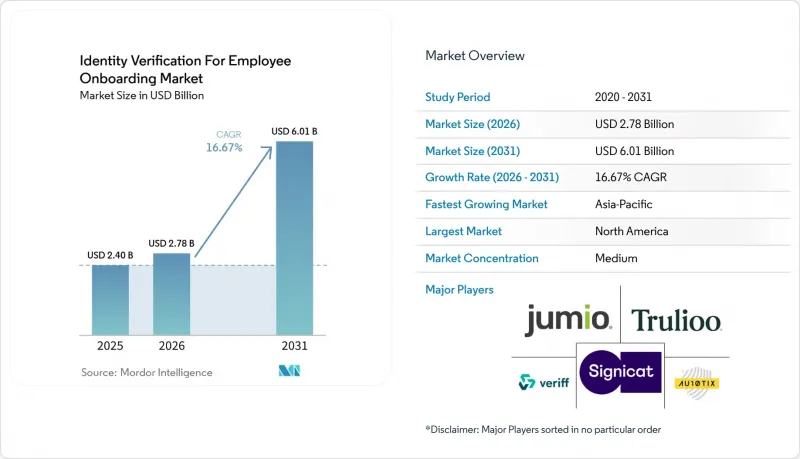
This report is Segmented by Offering (Solutions, and Services), Deployment Model (Cloud-Based, Hybrid, and More), Enterprise Size (Large Enterprises, and More), Verification Method (Document and Credential Verification, and More), End-User Industry (BFSI, Healthcare and Life Sciences, and More), and Geography. The Market Forecasts are Provided in Terms of Value (USD).
Global Identity Verification For Employee Onboarding Market Trends and Insights
Escalating Candidate Impersonation, Synthetic Identity, and Insider Fraud Risks
Hiring pipelines have become a visible attack surface for identity verification for the employee onboarding market, because remote workflows let fraudulent applicants reach employers without any physical identity touchpoint. Organized schemes now span candidate impersonation, synthetic identities, insider fraud, and ghost-hire activity, which means the risk no longer ends once a worker clears the first screening step. AI-generated phishing attacks created in 5 minutes are more than 4 times as effective as human-crafted attacks, which helps explain why employers are reassessing how easily bad actors can manipulate pre-hire and post-hire interactions. This threat pattern is widening the scope of buying decisions, because identity verification now needs to support payroll changes, device enrollment, credential recovery, and privileged access controls rather than only day-one onboarding. The identity verification for employee onboarding market is therefore seeing stronger demand for layered document, biometric, liveness, and behavior-linked controls in a single workflow. That shift is also favoring vendors that can support continuous reverification, since a point-in-time pass at the hiring stage no longer satisfies enterprise security teams.
Growth In Remote and Hybrid Hiring Workflows
The permanent shift to remote and hybrid hiring continues to expand the addressable market for identity verification in employee onboarding, as employers cannot rely on in-person office visits or document inspection at scale. Distributed recruiting also creates handoff gaps across talent acquisition, hiring managers, IT, and compliance teams, giving fraud rings more room to exploit weak ownership of the process. Checkr launched its IDV product in March 2026, with liveness detection, forensic document analysis, and device and network intelligence built into the early hiring flow, demonstrating how vendors are moving identity checks closer to the first candidate touchpoint. Remote hiring has also increased the frequency with which employers verify the same person, because contractor re-engagement, marketplace work, and repeat staffing cycles now trigger new checks rather than a single historical verification. That pattern is changing vendor economics, since per-transaction models become less attractive when employers want identity coverage across the full workforce lifecycle. The identity verification market for employee onboarding is benefiting from this shift, because subscription and platform pricing better align with recurring verification than one-off document-review fees.
Privacy, Biometric Consent, and Data Residency Constraints
Privacy law remains one of the clearest limits on adoption in the identity verification for employee onboarding market, because the strongest fraud controls often depend on facial biometrics, liveness checks, and long-lived identity records. Illinois BIPA still requires strict written consent, retention schedules, and destruction policies, even after the April 2026 Seventh Circuit ruling reduced historical per-scan exposure for some defendants. GDPR Article 9 treats biometric data used for unique identification as special-category data, which means employers in Europe face tighter legal bases and process design requirements before deployment. The EU AI Act adds another layer, as biometric identification systems may fall under high-risk obligations that increase compliance burdens for vendors and employers. India's data protection regime and China's PIPL also make global rollout harder, as multinational employers often need regional infrastructure, local data-handling policies, and separate legal workflows to remain compliant. These legal and operational burdens slow conversion cycles, raise total ownership costs, and lead some employers to limit biometric use to higher-risk roles rather than broad workforce onboarding.
Other drivers and restraints analyzed in the detailed report include:
- Stricter Right-To-Work, Employment Eligibility, and Workforce Compliance Requirements
- Rising Adoption Of Biometric and Liveness Verification In Digital Onboarding
- Integration Complexity Across Legacy HR, ATS, And Compliance Systems
For complete list of drivers and restraints, kindly check the Table Of Contents.
Segment Analysis
Solutions held 72.12% of the identity verification for employee onboarding market share in 2025, which reflects the continued strength of SaaS platforms that bundle document verification, biometric matching, liveness checks, workflow orchestration, and compliance reporting into a single enterprise product. This lead also shows that buyers still prefer configurable software control when identity verification must connect with recruiting, payroll, and access management systems across different business units. Platform-based delivery works well for employers that want direct API access, policy configuration, internal governance controls, and centralized audit records without depending on a manual review team for every exception. The dominance of solutions also aligns with the needs of large enterprises, which often standardize on a few core security and HR platforms and want identity controls embedded in those systems rather than outsourced as isolated tasks. In the identity verification for employee onboarding market, this structure favors vendors that can support broad document libraries, cross-border hiring workflows, and enterprise-grade reporting inside the same stack.
Services are projected to expand at a 17.71% CAGR from 2026 to 2031, as buyers increasingly seek verified outcomes, updated compliance logic, and managed fraud operations, rather than just software access. Managed verification workflows are gaining traction among employers that lack dedicated identity teams and need help with template updates, rule tuning, exception handling, and policy changes across jurisdictions. This is especially relevant in the mid-market, where hiring volumes can be high enough to create risk exposure but not large enough to justify a specialized internal identity operations function. The service layer is also becoming more recurring, because advisory retainers, compliance monitoring, and ongoing workflow optimization now extend well beyond initial implementation. As that pattern grows, the identity verification for employee onboarding market is narrowing the line between software licensing and service delivery. Vendors that once sold point products are increasingly building long-term managed relationships, which changes revenue mix, customer stickiness, and the basis on which enterprise buyers compare providers.
Cloud-based deployments accounted for 69.41% of the market share in 2025, underscoring how closely the identity verification for employee onboarding market aligns with the broader SaaS architecture of modern HR, payroll, and recruiting systems. Cloud delivery aligns with hiring workflows by enabling fast updates to document templates, real-time improvements to fraud signal, elastic processing during recruitment surges, and easier rollout across geographically dispersed teams. It also aligns with how employers buy ATS and HRIS software, since many organizations already run onboarding, screening, and access provisioning in the cloud. These advantages make cloud deployment the default option for most employers, especially where speed, standardization, and lower internal IT burden matter more than deep infrastructure control. The identity verification market for employee onboarding continues to benefit from this bias, as cloud deployment reduces onboarding friction for both vendors and customers.
The identity verification market for employee onboarding in hybrid deployments is projected to expand at a 16.73% CAGR from 2026 to 2031, driven by regulated employers seeking stronger control over sensitive data while still leveraging cloud-based verification intelligence. Hybrid models appeal to financial institutions, government contractors, and healthcare systems that want certain records and workflows to remain inside controlled environments. They also provide a middle path for companies responding to GDPR-related data-handling requirements, HIPAA-linked workforce onboarding concerns, and internal security rules governing protected information. On-premises deployment remains relevant for a narrower set of defense, public-sector, and highly restricted environments, but it is unlikely to gain a significant share. Hybrid growth, therefore, reflects a practical compromise rather than a return to legacy architecture. It lets employers combine local data governance with cloud-scale matching, document analysis, and fraud model updates that would be harder to maintain internally.
Geography Analysis
North America held 39.71% of the identity verification for employee onboarding market share in 2025, keeping it firmly ahead of other regions because employment eligibility rules and biometric privacy requirements are both more active and enforceable there. The United States provides a broad structural base for demand, since any employer with even 1 U.S.-based hire must complete identity and work authorization checks as part of onboarding. That requirement makes workforce identity verification a common operational need rather than a niche control reserved for a few regulated employers. State-level biometric laws, led by Illinois BIPA, also raise the importance of consent, retention, and audit design, which gives vendors more room to sell compliance-ready workflow features. Europe remained the second-largest regional block in the identity verification for employee onboarding market, supported by eIDAS 2.0 planning and employer interest in wallet-based digital identity ecosystems. The United Kingdom's Digital Identity and Attributes Trust Framework added practical momentum by defining a recognized certification route for providers that perform right-to-work checks for employers.
The identity verification for employee onboarding market size in Asia-Pacific is projected to expand at 18.41% CAGR from 2026 to 2031, which makes the region the strongest growth engine over the forecast period. Japan is central to that outlook, because My Number Card circulation passed 100 million cards and exceeded 80% population penetration by December 2025, giving employers a much stronger digital credential base for formal identity workflows. The Digital Agency's February 2026 guidance then extended JPKI-based verification into private employment settings, which moved digital identity closer to mainstream hiring operations. Demae-can adopted NEC's financial-grade identity verification service for delivery driver registration in March 2026, showing that gig and platform labor is becoming a meaningful demand pool rather than a side case. India and South Korea are also becoming more important in the identity verification for employee onboarding market, supported by digital identity infrastructure, fintech staffing needs, and tighter compliance expectations in remote and cross-border hiring environments.
South America, the Middle East, and Africa remained earlier-stage regions in 2026, but the identity verification for employee onboarding market is building a clearer long-term opportunity base there. Brazil is the most developed South American market in the current mix, and Jumio expanded selfie.DONE across South America in April 2026 after first launching it in Brazil in October 2025. Saudi Arabia and the United Arab Emirates are generating demand through digital workforce infrastructure programs tied to broader economic modernization and sector expansion in financial services, construction, and hospitality. In Africa, South Africa and Nigeria stand out because fintech-led hiring and improving mobile connectivity are creating more workable conditions for biometric and liveness-based onboarding at scale.
- Jumio Corporation
- Veriff OU
- Trulioo Information Services Inc.
- IDnow GmbH
- Persona Identities, Inc.
- Yoti Limited
- Sum and Substance Ltd.
- AuthenticID, Inc.
- Incode Technologies, Inc.
- Signicat AS
- Innovatrics, s.r.o.
- PXL Vision AG
- Shufti Pro Limited
- HyperVerge Technologies Private Limited
- IDfy Technologies Private Limited
- iDenfy UAB
- Ondato UAB
- ComplyCube Limited
- Socure Inc.
- Zenoo Limited
Additional Benefits:
- The market estimate (ME) sheet in Excel format
- 3 months of analyst support
TABLE OF CONTENTS
1 INTRODUCTION
- 1.1 Study Assumptions And Market Definition
- 1.2 Scope Of The Study
2 RESEARCH METHODOLOGY
3 EXECUTIVE SUMMARY
4 MARKET LANDSCAPE
- 4.1 Market Overview
- 4.2 Market Drivers
- 4.2.1 Growth In Remote And Hybrid Hiring Workflows
- 4.2.2 Stricter Right-To-Work, Employment Eligibility, And Workforce Compliance Requirements
- 4.2.3 Escalating Candidate Impersonation, Synthetic Identity, And Insider Fraud Risks
- 4.2.4 Rising Adoption Of Biometric And Liveness Verification In Digital Onboarding
- 4.2.5 Reusable Digital Identity Wallets For Repeat Workforce Onboarding
- 4.2.6 ATS And HRIS Embedding Of Identity APIs For High-Volume Hiring
- 4.3 Market Restraints
- 4.3.1 Privacy, Biometric Consent, And Data Residency Constraints
- 4.3.2 Integration Complexity Across Legacy HR, ATS, And Compliance Systems
- 4.3.3 False Reject Risk In Tight Labor Markets
- 4.3.4 Jurisdiction-Specific Employment Document Rules Limiting Global Standardization
- 4.4 Industry Value-Chain Analysis
- 4.5 Regulatory Landscape
- 4.6 Technological Outlook
- 4.7 Impact Of Macroeconomic Factors On The Market
- 4.8 Porter's Five Forces Analysis
- 4.8.1 Threat Of New Entrants
- 4.8.2 Bargaining Power Of Buyers
- 4.8.3 Bargaining Power Of Suppliers
- 4.8.4 Threat Of Substitutes
- 4.8.5 Intensity of Competitive Rivalry
5 MARKET SIZE AND GROWTH FORECASTS (VALUE)
- 5.1 By Offering
- 5.1.1 Solutions
- 5.1.2 Services
- 5.2 By Deployment Mode
- 5.2.1 Cloud-Based
- 5.2.2 On-Premises
- 5.2.3 Hybrid
- 5.3 By End User Enterprise Size
- 5.3.1 Large Enterprises
- 5.3.2 Small and Medium-sized Enterprises
- 5.4 By Verification Method
- 5.4.1 Document And Credential Verification
- 5.4.2 Biometric Verification
- 5.4.3 Database And Identity Network Verification
- 5.4.4 Liveness And Deepfake Detection
- 5.4.5 Video And Assisted Verification
- 5.4.6 Reusable Identity And Wallet Verification
- 5.5 By End User Industry
- 5.5.1 BFSI
- 5.5.2 Healthcare and Life Sciences
- 5.5.3 Information Technology and Telecom
- 5.5.4 Retail and E-commerce
- 5.5.5 Industrial Manufacturing
- 5.5.6 Government and Public Sector
- 5.5.7 Other End-user Industries
- 5.6 By Geography
- 5.6.1 North America
- 5.6.1.1 United States
- 5.6.1.2 Canada
- 5.6.1.3 Mexico
- 5.6.2 South America
- 5.6.2.1 Brazil
- 5.6.2.2 Argentina
- 5.6.2.3 Rest of South America
- 5.6.3 Europe
- 5.6.3.1 Germany
- 5.6.3.2 United Kingdom
- 5.6.3.3 France
- 5.6.3.4 Italy
- 5.6.3.5 Spain
- 5.6.3.6 Russia
- 5.6.3.7 Netherlands
- 5.6.3.8 Rest of Europe
- 5.6.4 Asia-Pacific
- 5.6.4.1 China
- 5.6.4.2 Japan
- 5.6.4.3 India
- 5.6.4.4 South Korea
- 5.6.4.5 Australia and New Zealand
- 5.6.4.6 Rest of Asia-Pacific
- 5.6.5 Middle East
- 5.6.5.1 Saudi Arabia
- 5.6.5.2 United Arab Emirates
- 5.6.5.3 Rest of Middle East
- 5.6.6 Africa
- 5.6.6.1 South Africa
- 5.6.6.2 Nigeria
- 5.6.6.3 Rest of Africa
- 5.6.1 North America
6 COMPETITIVE LANDSCAPE
- 6.1 Market Concentration
- 6.2 Strategic Moves
- 6.3 Market Share Analysis
- 6.4 Company Profiles (includes Global Level Overview, Market Level Overview, Core Segments, Financials as available, Strategic Information, Market Rank/Share, Products and Services, Recent Developments).
- 6.4.1 Jumio Corporation
- 6.4.2 Veriff OU
- 6.4.3 Trulioo Information Services Inc.
- 6.4.4 IDnow GmbH
- 6.4.5 Persona Identities, Inc.
- 6.4.6 Yoti Limited
- 6.4.7 Sum and Substance Ltd.
- 6.4.8 AuthenticID, Inc.
- 6.4.9 Incode Technologies, Inc.
- 6.4.10 Signicat AS
- 6.4.11 Innovatrics, s.r.o.
- 6.4.12 PXL Vision AG
- 6.4.13 Shufti Pro Limited
- 6.4.14 HyperVerge Technologies Private Limited
- 6.4.15 IDfy Technologies Private Limited
- 6.4.16 iDenfy UAB
- 6.4.17 Ondato UAB
- 6.4.18 ComplyCube Limited
- 6.4.19 Socure Inc.
- 6.4.20 Zenoo Limited
7 MARKET OPPORTUNITIES AND FUTURE OUTLOOK
- 7.1 White-Space And Unmet-Need Assessment

