PUBLISHER: Mordor Intelligence | PRODUCT CODE: 2065570

PUBLISHER: Mordor Intelligence | PRODUCT CODE: 2065570
HR Governance, Risk, And Compliance (GRC) Platform - Market Share Analysis, Industry Trends & Statistics, Growth Forecasts (2026 - 2031)
According to Mordor Intelligence, the hR governance, risk, and Compliance (GRC) platform market size was valued at USD 4.39 billion in 2025 and is projected to reach USD 8.85 billion by 2031, expanding at a CAGR of 12.41% during the 2026-2031 forecast period.
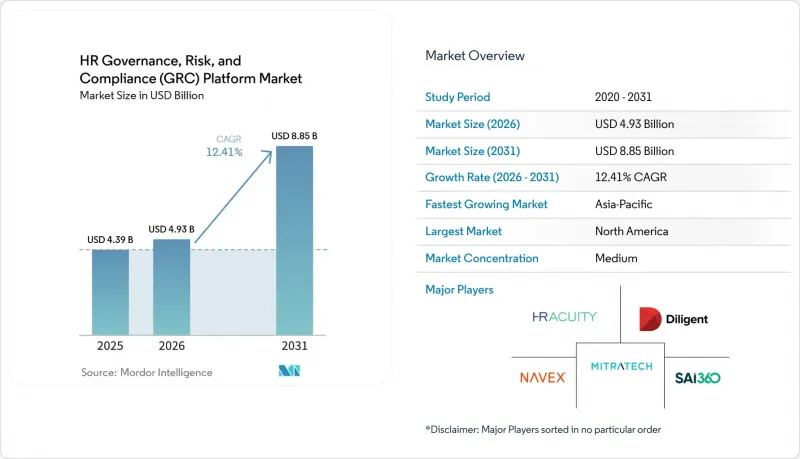
This report is Segmented by Component (Software, and Services), Functionality (Policy and Procedure Management, and More), Deployment Mode (Cloud-Based, and More), Organization Size (Large Enterprises, and Small and Medium-Sized Enterprises), Industry Vertical (Healthcare and Life Sciences, and More), and Geography. The Market Forecasts are Provided in Terms of Value (USD).
Global HR Governance, Risk, And Compliance (GRC) Platform Market Trends and Insights
Rising Labor and Whistleblower Compliance Complexity
The pace of labor and whistleblower regulation has moved beyond what most manual compliance processes can absorb. The EU Whistleblower Protection Directive now applies across all 27 member states, and enforcement has become more visible and more immediate in employer planning cycles. The European Commission reported that the EU Court of Justice imposed combined fines of EUR 39 million (USD 44 million) on 5 member states for delayed transposition, which signaled that weak implementation would carry financial consequences. For employers, the challenge is no longer just about policy wording; every report now needs structured intake, routing, follow-up, and evidence retention that can stand up to review. This shift is pushing the HR Governance, Risk, and Compliance (GRC) Platform Market toward platforms that can turn recurring labor risk into a documented operating process.
Shift toward Integrated Cloud-Native Compliance Platforms
Buyers increasingly prefer a single platform that combines policy management, incident reporting, case management, analytics, and training, rather than maintaining a stack of disconnected tools. Mitratech reinforced this direction in March 2026, when it launched its Global GRC Platform, bringing ethics and whistleblowing, policy management, operational resilience, cyber and IT risk, and compliance training into one interface. Cloud-native delivery is a strong part of this shift because it removes version-control bottlenecks, supports faster updates, and makes shared analytics easier to use across business units. Integration with core HCM systems is now a basic buying requirement, as shown by HR Acuity joining the Workday Innovation Partner Program in March 2026. The HR Governance, Risk, and Compliance (GRC) Platform Market is benefiting from integrated cloud platforms that reduce operational friction while compliance expectations are becoming broader and more detailed.
High Implementation and Change Management Burden
Implementation remains one of the biggest limits on faster adoption in the HR Governance, Risk, and Compliance (GRC) Platform Market. Enterprise deployments often take 6 to 12 months, and services spending can match 1 to 2 times the annual license fee, which is difficult for mid-market buyers to absorb. The operational burden is higher in HR workflows because HR, legal, employee relations, and compliance teams all need to adopt the same system while working under different permissions and process rules. Long rollouts also create a parallel-system phase in which old and new records sit side by side, weakening the audit trail the platform is supposed to strengthen. Vendors are trying to reduce this drag, and LogicGate said in April 2026 that Config Newton could reduce implementation time-to-value by 25%.
Other drivers and restraints analyzed in the detailed report include:
- EU Pay Transparency Directive Readiness
- Growing Need for Auditable Policy, Hotline, and Investigation Workflows
- Platform Consolidation Pressure from Broader GRC Suites
For complete list of drivers and restraints, kindly check the Table Of Contents.
Segment Analysis
Software held 67.14% of the market in 2025, which shows that buyers continue to prefer configurable recurring platforms over project-led engagement models. This segment led because policy records, investigation histories, attestation trails, and pay governance data become harder to move once centralized in a single system. That creates meaningful switching costs and helps software vendors retain long-term accounts in the HR Governance, Risk, and Compliance (GRC) Platform Market. Software also benefits from the need for standardized controls, internal analytics, and reusable workflow templates that can scale across regions and business units.
Services are projected to grow at a 14.53% CAGR through 2031, which reflects the fact that regulatory complexity is still outpacing the bandwidth of many internal compliance teams. Advisory and managed services are gaining traction because buyers want help with ongoing monitoring, control updates, and program administration, rather than just one-time setup. Implementation and integration work remain central because HR Governance, Risk, and Compliance (GRC) Platform industry deployments often touch HR systems, legal review processes, hotline intake, and reporting layers simultaneously. Vendors are trying to reduce service dependency with faster configuration tools, and LogicGate's agentic setup approach is one example of that push.
Policy and procedure management accounted for 38.29% of revenue in 2025, giving it the largest share among functionality types. The broad position of this module is logical because every regulated employer needs version control, approvals, and employee attestation even before a complaint or investigation begins. In practice, policy management anchors many buying decisions in the HR Governance, Risk, and Compliance (GRC) Platform Market because other functions depend on a documented rule base. Competitive differentiation is shifting away from simple document storage and toward policy mapping, employee acknowledgment workflows, and tighter linkage with downstream cases.
Pay transparency and compensation governance are projected to grow at a 13.09% CAGR through 2031, making it the fastest-growing functionality. Employers are developing new processes for job evaluation criteria, pay-band governance, and compensation reporting because a static policy file is insufficient for ongoing disclosure obligations. Whistleblowing, case management, and analytics also work best when they are connected, since one complaint can trigger an investigation, require policy reference, and feed into outcome reporting in the same cycle. The HR Governance, Risk, and Compliance (GRC) Platform Market is rewarding vendors that can integrate these functions into a single evidence chain rather than treating them as separate tools.
Geography Analysis
North America held 35.68% of the HR Governance, Risk, and Compliance (GRC) Platform market share in 2025, making it the largest regional contributor. The United States accounted for most of that spending because federal and state employment rules keep policy control, reporting, and case management requirements active across large employers. Canada added demand as pay transparency measures widened the need for repeatable reporting and compensation governance workflows. Mexico added another layer for multinationals that needed consistent worker-protection records and documented processes across North American operations.
Europe was the second-largest region in the HR Governance, Risk, and Compliance (GRC) Platform Market in 2025. The pay transparency transposition cycle, whistleblower enforcement, and tighter review of employment AI are shaping demand in Europe. The European Commission highlighted stronger enforcement momentum when the EU Court of Justice imposed combined fines of EUR 39 million (USD 44 million) on 5 member states for the delayed transposition of whistleblower legislation. Germany, France, and the United Kingdom remain the largest country opportunities because they combine large employer bases with dense compliance obligations. Works council reviews and local labor consultation practices can slow deployment, increasing the need for localized workflow support and structured employee data governance.
Asia-Pacific is projected to grow at a 13.44% CAGR through 2031, making it the fastest-growing region in the HR Governance, Risk, and Compliance (GRC) Platform market over the forecast period. Regional growth is tied to multinational expansion, fragmented national labor frameworks, and rising scrutiny of employee data handling across India, Japan, South Korea, Australia, and New Zealand. South America remains an emerging opportunity, led by Brazil and Argentina, where global employers are formalizing workforce governance and documentation standards. The Middle East and Africa still represent a smaller base, but the UAE and Saudi Arabia are widening demand as labor protection and broader workforce governance expectations become more structured.
- NAVEX Global, Inc.
- Mitratech Holdings, Inc.
- HR Acuity, LLC
- ComplianceHR, LLC
- Resolver Inc.
- SAI Global Compliance, Inc.
- Ethena, Inc.
- Syndio Solutions, Inc.
- Trusaic, Inc.
- EQS Group AG
- VinciWorks Ltd.
- Whistleblowing Solutions AB
- WorkBright, Inc.
- AllVoices, Inc.
- GAN Integrity Inc.
- LogicGate, Inc.
- Riskonnect, Inc.
- Safecall Ltd.
- LRN Corporation
- Diligent Corporation
Additional Benefits:
- The market estimate (ME) sheet in Excel format
- 3 months of analyst support
TABLE OF CONTENTS
1 INTRODUCTION
- 1.1 Study Assumptions and Market Definition
- 1.2 Scope of the Study
2 RESEARCH METHODOLOGY
3 EXECUTIVE SUMMARY
4 MARKET LANDSCAPE
- 4.1 Market Overview
- 4.2 Market Drivers
- 4.2.1 Rising Labor and Whistleblower Compliance Complexity
- 4.2.2 Shift Toward Integrated Cloud-Native Compliance Platforms
- 4.2.3 Growing Need for Auditable Policy, Hotline, and Investigation Workflows
- 4.2.4 Expanding Adoption by Small and Medium-Sized Enterprises
- 4.2.5 EU Pay Transparency Directive Readiness
- 4.2.6 Governance Needs for Employment AI and Automated Hiring Decisions
- 4.3 Market Restraints
- 4.3.1 High Implementation and Change Management Burden
- 4.3.2 Platform Consolidation Pressure From Broader GRC Suites
- 4.3.3 Cross-Border Employee Data Residency Constraints
- 4.3.4 Works Council Review Slowing Workflow Rollouts
- 4.4 Industry Value Chain Analysis
- 4.5 Regulatory Landscape
- 4.6 Technological Outlook
- 4.7 Impact of Macroeconomic Factors on the Market
- 4.8 Porter's Five Forces Analysis
- 4.8.1 Bargaining Power of Buyers
- 4.8.2 Bargaining Power of Suppliers
- 4.8.3 Threat of New Entrants
- 4.8.4 Threat of Substitutes
- 4.8.5 Intensity of Competitive Rivalry
5 MARKET SIZE AND GROWTH FORECASTS (VALUE)
- 5.1 By Component
- 5.1.1 Software
- 5.1.2 Services
- 5.1.2.1 Implementation and Integration Services
- 5.1.2.2 Advisory and Managed Services
- 5.1.2.3 Training and Support Services
- 5.2 By Functionality
- 5.2.1 Policy and Procedure Management
- 5.2.2 Whistleblowing and Incident Management
- 5.2.3 Employee Relations Case Management
- 5.2.4 Pay Transparency and Compensation Governance
- 5.2.5 Analytics and Reporting
- 5.2.6 Other Functionalities
- 5.3 By Deployment Mode
- 5.3.1 Cloud-Based
- 5.3.2 On-Premises
- 5.3.3 Hybrid
- 5.4 By Organization Size
- 5.4.1 Large Enterprises
- 5.4.2 Small and Medium-Sized Enterprises
- 5.5 By Industry Vertical
- 5.5.1 Banking, Financial Services, and Insurance
- 5.5.2 Healthcare and Life Sciences
- 5.5.3 Information Technology and Telecommunications
- 5.5.4 Retail and E-commerce
- 5.5.5 Manufacturing
- 5.5.6 Other Industry Verticals
- 5.6 By Geography
- 5.6.1 North America
- 5.6.1.1 United States
- 5.6.1.2 Canada
- 5.6.1.3 Mexico
- 5.6.2 South America
- 5.6.2.1 Brazil
- 5.6.2.2 Argentina
- 5.6.2.3 Chile
- 5.6.2.4 Rest of South America
- 5.6.3 Europe
- 5.6.3.1 United Kingdom
- 5.6.3.2 Germany
- 5.6.3.3 France
- 5.6.3.4 Italy
- 5.6.3.5 Spain
- 5.6.3.6 Russia
- 5.6.3.7 Rest of Europe
- 5.6.4 Asia-Pacific
- 5.6.4.1 China
- 5.6.4.2 Japan
- 5.6.4.3 India
- 5.6.4.4 South Korea
- 5.6.4.5 Australia and New Zealand
- 5.6.4.6 Rest of Asia-Pacific
- 5.6.5 Middle East
- 5.6.5.1 United Arab Emirates
- 5.6.5.2 Saudi Arabia
- 5.6.5.3 Turkey
- 5.6.5.4 Rest of Middle East
- 5.6.6 Africa
- 5.6.6.1 South Africa
- 5.6.6.2 Nigeria
- 5.6.6.3 Rest of Africa
- 5.6.1 North America
6 COMPETITIVE LANDSCAPE
- 6.1 Market Concentration
- 6.2 Strategic Moves
- 6.3 Market Share Analysis
- 6.4 Company Profiles (includes Global Level Overview, Market Level Overview, Core Segments, Financials as available, Strategic Information, Market Rank/Share, Products and Services, Recent Developments)
- 6.4.1 NAVEX Global, Inc.
- 6.4.2 Mitratech Holdings, Inc.
- 6.4.3 HR Acuity, LLC
- 6.4.4 ComplianceHR, LLC
- 6.4.5 Resolver Inc.
- 6.4.6 SAI Global Compliance, Inc.
- 6.4.7 Ethena, Inc.
- 6.4.8 Syndio Solutions, Inc.
- 6.4.9 Trusaic, Inc.
- 6.4.10 EQS Group AG
- 6.4.11 VinciWorks Ltd.
- 6.4.12 Whistleblowing Solutions AB
- 6.4.13 WorkBright, Inc.
- 6.4.14 AllVoices, Inc.
- 6.4.15 GAN Integrity Inc.
- 6.4.16 LogicGate, Inc.
- 6.4.17 Riskonnect, Inc.
- 6.4.18 Safecall Ltd.
- 6.4.19 LRN Corporation
- 6.4.20 Diligent Corporation
7 MARKET OPPORTUNITIES AND FUTURE OUTLOOK
- 7.1 White-Space and Unmet-Need Assessment

