PUBLISHER: Mordor Intelligence | PRODUCT CODE: 2065601

PUBLISHER: Mordor Intelligence | PRODUCT CODE: 2065601
Healthcare Environmental Services - Market Share Analysis, Industry Trends & Statistics, Growth Forecasts (2026 - 2031)
According to Mordor Intelligence, the healthcare environmental services market size is expected to increase from USD 53.90 billion in 2025 to USD 58.07 billion in 2026 and reach USD 84.35 billion by 2031, growing at a CAGR of 7.75% over 2026-2031.
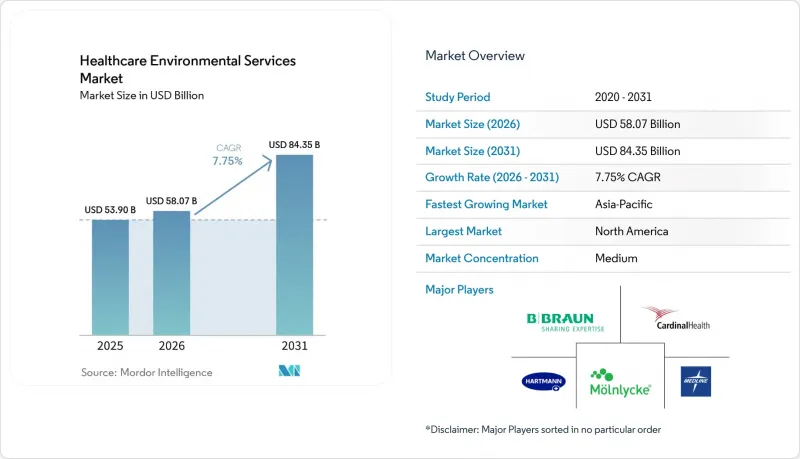
This report is Segmented by Service Type (Cleaning & Disinfection, Linen & Laundry, Waste Management, Pest Control, Staff Training), Delivery Model (Scheduled, On-Demand), Facility Type (Hospitals, Ascs, Clinics & Physician Offices, Labs & Research, Long-Term Care, Diagnostic & Imaging), and Geography (North America, Europe, APAC, MEA, South America). Forecasts are in Terms of Value (USD).
Global Healthcare Environmental Services Market Trends and Insights
HAI Prevention and Stricter Hygiene Standards
Infection control remains a critical driver in the healthcare environmental services market, with surface hygiene, waste handling, and validated cleaning protocols now integral to patient safety. The HHS has set ambitious targets for reducing CLABSI, hospital-onset MRSA bacteremia, and CDI, emphasizing the need for enhanced disinfection methods. Persistent challenges with spore-forming pathogens are pushing providers to adopt advanced technologies like UV-C systems, electrostatic applications, and rigorous cleaning performance verification. Facilities are increasingly linking environmental service performance to infection outcomes rather than cleaning frequency.
Outsourcing to Lift HCAHPS and Patient Loyalty Scores
Patient experience scores are becoming increasingly important in the healthcare environmental services market, as cleanliness impacts both quality outcomes and patient loyalty. Sodexo expanded its partnership with Adventist Health, adding sites and employees, reflecting the trend of deepening outsourced EVS relationships. Similarly, Aramark's agreement with the University of Pennsylvania Health System highlights the growing preference for partnerships that combine environmental services with other support functions. Outsourced providers leverage advanced tools across multiple sites, offering consistent cleaning, robust reporting, and flexible staffing solutions.
In-house EVS Insourcing by Large Health Systems
Large health systems are increasingly insourcing environmental services to gain tighter control over infection prevention, cleanliness, and labor relations. This approach enables multi-hospital networks to bring specific functions in-house or adopt hybrid models while maintaining cleaning and waste handling needs. Executives are drawn to insourcing for its potential to enhance service consistency, staff accountability, and alignment with internal quality goals. However, insourcing often underestimates costs related to hiring, training, compliance monitoring, and technology maintenance, which become evident post-implementation. Accreditation and audit requirements continue to anchor many systems to specialist expertise, limiting the extent of pure insourcing.
Other drivers and restraints analyzed in the detailed report include:
- Higher Hospital and Ambulatory Throughput
- Tightening Medical and Pharmaceutical Waste Regulations
- Labor Intensity, Wage Inflation, and Turnover
For complete list of drivers and restraints, kindly check the Table Of Contents.
Segment Analysis
Cleaning & Disinfection Services dominate the healthcare environmental services market, holding 54.35% of the market share in 2025. This leadership reflects the critical need for surface decontamination in hospitals, clinics, and long-term care settings. The segment remains essential for infection prevention, as lapses in hygiene can impact patient outcomes, audits, and trust. Spending in this category remains resilient despite budget reviews.
Linen & Laundry Services are projected to grow at an 8.75% CAGR through 2031, making it the fastest-growing segment. Hospitals are increasingly outsourcing laundering to better manage utilities, water use, and contamination control. Innovations like RFID tracking and infection-barrier textiles are transforming linen services into critical clinical support functions.
Geography Analysis
In 2025, North America held a 39.77% share of the healthcare environmental services market, maintaining its leading position by revenue. The U.S. drives this dominance due to stringent cleanliness standards tied to reimbursements, strong accreditation benchmarks, and a mature outsourcing landscape. Sodexo's January 2026 partnership with Adventist Health, covering 26 sites with a projected value of USD 70 million, highlights the scale large providers can achieve. The region benefits from a diverse mix of vendors addressing cleaning, linen, pest control, hazardous waste, and training needs across hospital networks. Additionally, stricter pharmaceutical waste regulations in several states are driving recurring compliance demand for specialist service providers.
Europe remains a key player in the healthcare environmental services market, though outsourcing depth varies by country and procurement models. The UK and parts of continental Europe support broad outsourcing, while others retain more activities under hospital control. Vendors must adapt to local labor laws, union expectations, and public-sector contracting norms. Rising sustainability and waste management demands are increasing the value of specialist providers in pharmaceutical waste, linen handling, and traceable environmental reporting.
Asia-Pacific is projected to grow at an 8.98% CAGR through 2031, making it the fastest-growing region in the healthcare environmental services market. Growth is driven by expanding healthcare capacity, rising patient volumes, and gaps in water, sanitation, hygiene, and waste services in lower-middle-income regions. Developed markets like Japan, South Korea, and Australia are nearing European environmental standards, while Southeast Asia offers significant opportunities for full-scope outsourcing. The Middle East, Africa, and South America are gradually formalizing environmental service requirements, supported by public health initiatives around WASH and safer healthcare waste practices.
- ABM Industries Incorporated
- Aramark
- Clean Earth, Inc.
- Clean Harbors
- Compass Group
- Coverall North America, Inc.
- Daniels Sharpsmart
- Ecolab
- Healthcare Services Group
- Hospital Housekeeping Systems, LLC
- ISS A/S
- Kellermeyer Bergensons Services, LLC
- MedPro Disposal, LLC
- Rentokil Initial plc
- ServiceMaster Clean
- Servicon Systems, Inc.
- Sodexo S.A.
- Veolia Environnement S.A.
- WM Healthcare Solutions
- Xanitos, Inc.
Additional Benefits:
- The market estimate (ME) sheet in Excel format
- 3 months of analyst support
TABLE OF CONTENTS
1 Introduction
- 1.1 Study Assumptions & Market Definition
- 1.2 Scope of the Study
2 Research Methodology
3 Executive Summary
4 Market Landscape
- 4.1 Market Overview
- 4.2 Market Drivers
- 4.2.1 HAI Prevention and Stricter Hygiene Standards
- 4.2.2 Outsourcing to Lift HCAHPS and Patient Loyalty
- 4.2.3 Higher Hospital and Ambulatory Throughput
- 4.2.4 Tightening Medical and Pharmaceutical Waste Compliance
- 4.2.5 WASH and Waste-Service Gaps in Emerging-Market Facilities
- 4.2.6 Reusable Sharps and Circular-Medtech Programs
- 4.3 Market Restraints
- 4.3.1 In-House EVS Insourcing by Large Health Systems
- 4.3.2 Labor Intensity, Wage Inflation, and Turnover
- 4.3.3 Incineration Permitting and Treatment-Capacity Bottlenecks
- 4.3.4 Waste Misclassification and Weak Segregation
- 4.4 Value / Supply-Chain Analysis
- 4.5 Regulatory Landscape
- 4.6 Technological Outlook
- 4.7 Porter's Five Forces Analysis
- 4.7.1 Threat of New Entrants
- 4.7.2 Bargaining Power of Suppliers
- 4.7.3 Bargaining Power of Buyers
- 4.7.4 Threat of Substitutes
- 4.7.5 Competitive Rivalry
5 Market Size & Growth Forecast, (Value, USD)
- 5.1 By Service Type
- 5.1.1 Cleaning & Disinfection Services
- 5.1.2 Linen & Laundry Services
- 5.1.3 Waste Management Services
- 5.1.4 Pest Control Services
- 5.1.5 Staff Training & Consultancy Services
- 5.2 By Delivery Model
- 5.2.1 Scheduled Services
- 5.2.2 On-demand Services
- 5.3 By Facility Type
- 5.3.1 Hospitals
- 5.3.2 Ambulatory Surgical Centers
- 5.3.3 Clinics & Physician Offices
- 5.3.4 Laboratories & Research Facilities
- 5.3.5 Long-term Care Facilities
- 5.3.6 Diagnostic & Imaging Centers
- 5.4 By Geography
- 5.4.1 North America
- 5.4.1.1 United States
- 5.4.1.2 Canada
- 5.4.1.3 Mexico
- 5.4.2 Europe
- 5.4.2.1 Germany
- 5.4.2.2 United Kingdom
- 5.4.2.3 France
- 5.4.2.4 Italy
- 5.4.2.5 Spain
- 5.4.2.6 Rest of Europe
- 5.4.3 Asia-Pacific
- 5.4.3.1 China
- 5.4.3.2 India
- 5.4.3.3 Japan
- 5.4.3.4 Australia
- 5.4.3.5 South Korea
- 5.4.3.6 Rest of Asia-Pacific
- 5.4.4 Middle East and Africa
- 5.4.4.1 GCC
- 5.4.4.2 South Africa
- 5.4.4.3 Rest of Middle East and Africa
- 5.4.5 South America
- 5.4.5.1 Brazil
- 5.4.5.2 Argentina
- 5.4.5.3 Rest of South America
- 5.4.1 North America
6 Competitive Landscape
- 6.1 Market Concentration
- 6.2 Market Share Analysis
- 6.3 Company Profiles (includes Global level Overview, Market level overview, Core Segments, Financials as available, Strategic Information, Market Rank/Share for key companies, Products & Services, and Recent Developments)
- 6.3.1 ABM Industries Incorporated
- 6.3.2 Aramark
- 6.3.3 Clean Earth, Inc.
- 6.3.4 Clean Harbors, Inc.
- 6.3.5 Compass Group PLC
- 6.3.6 Coverall North America, Inc.
- 6.3.7 Daniels Sharpsmart Inc.
- 6.3.8 Ecolab Inc.
- 6.3.9 Healthcare Services Group, Inc.
- 6.3.10 Hospital Housekeeping Systems, LLC
- 6.3.11 ISS A/S
- 6.3.12 Kellermeyer Bergensons Services, LLC
- 6.3.13 MedPro Disposal, LLC
- 6.3.14 Rentokil Initial plc
- 6.3.15 ServiceMaster Clean
- 6.3.16 Servicon Systems, Inc.
- 6.3.17 Sodexo S.A.
- 6.3.18 Veolia Environnement S.A.
- 6.3.19 WM Healthcare Solutions
- 6.3.20 Xanitos, Inc.
7 Market Opportunities & Future Outlook
- 7.1 White-space & Unmet-need Assessment

