PUBLISHER: Mordor Intelligence | PRODUCT CODE: 2065623

PUBLISHER: Mordor Intelligence | PRODUCT CODE: 2065623
United States Wedding Services - Market Share Analysis, Industry Trends & Statistics, Growth Forecasts (2026 - 2031)
According to Mordor Intelligence, the united states wedding services market is expected to grow from USD 62.45 billion in 2025 to USD 63.95 billion in 2026 and is forecast to reach USD 85.36 billion by 2031 at 5.95% CAGR over 2026-2031.
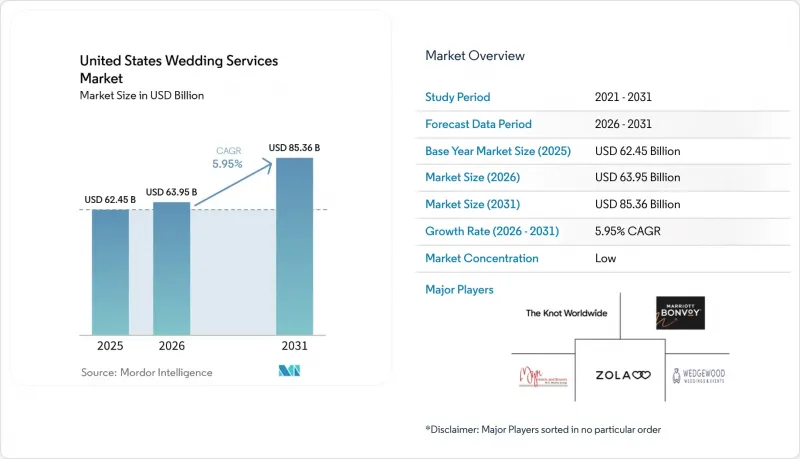
This report is Segmented by Wedding Type (local and Destination), Booking Mode (online and Offline), Service Type (catering, Decoration, Entertainment and Music, and Others), Planning Scope(full-Service, Partial, and Day-Of), Price Tier (luxury and Premium, Mid-Market, and Budget), and Geography (Northeast, Midwest, South, and West). The Market Forecasts are Provided in Terms of Value, USD.
United States Wedding Services Market Trends and Insights
Personalized and experience-led celebrations
Couples in the United States wedding services market are shifting away from traditional ceremonies and receptions, focusing instead on personal identity, guest experience, and visual uniqueness. Many couples incorporate religious, ethnic, or cultural elements, choose eco-friendly suppliers, or source locally produced products. These preferences expand vendor requirements, as they demand customized food, design, entertainment, and sourcing instead of standard packages. The average number of vendors hired has increased, with guest experience consistently ranked as the top planning priority, driving higher service intensity across the market. Couples are also contacting more venues before making a decision, reflecting a growing emphasis on selectivity over price comparison.
Destination wedding migration within the United States
Domestic destination weddings are transitioning from a niche option to a broader demand, driving spending toward resorts, lodging, and integrated event markets. Reports indicate that many couples are choosing United States locations over international venues for destination ceremonies. This trend significantly impacts the United States wedding services market, as destination weddings often include additional events like welcome dinners, rehearsal gatherings, and farewell brunches alongside the main ceremony and reception. These added elements increase revenue opportunities for planners, caterers, venue operators, and hotel-linked providers. Markets that combine accommodation, event management, and local experience design into a cohesive offering are positioned to benefit the most.
Wedding budget inflation and affordability pressure
Budget constraints significantly impact the United States wedding services market as rising event costs outpace couples' financial capacities. Venue expenses increased substantially between 2015 and 2025, alongside notable growth in catering costs. By 2025, over half of couples reported exceeding their budgets, with most citing economic conditions as a key factor influencing their planning. Many couples delayed financial goals to fund weddings, including home purchases and debt repayment. High-cost regions, such as the Mid-Atlantic, saw average wedding spending reach significant levels, prompting some couples to opt for smaller guest lists, more affordable locations, or simplified event formats.
Other drivers and restraints analyzed in the detailed report include:
- Online Discovery and Booking Platform Adoption Reshapes Lead Generation
- Greater planner usage for execution certainty
- Seasonal demand concentration and weather disruption
For complete list of drivers and restraints, kindly check the Table Of Contents.
Segment Analysis
In 2025, local weddings accounted for 78.93% of the revenue in the United States Wedding Services Market. Couples continue to prefer local celebrations, drawn by the proximity to family, familiar vendors, and reduced travel complexities. With nearly 2 million weddings in the United States that year, local events ensured a steady stream of bookings for venues, caterers, entertainment providers, and photographers, all benefiting from consistent regional demand. The stability of this segment of the United States Wedding Services industry stems from its broad-based spending, rather than reliance on a niche premium clientele. Local weddings enjoy advantages like simpler guest logistics and reduced accommodation needs, allowing couples to allocate more of their budget to decor, food, entertainment, and photography. This dynamic explains the enduring prominence of hometown and regional celebrations, even as destination weddings gain traction.
Destination weddings are on the rise, projected to grow at a 6.57% CAGR through 2031, outpacing the overall United States wedding services market. Couples planning for 2026 are increasingly opting for destination weddings, with popular locations including Florida, California, and Hawaii. These weddings typically feature smaller guest lists but involve higher spending per guest due to multiple events surrounding the main ceremony. The United States wedding market for destination ceremonies often includes welcome dinners, farewell brunches, and hospitality packages, driving up costs for planners and caterers. Providers of lodging, venue management, and planning services are well-positioned to capture a larger share of these celebrations.
Offline bookings represented 68.21% of revenue in 2025, reflecting the United States Wedding Services market's reliance on in-person trust, venue tours, and direct planner interactions. Around 83% of couples prioritized venue visits, and 89% chose professionally managed venues, emphasizing the importance of physical evaluations in high-value purchases. Family involvement in budget and style discussions further reinforces the need for face-to-face interactions. Final conversions often occur after tours, calls, and consultations rather than through digital checkouts, explaining the dominance of offline bookings despite the growing role of digital discovery.
Online bookings are projected to grow at a 7.46% CAGR through 2031, making them the fastest-growing channel in the United States wedding services market. Platforms like The Knot connect couples with nearly 200,000 wedding professionals, while Zola has generated over 4 million vendor leads. AI tools are driving this shift by assisting with etiquette queries, timeline planning, and vendor communication drafts before direct contact. The hybrid model, where couples research and compare online but confirm decisions through calls, visits, or planner support, is reshaping lead generation, response expectations, and vendor marketing across the market.
List of Companies Covered in this Report:
- The Knot Worldwide
- Zola, Inc.
- Joy
- Wedgewood Weddings
- Walters Wedding Estates
- Complete Weddings + Events
- George Street Photo & Video
- Wedding Spot
- PartySpace
- Disney's Fairy Tale Weddings & Honeymoons
- Marriott Bonvoy Weddings
- Hilton
- MGM Resorts Weddings
- Caesars Weddings
- Mindy Weiss Party Consultants
- Rafanelli Events
- Colin Cowie Lifestyle
- Marcy Blum Events
- Easton Events
- Bash Please
Additional Benefits:
- The market estimate (ME) sheet in Excel format
- 3 months of analyst support
TABLE OF CONTENTS
1 Introduction
- 1.1 Study Assumptions & Market Definition
- 1.2 Scope of the Study
2 Research Methodology
3 Executive Summary
4 Market Landscape
- 4.1 Market Overview
- 4.2 Market Drivers
- 4.2.1 Personalized and experience-led celebrations
- 4.2.2 Destination wedding migration within the United States
- 4.2.3 Online discovery and booking platform adoption
- 4.2.4 Greater planner usage for execution certainty
- 4.2.5 Multi-day wedding formats lift vendor wallet share
- 4.2.6 Lab-grown ring savings reallocated to wedding experiences
- 4.3 Market Restraints
- 4.3.1 Wedding budget inflation and affordability pressure
- 4.3.2 Seasonal demand concentration and weather disruption
- 4.3.3 Price-transparency-driven vendor comparison pressure
- 4.3.4 Shorter booking windows strain premium vendor capacity
- 4.4 Value / Supply-Chain Analysis
- 4.5 Regulatory Landscape
- 4.6 Technological Outlook
- 4.7 Porter's Five Forces
- 4.7.1 Bargaining Power of Buyers
- 4.7.2 Bargaining Power of Suppliers
- 4.7.3 Threat of New Entrants
- 4.7.4 Threat of Substitutes
- 4.7.5 Industry Rivalry
5 Market Size & Growth Forecasts (Value, USD Billion)
- 5.1 By Wedding Type
- 5.1.1 Local Wedding
- 5.1.2 Destination Wedding
- 5.2 By Booking Mode
- 5.2.1 Online Booking
- 5.2.2 Offline Booking
- 5.3 By Service Type
- 5.3.1 Catering Services
- 5.3.2 Decoration Services
- 5.3.3 Entertainment & Music
- 5.3.4 Videography & Photography Services
- 5.3.5 Wedding Planning Services
- 5.3.6 Other Services
- 5.4 By Planning Scope
- 5.4.1 Full-Service Planning
- 5.4.2 Partial Planning
- 5.4.3 Day-Of Coordination
- 5.5 By Price Tier
- 5.5.1 Luxury / Premium
- 5.5.2 Mid-Market
- 5.5.3 Value / Budget
- 5.6 By Region
- 5.6.1 Northeast
- 5.6.2 Midwest
- 5.6.3 South
- 5.6.4 West
6 Competitive Landscape
- 6.1 Market Concentration
- 6.2 Strategic Moves
- 6.3 Market Share Analysis
- 6.4 Company Profiles (includes Global level Overview, Market level overview, Core Segments, Financials as available, Strategic Information, Market Rank/Share for key companies, Products & Services, and Recent Developments)
- 6.4.1 The Knot Worldwide
- 6.4.2 Zola, Inc.
- 6.4.3 Joy
- 6.4.4 Wedgewood Weddings
- 6.4.5 Walters Wedding Estates
- 6.4.6 Complete Weddings + Events
- 6.4.7 George Street Photo & Video
- 6.4.8 Wedding Spot
- 6.4.9 PartySpace
- 6.4.10 Disney's Fairy Tale Weddings & Honeymoons
- 6.4.11 Marriott Bonvoy Weddings
- 6.4.12 Hilton
- 6.4.13 MGM Resorts Weddings
- 6.4.14 Caesars Weddings
- 6.4.15 Mindy Weiss Party Consultants
- 6.4.16 Rafanelli Events
- 6.4.17 Colin Cowie Lifestyle
- 6.4.18 Marcy Blum Events
- 6.4.19 Easton Events
- 6.4.20 Bash Please
7 Market Opportunities & Future Outlook
- 7.1 White-space & unmet-need assessment

