PUBLISHER: Mordor Intelligence | PRODUCT CODE: 2065624

PUBLISHER: Mordor Intelligence | PRODUCT CODE: 2065624
Foot Care Products - Market Share Analysis, Industry Trends & Statistics, Growth Forecasts (2026 - 2031)
According to Mordor Intelligence, the foot care products market size was valued at USD 11.23 billion in 2025 and is estimated to grow from USD 12.01 billion in 2026 to reach USD 16.83 billion by 2031, at a CAGR of 6.98% during the forecast period (2026-2031).
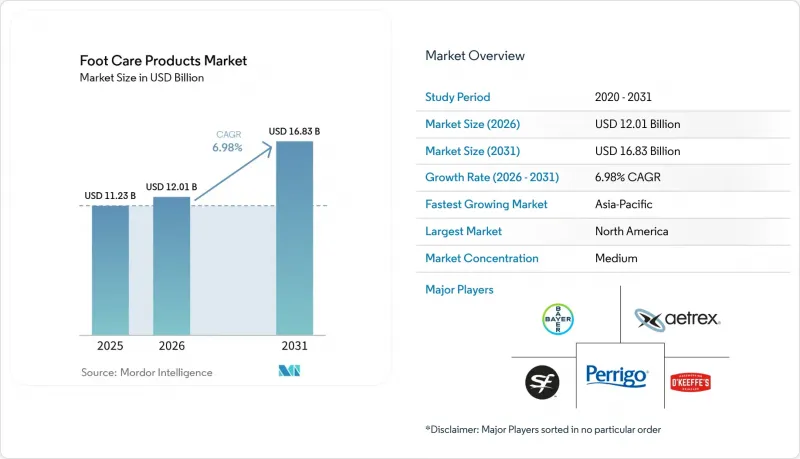
This report is Segmented by Product Type (Insoles & Orthotics, Treatments, and Others), Product Form (Cream, Lotion, Gel, Spray, and Others), Application (Medical/Therapeutic, and Others), Distribution Channel (Pharmacies, Supermarkets, and Others), and Geography (North America, Europe, Asia-Pacific, MEA, South America). The Market Forecasts are Provided in Terms of Value (USD).
Global Foot Care Products Market Trends and Insights
Rising Diabetic and Aging-Foot Burden
The foot care products market benefits from a growing long-term patient base, with 589 million adults aged 20 to 79 living with diabetes in 2025, representing 1 in 9 adults globally. Of these, 43% or 252 million remained undiagnosed, and 81% resided in low- and middle-income countries, indicating a delayed entry into preventive care pathways. Diabetes-related health expenditure reached USD 1.015 trillion in 2024, a 338% increase over 17 years, highlighting the significant impact of chronic foot-risk conditions on healthcare spending and self-care purchasing. Globally, 6.3% of adults with diabetes experience diabetic foot ulcers, with North America showing a higher prevalence of 13.0%. This drives consistent demand for products like plantar-pressure insoles, medicated creams, antifungal treatments, and protective skin regimens, emphasizing preventive care. Additionally, the aging population sustains demand, with studies supporting the use of arch-support and pressure-redistribution insoles for managing common foot pain.
OTC Shift Toward Preventive Foot Health
The market is witnessing a shift from reactive purchases to planned preventive use, particularly in developed regions where consumers increasingly invest in therapeutic foot products before symptoms worsen. This trend is evident in premium insoles, foot repair creams, and antifungal treatments, which are now positioned closer to daily wellness items. This shift creates a middle tier between low-cost commodities and prescription products, enabling clinically positioned brands to expand their price range while maintaining accessibility. Independent endorsements, such as the American Podiatric Medical Association Seal of Acceptance for ARRIS Composites' AURORRA carbon fiber insoles, are becoming more valuable. Regulatory frameworks also favor established players with robust product testing and compliance systems.
Low Reimbursement for Routine Foot Care
In the U.S., the foot care products market faces structural challenges due to reimbursement policies. Medicare Part B excludes most routine foot care services unless a qualifying systemic condition is properly documented. Consequently, a significant portion of preventive spending becomes out-of-pocket, even for products addressing critical risks like diabetic skin breakdown or fungal recurrence. A 2025 audit revealed that 49% of sampled claims for routine foot care tied to systemic conditions did not meet Medicare requirements. This drives a large segment of the market toward over-the-counter and retail channels, where consumers often prioritize price over long-term value. Expanding coverage for preventive diabetic footwear or related services could significantly impact market growth beyond current forecasts.
Other drivers and restraints analyzed in the detailed report include:
- Premium Foot Repair and Antifungal Regimens
- Pharmacy-Led and E-Commerce Discovery
- PFAS and Material-Compliance Pressure
For complete list of drivers and restraints, kindly check the Table Of Contents.
Segment Analysis
In 2025, Treatment & Condition-Specific Remedies held 42.80% of the foot care products market share, driven by recurring conditions like athlete's foot, fungal nails, and plantar fasciitis. These products benefit from strong shelf visibility, symptom-led merchandising, and ease of selection without formal diagnosis. Foot Skincare & Cosmetic Care has expanded its audience by attracting wellness-focused consumers who integrate foot masks, balms, and exfoliants into regular self-care routines.
Insoles & Orthotics is projected to grow at a CAGR of 8.10% through 2031, supported by the shift from clinic-based customization to digitally accessible retail options. Advanced insole designs, such as lattice-based structures, enhance plantar pressure redistribution, offering brands a strong value proposition for comfort, prevention, and performance. Foot Hygiene & Odor Control remains stable, with probiotic deodorant formats signaling innovation through formulation science.
Cream led the market with a 34.40% share in 2025, owing to its versatility in addressing cosmetic hydration and medicinal treatments. Lotion remains popular for daily moisturization, while gel formats cater to cooling and recovery needs. Patch/Pad/Tape products maintain strong credibility in Europe due to their association with visible protection and symptom relief.
Spray is forecast to grow at a CAGR of 7.20% through 2031, driven by convenience, quick-drying features, and improved suitability for interdigital application. Enhanced propellant systems and carrier technology have enabled sprays to expand into clinically relevant uses. Device and tool formats, such as electronic foot files, create new growth opportunities by linking hardware with consumable products.
Geography Analysis
In 2025, North America accounted for 40.12% of the foot care products market, with the U.S. as the leading center for OTC therapeutic foot care. This dominance is driven by a high disease burden, as 13.0% of adults with diabetes in the region experience diabetic foot ulcers compared to the global average of 6.3%. The region benefits from a strong pharmacy network, high product awareness, and consumer willingness to invest in advanced formulations and insoles. Canada mirrors U.S. purchasing trends in pharmacist-led and self-care categories, while Mexico contributes to volume growth through expanding retail and pharmacy infrastructure.
Europe ranked as the second-largest regional market, with Germany, the U.K., France, Italy, and Spain as key demand centers. Germany stands out due to reimbursement structures and a pharmacy culture that supports a stronger therapeutic mix. Beiersdorf's Health Care division, including Hansaplast, reported growth. Europe is also adapting to material compliance changes, favoring brands transitioning to PFAS-free inputs without compromising performance or pricing.
Asia-Pacific is the fastest-growing region in the foot care products market, with a projected CAGR of 9.35% from 2026 to 2031. China and India lead due to large diabetic populations and growing preventive foot care adoption. By late 2024, China's population aged 60 and above reached nearly 297 million, driving demand for products focused on pressure relief, skin care, and circulation support. Japan follows a mature model, promoting foot care as part of routine health management. The Middle East and Africa benefit from high obesity and diabetes rates in GCC countries, while South America sees growth in antifungal and hygiene products as retail networks expand.
- Aetrex, Inc.
- AHAVA Dead Sea Laboratories Ltd.
- Algeos Limited
- Bauerfeind
- Bayer
- Beiersdorf
- CURREX
- Eduard Gerlach GmbH
- Implus Footcare, LLC
- Kenvue Inc.
- KvG Group Inc.
- O' Keeffe's Company
- PediFix, Inc.
- Perrigo Company
- PowerStep
- Scholl's Wellness Company Limited
- SIDAS
- Spenco
- Superfeet Worldwide, LLC
- Tynor Orthotics Private Limited
Additional Benefits:
- The market estimate (ME) sheet in Excel format
- 3 months of analyst support
TABLE OF CONTENTS
1 Introduction
- 1.1 Study Assumptions & Market Definition
- 1.2 Scope of the Study
2 Research Methodology
3 Executive Summary
4 Market Landscape
- 4.1 Market Overview
- 4.2 Market Drivers
- 4.2.1 Rising Diabetic and Aging-Foot Burden
- 4.2.2 OTC Shift Toward Preventive Foot Health
- 4.2.3 Premium Foot Repair and Antifungal Regimens
- 4.2.4 Pharmacy-Led and E-Commerce Discovery
- 4.2.5 Retail Scan-to-Fit Orthotics Scaling
- 4.2.6 Climate-Linked Fungal and Sweat Burden
- 4.3 Market Restraints
- 4.3.1 Low Reimbursement for Routine Foot Care
- 4.3.2 Evidence Gaps Across OTC Claims
- 4.3.3 Regulatory Scrutiny on Orthotics and Claims
- 4.3.4 PFAS and Material-Compliance Pressure
- 4.4 Value / Supply-Chain Analysis
- 4.5 Regulatory Landscape
- 4.6 Technological Outlook
- 4.7 Porter's Five Forces Analysis
- 4.7.1 Threat of New Entrants
- 4.7.2 Bargaining Power of Suppliers
- 4.7.3 Bargaining Power of Buyers
- 4.7.4 Threat of Substitutes
- 4.7.5 Competitive Rivalry
5 Market Size & Growth Forecasts (Value, USD)
- 5.1 By Product Type
- 5.1.1 Insoles & Orthotics
- 5.1.1.1 Athletic / Performance Insoles
- 5.1.1.2 Gel Insoles
- 5.1.1.3 Foam Insoles
- 5.1.1.4 Orthotic Insoles
- 5.1.1.5 Heel Cups & Arch Supports
- 5.1.2 Treatments & Condition-Specific Remedies
- 5.1.2.1 Athlete's Foot Treatments
- 5.1.2.2 Anti-blister Products
- 5.1.2.3 Corn & Callus Treatments
- 5.1.2.4 Fungal Nail Treatments
- 5.1.2.5 Plantar Fasciitis Relief Products
- 5.1.3 Foot Skincare & Cosmetic Care
- 5.1.3.1 Foot Creams
- 5.1.3.2 Foot Lotions & Moisturizers
- 5.1.3.3 Foot Masks & Peels
- 5.1.3.4 Foot Files & Exfoliators
- 5.1.3.5 Foot Balms
- 5.1.4 Foot Hygiene & Odor Control
- 5.1.4.1 Foot Powders
- 5.1.4.2 Sprays & Deodorants
- 5.1.4.3 Sanitizing Solutions
- 5.1.5 Protective Pads & Accessories
- 5.1.5.1 Shoe Pads
- 5.1.5.2 Toe Separators & Sleeves
- 5.1.5.3 Cushions & Tapes
- 5.1.1 Insoles & Orthotics
- 5.2 By Product Form
- 5.2.1 Cream
- 5.2.2 Lotion
- 5.2.3 Gel
- 5.2.4 Spray
- 5.2.5 Powder
- 5.2.6 Patch / Pad / Tape
- 5.2.7 Insole / Insert
- 5.2.8 Device / Tool
- 5.3 By Application
- 5.3.1 Medical / Therapeutic
- 5.3.2 Sports & Athletics
- 5.3.3 Personal Comfort
- 5.3.4 Beauty / Grooming
- 5.4 By Distribution Channel
- 5.4.1 Pharmacies & Drug Stores
- 5.4.2 Supermarkets & Hypermarkets
- 5.4.3 Online / E-commerce
- 5.4.4 Specialty Stores
- 5.4.5 Hospitals & Clinics
- 5.4.6 Convenience Stores
- 5.5 By Geography
- 5.5.1 North America
- 5.5.1.1 United States
- 5.5.1.2 Canada
- 5.5.1.3 Mexico
- 5.5.2 Europe
- 5.5.2.1 Germany
- 5.5.2.2 United Kingdom
- 5.5.2.3 France
- 5.5.2.4 Italy
- 5.5.2.5 Spain
- 5.5.2.6 Rest of Europe
- 5.5.3 Asia-Pacific
- 5.5.3.1 China
- 5.5.3.2 India
- 5.5.3.3 Japan
- 5.5.3.4 Australia
- 5.5.3.5 South Korea
- 5.5.3.6 Rest of Asia-Pacific
- 5.5.4 Middle East and Africa
- 5.5.4.1 GCC
- 5.5.4.2 South Africa
- 5.5.4.3 Rest of Middle East and Africa
- 5.5.5 South America
- 5.5.5.1 Brazil
- 5.5.5.2 Argentina
- 5.5.5.3 Rest of South America
- 5.5.1 North America
6 Competitive Landscape
- 6.1 Market Concentration
- 6.2 Market Share Analysis
- 6.3 Company Profiles (includes Global level Overview, Market level overview, Core Segments, Financials as available, Strategic Information, Market Rank/Share for key companies, Products & Services, and Recent Developments)
- 6.3.1 Aetrex, Inc.
- 6.3.2 AHAVA Dead Sea Laboratories Ltd.
- 6.3.3 Algeos Limited
- 6.3.4 Bauerfeind AG
- 6.3.5 Bayer AG
- 6.3.6 Beiersdorf AG
- 6.3.7 CURREX
- 6.3.8 Eduard Gerlach GmbH
- 6.3.9 Implus Footcare, LLC
- 6.3.10 Kenvue Inc.
- 6.3.11 KvG Group Inc.
- 6.3.12 O' Keeffe's Company
- 6.3.13 PediFix, Inc.
- 6.3.14 Perrigo Company plc
- 6.3.15 PowerStep
- 6.3.16 Scholl's Wellness Company Limited
- 6.3.17 SIDAS
- 6.3.18 Spenco
- 6.3.19 Superfeet Worldwide, LLC
- 6.3.20 Tynor Orthotics Private Limited
7 Market Opportunities & Future Outlook
- 7.1 White-space & Unmet-need Assessment

