PUBLISHER: Mordor Intelligence | PRODUCT CODE: 2065722

PUBLISHER: Mordor Intelligence | PRODUCT CODE: 2065722
U.S. Dental Care - Market Share Analysis, Industry Trends & Statistics, Growth Forecasts (2026 - 2031)
According to Mordor Intelligence, the u.S. dental care market size is projected to expand from USD 215 billion in 2025 and USD 224.56 billion in 2026 to USD 279.18 billion by 2031, registering a CAGR of 4.45% between 2026 to 2031.
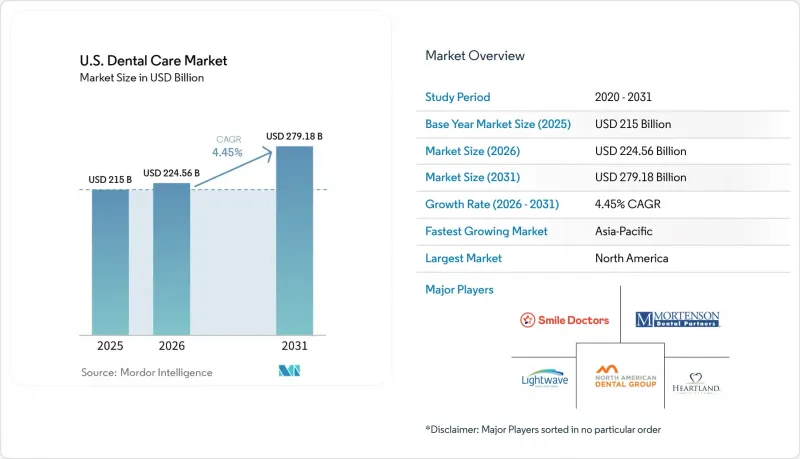
This report is Segmented by Service Type (Non-Surgical Services, Surgical Services), Patient Age Group (0-17 Years, 18-34 Years, 35-64 Years, 65 Years and Above), and Care Setting (Dental Clinics, Hospital, Dental Service Organization, Others). The Market Forecasts are Provided in Terms of Value (USD).
U.S. Dental Care Market Trends and Insights
Medicare Advantage Dental Benefit Expansion Fueling Senior Utilization
In 2025, Medicare Advantage enrollment reached 34.1 million, representing 54% of the eligible Medicare population, a 4% increase from the previous year. Projections indicate this share could grow to 64% by 2034, signaling continued expansion of senior dental coverage. Over 97% of Medicare Advantage plans included dental benefits in 2025, with supplemental dental benefits also widely available. Special Needs Plans saw a 71% enrollment increase, driving demand for restorative, periodontal, and specialty procedures, resulting in higher revenue per senior patient.
Adult Medicaid Dental Benefit Expansion Broadening the Addressable Population
By the end of 2024, 11 states and Washington, D.C., offered extensive adult dental benefits under Medicaid, up from 4 states in 2020. Recent changes expanded service coverage, raised annual benefit limits, and targeted specific adult groups. This broadened the patient base, enabling more low-income adults to access dental care. Larger groups and DSO-backed practices are better positioned to manage lower reimbursements and higher volumes, making them key beneficiaries of this expansion.
Hygienist And Assistant Shortages Constraining Capacity At A Critical Growth Inflection
The U.S. dental care market faces capacity constraints as shortages of hygienists and assistants limit the conversion of insured demand into appointments. In 2025, 74% of dentists reported extreme difficulty in recruiting hygienists, with 57.2% of positions unfilled. A projected shortfall of 30,000 hygienists by 2037, driven by limited clinic space in training programs, further exacerbates the issue. These shortages have reduced practice capacity by 11%, increasing wait times, lowering visit throughput, and causing delays in treatment. Retention challenges, influenced by pay, workload, and scope-of-practice limits, remain a critical barrier to resolving this issue.
Other drivers and restraints analyzed in the detailed report include:
- DSO Consolidation And Specialty Rollout
- Cosmetic, Clear-Aligner, And Implant Demand Elevating Revenue Per Visit
- Out-Of-Pocket Burden And Annual Benefit Caps Suppressing Discretionary Demand
For complete list of drivers and restraints, kindly check the Table Of Contents.
Segment Analysis
In 2025, non-surgical services accounted for 55.46% of the U.S. dental care market share, driven by preventive care such as cleanings and exams, which are repeatable across all age groups. Employer-sponsored dental insurance supports this category by offering broad reimbursements for preventive and restorative procedures, stabilizing routine utilization. Restorative services like fillings, crowns, and bridges, along with cosmetic dentistry options such as whitening and veneers, further enhance demand and revenue potential.
Surgical services are projected to grow at a 6.15% CAGR from 2026 to 2031, the fastest among service types. Implant adoption is a key driver, addressing both aging patients' tooth replacement needs and younger adults' demand for appearance-driven treatments. Orthodontics is expanding beyond adolescents to working adults, while advancements in endodontics and periodontics are increasing billable interventions, shifting the market toward higher-revenue specialty procedures.
List of Companies Covered in this Report:
- 42 North Dental
- Affordable Care, LLC
- Benevis
- Dental Care Alliance
- Freedom Dental Health
- Great Expressions Dental Centers
- Heartland Dental
- InterDent
- Lightwave Dental Management LLC
- MAX Surgical Specialty Management
- MB2 Dental
- Mortenson Dental Partners
- North American Dental Group
- Parkview Dental Partners
- PDS Health
- Smile Brands
- Smile Doctors
- Sonrava Health
- Specialized Dental Partners
- The Aspen Group
Additional Benefits:
- The market estimate (ME) sheet in Excel format
- 3 months of analyst support
TABLE OF CONTENTS
1 Introduction
- 1.1 Study Assumptions & Market Definition
- 1.2 Scope of the Study
2 Research Methodology
3 Executive Summary
4 Market Landscape
- 4.1 Market Overview
- 4.2 Market Drivers
- 4.2.1 Medicare Advantage Dental Benefit Expansion
- 4.2.2 Adult Medicaid Dental Benefit Expansion and EHB Pathway
- 4.2.3 DSO Consolidation and Specialty Rollout
- 4.2.4 Cosmetic, Clear-Aligner, and Implant Demand
- 4.2.5 AI Diagnostics and Dental-Medical Integration
- 4.3 Market Restraints
- 4.3.1 Hygienist and Assistant Shortages
- 4.3.2 Out-of-Pocket Burden and Annual Benefit Caps
- 4.3.3 Low Medicaid Reimbursement and Administrative Friction
- 4.4 Value Chain Analysis
- 4.5 Regulatory Landscape
- 4.6 Technological Outlook
- 4.7 Porter's Five Forces Analysis
- 4.7.1 Bargaining power of suppliers
- 4.7.2 Bargaining power of buyers
- 4.7.3 Threat of new entrants
- 4.7.4 Threat of substitutes
- 4.7.5 Intensity of competitive rivalry
5 Market Size & Growth Forecasts (Value, USD)
- 5.1 By Service Type
- 5.1.1 Non-surgical Services
- 5.1.1.1 Preventive Dentistry
- 5.1.1.2 Restorative Dentistry
- 5.1.1.3 Cosmetic Dentistry
- 5.1.2 Surgical Services
- 5.1.2.1 Implants & Oral Surgery
- 5.1.2.2 Orthodontics
- 5.1.2.3 Endodontics & Periodontics
- 5.1.1 Non-surgical Services
- 5.2 By Patient Age Group
- 5.2.1 0-17 years
- 5.2.2 18-34 years
- 5.2.3 35-64 years
- 5.2.4 65 years and above
- 5.3 By Care Setting
- 5.3.1 Dental Clinics
- 5.3.2 Hospital
- 5.3.3 Dental Service Organization
- 5.3.4 Others
6 Competitive Landscape
- 6.1 Market Concentration
- 6.2 Market Share Analysis
- 6.3 Company Profiles (includes Global level Overview, Market level overview, Core Segments, Financials as available, Strategic Information, Market Rank/Share for key companies, Products & Services, and Recent Developments)
- 6.3.1 42 North Dental
- 6.3.2 Affordable Care, LLC
- 6.3.3 Benevis
- 6.3.4 Dental Care Alliance
- 6.3.5 Freedom Dental Health
- 6.3.6 Great Expressions Dental Centers
- 6.3.7 Heartland Dental
- 6.3.8 InterDent
- 6.3.9 Lightwave Dental Management LLC
- 6.3.10 MAX Surgical Specialty Management
- 6.3.11 MB2 Dental
- 6.3.12 Mortenson Dental Partners
- 6.3.13 North American Dental Group
- 6.3.14 Parkview Dental Partners
- 6.3.15 PDS Health
- 6.3.16 Smile Brands
- 6.3.17 Smile Doctors
- 6.3.18 Sonrava Health
- 6.3.19 Specialized Dental Partners
- 6.3.20 The Aspen Group
7 Market Opportunities & Future Outlook
- 7.1 White-space & Unmet-need Assessment

