PUBLISHER: Mordor Intelligence | PRODUCT CODE: 2065740

PUBLISHER: Mordor Intelligence | PRODUCT CODE: 2065740
Medical Spa - Market Share Analysis, Industry Trends & Statistics, Growth Forecasts (2026 - 2031)
According to Mordor Intelligence, the medical spa market size is projected to be USD 23.29 billion in 2025, USD 26.20 billion in 2026, and reach USD 47.17 billion by 2031, growing at a CAGR of 12.48% from 2026 to 2031.
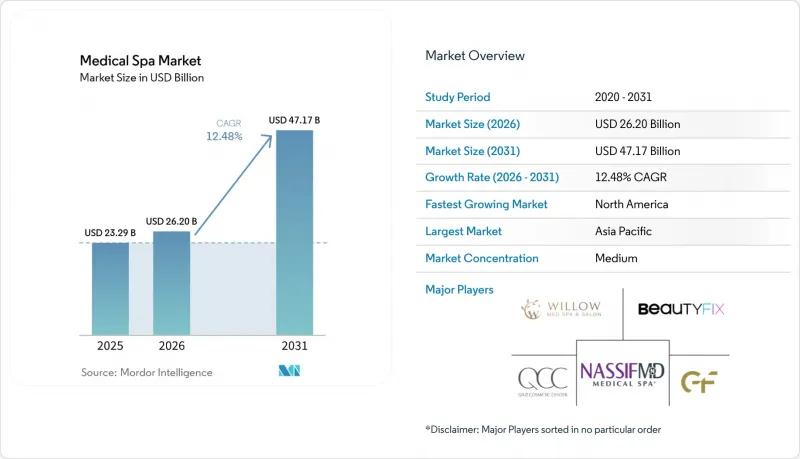
This report is Segmented by Services (Facial Treatment, Body Shaping & Contouring, Laser Hair Removal, Tattoo Removal, Scars & Striae Treatment, Injectables), End User (Female, Male), and Geography (North America, Europe, Asia-Pacific, Middle East & Africa, South America). The Market Forecasts are Provided in Terms of Value (USD).
Global Medical Spa Market Trends and Insights
Surging Demand for Minimally Invasive Cosmetic Procedures
Non-surgical treatments recorded 30% demand growth in 2024. Consumers value shorter recovery and natural-looking outcomes that energy-based devices and injectables can provide. The American Society for Laser Medicine and Surgery recently cleared 1,726 nm lasers for acne management, expanding the minimally invasive toolkit. Integrated treatment plans that combine neuromodulators, fillers and fractional lasers replicate surgical-quality results without scalpel intervention. Clinics report rising average ticket sizes because patients now bundle multiple therapies during the same visit. This preference is reshaping staffing models by prioritizing advanced-practice providers and device specialists, reinforcing expansion across the medical spa market.
Influence of Social Media & Beauty Culture
Digital platforms introduced 48.9% of patients to their current providers, with Instagram dominating discovery at 64.1% usage. Viral aesthetics such as the "Instagram face" drive interest in cheek enhancement, lip shaping and jawline contouring. Short-form video on TikTok has normalized injectables among consumers under 30. Yet unrealistic expectations foster dissatisfaction: a recent study linked higher revision requests to social media-referred clients. Providers are responding with enhanced consultations and pre-procedure education to align outcomes with digital imagery.
High Cost of Equipment & Advanced Procedures
State-of-the-art energy platforms can cost more than USD 500,000 per site and require updates within five years. Leasing mitigates upfront cash but lifts long-term expense as bundled service contracts add 10%-15% to annual outlay. The financial burden splits the market: multi-site chains deploy the newest lasers, while small clinics extend depreciation cycles and risk obsolescence. Vendors have started subscription plans where disposable applicators and maintenance are packaged into per-treatment fees, but margins compress when utilization falters. This capital intensity constrains entry in rural zones and slows technology diffusion, creating structural challenges for the medical spa market.
Other drivers and restraints analyzed in the detailed report include:
- Rising Disposable Income in Emerging Economies
- Aging Population Seeking Anti-Aging Solutions
- Limited Insurance Coverage for Aesthetic Services
For complete list of drivers and restraints, kindly check the Table Of Contents.
Segment Analysis
Facial treatments generated 52.18% of 2025 revenue, cementing their role as the anchor product line that draws regular appointments and cross-selling opportunities. The medical spa market size for facial rejuvenation is forecast to grow further as clinics integrate AI complexion mapping that tailors peel depth, microneedling needle length and light-based protocols to patient phenotype. Injectable trends such as "Baby Botox" encourage earlier adoption among consumers aged 25-34, enhancing lifetime value per client. Laser hair removal, the fastest-expanding segment at 15.22% CAGR, benefits from diode platforms capable of treating Fitzpatrick V-VI skin types. Its popularity among male clients and time-poor professionals supports strong weekday utilization.
Non-invasive body contouring technologies, including cryolipolysis and high-intensity focused ultrasound, are gaining traction as complementary upsells to facial programs. Tattoo removal demand is rising as picosecond lasers shorten clearance timelines from 10 sessions to six, improving satisfaction and clinic throughput. Scars and striae treatments, once niche, now leverage fractional resurfacing combined with platelet-rich plasma to deliver visible textural improvement. Overall, the services portfolio is diversifying from single-modality therapies toward curated combinations that lift average revenue per visit and lock in longer-term care plans, reinforcing expansion across the medical spa market.
Geography Analysis
North America secured 36.95% revenue share in 2025, supported by high disposable income, robust regulatory frameworks and the presence of device innovators that pilot new platforms domestically. The United States propels regional demand through aggressive clinic rollouts inside medical office buildings, while Canada gains incremental growth from inbound wellness tourists seeking bundled vacation-procedure packages. Mexico attracts US patients with cost advantages yet maintains board-certified standards that reassure international clientele. Cross-border dynamics encourage bilingual staff hires and omni-currency payment gateways.
Asia-Pacific is forecast to deliver a 14.52% CAGR to 2031, underscoring its role as the growth backbone of the medical spa market. China remains pivotal as urban consumers dedicate larger disposable income shares to personal care and as hospital-affiliated aesthetic centers extend credit-card-linked memberships. Japan advances technological leadership in ultrashort-pulse lasers, while South Korea exports K-beauty protocols and training curricula that influence regional practice standards. India's tier-1 and tier-2 cities gain traction through medical tourism corridors anchored by private hospital groups that allocate floor space to hybrid wellness-aesthetic wings.
Europe continues stable mid-single-digit expansion based on cross-border treatment access within the Schengen Area and mature wellness culture. Germany, France and Italy emphasize clinical excellence, whereas Spain combines aesthetic packages with coastal retreat experiences. Eastern Europe offers cost-efficient procedures that attract UK and Irish clients seeking lower out-of-pocket payments post-Brexit travel adjustments. The Middle East witnesses premium demand centered in GCC hubs that co-locate luxury hospitality with specialist clinics. Latin America shows similar hybrid tourism drivers, with Brazil's established cosmetic surgery reputation feeding non-surgical procedure spill-over.
- Allure Medspa
- Canyon Ranch
- Clinique La Prairie
- Four Seasons Hotels & Resorts
- Qazi Cosmetic Clinic
- Willow Med Spa
- The BioMed Spa
- Beauty Fix MedSpa
- Nassif Medical Spa
- Cocoon Medical Spa
- Hilton Spas
- SkinSpirit
- Ideal Image
- Sono Bello
- Evolution MedSpa Boston
- Ritz-Carlton Spas
- Miraval Group
- Rosewood - Sense Spa
- Lanserhof
- Joali Being
Additional Benefits:
- The market estimate (ME) sheet in Excel format
- 3 months of analyst support
TABLE OF CONTENTS
1 Introduction
- 1.1 Study Assumptions & Market Definition
- 1.2 Scope of the Study
2 Research Methodology
3 Executive Summary
4 Market Landscape
- 4.1 Market Overview
- 4.2 Market Drivers
- 4.2.1 Surging Demand for Minimally Invasive Cosmetic Procedures
- 4.2.2 Influence of Social Media & Beauty Culture
- 4.2.3 Rising Disposable Income in Emerging Economies
- 4.2.4 Aging Population Seeking Anti-Aging Solutions
- 4.2.5 AI-Powered Personalization & Skin Diagnostics
- 4.2.6 Subscription-Based Wellness Models
- 4.3 Market Restraints
- 4.3.1 High Cost of Equipment & Advanced Procedures
- 4.3.2 Limited Insurance Coverage for Aesthetic Services
- 4.3.3 Shortage of Certified Practitioners & Regulatory Complexity
- 4.3.4 Cybersecurity & Data Privacy Risks
- 4.4 Porter's Five Forces Analysis
- 4.4.1 Threat of New Entrants
- 4.4.2 Bargaining Power of Buyers
- 4.4.3 Bargaining Power of Suppliers
- 4.4.4 Threat of Substitutes
- 4.4.5 Intensity of Competitive Rivalry
5 Market Size & Growth Forecasts (Value in USD)
- 5.1 By Services
- 5.1.1 Facial Treatment
- 5.1.2 Body Shaping & Contouring
- 5.1.3 Laser Hair Removal
- 5.1.4 Tattoo Removal
- 5.1.5 Scars & Striae Treatment
- 5.1.6 Injectables
- 5.2 By End User
- 5.2.1 Female
- 5.2.2 Male
- 5.3 By Geography
- 5.3.1 North America
- 5.3.1.1 United States
- 5.3.1.2 Canada
- 5.3.1.3 Mexico
- 5.3.2 Europe
- 5.3.2.1 Germany
- 5.3.2.2 United Kingdom
- 5.3.2.3 France
- 5.3.2.4 Italy
- 5.3.2.5 Spain
- 5.3.2.6 Rest of Europe
- 5.3.3 Asia-Pacific
- 5.3.3.1 China
- 5.3.3.2 Japan
- 5.3.3.3 India
- 5.3.3.4 Australia
- 5.3.3.5 South Korea
- 5.3.3.6 Rest of Asia-Pacific
- 5.3.4 Middle East & Africa
- 5.3.4.1 GCC
- 5.3.4.2 South Africa
- 5.3.4.3 Rest of Middle East & Africa
- 5.3.5 South America
- 5.3.5.1 Brazil
- 5.3.5.2 Argentina
- 5.3.5.3 Rest of South America
- 5.3.1 North America
6 Competitive Landscape
- 6.1 Market Concentration
- 6.2 Market Share Analysis
- 6.3 Company Profiles (includes Global level Overview, Market level overview, Core Segments, Financials as available, Strategic Information, Market Rank/Share for key companies, Products & Services, and Recent Developments)
- 6.3.1 Allure Medspa
- 6.3.2 Canyon Ranch
- 6.3.3 Clinique La Prairie
- 6.3.4 Four Seasons Hotels & Resorts
- 6.3.5 Qazi Cosmetic Clinic
- 6.3.6 Willow Med Spa
- 6.3.7 The BioMed Spa
- 6.3.8 Beauty Fix MedSpa
- 6.3.9 Nassif Medical Spa
- 6.3.10 Cocoon Medical Spa
- 6.3.11 Hilton Spas
- 6.3.12 SkinSpirit
- 6.3.13 Ideal Image
- 6.3.14 Sono Bello
- 6.3.15 Evolution MedSpa Boston
- 6.3.16 Ritz-Carlton Spas
- 6.3.17 Miraval Group
- 6.3.18 Rosewood - Sense Spa
- 6.3.19 Lanserhof
- 6.3.20 Joali Being
7 Market Opportunities & Future Outlook
- 7.1 White-space & Unmet-need Assessment

