PUBLISHER: Mordor Intelligence | PRODUCT CODE: 2065746

PUBLISHER: Mordor Intelligence | PRODUCT CODE: 2065746
Europe Bus - Market Share Analysis, Industry Trends & Statistics, Growth Forecasts (2026 - 2031)
According to Mordor Intelligence, the europe bus market size is expected to grow from USD 5.84 billion in 2025 to USD 6.37 billion in 2026 and is forecast to reach USD 9.85 billion by 2031 at a 9.13% CAGR over 2026-2031.
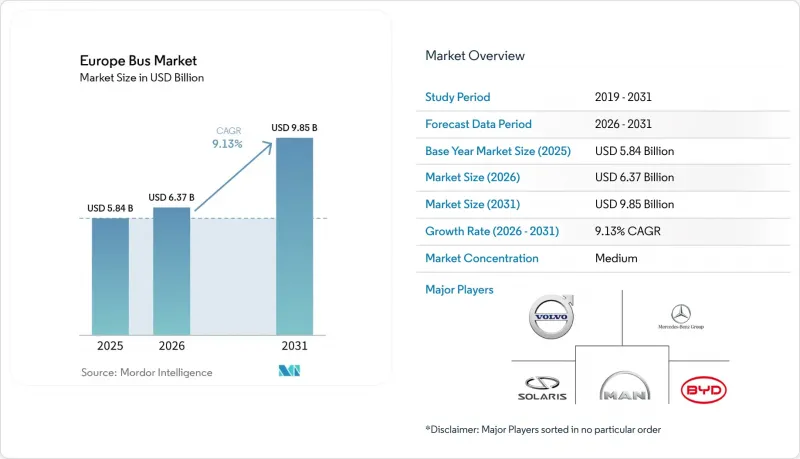
This report is Segmented by Deck Type (Single and Double), Application (Transit Bus and More), Fuel Type (Diesel, Battery Electric, and More), Seating Capacity (Up To 30 Seats and More), Bus Length (Up To 9 M, 9-12 M, and More Than 12 M), and Geography. Market Forecasts are Provided in Value (USD) and Volume (Units).
Europe Bus Market Trends and Insights
EU Clean-Bus Mandate (2025/30 Targets)
Under the Clean Vehicle Directive, member states must ensure that by 2025, a significant percentage of procured buses are clean, with this requirement increasing further by 2030 . Notably, half of these buses must feature zero-emission drivetrains. In response, operators are securing their positions: DB Regio, for instance, has placed a substantial multi-year order for thousands of units. This move not only sidesteps potential penalties but also solidifies demand for battery-electric platforms. Evidence of over-compliance is apparent: in 2024, nearly half of new city buses delivered in the EU were zero-emission, a notable increase from the previous year, showcasing a shift in fleet planning . OEMs boasting modular platforms adaptable to various member-state regulations stand to gain the most, positioning themselves for rapid scaling.
Expansion of Urban Low-/Zero-Emission Zones
Thirty-five cities across Europe have either implemented or announced zero-emission zones, effectively banning diesel buses in specific areas. This move is hastening the early retirement of internal combustion engine (ICE) assets. London currently boasts over 1,800 electric buses and has mandated that all new double-decker buses must be zero-emission starting in 2025 . Similarly, Paris is on track to fully electrify its RATP fleet by 2025, necessitating 4,700 electric buses and corresponding charging infrastructure upgrades. These zero-emission zones have led to a divided market: urban operators grapple with strict compliance deadlines, while their suburban counterparts still have the flexibility to use diesel, driving up the demand for nimble sub-9-meter buses adept at navigating the city's historic districts.
Phase-Down of National E-Bus Purchase Subsidies
Germany has reduced its KsNI subsidy to a significantly lower portion of the list price. Meanwhile, the UK's ZEBRA program lapsed in March 2024, and there's no immediate replacement in sight. To navigate financing challenges, operators are turning to battery-leasing and residual-value agreements with OEMs like Daimler and Volvo. Given their capital constraints, regional fleets might postpone electrification, leading to a temporary dip in orders until fresh fiscal solutions are introduced.
Other drivers and restraints analyzed in the detailed report include:
- Post-COVID Public-Transport Ridership Rebound
- EU Recovery and Resilience Facility Capital Spending
- Depot Grid-Connection and Power-Capacity Delays
For complete list of drivers and restraints, kindly check the Table Of Contents.
Segment Analysis
Double-deckers are advancing at a 9.15% CAGR through 2031. The Europe bus market size for this deck type will therefore widen faster than that of single-decks, even though single-decks commanded 81.31% share in 2025. Recent contracts include 104 Wrightbus StreetDeck Electroliners delivered to Go-Ahead Oxford and an 800-unit framework awarded by Ireland's National Transport Authority, signaling strong replacement demand in the UK and Ireland. Chinese OEMs are also testing the segment: Yutong's U11DD trial offers 662 kWh of battery capacity aimed at long-range intercity work. Growth is tied to the need for high-capacity vehicles on constrained curb space, especially in London, Dublin, and Belfast.
Single-deckers will keep dominating everyday urban operations because of lower acquisition cost, broader height clearance, and mature service networks. However, their slower growth rate suggests incremental rather than breakout volume. OEM differentiation will hinge on offering modular layouts that can be homologated quickly for varying door positions and interior specifications across continental Europe.
Transit buses drove 67.37% of 2025 deliveries but intercity and motorcoach applications will post the quickest 9.21% CAGR to 2031, transforming the Europe bus market. Volvo's 8900 Electric secured 60-unit orders from Sweden's Svealandstrafiken, while DB Regio added 200 BYD electric coaches to serve regional corridors. Operators cite 500-700 km certified range as the tipping point for diesel replacement on popular lines such as Berlin-Hamburg and Madrid-Valencia.
Although school and charter niches remain small, the shift toward step-free, low-entry coach designs to comply with EU accessibility mandates adds incremental demand. OEMs with platforms that share drivetrains and electronics across transit and intercity variants capture scale efficiencies, boosting margins while simplifying parts inventory for operators.
List of Companies Covered in this Report:
- BYD Company Ltd
- Daimler Buses (Mercedes-Benz Group AG)
- MAN Truck & Bus SE
- Volvo Group
- Solaris Bus & Coach
- Traton Group (Scania, Volkswagen CVI)
- IVECO Group (Heuliez Bus)
- VDL Bus & Coach
- Alexander Dennis Ltd
- Wrightbus
- Ebusco Holding NV
- Yutong Europe
- Irizar e-Mobility
- Van Hool
- Otokar Otomotiv
- Rampini Carbri
- Karsan
- Unvibus
- Hyzon Motors
Additional Benefits:
- The market estimate (ME) sheet in Excel format
- 3 months of analyst support
TABLE OF CONTENTS
1 Introduction
- 1.1 Study Assumptions & Market Definition
- 1.2 Scope of the Study
2 Research Methodology
3 Executive Summary
4 Market Landscape
- 4.1 Market Overview
- 4.2 Market Drivers
- 4.2.1 EU Clean-Bus Mandate (2025/30 Targets)
- 4.2.2 Expansion of Urban Low-/Zero-Emission Zones
- 4.2.3 EU Recovery and Resilience Facility Capital Spending
- 4.2.4 Post-COVID Public-Transport Ridership Rebound
- 4.2.5 OEM "Battery-As-A-Service" and Residual-Value Guarantees
- 4.2.6 Growth of Intercity Low-Entry E-Bus Tenders
- 4.3 Market Restraints
- 4.3.1 Phase-Down of National E-Bus Purchase Subsidies
- 4.3.2 Depot Grid-Connection and Power-Capacity Delays
- 4.3.3 Professional-Driver Shortages
- 4.3.4 High Upfront Cost of Hydrogen Fuel-Cell Buses
- 4.4 Value / Supply-Chain Analysis
- 4.5 Regulatory Landscape
- 4.6 Technological Outlook
- 4.7 Porter's Five Forces
- 4.7.1 Bargaining Power of Suppliers
- 4.7.2 Bargaining Power of Buyers
- 4.7.3 Threat of New Entrants
- 4.7.4 Threat of Substitutes
- 4.7.5 Competitive Rivalry
5 Market Size & Growth Forecasts (Value (USD) and Volume (Units))
- 5.1 By Deck Type
- 5.1.1 Single
- 5.1.2 Double
- 5.2 By Application
- 5.2.1 Transit Bus
- 5.2.2 Intercity Bus / Motorcoach
- 5.2.3 School Bus
- 5.2.4 Others
- 5.3 By Fuel Type
- 5.3.1 Diesel
- 5.3.2 Battery Electric
- 5.3.3 Plug-in Hybrid
- 5.3.4 Fuel Cell Electric
- 5.3.5 Others
- 5.4 By Seating Capacity
- 5.4.1 Up to 30 seats
- 5.4.2 31 - 50 seats
- 5.4.3 More than 50 seats
- 5.5 By Bus Length
- 5.5.1 Up to 9 m
- 5.5.2 9 - 12 m
- 5.5.3 More than 12 m
- 5.6 By Country
- 5.6.1 Germany
- 5.6.2 France
- 5.6.3 United Kingdom
- 5.6.4 Italy
- 5.6.5 Spain
- 5.6.6 Rest of Europe
6 Competitive Landscape
- 6.1 Market Concentration
- 6.2 Strategic Moves
- 6.3 Market Share Analysis
- 6.4 Company Profiles (includes Global Level Overview, Market Level Overview, Core Segments, Financials as Available, Strategic Information, Market Rank/Share for Key Companies, Products and Services, SWOT Analysis, and Recent Developments)
- 6.4.1 BYD Company Ltd
- 6.4.2 Daimler Buses (Mercedes-Benz Group AG)
- 6.4.3 MAN Truck & Bus SE
- 6.4.4 Volvo Group
- 6.4.5 Solaris Bus & Coach
- 6.4.6 Traton Group (Scania, Volkswagen CVI)
- 6.4.7 IVECO Group (Heuliez Bus)
- 6.4.8 VDL Bus & Coach
- 6.4.9 Alexander Dennis Ltd
- 6.4.10 Wrightbus
- 6.4.11 Ebusco Holding NV
- 6.4.12 Yutong Europe
- 6.4.13 Irizar e-Mobility
- 6.4.14 Van Hool
- 6.4.15 Otokar Otomotiv
- 6.4.16 Rampini Carbri
- 6.4.17 Karsan
- 6.4.18 Unvibus
- 6.4.19 Hyzon Motors
7 Market Opportunities & Future Outlook
- 7.1 White-space & Unmet-need Assessment

