PUBLISHER: Mordor Intelligence | PRODUCT CODE: 2065747

PUBLISHER: Mordor Intelligence | PRODUCT CODE: 2065747
Artificial Intelligence (AI) In MRI - Market Share Analysis, Industry Trends & Statistics, Growth Forecasts (2026 - 2031)
According to Mordor Intelligence, the artificial intelligence (AI) in MRI Market size is expected to grow from USD 1.65 billion in 2025 to USD 1.98 billion in 2026 and is forecast to reach USD 4.94 billion by 2031 at 20.04% CAGR over 2026-2031.
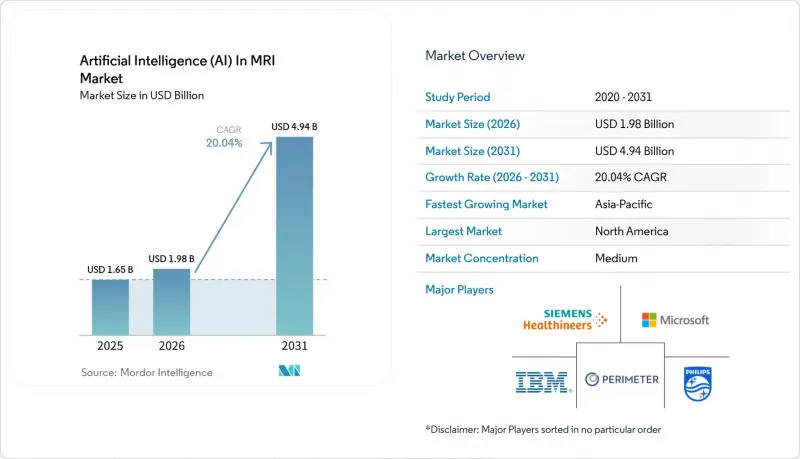
This report Segments the Industry Into by Clinical Applications (Musculoskeletal, Oncology, Liver, Cardiovascular, and More), by Solution (Software, Services), by Technology (Deep Learning, Machine Learning, Computer Vision, and More), by Deployment Type (On-Premise, Cloud-Based), by End Users (Hospitals, Clinics, and More), and Geography (North America, Europe, Asia-Pacific, and More).
Global Artificial Intelligence (AI) In MRI Market Trends and Insights
Reimbursement Shift to New-Technology Add-On Payments
Medicare's expansion of new-technology add-on payments (NTAP) to cover FDA-cleared AI MRI tools turns AI from a discretionary spend into a reimbursable service . Systems now recoup algorithm costs per scan, creating predictable revenue that accelerates enterprise rollouts. Private insurers typically mirror Medicare within 12-18 months, widening the payment pool. Vendors meeting NTAP criteria report faster sales cycles and higher renewal rates. The policy shift especially benefits algorithms that boost diagnostic accuracy, such as stroke triage tools now documenting 21% higher lesion-detection rates.
Multi-Omics Integration Drives Precision Medicine Convergence
AI platforms that fuse MRI radiomics with genomic and proteomic data reach 86.05% accuracy in schizophrenia classification and outperform imaging-only models in therapy response prediction . Oncology centers deploy such solutions to personalize regimens, reducing trial-and-error prescribing. Data governance frameworks and standardized vocabularies are essential to manage cross-modal inputs, enlarging demand for AI middleware. Research consortia in the United States, Japan, and Germany are pooling de-identified multi-omics datasets to refine predictive models. As protocols mature, multi-omics AI is expected to migrate from flagship hospitals to community imaging networks.
Fragmented Image-Data Ownership Impedes Algorithm Generalizability
Medical images remain locked in individual health-system silos, limiting access to diverse datasets needed for robust AI training . Rare-disease models suffer most due to low case volumes. Recent hospital mergers exacerbate silo size without improving sharing. Federated learning can train across sites without moving data, but high compute demands and network latency slow adoption. Industry associations are drafting interoperability charters, yet legal hurdles around secondary data use persist.
Other drivers and restraints analyzed in the detailed report include:
- Advances in Low-Field Portable MRI Expand Access
- Vendor-Neutral Marketplaces Accelerate Algorithm Adoption
- Enterprise-Wide Cloud PACS Migration
- National Screening Programs Standardize AI
- Shortage of Annotated 7-Tesla Datasets
- Cyber-Security and PHI-Compliance Costs
- Opaque Model Explainability Risks Clinical Liability
For complete list of drivers and restraints, kindly check the Table Of Contents.
Segment Analysis
Neurology held 28.04% of the AI in MRI market in 2025 due to mature algorithms for stroke, multiple-sclerosis lesion load, and neurodegenerative disease tracking. Oncology's 21.05% CAGR is poised to narrow the gap as radiogenomic models boost therapy stratification accuracy. Cardiovascular tools automate ejection-fraction measurement with +-3% variance. Musculoskeletal imaging uses AI to grade cartilage degeneration, while prostate algorithms achieve 97.9% sensitivity for clinically significant cancer. The AI in MRI market size for oncology is projected to climb to USD 1.32 billion by 2031 at the segment level, underscoring growth potential.
Neurology vendors focus on acute-stroke triage and longitudinal brain-atrophy quantification, both reimbursed under NTAP. Oncology developers integrate MRI with next-generation sequencing to guide immunotherapy choices. Cardiovascular AI sees broader use as myocardial-perfusion protocols gain insurer coverage. Musculoskeletal models find buyers among sports-medicine clinics seeking point-of-injury decisions. Prostate imaging benefits from active-surveillance programs that favor non-invasive monitoring. Fetal and neonatal applications remain nascent but attract grants targeted at reducing infant morbidity.
Software captured 64.12% AI in MRI market share in 2025, reflecting straightforward deployment via PACS plugins and thin-client viewers. AI in MRI market size for services is growing fastest, supported by 20.31% CAGR tied to implementation consulting and algorithm recalibration. Hardware contributes smaller revenue but is critical to edge inference. Super-resolution reconstructions run on GPUs embedded in scanners, aiding sub-second latency.
Hospitals increasingly sign multi-year managed-service contracts that bundle algorithm updates, uptime guarantees, and on-call clinical scientists. Service providers monitor model drift and retrain quarterly using local data. Hardware makers roll out accelerator cards optimized for mixed-precision compute to cut power consumption by 35%. The interplay of software, hardware, and services creates recurring revenue streams that stabilize vendor cash flows.
Deep learning accounted for 32.35% of the AI in MRI market size in 2025 through convolutional and transformer-based networks that segment tissue and quantify lesions. NLP posts 20.86% CAGR as radiology departments automate report generation and mine unstructured text for follow-up compliance. Classical machine-learning retains value in small-dataset settings, while computer vision pipelines provide image normalization and artifact suppression.
Speech recognition integrated with NLP allows real-time dictation feedback that flags inconsistencies. Federated learning gains traction in multi-site research, using secure aggregation to train joint models without copying data. Vendors blend techniques, embedding NLP outputs into image-based networks to create holistic patient profiles.
Geography Analysis
North America led the AI in MRI market with 45.28% share in 2025, supported by more than 1,000 FDA-cleared imaging algorithms and favorable NTAP reimbursement. Venture capital funding surpassed USD 1.2 billion for MRI-focused AI start-ups between 2023 and 2025, enabling rapid clinical pilots. Large networks such as Sutter Health deployed cloud AI across 27 hospitals, cutting brain MRI read times by 22%. Academic alliances in Canada leverage national compute grids for federated learning, advancing cross-province stroke models.
Asia-Pacific registers the fastest 21.43% CAGR, driven by public-sector investment and large patient datasets. China's regulator approved 59 AI devices through Class III pathways by mid-2024, demonstrating high trust in local AI vendors. Japan funds AI to offset radiologist shortages tied to an aging workforce. South Korea's 5G backbone underpins cloud-first deployments that stream raw k-space data for off-site reconstruction. Australia pilots portable AI-MRI units in remote Indigenous communities.
Europe maintains steady growth aided by the EU AI Act, which classifies medical-device AI as high-risk and mandates quality management systems. Germany's national radiology society publishes AI scorecards for algorithm transparency, boosting clinician confidence. The United Kingdom's NHS AI Lab sponsors trials that integrate MRI AI outputs directly into care-pathway dashboards. Middle East health ministries invest in AI to reduce outbound medical tourism, while Chile and Brazil use public-private partnerships to upgrade imaging fleets.
- IBM
- Siemens Healthineers
- Koninklijke Philips
- GE HealthCare Technologies Inc.
- Samsung Group
- NVIDIA
- Microsoft Corp. (Nuance Communications Inc.)
- Arterys Inc.
- Nanox (Zebra Medical Vision Inc.)
- Median Technologies
- Perspectum Diagnostics Ltd
- Aidoc Medical Ltd
- Viz.ai Inc.
- RapidAI
- Hyperfine
- Canon
- Enlitic Inc.
- Lunit
- Gleamer SAS
- Oxipit UAB
- Paige AI Inc.
- Exo Imaging Inc.
- Blackford Analysis Ltd
- Perimeter Medical Imaging AI
- Resonance Health Ltd
Additional Benefits:
- The market estimate (ME) sheet in Excel format
- 3 months of analyst support
TABLE OF CONTENTS
1 Introduction
- 1.1 Study Assumptions & Market Definition
- 1.2 Scope of the Study
2 Research Methodology
3 Executive Summary
4 Market Landscape
- 4.1 Market Overview
- 4.2 Market Drivers
- 4.2.1 Reimbursement shift to 'new-technology add-on payments' for FDA-cleared AI MRI tools
- 4.2.2 Surging multi-omics datasets requiring imaging-genomics integration
- 4.2.3 Advances in low-field portable MRI expanding point-of-care AI use-cases
- 4.2.4 Vendor-neutral AI marketplaces easing deployment barriers
- 4.2.5 Enterprise-wide cloud PACS migration accelerating AI adoption
- 4.2.6 National cancer-screening programs incorporating AI-assisted MRI
- 4.3 Market Restraints
- 4.3.1 Fragmented image-data ownership impeding algorithm generalizability
- 4.3.2 Shortage of annotated 7-Tesla datasets for ultra-high-field models
- 4.3.3 Cyber-security & PHI-compliance costs for cloud-deployed AI pipelines
- 4.3.4 Opaque model-explainability risking clinical liability
- 4.4 Value / Supply-Chain Analysis
- 4.5 Regulatory Landscape
- 4.6 Technological Outlook
- 4.7 Porter's Five Forces Analysis
- 4.7.1 Threat of New Entrants
- 4.7.2 Bargaining Power of Buyers/Consumers
- 4.7.3 Bargaining Power of Suppliers
- 4.7.4 Threat of Substitute Products
- 4.7.5 Intensity of Competitive Rivalry
5 Market Size & Growth Forecasts
- 5.1 By Clinical Application (Value, USD)
- 5.1.1 Musculoskeletal
- 5.1.2 Oncology
- 5.1.3 Liver
- 5.1.4 Cardiovascular
- 5.1.5 Neurology
- 5.1.6 Prostate
- 5.1.7 Fetal & Neonatal
- 5.1.8 Other Applications
- 5.2 By Solution
- 5.2.1 Software
- 5.2.2 Services
- 5.2.3 Hardware (Edge GPUs & Accelerators)
- 5.3 By Technology
- 5.3.1 Deep Learning
- 5.3.2 Machine Learning (non-deep)
- 5.3.3 Computer Vision
- 5.3.4 Natural Language Processing
- 5.3.5 Speech Recognition
- 5.3.6 Federated Learning
- 5.3.7 Other Emerging AI Technologies
- 5.4 By Deployment Type
- 5.4.1 On-premise
- 5.4.2 Cloud-based
- 5.4.3 Hybrid
- 5.5 By End User
- 5.5.1 Hospitals
- 5.5.2 Diagnostic Imaging Centers
- 5.5.3 Specialty Clinics
- 5.5.4 Ambulatory Surgical Centers
- 5.5.5 Research & Academic Institutes
- 5.6 By MRI Field Strength
- 5.6.1 Low-field (<1.5 T)
- 5.6.2 Mid-field (1.5 T)
- 5.6.3 High-field (3 T)
- 5.6.4 Ultra-High-field (7 T +)
- 5.7 By MRI System Architecture
- 5.7.1 Closed Bore
- 5.7.2 Open MRI
- 5.7.3 Portable / Point-of-Care MRI
- 5.8 By Business Model
- 5.8.1 License / Perpetual
- 5.8.2 Subscription (SaaS)
- 5.8.3 Pay-per-scan
- 5.8.4 AI-as-a-Service
- 5.9 By Geography
- 5.9.1 North America
- 5.9.1.1 United States
- 5.9.1.2 Canada
- 5.9.1.3 Mexico
- 5.9.2 Europe
- 5.9.2.1 Germany
- 5.9.2.2 United Kingdom
- 5.9.2.3 France
- 5.9.2.4 Italy
- 5.9.2.5 Spain
- 5.9.2.6 Rest of Europe
- 5.9.3 Asia-Pacific
- 5.9.3.1 China
- 5.9.3.2 Japan
- 5.9.3.3 India
- 5.9.3.4 South Korea
- 5.9.3.5 Australia
- 5.9.3.6 Rest of Asia-Pacific
- 5.9.4 Middle East
- 5.9.4.1 GCC
- 5.9.4.2 South Africa
- 5.9.4.3 Rest of Middle East
- 5.9.5 South America
- 5.9.5.1 Brazil
- 5.9.5.2 Argentina
- 5.9.5.3 Rest of South America
- 5.9.1 North America
6 Competitive Landscape
- 6.1 Market Concentration
- 6.2 Market Share Analysis
- 6.3 Company Profiles (includes Global level Overview, Market level overview, Core Segments, Financials as available, Strategic Information, Market Rank/Share for key companies, Products & Services, and Recent Developments)
- 6.3.1 IBM Corporation
- 6.3.2 Siemens Healthineers AG
- 6.3.3 Koninklijke Philips NV
- 6.3.4 GE HealthCare Technologies Inc.
- 6.3.5 Samsung Electronics Co. Ltd (Samsung Medison)
- 6.3.6 NVIDIA Corporation
- 6.3.7 Microsoft Corp. (Nuance Communications Inc.)
- 6.3.8 Arterys Inc.
- 6.3.9 Nanox (Zebra Medical Vision Inc.)
- 6.3.10 Median Technologies
- 6.3.11 Perspectum Diagnostics Ltd
- 6.3.12 Aidoc Medical Ltd
- 6.3.13 Viz.ai Inc.
- 6.3.14 RapidAI
- 6.3.15 Hyperfine Inc.
- 6.3.16 Canon Medical Systems Corporation
- 6.3.17 Enlitic Inc.
- 6.3.18 Lunit Inc.
- 6.3.19 Gleamer SAS
- 6.3.20 Oxipit UAB
- 6.3.21 Paige AI Inc.
- 6.3.22 Exo Imaging Inc.
- 6.3.23 Blackford Analysis Ltd
- 6.3.24 Perimeter Medical Imaging AI
- 6.3.25 Resonance Health Ltd
7 Market Opportunities & Future Outlook
- 7.1 White-Space & Unmet-Need Assessment

