PUBLISHER: Mordor Intelligence | PRODUCT CODE: 2065762

PUBLISHER: Mordor Intelligence | PRODUCT CODE: 2065762
Garden Seeds - Market Share Analysis, Industry Trends & Statistics, Growth Forecasts (2026 - 2031)
According to Mordor Intelligence, the garden seeds market size was valued at USD 7.5 billion in 2025 and estimated to grow from USD 7.94 billion in 2026 to reach USD 10.55 billion by 2031, at a CAGR of 5.86% during the forecast period (2026-2031).
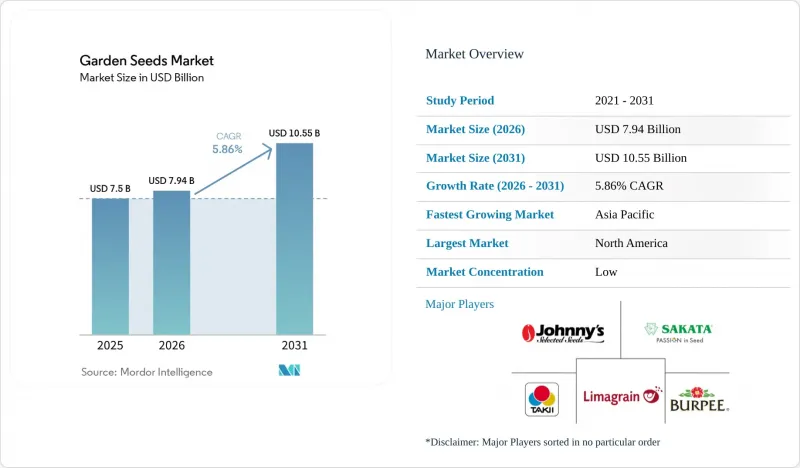
This report is Segmented by Seed Type (Vegetable Seeds, Flowers and Ornamental Seeds, and Fruit Seeds), by Sales Channel (Online Marketplaces, Brand-Owned Webshops, Garden Centers and Nurseries, and More), and by Geography (North America, Europe, Asia-Pacific, South America, Middle East, and Africa). The Market Forecasts are Provided in Terms of Value (USD).
Global Garden Seeds Market Trends and Insights
Rising Interest in Home Gardening and Urban Farming
Consumer preference for fresh, hyper-local produce intertwines with sustainability goals, leading municipalities to relax zoning rules for rooftop farms and community plots. Vertical farming kits designed for balconies broaden participation beyond suburban settings, while commercial kitchens integrate on-site greens to lower procurement costs and food miles. Millennials and Gen Z value transparency in food supply, spurring seed demand for pesticide-free, Non-GMO cultivars. Retailers respond with starter bundles that combine seed, substrate, and digital coaching apps. The segment's medium-term influence is reinforced by inflationary pressure on fresh produce, encouraging households to offset grocery bills through home harvests.
Expanding E-commerce and Online Seed Subscriptions
Seed brands leverage live chat agronomy support, augmented-reality garden planners, and AI recommendation engines to lift conversion rates. An omnichannel model that offers curbside pickup for bulky soil accessories while shipping small-packet seeds improves last-mile economics. Subscription boxes deliver season-appropriate assortments, fostering repeat purchases and predictable revenue. Data captured from order frequency and varietal preferences informs breeders' Research and Development pipelines, shortening the feedback loop between trial introduction and commercial launch. Salesforce reported a 16% merchandise value jump after deploying tailored content journeys for a leading the United States seed vendor.
Major Pest and Disease Outbreaks in Seed Crops
Fusarium graminearum alone inflicts USD 1 billion in annual crop losses, forcing producers to discard infected seed lots and tighten phytosanitary inspection regimes. Climate-driven shifts in humidity expand the pathogen's geographic reach, elevating fungicide usage and testing costs that ultimately flow into retail seed pricing. Biosecurity agencies intensify border checks, elongating lead times for international seed shipments and prompting growers to favor locally multiplied stock where possible.
Other drivers and restraints analyzed in the detailed report include:
- Government Incentives for Domestic Seed Multiplication
- Boom in Micro-greens and Edible Ornamentals Trend
- High Research and Development Cost for Premium, Disease-Free Seed Lines
For complete list of drivers and restraints, kindly check the Table Of Contents.
Segment Analysis
Vegetable seeds captured 58.02% of the garden seeds market in 2025 as households prioritized pantry staples that assure daily meal coverage. Tomato varieties alone are projected to touch USD 1.95 billion by 2031 at a 4.55% CAGR, driven by dual use in fresh salads and sauce processing. Herbs and leafy greens profit from micro-green applications that enable countertop production in high-density urban apartments. The garden seeds market size for vegetable cultivars is forecast to widen in tandem with recipe-sharing social platforms that spur varietal experimentation. Fruit seeds, though smaller in absolute terms, register the fastest 7.72% CAGR. Tropical berries and melons attract hobbyists seeking novel flavors, while dragon fruit and passion fruit seeds sell at premium packet prices due to limited domestic supply chains. This segment diversifies revenue and buffers seasonal swings inherent to annual vegetable cycles.
The demand shift introduces breeding imperatives for compact, container-friendly phenotypes that suit balconies and indoor grow lights. Heirloom strains regain popularity among eco-conscious consumers seeking biodiversity conservation. Concurrently, the garden seeds market share held by open-pollinated lines shrinks modestly as hybrid vigor appeals to yield-oriented gardeners.
Geography Analysis
North America held 32.21% revenue leadership in 2025 on the back of hobby-gardening traditions, robust logistics, and favorable intellectual property enforcement. Diverse microclimates foster regional testing programs that accelerate new-variety acceptance among both professionals and hobbyists. State universities partner with seed companies to publish extension bulletins, reinforcing evidence-based cultivar selection.
Asia-Pacific, posting a 6.88% CAGR, emerges as the primary growth engine. China's renewed subsidy framework for local seed enterprises reduces import dependence and boosts research into heat-tolerant horticultural crops. India channels public funds into breeder seed multiplication and village-level distribution networks, elevating certified seed penetration among smallholders. The garden seeds market size in the region scales further as urban rooftop farms proliferate and consumers shift toward antioxidant-rich fruits in response to lifestyle disease prevalence.
Europe records steady mid-single-digit growth anchored in sustainability mandates and organic certification uptake. The Netherlands, Spain, and Italy supply a substantial portion of global vegetable seed exports, leveraging technologically advanced greenhouse seed production hubs. Regulatory uncertainty around gene-edited crops prompts breeders to invest in conventional marker-assisted selection techniques. Eastern European markets provide expansion headroom as rising disposable incomes stimulate DIY gardening spending. Multilateral development banks finance seed laboratory upgrades and farmer demonstration plots, laying the groundwork for demand expansion once macroeconomic volatility eases.
- Groupe Limagrain (Vilmorin Jardin)
- Sakata Seed Corporation
- Takii & Co., Ltd.
- Johnny's Selected Seeds
- Territorial Seed Company
- West Coast Seeds
- BVG Group (Thompson & Morgan)
- Seed Savers Exchange
- W. Atlee Burpee Company
- Italian Garden Seeds
- Baker Creek Heirloom Seeds
- Bayer AG
- True Leaf Market Seed Company
- Ferry-Morse
- Growmark, Inc. (Select Seeds)
Additional Benefits:
- The market estimate (ME) sheet in Excel format
- 3 months of analyst support
TABLE OF CONTENTS
1 Introduction
- 1.1 Study Assumptions and Market Definition
- 1.2 Scope of the Study
2 Research Methodology
3 Executive Summary
4 Market Landscape
- 4.1 Market Overview
- 4.2 Market Drivers
- 4.2.1 Rising interest in home gardening and urban farming
- 4.2.2 Expanding e-commerce and online seed subscriptions
- 4.2.3 Government incentives for domestic seed multiplication
- 4.2.4 Boom in micro-greens and edible ornamentals trend
- 4.2.5 AI-powered seed-choice platforms boosting sales conversion
- 4.2.6 Demand for climate-resilient heirloom cultivars
- 4.3 Market Restraints
- 4.3.1 Major pest and disease outbreaks in seed crops
- 4.3.2 High Research and Development cost for premium, disease-free seed lines
- 4.3.3 Escalating genetic-patent litigation risks
- 4.3.4 Declining pollinator populations hurting open-pollinated seed set
- 4.4 Regulatory Landscape
- 4.5 Technological Outlook
- 4.6 Porter's Five Forces
- 4.6.1 Threat of New Entrants
- 4.6.2 Bargaining Power of Buyers/Consumers
- 4.6.3 Bargaining Power of Suppliers
- 4.6.4 Threat of Substitute Products
- 4.6.5 Intensity of Competitive Rivalry
5 Market Size and Growth Forecasts (Value)
- 5.1 By Seed Type
- 5.1.1 Vegetable Seeds
- 5.1.1.1 Tomato
- 5.1.1.2 Cucumber
- 5.1.1.3 Carrot
- 5.1.1.4 Pepper and Chili
- 5.1.1.5 Leafy Greens
- 5.1.1.6 Culinary Herbs
- 5.1.1.7 Other Vegetable Seeds (Eggplant, Squash, etc.)
- 5.1.2 Flower and Ornamental Seeds
- 5.1.2.1 Annuals
- 5.1.2.2 Perennials
- 5.1.2.3 Bulbous Flower Seeds
- 5.1.3 Fruit Seeds
- 5.1.3.1 Berries
- 5.1.3.2 Melons
- 5.1.3.3 Tropical and Exotic Fruits
- 5.1.1 Vegetable Seeds
- 5.2 By Sales Channel
- 5.2.1 Online Marketplaces
- 5.2.2 Brand-Owned Webshops
- 5.2.3 Garden Centers and Nurseries
- 5.2.4 Specialty Seed Stores
- 5.2.5 DIY/Home-Improvement Chains
- 5.2.6 Grocery and Mass Retail
- 5.3 By Geography
- 5.3.1 North America
- 5.3.1.1 United States
- 5.3.1.2 Canada
- 5.3.1.3 Mexico
- 5.3.1.4 Rest of North America
- 5.3.2 Europe
- 5.3.2.1 Germany
- 5.3.2.2 United Kingdom
- 5.3.2.3 France
- 5.3.2.4 Spain
- 5.3.2.5 Russia
- 5.3.2.6 Rest of Europe
- 5.3.3 Asia-Pacific
- 5.3.3.1 China
- 5.3.3.2 India
- 5.3.3.3 Japan
- 5.3.3.4 Australia
- 5.3.3.5 Rest of Asia-Pacific
- 5.3.4 South America
- 5.3.4.1 Brazil
- 5.3.4.2 Argentina
- 5.3.4.3 Colombia
- 5.3.4.4 Chile
- 5.3.4.5 Peru
- 5.3.4.6 Rest of South America
- 5.3.5 Middle East
- 5.3.5.1 Turkey
- 5.3.5.2 Saudi Arabia
- 5.3.5.3 United Arab Emirates
- 5.3.5.4 Rest of Middle East
- 5.3.6 Africa
- 5.3.6.1 South Africa
- 5.3.6.2 Kenya
- 5.3.6.3 Nigeria
- 5.3.6.4 Rest of Africa
- 5.3.1 North America
6 Competitive Landscape
- 6.1 Market Concentration
- 6.2 Strategic Moves
- 6.3 Market Share Analysis
- 6.4 Company Profiles (includes Global level Overview, Market level overview, Core Segments, Financials as available, Strategic Information, Market Rank/Share for key companies, Products and Services, and Recent Developments)
- 6.4.1 Groupe Limagrain (Vilmorin Jardin)
- 6.4.2 Sakata Seed Corporation
- 6.4.3 Takii & Co., Ltd.
- 6.4.4 Johnny's Selected Seeds
- 6.4.5 Territorial Seed Company
- 6.4.6 West Coast Seeds
- 6.4.7 BVG Group (Thompson & Morgan)
- 6.4.8 Seed Savers Exchange
- 6.4.9 W. Atlee Burpee Company
- 6.4.10 Italian Garden Seeds
- 6.4.11 Baker Creek Heirloom Seeds
- 6.4.12 Bayer AG
- 6.4.13 True Leaf Market Seed Company
- 6.4.14 Ferry-Morse
- 6.4.15 Growmark, Inc. (Select Seeds)
7 Market Opportunities and Future Outlook

