PUBLISHER: Mordor Intelligence | PRODUCT CODE: 2065769

PUBLISHER: Mordor Intelligence | PRODUCT CODE: 2065769
Industrial Distribution - Market Share Analysis, Industry Trends & Statistics, Growth Forecasts (2026 - 2031)
According to Mordor Intelligence, the industrial distribution market size was valued at USD 8.43 trillion in 2025 and estimated to grow from USD 8.88 trillion in 2026 to reach USD 11.53 trillion by 2031, at a CAGR of 5.35% during the forecast period (2026-2031).
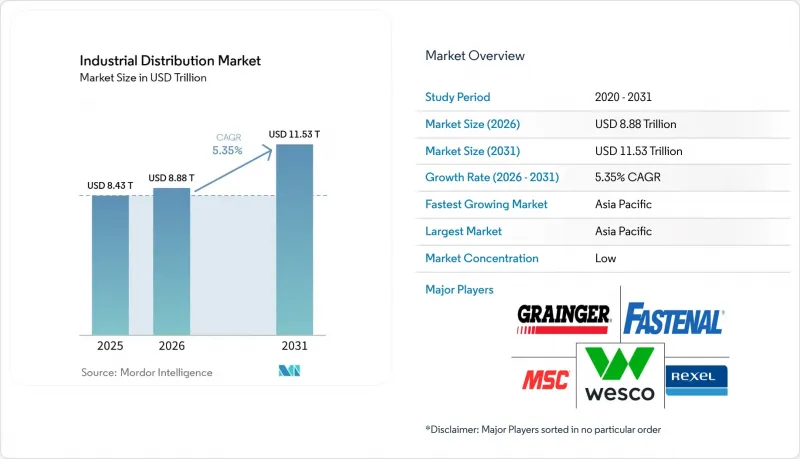
This report is Segmented by Product (Electrical Supplies, Fasteners, HVAC Equipment, and More), Distribution Channel (Offline (Branch / Inside Sales), and More), End-User Industry (Manufacturing, Construction and Infrastructure, and More), and by Geography. The Market Forecasts are Provided in Terms of Value (USD).
Global Industrial Distribution Market Trends and Insights
Industrial IoT and automation adoption
Real-time asset monitoring enables distributors to shift from reactive order fulfillment to data-driven replenishment services. Edge computing paired with predictive analytics cuts unplanned downtime and aligns stocking levels with machine health signals. Siemens' industrial foundation models illustrate how generative AI shortens engineering cycles and unlocks service revenue for distributors who bridge OEM platforms with factory users. Investments in connected sensors also pull through demand for high-precision electrical components and secure networking gear.
Infrastructure megaproject pipelines
A USD 2 trillion project slate in the United States and USD 1.5 trillion earmarked by China for smart infrastructure are translating into bulk orders for power cables, switchgear, and construction consumables. Distributors with project-management support and just-in-time delivery capabilities win large supply contracts. Southeast Asia adds momentum as governments accelerate airport, rail, and renewable energy builds, which favor distributors offering regional inventory and technical assistance.
Commodity-price volatility
Steel prices can fluctuate 15-20% within a quarter, forcing dynamic pricing and hedge strategies to avoid inventory write-downs. Customers delay orders when prices fall, inflating distributor stock and tying up cash. Energy price swings further complicate freight budgeting and demand planning.
Other drivers and restraints analyzed in the detailed report include:
- E-commerce-led MRO fulfillment boom
- Stricter workplace-safety regulations
- Global logistics cost inflation
For complete list of drivers and restraints, kindly check the Table Of Contents.
Segment Analysis
Electrical supplies contributed 26.97% of 2025 revenue, confirming their importance in power grid upgrades and data-center builds. The industrial distribution market size for electrical supplies is expected to climb steadily as renewable energy connections and factory automation lift unit demand. Safety and PPE products, growing at 9.38% CAGR, benefit from global safety mandates and corporate risk mitigation, while industrial fasteners and HVAC equipment ride steady construction starts and infrastructure upgrades.
Material-handling systems are attracting investment as e-commerce fulfillment pushes warehouses toward automation. Bearings and power-transmission parts see resilient MRO demand tied to predictive maintenance schedules. Lubricants face substitution by synthetics with longer drain intervals, yet digital condition-monitoring still spurs timely replenishment. Connected tools and instruments blend mechanical precision with cloud analytics, widening distributor service scopes.
Geography Analysis
Asia-Pacific held 36.21% revenue in 2025 and is set to compound at 8.55% CAGR through 2031 on the back of USD 10 trillion in Chinese manufacturing output and India's double-digit chemicals expansion. Growing regional supply-chain diversification into Southeast Asia strengthens cross-border distribution flows. Local distributors gain advantage from multilingual support and familiarity with varying regulatory codes.
North America represents a mature yet innovation-driven arena. Grainger's USD 17.2 billion 2024 sales underscore scale efficiencies and the region's appetite for e-commerce-enabled procurement. Manufacturers' 85% AI adoption plans lift demand for connected components, while infrastructure legislation channels capital into grid and broadband upgrades. Commodity swings and freight inflation motivate reshoring and regional warehousing.
Europe faces transformational policy pressures. The Carbon Border Adjustment Mechanism will raise imported steel costs by about 16.19% per ton by 2026, prompting distributors to stock regionally and source lower-emission materials. Sonepar's USD 2 billion acquisition spree in 2024 highlights ongoing consolidation aimed at scale gains and broader service portfolios. Sustainability goals spur interest in energy-efficient products and circular-economy offerings.
The Middle East and Africa record incremental gains from industrial diversification plans, while Latin America draws spending into mining infrastructure and auto manufacturing. Currency volatility and political instability remain watchpoints, but long-term infrastructure gaps present growth headroom for distributors with robust risk-management capabilities.
- W.W. Grainger Inc.
- Fastenal Company
- WESCO International Inc.
- MSC Industrial Direct Co. Inc.
- Airgas Inc.
- Motion Industries Inc.
- Winsupply Inc.
- Applied Industrial Technologies Inc.
- MRC Global Inc.
- Sonepar USA
- Rexel Group
- Graybar Electric Co.
- HD Supply (HD Inc.)
- Anixter International
- Ferguson PLC
- Bisco Industries
- Kimball Midwest
- DistributionNOW
- Bunzl PLC
- Lawson Products Inc.
- Endries International
- Grainger MonotaRO (Japan)
Additional Benefits:
- The market estimate (ME) sheet in Excel format
- 3 months of analyst support
TABLE OF CONTENTS
1 INTRODUCTION
- 1.1 Study Assumptions and Market Definition
- 1.2 Scope of the Study
2 RESEARCH METHODOLOGY
3 EXECUTIVE SUMMARY
4 MARKET LANDSCAPE
- 4.1 Market Overview
- 4.2 Market Drivers
- 4.2.1 Industrial IoT and Automation adoption
- 4.2.2 Infrastructure megaproject pipelines
- 4.2.3 E-commerce-led MRO fulfillment boom
- 4.2.4 Stricter workplace-safety regulations
- 4.2.5 OEM-distributor API-based auto-replenishment
- 4.2.6 Carbon border adjustments push regional inventory hubs
- 4.3 Market Restraints
- 4.3.1 Commodity-price volatility
- 4.3.2 Global logistics cost inflation
- 4.3.3 OEM risk-sharing contracts squeeze margins
- 4.3.4 OEM direct e-commerce channel cannibalization
- 4.4 Supply-Chain Analysis
- 4.5 Regulatory Landscape
- 4.6 Technological Outlook
- 4.7 Porter's Five Forces
- 4.7.1 Threat of New Entrants
- 4.7.2 Bargaining Power of Suppliers
- 4.7.3 Bargaining Power of Buyers
- 4.7.4 Threat of Substitutes
- 4.7.5 Industry Rivalry
- 4.8 Industry Value Chain Analysis
- 4.9 Macroeconomic Trend Impact Assessment
5 MARKET SIZE AND GROWTH FORECASTS (VALUE)
- 5.1 By Product
- 5.1.1 Electrical Supplies
- 5.1.2 Fasteners
- 5.1.3 HVAC Equipment
- 5.1.4 Safety and PPE Supplies
- 5.1.5 Material Handling and Packaging
- 5.1.6 Power Transmission and Bearings
- 5.1.7 Industrial Fluids and Lubricants
- 5.1.8 Tools and Instruments
- 5.1.9 Other Products
- 5.2 By Distribution Channel
- 5.2.1 Offline (Branch / Inside Sales)
- 5.2.2 Online / E-commerce Platforms
- 5.3 By End-user Industry
- 5.3.1 Manufacturing
- 5.3.2 Construction and Infrastructure
- 5.3.3 Energy and Utilities
- 5.3.4 Mining and Metals
- 5.3.5 Chemicals and Process
- 5.3.6 Transportation and Warehousing
- 5.3.7 Healthcare and Pharmaceuticals
- 5.3.8 Others
- 5.4 By Geography
- 5.4.1 North America
- 5.4.1.1 United States
- 5.4.1.2 Canada
- 5.4.1.3 Mexico
- 5.4.2 South America
- 5.4.2.1 Brazil
- 5.4.2.2 Argentina
- 5.4.2.3 Rest of South America
- 5.4.3 Europe
- 5.4.3.1 United Kingdom
- 5.4.3.2 Germany
- 5.4.3.3 France
- 5.4.3.4 Italy
- 5.4.3.5 Spain
- 5.4.3.6 Russia
- 5.4.3.7 Rest of Europe
- 5.4.4 Asia-Pacific
- 5.4.4.1 China
- 5.4.4.2 India
- 5.4.4.3 Japan
- 5.4.4.4 South Korea
- 5.4.4.5 Australia and New Zealand
- 5.4.4.6 Southeast Asia
- 5.4.4.7 Rest of Asia-Pacific
- 5.4.5 Middle East and Africa
- 5.4.5.1 Middle East
- 5.4.5.1.1 Saudi Arabia
- 5.4.5.1.2 United Arab Emirates
- 5.4.5.1.3 Turkey
- 5.4.5.1.4 Rest of Middle East
- 5.4.5.2 Africa
- 5.4.5.2.1 South Africa
- 5.4.5.2.2 Nigeria
- 5.4.5.2.3 Kenya
- 5.4.5.2.4 Rest of Africa
- 5.4.5.1 Middle East
- 5.4.1 North America
6 COMPETITIVE LANDSCAPE
- 6.1 Market Concentration
- 6.2 Strategic Moves
- 6.3 Market Share Analysis
- 6.4 Company Profiles (includes Global level Overview, Market level overview, Core Segments, Financials as available, Strategic Information, Market Rank/Share, Products and Services, Recent Developments)
- 6.4.1 W.W. Grainger Inc.
- 6.4.2 Fastenal Company
- 6.4.3 WESCO International Inc.
- 6.4.4 MSC Industrial Direct Co. Inc.
- 6.4.5 Airgas Inc.
- 6.4.6 Motion Industries Inc.
- 6.4.7 Winsupply Inc.
- 6.4.8 Applied Industrial Technologies Inc.
- 6.4.9 MRC Global Inc.
- 6.4.10 Sonepar USA
- 6.4.11 Rexel Group
- 6.4.12 Graybar Electric Co.
- 6.4.13 HD Supply (HD Inc.)
- 6.4.14 Anixter International
- 6.4.15 Ferguson PLC
- 6.4.16 Bisco Industries
- 6.4.17 Kimball Midwest
- 6.4.18 DistributionNOW
- 6.4.19 Bunzl PLC
- 6.4.20 Lawson Products Inc.
- 6.4.21 Endries International
- 6.4.22 Grainger MonotaRO (Japan)
7 MARKET OPPORTUNITIES AND FUTURE OUTLOOK
- 7.1 White-space and Unmet-Need Assessment

