PUBLISHER: Mordor Intelligence | PRODUCT CODE: 2065776

PUBLISHER: Mordor Intelligence | PRODUCT CODE: 2065776
Cloud Security Posture Management - Market Share Analysis, Industry Trends & Statistics, Growth Forecasts (2026 - 2031)
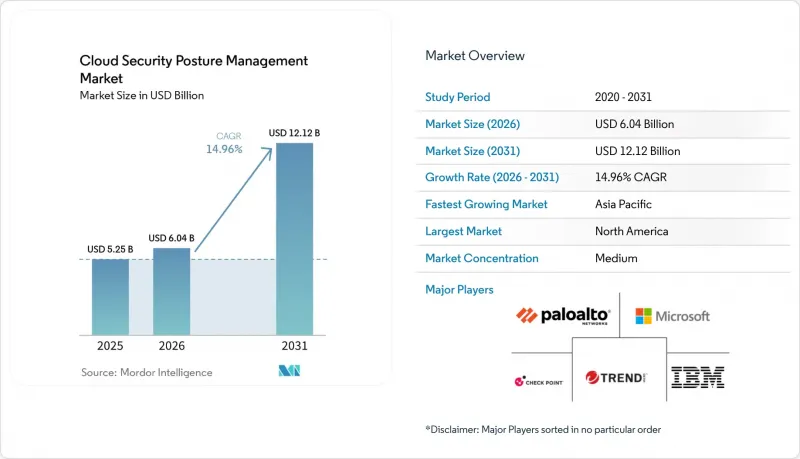
According to Mordor Intelligence, the cloud security posture management market size is projected to expand from USD 5.25 billion in 2025 and USD 6.04 billion in 2026 to USD 12.12 billion by 2031, registering a CAGR of 14.96% between 2026 to 2031.
This report is Segmented by Component (Solutions, and Services), Cloud Model (Infrastructure As A Service (IaaS), Platform As A Service (PaaS), and More), Deployment Mode (Public Cloud, Private Cloud, and More), Organization Size (Large Enterprises, and SMEs), Industry Vertical (BFSI, Healthcare, Manufacturing, and More), and Geography. The Market Forecasts are Provided in Terms of Value (USD).
Global Cloud Security Posture Management Market Trends and Insights
Integration of CSPM into Cloud-Native Application Protection Platform (CNAPP) ecosystems
cloud security posture management is rapidly shifting from a standalone dashboard to a foundational module inside unified CNAPP suites, a change that relieves security teams from juggling overlapping consoles and policies. Aqua Security's decision to ship posture analytics alongside container and workload controls shows how a single policy plane can now trace misconfigurations from build to runtime This evolution is driving growth in the cloud security posture management market,Organizations deploying converged platforms report materially lower mean-time-to-remediate because alerts arrive already correlated with asset context and exploit pathways. The same console also pushes guardrails back into developer pipelines, which curbs drift before it reaches production resources. Integrations with identity governance modules further reduce hidden attack surfaces by exposing privilege creep inside cloud accounts. Collectively, these changes tighten the feedback loop between DevOps and SecOps and raise the switching costs for point-product providers.
Rise of AI-assisted auto-remediation engines
Artificial-intelligence tooling now reads configuration graphs, ranks findings by business impact, and triggers fixes through Infrastructure-as-Code pull requests. Early adopters note that auto-generated remediation often cuts the backlog of open cloud alerts in half during the first 90 days of use. Deterministic policy engines reduce human error by proposing precise JSON or YAML changes instead of generalized best-practice advice. The approach counters the global cloud-security skills gap and frees senior analysts to focus on threat hunting, For providers, remediation depth becomes a clear differentiator because customers evaluate not just what the platform detects but how quickly it can act without manual approval loops. Vendors that own both the analytics layer and the automation workflow gain further stickiness through proprietary machine-learning models that improve with tenant data volume.
Alert fatigue and skills shortage in SecOps teams
The very success of cloud security posture management in surfacing risk has overwhelmed many security operations centers. Enterprises often receive thousands of posture alerts per day and cannot hire analysts fast enough to triage them. Fortinet field data show that even large teams investigate only a fraction of daily findings, leaving misconfigurations unaddressed and eroding trust in the tooling. Automation alleviates part of the burden, yet significant expertise remains necessary to tune policies and integrate fixes into CI/CD pipelines. As a result, managed-service options grow in popularity, but their cost pressures smaller businesses already coping with tight cybersecurity budgets.
Other drivers and restraints analyzed in the detailed report include:
- Expansion of zero-trust and shared-responsibility audits
- Regulatory push for real-time cloud-configuration reporting
- Tool overlap with CWPP and CIEM creating budget friction
For complete list of drivers and restraints, kindly check the Table Of Contents.
Segment Analysis
Solutions segment retained 66.45% share of the Cloud Security Posture Management market in 2025, confirming that detection and reporting remain the entry point for most buyers. Yet the Services category is expanding at 15.12% CAGR through 2031 as enterprises confront the operational complexity of turning alerts into lasting policy change. Managed-service partners offer continuous tuning, custom rule engineering, and 24X7 triage, activities that many teams lack the internal bandwidth to perform. The surge in service contracts also reflects growing demand for posture assessments prior to mergers or compliance certifications, a niche that consulting firms are quick to monetize. Platform vendors therefore boost service alliances or build in-house advisory teams to prevent revenue leakage.
The widening skills gap further fuels service uptake, particularly among mid-market organizations that cannot afford full-time cloud-security architects. Providers that deliver packaged offerings with outcome-based pricing-rather than hourly billing-gain traction because they map directly to risk-reduction goals. Over the forecast horizon, integration services for AI-driven remediation should see the fastest growth, given that deterministic policy engines require careful governance to avoid unintended configuration changes in production environments.
Infrastructure as a Service environments held 48.92% share of the Cloud Security Posture Management market in 2025, underscoring the historical dominance of virtual-machine and container workloads. However, SaaS resources will log the highest 15.2% CAGR because business units continue to adopt productivity suites, CRM platforms, and collaboration tools that store sensitive data outside the traditional perimeter. SaaS Security Posture Management modules plug this gap by scanning tenant-level settings, unused API tokens, and excessive sharing links. Enterprises adopting these capabilities note rapid risk reduction when orphaned accounts and third-party integrations are disabled.
Platform as a Service also enters mainstream consideration as serverless and managed database services proliferate. Here, posture management must understand ephemeral functions and context-aware least privilege, tasks poorly addressed by legacy scrapers that assume persistent servers. Vendors that expose consistent policy languages across IaaS, PaaS, and SaaS win executive support by curbing the operational burden of three separate tooling stacks. The shift cements the perception of cloud security posture management as a universal control layer spanning the full spectrum of cloud-delivery models.
Geography Analysis
North America retained 35.02% revenue share in 2025 owing to mature cloud adoption, a dense concentration of security vendors, and stringent frameworks such as FedRAMP that push agencies and contractors to maintain documented configuration baselines. Continued federal investment in zero-trust programs sustains platform spending, while a healthy venture ecosystem funds disruptive start-ups that introduce AI-native remediation features. Canadian enterprises increasingly align with U.S. security standards, enabling cross-border managed-service deals that lift regional revenue.
Asia-Pacific will deliver the fastest regional CAGR at 15.55% as governments legislate data-localization practices and provide tax incentives for local cloud datacenter builds. Large-scale national digitization projects in Japan, India, and Australia embed cloud-security posture reporting in procurement guidelines, effectively mandating tool deployment in state-backed workloads. Meanwhile, the Malaysian Cyber Security Act of 2024 requires continuous monitoring for critical-sector operators, accelerating vendor entry into Southeast Asian markets and creating channel opportunities for local systems integrators.
Europe exhibits a complex compliance landscape anchored by GDPR and newly adopted artificial-intelligence regulations that demand transparency in algorithmic decision-making. Enterprises thus seek posture dashboards that can produce multi-jurisdiction audit trails on demand. Germany and France spearhead sovereign-cloud initiatives that call for in-country data processing, prompting providers to launch EU-only hosting zones. In parallel, the United Kingdom's post-Brexit regulatory divergence drives demand for dual compliance mappings, which favors platforms with flexible policy engines. Latin America, the Middle East, and Africa remain nascent but attractive expansion territories as hyperscaler region launches bring modern APIs within reach of local businesses.
- Palo Alto Networks
- Check Point Software Technologies
- Microsoft
- Trend Micro
- IBM
- Fortinet
- McAfee
- AWS
- Oracle
- Qualys
- Wiz
- Orca Security
- Lacework
- Aqua Security
- Tenable
- Cisco Systems
- VMware
- CrowdStrike
- Zscaler
- Rapid7
Additional Benefits:
- The market estimate (ME) sheet in Excel format
- 3 months of analyst support
TABLE OF CONTENTS
1 INTRODUCTION
- 1.1 Study Assumptions and Market Definition
- 1.2 Scope of the Study
2 RESEARCH METHODOLOGY
3 EXECUTIVE SUMMARY
4 MARKET LANDSCAPE
- 4.1 Market Overview
- 4.2 Market Drivers
- 4.2.1 Integration of CSPM into Cloud Native Application Protection Platform (CNAPP) platforms
- 4.2.2 Rise of AI-assisted auto-remediation engines
- 4.2.3 Expansion of zero-trust and shared-responsibility audits
- 4.2.4 Regulatory push for real-time cloud-config reporting
- 4.2.5 Multi-cloud sprawl in mid-market enterprises
- 4.2.6 Insurance-driven security scorecard requirements
- 4.3 Market Restraints
- 4.3.1 Alert-fatigue and skills shortage in SecOps teams
- 4.3.2 Tool overlap with CWPP / CIEM creating budget friction
- 4.3.3 Limited API depth for some SaaS/PaaS providers
- 4.3.4 Data-residency barriers in sovereign-cloud projects
- 4.4 Value / Supply-Chain Analysis
- 4.5 Regulatory and Compliance Landscape
- 4.6 Technological Outlook
- 4.7 Porter's Five Forces Analysis
- 4.7.1 Bargaining Power of Suppliers
- 4.7.2 Bargaining Power of Consumers
- 4.7.3 Threat of New Entrants
- 4.7.4 Threat of Substitutes
- 4.7.5 Intensity of Competitive Rivalry
5 MARKET SIZE AND GROWTH FORECASTS (VALUES)
- 5.1 By Component
- 5.1.1 Solutions
- 5.1.2 Services
- 5.2 By Cloud Model
- 5.2.1 Infrastructure as a Service (IaaS)
- 5.2.2 Platform as a Service (PaaS)
- 5.2.3 Software as a Service (SaaS)
- 5.3 By Deployment Mode
- 5.3.1 Public Cloud
- 5.3.2 Private Cloud
- 5.3.3 Hybrid Cloud
- 5.4 By Organization Size
- 5.4.1 Large Enterprises
- 5.4.2 Small and Medium Enterprises (SMEs)
- 5.5 By Industry Vertical
- 5.5.1 Banking Finance Services and Insurances (BFSI)
- 5.5.2 Healthcare
- 5.5.3 Retail and E-commerce
- 5.5.4 IT and Telecommunication
- 5.5.5 Government and Public Sector
- 5.5.6 Education
- 5.5.7 Manufacturing
- 5.5.8 Others
- 5.6 By Geography
- 5.6.1 North America
- 5.6.1.1 United States
- 5.6.1.2 Canada
- 5.6.1.3 Mexico
- 5.6.2 Europe
- 5.6.2.1 Germany
- 5.6.2.2 United Kingdom
- 5.6.2.3 France
- 5.6.2.4 Italy
- 5.6.2.5 Spain
- 5.6.2.6 Russia
- 5.6.2.7 Rest of Europe
- 5.6.3 Asia-Pacific
- 5.6.3.1 China
- 5.6.3.2 Japan
- 5.6.3.3 India
- 5.6.3.4 South Korea
- 5.6.3.5 Australia and New Zealand
- 5.6.3.6 Rest of Asia-Pacific
- 5.6.4 South America
- 5.6.4.1 Brazil
- 5.6.4.2 Argentina
- 5.6.4.3 Rest of South America
- 5.6.5 Middle East and Africa
- 5.6.5.1 Middle East
- 5.6.5.1.1 United Arab Emirates
- 5.6.5.1.2 Saudi Arabia
- 5.6.5.1.3 Turkey
- 5.6.5.1.4 Rest of Middle East
- 5.6.5.2 Africa
- 5.6.5.2.1 South Africa
- 5.6.5.2.2 Nigeria
- 5.6.5.2.3 Rest of Africa
- 5.6.5.1 Middle East
- 5.6.1 North America
6 COMPETITIVE LANDSCAPE
- 6.1 Market Concentration
- 6.2 Strategic Moves
- 6.3 Market Share Analysis
- 6.4 Company Profiles (includes Global level Overview, Market level overview, Core Segments, Financials as available, Strategic Information, Market Rank/Share for key companies, Products and Services, and Recent Developments)
- 6.4.1 Palo Alto Networks
- 6.4.2 Check Point Software Technologies
- 6.4.3 Microsoft
- 6.4.4 Trend Micro
- 6.4.5 IBM
- 6.4.6 Fortinet
- 6.4.7 McAfee
- 6.4.8 AWS
- 6.4.9 Oracle
- 6.4.10 Qualys
- 6.4.11 Wiz
- 6.4.12 Orca Security
- 6.4.13 Lacework
- 6.4.14 Aqua Security
- 6.4.15 Tenable
- 6.4.16 Cisco Systems
- 6.4.17 VMware
- 6.4.18 CrowdStrike
- 6.4.19 Zscaler
- 6.4.20 Rapid7
7 MARKET OPPORTUNITIES AND FUTURE OUTLOOK
- 7.1 White-space and Unmet Need Analysis

