PUBLISHER: Mordor Intelligence | PRODUCT CODE: 2065787

PUBLISHER: Mordor Intelligence | PRODUCT CODE: 2065787
Luo Han Guo - Market Share Analysis, Industry Trends & Statistics, Growth Forecasts (2026 - 2031)
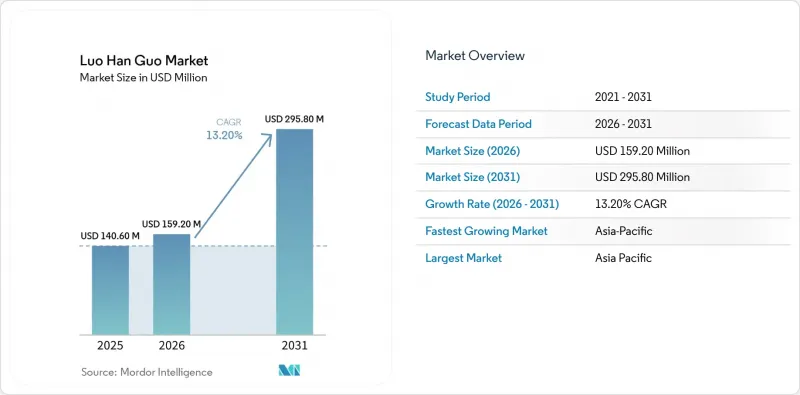
According to Mordor Intelligence, the luo han guo market size is projected to grow from USD 140.6 million in 2025 to USD 159.20 million in 2026, reaching USD 295.80 million by 2031, with a CAGR of 13.2% during the period 2026-2031.
This report is Segmented by Geography (North America, South America, Europe, Asia-Pacific, and More). The Report Includes Production Analysis (Volume), Consumption Analysis (Value and Volume), Import Analysis (Value and Volume), Export Analysis (Value and Volume), Wholesale Price Trend Analysis and Forecast, and More. The Market Forecasts are Provided in Terms of Value (USD) and Volume (Metric Tons)
Global Luo Han Guo Market Trends and Insights
Clean-Label Demand for Zero-Calorie Sweeteners
According to the International Food Information Council's 2025 Food and Health Survey, 34% of consumers consider "low in sugar" a key attribute of healthy food, highlighting a significant shift toward reduced sugar consumption. This trend is driving increased demand for natural, zero-calorie sweeteners like monk fruit (Luo Han Guo), as manufacturers reformulate products to meet clean-label requirements. The focus on sugar reduction is also prompting the replacement of artificial sweeteners with plant-based alternatives, particularly in beverages and snacks, emphasizing monk fruit's role in providing both functionality and label transparency in evolving product formulations.
Rising Prevalence of Diabetes and Obesity
According to the International Diabetes Federation, 589 million adults aged 20-79 were living with diabetes globally in 2024, underscoring the growing need for sugar-controlled diets. This increasing prevalence of diabetes is driving demand for low-glycemic, zero-calorie sweeteners such as luo han guo, as both consumers and manufacturers prioritize healthier sugar alternatives. As a result, food and beverage companies are reformulating products, particularly functional beverages and diet-focused offerings, to meet metabolic health requirements. This trend highlights monk fruit's expanding role in addressing dietary changes driven by concerns about diabetes and obesity.
Cultivation Confined Largely to Guangxi and Hunan Provinces
The extreme geographic concentration of cultivation continues to be a significant limitation for the Luo Han Guo market, restricting supply scalability and increasing susceptibility to regional disruptions. According to the researchers of the University of Melbourne, as of 2024, over 90% of monk fruit production is concentrated in Longsheng, Lingui, and Yongfu counties within Guangxi Province, China. This reliance on a single microclimate amplifies the risks associated with adverse weather conditions and seasonal variability, resulting in supply instability. Consequently, manufacturers encounter sourcing challenges and limited opportunities for expansion, which impede sustained market growth.
Other drivers and restraints analyzed in the detailed report include:
- Expansion of Natural-Ingredient Beverage Launches
- Regulatory Approvals in North America and the European Union
- High Extraction and Purification Costs versus Stevia
For complete list of drivers and restraints, kindly check the Table Of Contents.
Geography Analysis
Asia-Pacific accounted for 45% of the Luo Han Guo market share in 2025, and the market size is projected to grow at at he fastest 14.6% CAGR from 2026 to 2031. The region's growth is driven by the expansion of Chinese extraction hubs and Southeast Asian test plantings, which enhance supply routes. Guangxi's vertically integrated ecosystems, supported by companies such as Layn Natural Ingredients, provide a scale advantage. Additionally, Japan's functional beverage sector fuels premium demand, particularly for certified-organic and Non-GMO Project Verified grades. Emerging Southeast Asian markets also contribute to growth, supported by rising disposable incomes and sugar-tax initiatives aimed at addressing diabetes prevalence.
North America ranked second in consumption, with the United States being the earliest adopter due to the Food and Drug Administration's Generally Recognized as Safe (GRAS) status granted over a decade ago. However, the proposed 2025 tariff introduces cost pressures that may hinder short-term market growth unless domestic processing expansions, such as Layn's Indiana facility, mitigate these impacts. Canada follows similar regulatory frameworks and benefits from integrated cross-border supply chains, though its smaller population limits overall volume potential.
Europe is advancing at a steady pace as regulatory clarity improves. The United Kingdom Food Standards Agency's 2024 non-novel ruling has facilitated the use of monk fruit decoctions. However, extracts with mogroside V content above 50% still await European Food Safety Authority (EFSA) approval, leading to fragmented specifications and slower adoption of high-purity products. Southern European bakery and confectionery manufacturers value monk fruit's heat stability, but awareness remains lower compared to Northern Europe. The Middle East, Africa, and South America are emerging markets for Luo Han Guo. Rising diabetes prevalence and multinational beverage launches indicate early demand potential. However, high import costs and limited retail availability continue to delay significant market penetration in these regions.
- The market estimate (ME) sheet in Excel format
- 3 months of analyst support
TABLE OF CONTENTS
1 Introduction
- 1.1 Study Assumptions and Market Definition
- 1.2 Scope of the Study
2 Research Methodology
3 Executive Summary
4 Market Landscape
- 4.1 Market Overview
- 4.2 Market Drivers
- 4.2.1 Clean-label demand for zero-calorie sweeteners
- 4.2.2 Rising prevalence of diabetes and obesity
- 4.2.3 Expansion of natural-ingredient beverage launches
- 4.2.4 Regulatory approvals in North America and Europe
- 4.2.5 AI-enabled flavor-modulation improving taste profiles
- 4.2.6 Supply-chain diversification driven by 2025 tariff regime
- 4.3 Market Restraints
- 4.3.1 Cultivation confined largely to Guangxi and Hunan provinces
- 4.3.2 High extraction and purification costs vs. stevia
- 4.3.3 Tight novel-food regulations delaying European Union product roll-outs
- 4.3.4 Climate-change-linked crop-yield volatility in subtropics
- 4.4 Opportunities
- 4.5 Challenges
- 4.6 Value Chain Analysis
- 4.7 Technologies and usage of AI in the Industry
- 4.8 Input Market Analysis
- 4.8.1 Seeds
- 4.8.2 Fertilizers
- 4.8.3 Crop Protection Chemicals
- 4.9 Distribution Channel Analysis
- 4.10 Market Sentiment Analysis
- 4.11 PESTLE Analysis
5 Market Size and Growth Forecast (Value and Volume)
- 5.1 By Geography
- 5.1.1 North America
- 5.1.1.1 United States
- 5.1.1.1.1 Production Analysis (Production Volume)
- 5.1.1.1.2 Consumption Analysis (Consumption Value and Volume)
- 5.1.1.1.3 Import Market Analysis (Import Value, Volume, and Key Supplying Markets)
- 5.1.1.1.4 Export Market Analysis (Export Value, Volume, and Key Destination Markets)
- 5.1.1.1.5 Wholesale Price Trend Analysis and Forecast
- 5.1.1.1.6 Regulatory Framework
- 5.1.1.1.7 List of Key Players
- 5.1.1.1.8 Logistics and Infrastructure
- 5.1.1.1.9 Seasonality Analysis
- 5.1.1.2 Canada
- 5.1.1.2.1 Production Analysis (Production Volume)
- 5.1.1.2.2 Consumption Analysis (Consumption Value and Volume)
- 5.1.1.2.3 Import Market Analysis (Import Value, Volume, and Key Supplying Markets)
- 5.1.1.2.4 Export Market Analysis (Export Value, Volume, and Key Destination Markets)
- 5.1.1.2.5 Wholesale Price Trend Analysis and Forecast
- 5.1.1.2.6 Regulatory Framework
- 5.1.1.2.7 List of Key Players
- 5.1.1.2.8 Logistics and Infrastructure
- 5.1.1.2.9 Seasonality Analysis
- 5.1.1.1 United States
- 5.1.2 South America
- 5.1.2.1 Brazil
- 5.1.2.1.1 Production Analysis (Production Volume)
- 5.1.2.1.2 Consumption Analysis (Consumption Value and Volume)
- 5.1.2.1.3 Import Market Analysis (Import Value, Volume, and Key Supplying Markets)
- 5.1.2.1.4 Export Market Analysis (Export Value, Volume, and Key Destination Markets)
- 5.1.2.1.5 Wholesale Price Trend Analysis and Forecast
- 5.1.2.1.6 Regulatory Framework
- 5.1.2.1.7 List of Key Players
- 5.1.2.1.8 Logistics and Infrastructure
- 5.1.2.1.9 Seasonality Analysis
- 5.1.2.2 Argentina
- 5.1.2.2.1 Production Analysis (Production Volume)
- 5.1.2.2.2 Consumption Analysis (Consumption Value and Volume)
- 5.1.2.2.3 Import Market Analysis (Import Value, Volume, and Key Supplying Markets)
- 5.1.2.2.4 Export Market Analysis (Export Value, Volume, and Key Destination Markets)
- 5.1.2.2.5 Wholesale Price Trend Analysis and Forecast
- 5.1.2.2.6 Regulatory Framework
- 5.1.2.2.7 List of Key Players
- 5.1.2.2.8 Logistics and Infrastructure
- 5.1.2.2.9 Seasonality Analysis
- 5.1.2.1 Brazil
- 5.1.3 Europe
- 5.1.3.1 Germany
- 5.1.3.1.1 Production Analysis (Production Volume)
- 5.1.3.1.2 Consumption Analysis (Consumption Value and Volume)
- 5.1.3.1.3 Import Market Analysis (Import Value, Volume, and Key Supplying Markets)
- 5.1.3.1.4 Export Market Analysis (Export Value, Volume, and Key Destination Markets)
- 5.1.3.1.5 Wholesale Price Trend Analysis and Forecast
- 5.1.3.1.6 Regulatory Framework
- 5.1.3.1.7 List of Key Players
- 5.1.3.1.8 Logistics and Infrastructure
- 5.1.3.1.9 Seasonality Analysis
- 5.1.3.2 France
- 5.1.3.2.1 Production Analysis (Production Volume)
- 5.1.3.2.2 Consumption Analysis (Consumption Value and Volume)
- 5.1.3.2.3 Import Market Analysis (Import Value, Volume, and Key Supplying Markets)
- 5.1.3.2.4 Export Market Analysis (Export Value, Volume, and Key Destination Markets)
- 5.1.3.2.5 Wholesale Price Trend Analysis and Forecast
- 5.1.3.2.6 Regulatory Framework
- 5.1.3.2.7 List of Key Players
- 5.1.3.2.8 Logistics and Infrastructure
- 5.1.3.2.9 Seasonality Analysis
- 5.1.3.3 United Kingdom
- 5.1.3.3.1 Production Analysis (Production Volume)
- 5.1.3.3.2 Consumption Analysis (Consumption Value and Volume)
- 5.1.3.3.3 Import Market Analysis (Import Value, Volume, and Key Supplying Markets)
- 5.1.3.3.4 Export Market Analysis (Export Value, Volume, and Key Destination Markets)
- 5.1.3.3.5 Wholesale Price Trend Analysis and Forecast
- 5.1.3.3.6 Regulatory Framework
- 5.1.3.3.7 List of Key Players
- 5.1.3.3.8 Logistics and Infrastructure
- 5.1.3.3.9 Seasonality Analysis
- 5.1.3.4 Spain
- 5.1.3.4.1 Production Analysis (Production Volume)
- 5.1.3.4.2 Consumption Analysis (Consumption Value and Volume)
- 5.1.3.4.3 Import Market Analysis (Import Value, Volume, and Key Supplying Markets)
- 5.1.3.4.4 Export Market Analysis (Export Value, Volume, and Key Destination Markets)
- 5.1.3.4.5 Wholesale Price Trend Analysis and Forecast
- 5.1.3.4.6 Regulatory Framework
- 5.1.3.4.7 List of Key Players
- 5.1.3.4.8 Logistics and Infrastructure
- 5.1.3.4.9 Seasonality Analysis
- 5.1.3.5 Italy
- 5.1.3.5.1 Production Analysis (Production Volume)
- 5.1.3.5.2 Consumption Analysis (Consumption Value and Volume)
- 5.1.3.5.3 Import Market Analysis (Import Value, Volume, and Key Supplying Markets)
- 5.1.3.5.4 Export Market Analysis (Export Value, Volume, and Key Destination Markets)
- 5.1.3.5.5 Wholesale Price Trend Analysis and Forecast
- 5.1.3.5.6 Regulatory Framework
- 5.1.3.5.7 List of Key Players
- 5.1.3.5.8 Logistics and Infrastructure
- 5.1.3.5.9 Seasonality Analysis
- 5.1.3.1 Germany
- 5.1.4 Asia-Pacific
- 5.1.4.1 China
- 5.1.4.1.1 Production Analysis (Production Volume)
- 5.1.4.1.2 Consumption Analysis (Consumption Value and Volume)
- 5.1.4.1.3 Import Market Analysis (Import Value, Volume, and Key Supplying Markets)
- 5.1.4.1.4 Export Market Analysis (Export Value, Volume, and Key Destination Markets)
- 5.1.4.1.5 Wholesale Price Trend Analysis and Forecast
- 5.1.4.1.6 Regulatory Framework
- 5.1.4.1.7 List of Key Players
- 5.1.4.1.8 Logistics and Infrastructure
- 5.1.4.1.9 Seasonality Analysis
- 5.1.4.2 Japan
- 5.1.4.2.1 Production Analysis (Production Volume)
- 5.1.4.2.2 Consumption Analysis (Consumption Value and Volume)
- 5.1.4.2.3 Import Market Analysis (Import Value, Volume, and Key Supplying Markets)
- 5.1.4.2.4 Export Market Analysis (Export Value, Volume, and Key Destination Markets)
- 5.1.4.2.5 Wholesale Price Trend Analysis and Forecast
- 5.1.4.2.6 Regulatory Framework
- 5.1.4.2.7 List of Key Players
- 5.1.4.2.8 Logistics and Infrastructure
- 5.1.4.2.9 Seasonality Analysis
- 5.1.4.3 Thailand
- 5.1.4.3.1 Production Analysis (Production Volume)
- 5.1.4.3.2 Consumption Analysis (Consumption Value and Volume)
- 5.1.4.3.3 Import Market Analysis (Import Value, Volume, and Key Supplying Markets)
- 5.1.4.3.4 Export Market Analysis (Export Value, Volume, and Key Destination Markets)
- 5.1.4.3.5 Wholesale Price Trend Analysis and Forecast
- 5.1.4.3.6 Regulatory Framework
- 5.1.4.3.7 List of Key Players
- 5.1.4.3.8 Logistics and Infrastructure
- 5.1.4.3.9 Seasonality Analysis
- 5.1.4.4 Malaysia
- 5.1.4.4.1 Production Analysis (Production Volume)
- 5.1.4.4.2 Consumption Analysis (Consumption Value and Volume)
- 5.1.4.4.3 Import Market Analysis (Import Value, Volume, and Key Supplying Markets)
- 5.1.4.4.4 Export Market Analysis (Export Value, Volume, and Key Destination Markets)
- 5.1.4.4.5 Wholesale Price Trend Analysis and Forecast
- 5.1.4.4.6 Regulatory Framework
- 5.1.4.4.7 List of Key Players
- 5.1.4.4.8 Logistics and Infrastructure
- 5.1.4.4.9 Seasonality Analysis
- 5.1.4.1 China
- 5.1.5 Middle East
- 5.1.5.1 Saudi Arabia
- 5.1.5.1.1 Production Analysis (Production Volume)
- 5.1.5.1.2 Consumption Analysis (Consumption Value and Volume)
- 5.1.5.1.3 Import Market Analysis (Import Value, Volume, and Key Supplying Markets)
- 5.1.5.1.4 Export Market Analysis (Export Value, Volume, and Key Destination Markets)
- 5.1.5.1.5 Wholesale Price Trend Analysis and Forecast
- 5.1.5.1.6 Regulatory Framework
- 5.1.5.1.7 List of Key Players
- 5.1.5.1.8 Logistics and Infrastructure
- 5.1.5.1.9 Seasonality Analysis
- 5.1.5.2 United Arab Emirates
- 5.1.5.2.1 Production Analysis (Production Volume)
- 5.1.5.2.2 Consumption Analysis (Consumption Value and Volume)
- 5.1.5.2.3 Import Market Analysis (Import Value, Volume, and Key Supplying Markets)
- 5.1.5.2.4 Export Market Analysis (Export Value, Volume, and Key Destination Markets)
- 5.1.5.2.5 Wholesale Price Trend Analysis and Forecast
- 5.1.5.2.6 Regulatory Framework
- 5.1.5.2.7 List of Key Players
- 5.1.5.2.8 Logistics and Infrastructure
- 5.1.5.2.9 Seasonality Analysis
- 5.1.5.1 Saudi Arabia
- 5.1.6 Africa
- 5.1.6.1 South Africa
- 5.1.6.1.1 Production Analysis (Production Volume)
- 5.1.6.1.2 Consumption Analysis (Consumption Value and Volume)
- 5.1.6.1.3 Import Market Analysis (Import Value, Volume, and Key Supplying Markets)
- 5.1.6.1.4 Export Market Analysis (Export Value, Volume, and Key Destination Markets)
- 5.1.6.1.5 Wholesale Price Trend Analysis and Forecast
- 5.1.6.1.6 Regulatory Framework
- 5.1.6.1.7 List of Key Players
- 5.1.6.1.8 Logistics and Infrastructure
- 5.1.6.1.9 Seasonality Analysis
- 5.1.6.2 Nigeria
- 5.1.6.2.1 Production Analysis (Production Volume)
- 5.1.6.2.2 Consumption Analysis (Consumption Value and Volume)
- 5.1.6.2.3 Import Market Analysis (Import Value, Volume, and Key Supplying Markets)
- 5.1.6.2.4 Export Market Analysis (Export Value, Volume, and Key Destination Markets)
- 5.1.6.2.5 Wholesale Price Trend Analysis and Forecast
- 5.1.6.2.6 Regulatory Framework
- 5.1.6.2.7 List of Key Players
- 5.1.6.2.8 Logistics and Infrastructure
- 5.1.6.2.9 Seasonality Analysis
- 5.1.6.1 South Africa
- 5.1.1 North America
6 End Use and Application
- 6.1 Primary Applications and Emerging Applications
- 6.2 Consumption Breakdown by Industries
7 Competitive Landscape
- 7.1 Overview of the Competition
- 7.2 Recent Developments
- 7.3 Market Concentration Analysis
8 Market Opportunities and Future Outlook

