PUBLISHER: Mordor Intelligence | PRODUCT CODE: 2066389

PUBLISHER: Mordor Intelligence | PRODUCT CODE: 2066389
Specialty Chemicals - Market Share Analysis, Industry Trends & Statistics, Growth Forecasts (2026 - 2031)
According to Mordor Intelligence, the specialty chemicals market size is expected to increase from USD 1.21 trillion in 2025 to USD 1.26 trillion in 2026 and reach USD 1.54 trillion by 2031, growing at a CAGR of 4.09% over 2026-2031.
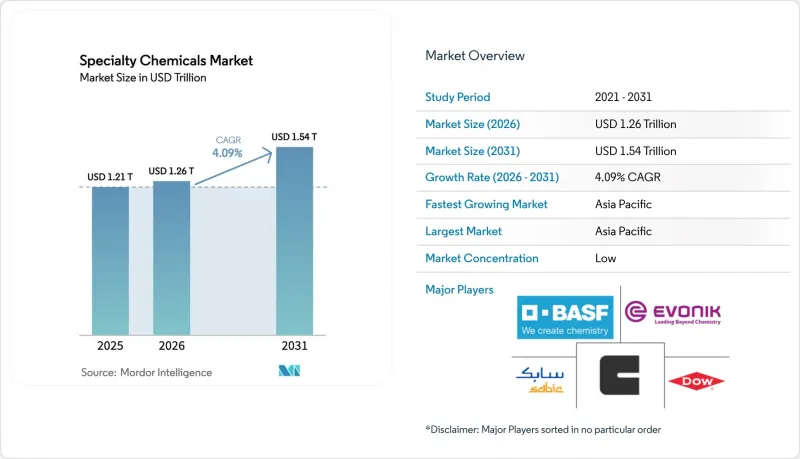
This report is Segmented by End-User Industry (Paints and Coatings, Catalysts, Construction Chemicals, Cosmetic Chemicals, Dyes, Inks and Pigments, Electronic Chemicals, Water Treatment Chemicals, Food Additives, Agrochemicals, and More) and Geography (Asia-Pacific, North America, Europe, South America, and Middle-East and Africa). The Market Forecasts are Provided in Terms of Value (USD).
Global Specialty Chemicals Market Trends and Insights
Infrastructure Spending Boom in Asia-Pacific and GCC Countries Boosts Construction Chemicals
Saudi Arabia's NEOM project, alongside the UAE's pipeline, Singapore's projected construction demand for 2025, and Australia's infrastructure program, are collectively fueling a consistent demand for polycarboxylate ether super-plasticizers, waterproofing membranes, and corrosion inhibitors. In a bid to align with green-building certifications, contractors, particularly in Singapore's Super Low Energy program, are increasingly opting for low-VOC sealants and rapid-cure repair mortars. To cater to the high-salinity desert environments and reduce delivery lead times, multinational suppliers like Sika, Fosroc, and Saint-Gobain are ramping up their regional admixture plants. Given the 100-year service life requirement for concrete blends in Gulf megaprojects, there's a notable surge in the use of shrinkage-compensating agents and crystalline waterproofing. Furthermore, EPC contractors are integrating digital-twin models to fine-tune dosage rates, leading to an uptick in the consumption of high-range water reducers for every cubic meter of concrete.
Semiconductor Capacity Race Spurs Electronic-Grade Chemical Demand
Entegris, Hemlock Semiconductor, and Sumika Electronic Materials received funding under the U.S. CHIPS and Science Act. These funds, directed toward ultra-high-purity solvents and polysilicon, underscore a notable shift in supply hubs from Asia to the U.S. SEMI forecasts higher spending on 300 mm fab equipment. This uptick broadens the market for hydrogen peroxide, sulfuric acid, and CMP slurries. Japan's acquisition of JSR is a strategic move, aligning photoresist capacity with national interests. Concurrently, Tokyo Ohka Kogyo is boosting production of EUV-grade products, adapting to the pace of foundry adoptions. To stabilize revenues, cleanroom chemical manufacturers are entering into 10-year take-or-pay contracts with fabs, a strategy aimed at mitigating the revenue fluctuations historically tied to wafer starts. As advanced packaging nodes evolve, there's a heightened demand for innovative dielectric pastes and low-k spin-on materials, essential for chiplet architectures.
Crude-Derivative Price Volatility Inflates Feedstock Costs
In 2026, as Brent crude prices retreat, naphtha-cracker spreads tighten. This shift creates challenges for specialty formulators linked to propylene and ethylene chains, as they grapple with passing on these costs. In 2024, Asian naphtha prices fluctuated, with forecasts predicting a dip in 2025. Meanwhile, spot prices for propylene and ethylene remain volatile, swaying with refinery downtimes and geopolitical events. Unlike industry giants BASF or Dow, smaller specialty producers operate without the luxury of hedging at scale. They often contend with three-month quotation delays, making them vulnerable to contract penalties if feedstock prices surge between tender and shipment. While bio-alternatives like succinic acid from Evonik and renewable-naphtha routes from BASF offer some respite, they come at a premium. This pricing poses challenges for downstream buyers, especially in applications with tight margins.
Other drivers and restraints analyzed in the detailed report include:
- Tightening Industrial-Water Discharge Norms Fuel Water-Treatment Additives
- Auto Lightweighting Rules Escalate Need for High-Performance Polymers
- VOC Regulations Restrict Solvent-Borne Chemistries
For complete list of drivers and restraints, kindly check the Table Of Contents.
Segment Analysis
Agrochemicals contributed 19.98% of the overall specialty chemicals market revenue in 2025 as fertilizer volumes held firm despite price turbulence. Nutrien reported notable shipments of potash and nitrogen, while Yara transported various crop nutrients. The specialty chemicals market size for construction chemicals is forecast to expand at a 6.33% CAGR between 2026 and 2031 on the back of GCC and Asia-Pacific megaproject pipelines, positioning admixtures, waterproofing, and repair mortars as the fastest incremental value creators. Emerging economies are driving demand for paints and coatings, bolstered by architectural repainting and lightweighting in the polymer-rich automotive sector. A testament to this trend is BASF's 2024 introduction of waterborne clearcoats tailored for electric vehicles, marking a significant technological shift into mainstream OEM offerings. Electronic chemicals are reaping the benefits of subsidy pools in the U.S. and ongoing expansions in Asia's wafer fabrication. This has led to a surge in demand for high-purity acids, CMP slurries, and photoresists. Meanwhile, water treatment chemicals are capitalizing on PFAS regulations, and the rising demand for adhesives and sealants is driven by e-commerce packaging and the need for heat-resistant PUR hot melts in battery-pack gasketing.
Geography Analysis
Asia-Pacific owned 46.94% of specialty chemicals revenue in 2025 and is tracking a 4.58% CAGR through 2031. This growth is largely driven by China's chemical sector pivoting towards high-end intermediates and bolstered by India's incentive scheme, which champions domestic agrochemicals and polymers. Indian clusters in Gujarat and Maharashtra are ramping up dye and pigment capacities, eyeing lucrative export opportunities. Japan and South Korea, benefiting from government-backed capital expansions post-2019 export restrictions, dominate the market with premium stakes in photoresists and hydrogen peroxide. Notably, JSR's acquisition by Japan Industrial Partners ensures that rights remain under domestic stewardship. In the ASEAN region, Vietnam's burgeoning industrial-park pipeline and Thailand's EEC corridor are enhancing capacity for admixtures and water treatment. Meanwhile, Singapore is setting the gold standard for green certifications, promoting low-VOC formulations.
While North America holds a smaller market share, its intensity of innovation is noteworthy. The continent is witnessing its most significant materials reshoring initiative since the 1980s, highlighted by funding and projected needs for upstream chemicals. U.S. mandates for vehicle lightweighting are driving up demand for carbon-fiber prepregs and PEEK. At the same time, impending PFAS regulations are catalyzing investments in alternative coagulants. Europe's proactive stance, evident in its revamped Industrial Emissions Directive and stringent wastewater mandates, is translating environmental leadership into heightened chemical demand. This includes membrane bioreactors, PFAS-free surfactants, and biobased dispersants. The Middle East's specialty chemicals sector is reaping rewards from Saudi Aramco's ambitious downstream investment and the NEOM megacity project, both of which have a voracious appetite for corrosion inhibitors, oilfield biocides, and high-performance concrete admixtures.
- 3M
- AECI
- Afton Chemical
- Akzo Nobel NV
- Albemarle Corporation
- ALTANA
- Archroma
- Arkema Group
- Ashland
- Asian Paints
- Axalta Coating Systems
- Baker Hughes Company
- BASF SE
- Berger Paints India Limited
- Buckman
- Chevron Corporation
- Clariant
- Corteva
- Covestro AG
- DIC Corporation
- Dow
- DSM
- DuPont
- Eastman Chemical Company
- Ecolab
- Evonik Industries AG
- Exxon Mobil Corporation
- Ferro Corporation
- Flint Group
- FMC Corporation
- GCP Applied Technologies Inc.
- H.B. Fuller Company
- Halliburton
- Henkel AG & Co. KGaA
- Hexcel Corporation
- Holcim
- Huntsman International LLC
- Infineum International Limited
- Kemira
- KRONOS Worldwide Inc.
- Kurita Water Industries Ltd
- LANXESS
- Lonza
- MAPEI SpA
- Merck KGaA
- NIPSEA GROUP
- Nouryon
- Nutrien Ltd
- Pidilite Industries Ltd
- PPG Industries Inc.
- Procter & Gamble
- RPM International Inc.
- SABIC
- Saint-Gobain
- Schlumberger Limited
- Sika AG
- Solenis
- Solvay
- Syngenta
- The Chemours Company
- The Lubrizol Corporation
- The Sherwin-Williams Company
- Venator Materials PLC
- Veolia
- W. R. Grace & Co.
- Wacker Chemie AG
- Yara
Additional Benefits:
- The market estimate (ME) sheet in Excel format
- 3 months of analyst support
TABLE OF CONTENTS
1 Introduction
- 1.1 Study Assumptions and Market Definition
- 1.2 Scope of the Study
2 Research Methodology
3 Executive Summary
4 Market Landscape
- 4.1 Market Overview
- 4.2 Market Drivers
- 4.2.1 Infrastructure spending boom in Asia-Pacific and GCC Countries boosts construction chemicals
- 4.2.2 Semiconductor capacity race spurs electronic-grade chemical demand
- 4.2.3 Tightening industrial-water discharge norms fuel water-treatment additives
- 4.2.4 Auto lightweighting rules escalate need for high-performance polymers
- 4.2.5 Perovskite PV scale-up creates niche for specialty conductive inks
- 4.3 Market Restraints
- 4.3.1 Crude-derivative price volatility inflates feedstock costs
- 4.3.2 VOC regulations restrict solvent-borne chemistries
- 4.3.3 Urban-farming DIY bio-inputs erode small-lot agrochemical sales
- 4.4 Value Chain Analysis
- 4.5 Raw-Material Analysis
- 4.6 Porter's Five Forces
- 4.6.1 Bargaining Power of Suppliers
- 4.6.2 Bargaining Power of Buyers
- 4.6.3 Threat of New Entrants
- 4.6.4 Threat of Substitutes
- 4.6.5 Degree of Competition
5 Market Size and Growth Forecasts (Value)
- 5.1 By End-User Industry
- 5.1.1 Paints and Coatings
- 5.1.1.1 Market Dynamics
- 5.1.1.2 Application
- 5.1.1.2.1 Architectural
- 5.1.1.2.2 Automotive
- 5.1.1.2.3 Industrial
- 5.1.1.2.4 Wood
- 5.1.1.2.5 Other Applications
- 5.1.2 Catalysts
- 5.1.2.1 Market Dynamics
- 5.1.2.2 Function
- 5.1.2.2.1 Chemical Synthesis Catalysts
- 5.1.2.2.2 Petroleum Refining Catalysts
- 5.1.2.2.3 Polymerization Catalysts
- 5.1.3 Construction Chemicals
- 5.1.3.1 Market Dynamics
- 5.1.3.2 Application
- 5.1.3.2.1 Commercial
- 5.1.3.2.2 Industrial
- 5.1.3.2.3 Infrastructure
- 5.1.3.2.4 Residential
- 5.1.3.2.5 Public Space
- 5.1.4 Cosmetic Chemicals
- 5.1.4.1 Market Dynamics
- 5.1.4.2 Application
- 5.1.4.2.1 Hair Care
- 5.1.4.2.2 Skin Care
- 5.1.4.2.3 Oral Care
- 5.1.4.2.4 Personal Hygiene
- 5.1.4.2.5 Other Applications
- 5.1.5 Dyes, Inks, and Pigments
- 5.1.5.1 Market Dynamics
- 5.1.5.2 Type
- 5.1.5.2.1 Inks
- 5.1.5.2.2 Dyes
- 5.1.5.2.3 Organic Pigments
- 5.1.5.2.4 Inorganic Pigments
- 5.1.6 Electronic Chemicals
- 5.1.6.1 Market Dynamics
- 5.1.6.2 Application
- 5.1.6.2.1 Semiconductors and Integrated Circuits
- 5.1.6.2.2 Printed Circuit Boards
- 5.1.7 Water Treatment Chemicals
- 5.1.7.1 Market Dynamics
- 5.1.7.2 Function
- 5.1.7.2.1 Flocculants
- 5.1.7.2.2 Coagulants
- 5.1.7.2.3 Biocides and Disinfectants
- 5.1.7.2.4 Defoamers and Defoaming Agents
- 5.1.7.2.5 pH Adjusters and Softeners
- 5.1.7.2.6 Other Functions
- 5.1.8 Food Additives
- 5.1.8.1 Market Dynamics
- 5.1.8.2 Type
- 5.1.8.2.1 Natural Additives
- 5.1.8.2.2 Synthetic Additives
- 5.1.9 Agrochemicals
- 5.1.9.1 Market Dynamics
- 5.1.9.2 Type
- 5.1.9.2.1 Fertilizers
- 5.1.9.2.2 Herbicide
- 5.1.9.2.3 Fungicide
- 5.1.9.2.4 Insecticide
- 5.1.9.2.5 Nematicide
- 5.1.9.2.6 Molluscicide
- 5.1.9.2.7 Other Crop Protection Chemicals
- 5.1.10 Industrial and Institutional Cleaners
- 5.1.10.1 Market Dynamics
- 5.1.10.2 Application
- 5.1.10.2.1 General Purpose Cleaners
- 5.1.10.2.2 Disinfectants and Sanitizers
- 5.1.10.2.3 Laundry Care Products
- 5.1.10.2.4 Vehicle Wash Products
- 5.1.11 Lubricant Additives
- 5.1.11.1 Market Dynamics
- 5.1.11.2 Product Type
- 5.1.11.2.1 Dispersants and Emulsifiers
- 5.1.11.2.2 Detergents
- 5.1.11.2.3 Oxidation Inhibitors
- 5.1.11.2.4 Extreme-pressure Additives and Anti-wear Additives
- 5.1.11.2.5 Viscosity Index Modifiers
- 5.1.11.2.6 Friction Modifiers
- 5.1.11.2.7 Corrosion Inhibitors
- 5.1.11.2.8 Other Product Types
- 5.1.12 Mining Chemicals
- 5.1.12.1 Market Dynamics
- 5.1.12.2 Function
- 5.1.12.2.1 Flotation Chemicals
- 5.1.12.2.2 Extraction Chemicals
- 5.1.12.2.3 Grinding Aids
- 5.1.13 Oilfield Chemicals
- 5.1.13.1 Market Dynamics
- 5.1.13.2 Application
- 5.1.13.2.1 Biocide
- 5.1.13.2.2 Corrosion and Scale Inhibitor
- 5.1.13.2.3 Demulsifier
- 5.1.13.2.4 Polymer
- 5.1.13.2.5 Surfactant
- 5.1.13.2.6 Other Chemical Types
- 5.1.14 Adhesives and Sealants
- 5.1.14.1 Market Dynamics
- 5.1.14.2 Technology
- 5.1.14.2.1 Water-borne Adhesives
- 5.1.14.2.2 Solvent-borne Adhesives
- 5.1.14.2.3 Hot-melt Adhesives
- 5.1.14.2.4 Reactive Adhesives
- 5.1.14.2.5 Other Adhesives
- 5.1.14.2.6 Sealants
- 5.1.15 Plastic Additives
- 5.1.15.1 Market Dynamics
- 5.1.15.2 Plastic Type
- 5.1.15.2.1 Polyethylene (PE)
- 5.1.15.2.2 Polystyrene (PS)
- 5.1.15.2.3 Polypropylene (PP)
- 5.1.15.2.4 Polyamide (PA)
- 5.1.15.2.5 Polyethylene Terephthalate (PET)
- 5.1.15.2.6 Polyvinyl Chloride (PVC)
- 5.1.15.2.7 Polycarbonate (PC)
- 5.1.15.2.8 Other Plastic Types
- 5.1.16 Rubber Processing Chemicals
- 5.1.16.1 Market Dynamics
- 5.1.16.2 Application
- 5.1.16.2.1 Tire
- 5.1.16.2.2 Non-tire
- 5.1.17 Specialty Polymers
- 5.1.17.1 Market Dynamics
- 5.1.18 Textile Chemicals
- 5.1.18.1 Market Dynamics
- 5.1.18.2 Application
- 5.1.18.2.1 Coating and Sizing Chemicals
- 5.1.18.2.2 Colorants and Auxiliaries
- 5.1.18.2.3 Finishing Agents
- 5.1.18.2.4 Desizing Agents
- 5.1.18.2.5 Other Application
- 5.1.1 Paints and Coatings
- 5.2 By Geography
- 5.2.1 Asia-Pacific
- 5.2.1.1 China
- 5.2.1.2 India
- 5.2.1.3 Japan
- 5.2.1.4 South Korea
- 5.2.1.5 ASEAN Countries
- 5.2.1.6 Rest of Asia-Pacific
- 5.2.2 North America
- 5.2.2.1 United States
- 5.2.2.2 Canada
- 5.2.2.3 Mexico
- 5.2.3 Europe
- 5.2.3.1 Germany
- 5.2.3.2 United Kingdom
- 5.2.3.3 Italy
- 5.2.3.4 France
- 5.2.3.5 Spain
- 5.2.3.6 Rest of Europe
- 5.2.4 South America
- 5.2.4.1 Brazil
- 5.2.4.2 Argentina
- 5.2.4.3 Rest of South America
- 5.2.5 Middle-East and Africa
- 5.2.5.1 Saudi Arabia
- 5.2.5.2 South Africa
- 5.2.5.3 Rest of Middle-East and Africa
- 5.2.1 Asia-Pacific
6 Competitive Landscape
- 6.1 Market Concentration
- 6.2 Strategic Moves
- 6.3 Market Share/Ranking Analysis
- 6.3.1 Adhesives and Sealants
- 6.3.2 Agrochemicals
- 6.3.3 Construction Chemicals
- 6.3.4 Lubricants and Oil Additives
- 6.3.5 Mining Chemicals
- 6.3.6 Oilfield Chemicals
- 6.3.7 Paints and Coatings
- 6.3.8 Specialty Polymers
- 6.3.9 Water Treatment Chemicals
- 6.4 Company Profiles {(includes Global level Overview, Market level overview, Core Segments, Financials as available, Strategic Information, Market Rank/Share for key companies, Products and Services, and Recent Developments)}
- 6.4.1 3M
- 6.4.2 AECI
- 6.4.3 Afton Chemical
- 6.4.4 Akzo Nobel NV
- 6.4.5 Albemarle Corporation
- 6.4.6 ALTANA
- 6.4.7 Archroma
- 6.4.8 Arkema Group
- 6.4.9 Ashland
- 6.4.10 Asian Paints
- 6.4.11 Axalta Coating Systems
- 6.4.12 Baker Hughes Company
- 6.4.13 BASF SE
- 6.4.14 Berger Paints India Limited
- 6.4.15 Buckman
- 6.4.16 Chevron Corporation
- 6.4.17 Clariant
- 6.4.18 Corteva
- 6.4.19 Covestro AG
- 6.4.20 DIC Corporation
- 6.4.21 Dow
- 6.4.22 DSM
- 6.4.23 DuPont
- 6.4.24 Eastman Chemical Company
- 6.4.25 Ecolab
- 6.4.26 Evonik Industries AG
- 6.4.27 Exxon Mobil Corporation
- 6.4.28 Ferro Corporation
- 6.4.29 Flint Group
- 6.4.30 FMC Corporation
- 6.4.31 GCP Applied Technologies Inc.
- 6.4.32 H.B. Fuller Company
- 6.4.33 Halliburton
- 6.4.34 Henkel AG & Co. KGaA
- 6.4.35 Hexcel Corporation
- 6.4.36 Holcim
- 6.4.37 Huntsman International LLC
- 6.4.38 Infineum International Limited
- 6.4.39 Kemira
- 6.4.40 KRONOS Worldwide Inc.
- 6.4.41 Kurita Water Industries Ltd
- 6.4.42 LANXESS
- 6.4.43 Lonza
- 6.4.44 MAPEI SpA
- 6.4.45 Merck KGaA
- 6.4.46 NIPSEA GROUP
- 6.4.47 Nouryon
- 6.4.48 Nutrien Ltd
- 6.4.49 Pidilite Industries Ltd
- 6.4.50 PPG Industries Inc.
- 6.4.51 Procter & Gamble
- 6.4.52 RPM International Inc.
- 6.4.53 SABIC
- 6.4.54 Saint-Gobain
- 6.4.55 Schlumberger Limited
- 6.4.56 Sika AG
- 6.4.57 Solenis
- 6.4.58 Solvay
- 6.4.59 Syngenta
- 6.4.60 The Chemours Company
- 6.4.61 The Lubrizol Corporation
- 6.4.62 The Sherwin-Williams Company
- 6.4.63 Venator Materials PLC
- 6.4.64 Veolia
- 6.4.65 W. R. Grace & Co.
- 6.4.66 Wacker Chemie AG
- 6.4.67 Yara
7 Market Opportunities and Future Outlook
- 7.1 White-space and Unmet-need Assessment

