PUBLISHER: Mordor Intelligence | PRODUCT CODE: 2066393

PUBLISHER: Mordor Intelligence | PRODUCT CODE: 2066393
Face Mask - Market Share Analysis, Industry Trends & Statistics, Growth Forecasts (2026 - 2031)
According to Mordor Intelligence, the face mask market size is expected to grow from USD 9.79 billion in 2025 to USD 10.65 billion in 2026 and is forecast to reach USD 16.20 billion by 2031 at a 8.76% CAGR over 2026-2031.
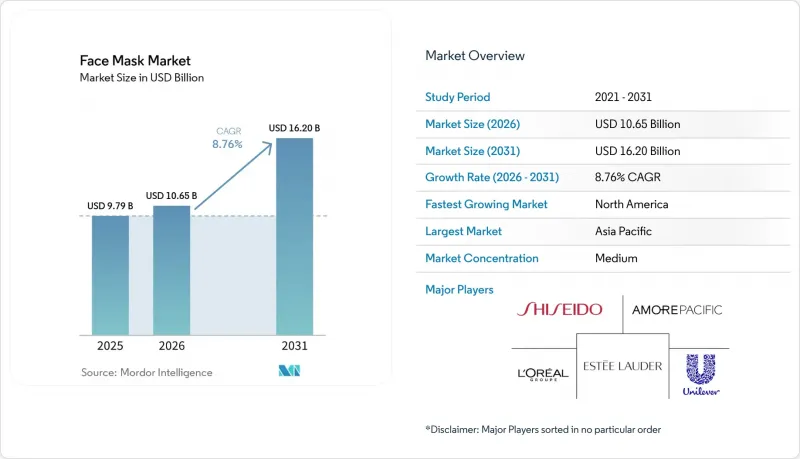
This report is Segmented by Product Type (Clay Mask, Peel-Off Mask, Sheet Mask, and Cream Mask/Gel Mask), End User (Men and Women), Ingredient (Natural and Organic and Conventional), Distribution Channel (Supermarkets/Hypermarkets, Specialty Stores, and More), and Geography (North America, Europe, Asia-Pacific, South America, and Middle East and Africa). The Market Forecasts are Provided in Terms of Value (USD).
Global Face Mask Market Trends and Insights
Technological innovations in terms of ingredients and functionality
Ingredient science is evolving from mere hydration to proactive correction. Brands are now harnessing the power of peptides, growth factors, and encapsulated retinoids, ensuring they thrive even in challenging environments. L'Oreal, in July 2025, unveiled Melasyl, a product that curbs melanin production through a unique pathway, setting it apart from traditional tyrosinase blockers. This innovation not only offers a competitive edge but also comes with patent protection, bolstering L'Oreal's stance in the hyperpigmentation market. Shiseido, in November 2025, laid out its Action 2030 blueprint, dedicating a substantial JPY 100 billion (USD 670 million) towards medical dermatology. This investment encompasses cutting-edge solutions like LED-integrated masks, which merge light therapy with active topicals, and micro-needle patches designed for enhanced transdermal delivery. Estee Lauder, in 2025, rolled out its Advanced Night Repair PowerFoil Mask, leveraging a unique heat-generating foil to amplify the absorption of its signature Chronolux technology. Such groundbreaking advancements are not just elevating at-home skincare routines to professional standards but are also heightening consumer expectations and pushing up average selling prices. On the regulatory front, the Food and Drug Administration's Modernization of Cosmetics Regulation Act (MoCRA), finalized in December 2023, introduced new mandates like facility registration and adverse-event reporting. These regulations seem to tilt the playing field, benefiting established players with robust compliance infrastructures while posing challenges for smaller entrants.
Increased air pollution and environmental concerns
The demand for anti-pollution skincare has surged, driven by urban particulate exposure. Research in the Journal of Investigative Dermatology highlights that pollutants like PM2.5, PM10, and polycyclic aromatic hydrocarbons can cause oxidative stress, activate the aryl hydrocarbon receptor, and lead to the degradation of collagen and elastin fibers. In China and India, where air-quality issues are a constant concern, consumers are turning to masks enriched with antioxidants like niacinamide, resveratrol, and green-tea polyphenols. This preference is now making its way into cities across the Middle East and Africa, regions grappling with rising particulate levels due to swift industrialization. Brands are touting pollution-defense benefits, often referencing in-vitro assays that gauge the scavenging of reactive oxygen species. However, it's worth noting that regulatory bodies have yet to establish standardized testing protocols. Looking ahead, as climate change exacerbates wildfires and dust storms, what was once a niche anti-pollution formulation is poised to become a standard expectation in skincare.
Health concerns over chemical ingredients
As consumers grow wary of synthetic preservatives and fragrances, formulation priorities are shifting. Clinical patch-testing data from the Journal of the American Academy of Dermatology reveal that fragrances in cosmetics cause contact dermatitis in 14% to 30% of cases, while preservatives like methylisothiazolinone and parabens account for another 10% to 15%. In 2024, the Food and Drug Administration's MedWatch logged thousands of complaints related to cosmetics, even though the agency only pre-approves color additives. In the U.S., "hypoallergenic" claims lack regulation, leading to a trust gap. Clean-beauty brands capitalize on this by highlighting excluded ingredients instead of making vague safety promises. While European Regulation 1223/2009 enforces safety assessments and restricts over 1,300 substances, U.S. oversight remains more lenient. This discrepancy pressures multinational brands to either harmonize their formulations or keep separate SKUs for different markets. Consequently, brands face margin compression as they invest in allergen testing, fragrance-free variants, and transparent labeling to sidestep regulatory scrutiny and consumer backlash.
Other drivers and restraints analyzed in the detailed report include:
- Influence of social media and celebrity endorsements
- Demand for natural, organic, and clean facial care products
- Supply chain and raw material constraints
For complete list of drivers and restraints, kindly check the Table Of Contents.
Segment Analysis
Clay masks are projected to grow at a 2.80% CAGR through 2031, outpacing the overall market, even as cream and gel masks command a 46.96% share in 2025. This resurgence is largely attributed to the trend of multi-masking. In this practice, consumers apply various mask types to different facial zones, using clay on the T-zone to absorb sebum and a hydrating cream on the cheeks, to tackle mixed skin concerns in one session. Kaolin and bentonite clays, valued for their cation-exchange capacity, effectively bind impurities without compromising the skin's lipid barrier. Bubble clay masks, which produce an oxygen foam upon application, offer a unique sensory experience that boosts social media shares and encourages repeat purchases. While sheet masks dominate in the Asia Pacific, benefiting from biocellulose and hydrogel substrates that mold to facial contours and minimize essence evaporation, their growth is slowing due to rising sustainability concerns over single-use packaging. Peel-off masks, though catering to a niche audience seeking visible debris removal, come with dermatologist warnings about potential barrier integrity compromise from aggressive peeling. Cream and gel masks hold the largest market share, thanks to their versatility across all skin types, adaptable application times, and seamless integration into routines. Highlighting a shift towards hybrid formats, Shiseido's November 2025 strategy underscores a focus on LED-integrated masks and micro-needle patches, blending topical delivery with physical methods.
Substrate technology innovations are increasingly blurring the lines between product types. Estee Lauder's 2025 PowerFoil Mask, featuring a heat-generating metallic film, boosts penetration, effectively combining the ease of a sheet mask with the active-delivery prowess of a cream. Hydrogel masks, composed of 90 to 95 percent water or serum, are carving a niche in premium segments due to their drip-free adherence and cooling effect, which calms inflamed skin. Regulatory standards differ by mask type: while most jurisdictions classify leave-on masks under cosmetic regulations, those with prescription-strength actives, like tretinoin or concentrated acids, might be deemed over-the-counter drugs, necessitating pre-market approval. The Food and Drug Administration's MoCRA, finalized in December 2023, imposes facility registration and adverse-event reporting mandates on all cosmetic manufacturers, a move that escalates compliance costs, particularly for smaller brands.
Natural and organic masks are projected to grow at a 3.93% CAGR, nearly 50% faster than conventional counterparts, driven by clean-beauty mandates and shifting consumer expectations. Conventional formulations, holding a 69.74% market share in 2025 due to proven efficacy and cost advantages, face mounting regulatory challenges. The EU's Regulation 2021/850 restricts titanium dioxide in leave-on products and caps salicylic acid, prompting reformulation cycles that benefit brands with in-house research and development. COSMOS certification, requiring 95% physically processed plant ingredients and at least 20% organic content for leave-on products, is becoming the standard in European specialty retail. Sephora's Clean program excludes over 50 ingredients, including parabens, phthalates, and mineral oils, setting stricter private-sector benchmarks than Food and Drug Administration guidelines.
The shift to natural ingredients introduces supply-chain complexities. Organic certification requires a three-year pesticide-free land transition, while fair-trade premiums add 10-15% to raw-material costs. Botanical extracts like chamomile and calendula are vulnerable to climate variability; droughts in key regions can cut yields by 20-30%, forcing formulators to substitute or accept margin compression. Preservative restrictions add to the challenge: as parabens and formaldehyde-releasers fall out of favor, brands turn to alternatives like phenoxyethanol, benzyl alcohol, and radish-root ferment, which require higher usage rates for equivalent microbial protection. L'Oreal's 27% online sales penetration in 2023 highlights the channel's role in educating consumers and justifying premium pricing for clean formulations. While conventional masks retain cost advantages in mass channels, the margin gap is narrowing as scale economies emerge in organic agriculture and fermentation-derived actives.
Geography Analysis
In 2025, Asia Pacific dominated the global face mask revenue, accounting for 75.43%. This stronghold is attributed to the region's multi-step skincare rituals, where masking is embraced as a routine, often weekly or even daily, rather than a mere occasional treat. South Korea's renowned 10-step regimen, encompassing double cleansing, toning, essence, serum, sheet mask, eye cream, moisturizer, and sunscreen, has gained worldwide traction, thanks to K-beauty brands and social media tutorials. Meanwhile, Japan prioritizes prevention over correction, fueling the demand for hydrating and anti-aging masks, often infused with sake, rice bran, and camellia oil. China's rich tradition in herbal medicine accentuates the value of ingredients like ginseng, pearl powder, and bird's nest. These not only command premium prices but also resonate deeply with consumers who appreciate their culturally rooted efficacy. In Q3 2024, Amorepacific boasted a revenue of KRW 1.4 trillion (USD 1.05 billion), with skincare products constituting over 60% of its sales. Shiseido, in its November 2025 strategy, acknowledged that while China accounts for 30% of its group revenue, the brand is diversifying into the U.S., Europe, India, and Africa to mitigate concentration risks. India's beauty market is on an upward trajectory, especially with the surge of online channels. Hindustan Unilever's strategic acquisition of Minimalist for INR 27.06 billion (USD 325 million) in 2025 underscores the multinational's recognition of India's burgeoning potential. Simultaneously, Marico's acquisition of Beardo, targeting the men's grooming segment, was valued at approximately INR 4 billion (USD 48 million).
North America is set to lead with a 4.56% CAGR through 2031, the fastest among all regions. This growth is fueled by the rising trend of clean beauty, the normalization of male grooming, and the expansion of specialty retail. Initiatives like Sephora's Clean program and Ulta's Conscious Beauty have raised ingredient standards, often surpassing Food and Drug Administration requirements, compelling brands to either reformulate or face delisting. The Food and Drug Administration's MoCRA, finalized in December 2023, introduced mandates like facility registration, product listing, and adverse-event reporting. While these measures elevate compliance costs, they also create entry barriers, favoring established industry players. L'Oreal's SAPMENA region, encompassing Sub-Saharan Africa, Pakistan, the Middle East, and North Africa, boasts over 43% of the global population under 25. With more than 50 million Beauty Tech interactions recorded, the region showcases significant untapped potential in digital commerce.
Europe's growth faces hurdles due to market saturation and intricate regulations. For instance, Regulation 1223/2009 restricts over 1,300 substances, while Regulation 2021/850 places further limitations on titanium dioxide and salicylic acid, necessitating constant reformulation. Although South America and the Middle East and Africa are smaller markets, urban centers within these regions present lucrative opportunities. Rising incomes and the allure of Western beauty ideals are driving up skincare expenditures. Brazil, with its vast population and rich beauty culture, stands out as a prime entry point for global brands. In contrast, countries within the Gulf Cooperation Council showcase impressive per-capita spending on luxury cosmetics.
- L'Oreal S.A.
- The Estee Lauder Companies Inc.
- Unilever PLC
- Shiseido Company, Limited
- Amorepacific Corporation
- Kenvue
- Natura & Co Holding S.A.
- Kao Corporation
- Himalaya Global Holdings Ltd.
- Tony Moly
- Honasa Consumer Limited
- Beiersdorf AG
- Procter and Gamble Company
- Herbivore Botanicals
- LVMH Moet Hennessy Louis Vuitton SE
- Church & Dwight Co., Inc.
- Coty Inc.
- Oriflame Holding AG
- Groupe Rocher
- Kose Corporation
Additional Benefits:
- The market estimate (ME) sheet in Excel format
- 3 months of analyst support
TABLE OF CONTENTS
1 INTRODUCTION
- 1.1 Study Assumptions and Market Definition
- 1.2 Scope of the Study
2 RESEARCH METHODOLOGY
3 EXECUTIVE SUMMARY
4 MARKET LANDSCAPE
- 4.1 Market Overview
- 4.2 Market Drivers
- 4.2.1 Technological innovations in terms of ingredients and functionality
- 4.2.2 Increased air pollution and environmental concerns
- 4.2.3 Rising consumer spending on skincare products
- 4.2.4 Influence of social media and celebrity endorsements
- 4.2.5 Increasing prevalence of skin issues
- 4.2.6 Demand for natural, organic, and clean facial care products
- 4.3 Market Restraints
- 4.3.1 Health concern over the chemical ingredient
- 4.3.2 Alternative and traditional methods of skin routine practices
- 4.3.3 Skin sensitivity and allergic reactions
- 4.3.4 Supply chain and raw material constraints
- 4.4 Consumer Behaviour Analysis
- 4.5 Regulatory Landscape
- 4.6 Technological Outlook
- 4.7 Porter's Five Forces
- 4.7.1 Threat of New Entrants
- 4.7.2 Bargaining Power of Buyers
- 4.7.3 Bargaining Power of Suppliers
- 4.7.4 Threat of Substitutes
- 4.7.5 Intensity of Competitive Rivalry
5 MARKET SIZE AND GROWTH FORECASTS (VALUE)
- 5.1 Product Type
- 5.1.1 Clay Mask
- 5.1.2 Peel-Off Mask
- 5.1.3 Sheet Mask
- 5.1.4 Cream Mask/Gel Mask
- 5.2 Ingredient
- 5.2.1 Conventional
- 5.2.2 Natural and Organic
- 5.3 End User
- 5.3.1 Men
- 5.3.2 Women
- 5.4 Distribution Channel
- 5.4.1 Supermarkets and Hypermarkets
- 5.4.2 Specialty Stores
- 5.4.3 Online Retail Stores
- 5.4.4 Other Distribution Channels
- 5.5 Geography
- 5.5.1 North America
- 5.5.1.1 United States
- 5.5.1.2 Canada
- 5.5.1.3 Mexico
- 5.5.1.4 Rest of North America
- 5.5.2 Europe
- 5.5.2.1 United Kingdom
- 5.5.2.2 Germany
- 5.5.2.3 France
- 5.5.2.4 Italy
- 5.5.2.5 Spain
- 5.5.2.6 Sweden
- 5.5.2.7 Belgium
- 5.5.2.8 Poland
- 5.5.2.9 Netherlands
- 5.5.2.10 Rest of Europe
- 5.5.3 Asia-Pacific
- 5.5.3.1 China
- 5.5.3.2 Japan
- 5.5.3.3 India
- 5.5.3.4 Thailand
- 5.5.3.5 Singapore
- 5.5.3.6 Indonesia
- 5.5.3.7 South Korea
- 5.5.3.8 Australia
- 5.5.3.9 New Zealand
- 5.5.3.10 Rest of Asia Pacific
- 5.5.4 South America
- 5.5.4.1 Brazil
- 5.5.4.2 Argentina
- 5.5.4.3 Peru
- 5.5.4.4 Colombia
- 5.5.4.5 Chile
- 5.5.4.6 Rest of South America
- 5.5.5 Middle East and Africa
- 5.5.5.1 South Africa
- 5.5.5.2 Nigeria
- 5.5.5.3 Egypt
- 5.5.5.4 Morocco
- 5.5.5.5 Turkey
- 5.5.5.6 Rest of Middle East and Africa
- 5.5.1 North America
6 COMPETITIVE LANDSCAPE
- 6.1 Market Concentration
- 6.2 Strategic Moves
- 6.3 Market Share Analysis
- 6.4 Company Profiles
- 6.4.1 L'Oreal S.A.
- 6.4.2 The Estee Lauder Companies Inc.
- 6.4.3 Unilever PLC
- 6.4.4 Shiseido Company, Limited
- 6.4.5 Amorepacific Corporation
- 6.4.6 Kenvue
- 6.4.7 Natura & Co Holding S.A.
- 6.4.8 Kao Corporation
- 6.4.9 Himalaya Global Holdings Ltd.
- 6.4.10 Tony Moly
- 6.4.11 Honasa Consumer Limited
- 6.4.12 Beiersdorf AG
- 6.4.13 Procter and Gamble Company
- 6.4.14 Herbivore Botanicals
- 6.4.15 LVMH Moet Hennessy Louis Vuitton SE
- 6.4.16 Church & Dwight Co., Inc.
- 6.4.17 Coty Inc.
- 6.4.18 Oriflame Holding AG
- 6.4.19 Groupe Rocher
- 6.4.20 Kose Corporation
7 MARKET OPPORTUNITIES AND FUTURE OUTLOOK

