PUBLISHER: Mordor Intelligence | PRODUCT CODE: 2066407

PUBLISHER: Mordor Intelligence | PRODUCT CODE: 2066407
Agricultural Machinery - Market Share Analysis, Industry Trends & Statistics, Growth Forecasts (2026 - 2031)
According to Mordor Intelligence, the agricultural machinery market size is projected to grow from USD 180.9 billion in 2025 to USD 193.0 billion in 2026 and USD 267.0 billion by 2031, registering a CAGR of 6.71% during 2026-2031.
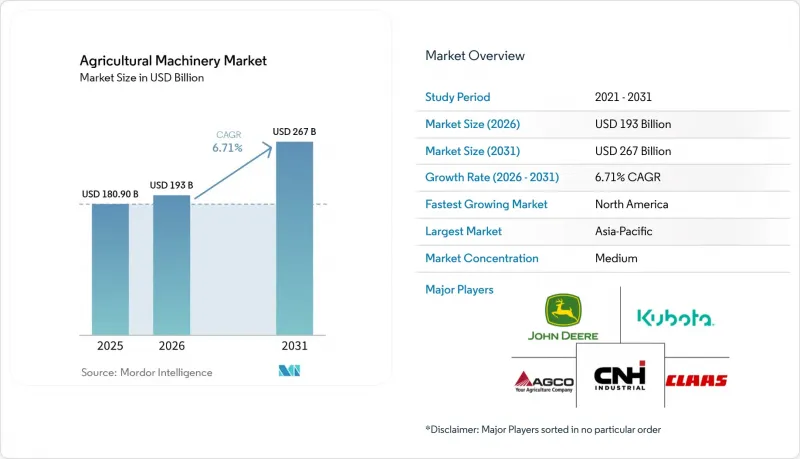
This report is Segmented by Type (Tractors, Soil Preparation and Cultivation Machinery, Planting and Seeding Machinery, and Other Types), by Automation Level (Manual, Automatic, and Semi-Automatic), and by Geography (North America, Europe, Asia-Pacific, South America, Middle East, and Africa). The Market Forecasts are Provided in Terms of Value (USD).
Global Agricultural Machinery Market Trends and Insights
Farm Labor Scarcity and Wage Inflation
The agricultural machinery market is currently influenced by tighter farm labor conditions. According to America Farm Bureau Federation, nearly 384,900 H-2A temporary agricultural worker visas were issued in fiscal year 2024 . Despite this, labor shortages persist in many seasonal operations. This has impacted purchasing decisions within the agricultural machinery market, as growers increasingly compare labor costs with the expenses and operational stability associated with machine ownership. Equipment that reduces peak labor demand in activities such as harvesting, transplanting, and spraying is gaining popularity, even as overall demand for machinery remains subdued.
Precision Agriculture and Telematics Integration
The agricultural machinery market is increasingly transitioning to a stage where telematics and digital agronomy tools are becoming standard features on mid-range and premium equipment. In February 2025, Deere & Company launched its Precision Essentials package, which includes a StarFire 7500 receiver, G5 display, and JDLink modem. This package enables both newer and older machines to be upgraded more efficiently. This development is significant for the agricultural machinery market, as retrofit options allow farmers to extend the lifespan of existing equipment while adopting features such as guided operations, connectivity, and field data functionalities. Consequently, market competition is evolving from a focus solely on hardware to integrated ecosystems comprising hardware, software, and services.
High Upfront Cost and Financing Pressure
The agricultural machinery market faces challenges due to the high cost of new equipment and the financial strain associated with large purchases. This issue is particularly pronounced in high-horsepower tractors and combines, where farmers are postponing replacement cycles due to constrained cash flow and increased borrowing costs. AGCO Corporation reported net sales of USD 10.1 billion in 2025, a 13.5% decrease compared to 2024 . According to the Association of Equipment Manufacturers (AEM) 2026 report, the sales of agricultural tractors in the United States were down 9.1%, and combine sales dropped 25.3% compared to March 2025, driven by weaker farm economics and financial pressures. Dealer inventory normalization and improved credit conditions are critical for a stronger recovery in equipment demand.
Other drivers and restraints analyzed in the detailed report include:
- Subsidies and Mechanization Credit Support
- Farm Consolidation and Output-Per-Acre Pressure
- Fragmented Farm Structures and Uneven Payback
For complete list of drivers and restraints, kindly check the Table Of Contents.
Segment Analysis
Tractors led the agricultural machinery market with 35.9% of the market share in 2025, keeping them the largest type category by value. This dominance reflects their role as the primary power source for field preparation, planting, haulage, crop care, and various attachments across most farming systems. However, demand within the tractor category varies. Compact models are performing well in horticulture and specialty applications, while machines with 100 horsepower and above remain essential for large row-crop operations in North America and Europe. Additionally, there is growing interest in purpose-built orchard and vineyard tractors, driven by advancements in autonomy and precision spraying for specialty crops.
The harvesting machinery segment of the agricultural machinery market is projected to grow at a CAGR of 6.0% from 2026 to 2031, making it the fastest-growing segment. This growth is attributed to increased adoption of automated settings, crop sensing, header control, and grain-quality management technologies, which enhance field efficiency during limited harvest periods. The market is also expanding beyond traditional combines and threshers, with forage harvesters gaining traction in dairy and livestock systems and specialty crop harvesters transitioning from pilot use to broader commercialization. Other key categories, such as soil preparation and cultivation machinery, planting and seeding machinery, and spraying and crop protection machinery, continue to benefit from advancements in conservation tillage, precision application, and improved input control.
Geography Analysis
Asia-Pacific accounted for the largest 36.8% of the agricultural machinery market size in 2025, which made it the largest regional market. The market in this region is driven by China's fleet modernization initiatives and India's significant tractor demand by volume. China is focusing on intelligent machinery, autonomous driving support systems, and new-energy equipment, with agricultural drone usage already operating at a substantial scale. In India, demand is bolstered by robust farm activity and ongoing mechanization needs. For instance, Mahindra and Mahindra Limited reported tractor sales of 46,404 units in April 2026, reflecting a 20% year-on-year increase. Meanwhile, the agricultural machinery markets in Japan and Australia are more mature and technology-driven, whereas Southeast Asian markets are expanding through smallholder mechanization programs.
North America is projected to grow at the fastest 7.2% CAGR from 2026 to 2031, which makes it the fastest-growing geography in the agricultural machinery market. Although the market is currently experiencing a cyclical trough, replacement demand from fleets purchased in the last decade is projected to drive a later-cycle recovery. South America remains a high-potential region for the agricultural machinery market. Brazil and Argentina are supported by large-scale crop production, although tighter credit conditions have slowed near-term purchases.
Europe continues to be a significant agricultural machinery market due to its robust manufacturing base, high levels of mechanization, and ongoing investments in precision farming technologies. Demand in the region is shaped by factors such as replacement cycles, financing conditions, and agricultural policies focused on sustainability, which promote efficiency improvements on farms. In the Middle East, irrigation expansion projects and controlled-environment agriculture are driving demand for specialized machinery and water-management equipment. Africa, while at an earlier stage of mechanization, is witnessing gradual growth in long-term machinery demand, supported by government-led agricultural modernization programs and food security initiatives in several developing farming economies.
- Deere & Company
- CNH Industrial N.V.
- AGCO Corporation
- Kubota Corporation
- Mahindra & Mahindra Limited
- CLAAS KGaA mbH
- SDF S.p.A.
- Yanmar Holdings Co., Ltd.
- Iseki & Co., Ltd.
- Argo Tractors S.p.A.
- Bucher Industries AG
- Valmont Industries, Inc.
- Lindsay Corporation
- Tractors and Farm Equipment Limited
- Maschio Gaspardo S.p.A.
Additional Benefits:
- The market estimate (ME) sheet in Excel format
- 3 months of analyst support
TABLE OF CONTENTS
1 Introduction
- 1.1 Study Assumptions and Market Definition
- 1.2 Scope of the Study
2 Research Methodology
3 Executive Summary
4 Market Landscape
- 4.1 Market Overview
- 4.2 Market Drivers
- 4.2.1 Farm labor scarcity and wage inflation
- 4.2.2 Precision agriculture and telematics integration
- 4.2.3 Subsidies and mechanization credit support
- 4.2.4 Farm consolidation and output-per-acre pressure
- 4.2.5 Custom hiring and equipment-as-a-service expansion
- 4.2.6 Regenerative and low-emission equipment funding
- 4.3 Market Restraints
- 4.3.1 High upfront cost and financing pressure
- 4.3.2 Fragmented farm structures and uneven payback
- 4.3.3 Autonomous field-operation regulatory uncertainty
- 4.3.4 Data ownership, repair access, and interoperability frictions
- 4.4 Regulatory Landscape
- 4.5 Technological Outlook
- 4.6 Porter's Five Forces
- 4.6.1 Threat of New Entrants
- 4.6.2 Bargaining Power of Buyers
- 4.6.3 Bargaining Power of Suppliers
- 4.6.4 Threat of Substitute Products
- 4.6.5 Intensity of Competitive Rivalry
5 Market Size and Growth Forecasts (Value)
- 5.1 By Type
- 5.1.1 Tractors
- 5.1.1.1 By Horsepower
- 5.1.1.1.1 Less than 40 HP
- 5.1.1.1.2 40 HP to 99 HP
- 5.1.1.1.3 100 HP and Above
- 5.1.1.2 By Tractor Type
- 5.1.1.2.1 Compact Utility Tractors
- 5.1.1.2.2 Utility Tractors
- 5.1.1.2.3 Row Crop Tractors
- 5.1.1.2.4 Orchard and Vineyard Tractors
- 5.1.1.1 By Horsepower
- 5.1.2 Soil Preparation and Cultivation Machinery
- 5.1.2.1 Plows
- 5.1.2.2 Harrows
- 5.1.2.3 Cultivators and Tillers
- 5.1.3 Planting and Seeding Machinery
- 5.1.3.1 Seed Drills
- 5.1.3.2 Planters
- 5.1.3.3 Broadcast Spreaders
- 5.1.3.4 Transplanters
- 5.1.4 Harvesting Machinery
- 5.1.4.1 Combine Harvesters and Threshers
- 5.1.4.2 Forage Harvesters
- 5.1.4.3 Specialty Crop Harvesters
- 5.1.5 Spraying and Crop Protection Machinery
- 5.1.5.1 Self-Propelled Sprayers
- 5.1.5.2 Trailed and Mounted Sprayers
- 5.1.5.3 Aerial and Drone-Enabled Spraying Systems
- 5.1.6 Hay and Forage Machinery
- 5.1.6.1 Mower-Conditioners
- 5.1.6.2 Balers
- 5.1.6.3 Rakes and Tedders
- 5.1.7 Irrigation Machinery
- 5.1.7.1 Sprinkler Irrigation
- 5.1.7.2 Drip Irrigation
- 5.1.7.3 Mechanized Pivot Systems
- 5.1.1 Tractors
- 5.2 By Automation Level
- 5.2.1 Manual
- 5.2.2 Semi-Automatic
- 5.2.3 Automatic
- 5.3 By Geography
- 5.3.1 North America
- 5.3.1.1 United States
- 5.3.1.2 Canada
- 5.3.1.3 Mexico
- 5.3.1.4 Rest of North America
- 5.3.2 South America
- 5.3.2.1 Brazil
- 5.3.2.2 Argentina
- 5.3.2.3 Rest of South America
- 5.3.3 Europe
- 5.3.3.1 Germany
- 5.3.3.2 France
- 5.3.3.3 United Kingdom
- 5.3.3.4 Italy
- 5.3.3.5 Russia
- 5.3.3.6 Rest of Europe
- 5.3.4 Asia-Pacific
- 5.3.4.1 China
- 5.3.4.2 India
- 5.3.4.3 Japan
- 5.3.4.4 Australia
- 5.3.4.5 Rest of Asia-Pacific
- 5.3.5 Middle East
- 5.3.5.1 Saudi Arabia
- 5.3.5.2 United Arab Emirates
- 5.3.5.3 Turkey
- 5.3.5.4 Rest of Middle East
- 5.3.6 Africa
- 5.3.6.1 South Africa
- 5.3.6.2 Nigeria
- 5.3.6.3 Rest of Africa
- 5.3.1 North America
6 Competitive Landscape
- 6.1 Market Concentration
- 6.2 Strategic Moves
- 6.3 Market Share Analysis
- 6.4 Company Profiles (Includes Global Level Overview, Market Level Overview, Core Segments, Financials as Available, Strategic Information, Market Rank/Share for Key Companies, Products and Services, and Recent Developments)
- 6.4.1 Deere & Company
- 6.4.2 CNH Industrial N.V.
- 6.4.3 AGCO Corporation
- 6.4.4 Kubota Corporation
- 6.4.5 Mahindra & Mahindra Limited
- 6.4.6 CLAAS KGaA mbH
- 6.4.7 SDF S.p.A.
- 6.4.8 Yanmar Holdings Co., Ltd.
- 6.4.9 Iseki & Co., Ltd.
- 6.4.10 Argo Tractors S.p.A.
- 6.4.11 Bucher Industries AG
- 6.4.12 Valmont Industries, Inc.
- 6.4.13 Lindsay Corporation
- 6.4.14 Tractors and Farm Equipment Limited
- 6.4.15 Maschio Gaspardo S.p.A.
7 Market Opportunities and Future Outlook

