
PUBLISHER: Mordor Intelligence | PRODUCT CODE: 2066409

PUBLISHER: Mordor Intelligence | PRODUCT CODE: 2066409
Protective Clothing For Life Sciences Industry - Market Share Analysis, Industry Trends & Statistics, Growth Forecasts (2026 - 2031)
According to Mordor Intelligence, the protective clothing market size is projected to expand from USD 4.68 billion in 2025 and USD 5.10 billion in 2026 to USD 7.49 billion by 2031, registering a CAGR of 8.01% between 2026 to 2031.
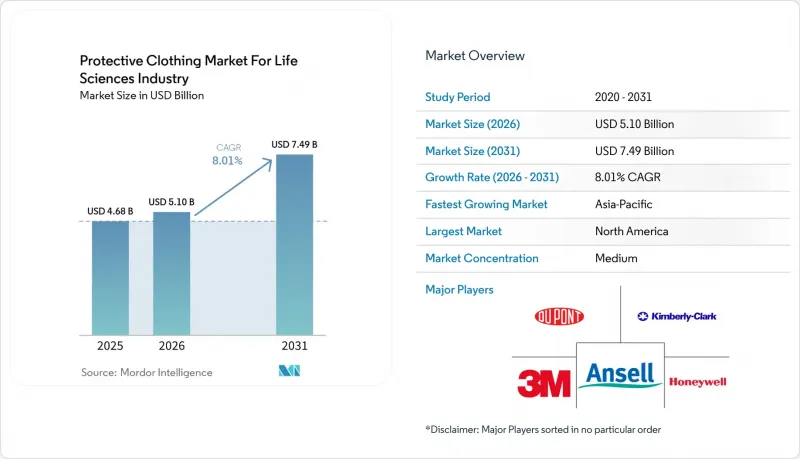
This report is Segmented by Product (Suits/Coveralls, Gloves, Aprons, and More), Material (SMS Fabric, Tyvek and Other HDPE, and More), Type (Disposable, and Reusable), Application (Cleanroom Clothing, Radiation Protection, and More), End User (Pharmaceutical Manufacturing Companies, and More), and Geography. The Market Forecasts are Provided in Terms of Value (USD).
Insights and Trends of Protective Clothing Market For Life Sciences Industry
Strict Regulatory Standards on Patient Safety
Revisions to EU Regulation 2016/425 have harmonized four barrier-performance standards, compelling suppliers to validate microbial and liquid penetration resistance under uniform laboratory methods. ISO 14644-5:2025 now prescribes recorded competency checks, meaning procurement contracts increasingly bundle garments with annual requalification services. U.S. FDA warning letters doubled year-on-year in early 2026, with 40% citing contamination control gaps, a signal that domestic plants must tighten gowning discipline. Draft ISO/DIS 22615 will introduce risk classes for apparel against infectious agents, foreshadowing new label claims that could reset buyers' specification lists. AAMI PB70 Level 4 remains the North American gold standard for high-risk zones, keeping demand strong for multi-layer fabrics.
Growth In Biotechnology and Healthcare Spending
Advanced therapy medicinal product pipelines are scaling aggressively as R&D budgets stay in double-digit territory. CDMOs booked USD 173 billion revenue in 2024 and are tracking toward USD 323 billion by 2033, stoking appetite for validated garment inventories at new fill-finish suites. Mega-facilities in Chengdu, Singapore, and North Carolina each need millions of cleanroom pieces per year once fully online. Capital intensity is high, so sponsors embed garment lifecycle cost models into project economics from day one. Asia-Pacific capacity adds are diversifying sourcing, yet North America still anchors premium-priced biologics runs that specify low-lint fabrics.
Volatility In Technical Fabric Supply Chains
Middle East geopolitical disruption lifted polypropylene resin to a USD 890-1,030 per ton band in 2026, squeezing SMS fabric converters. Force-majeure notices from Gulf suppliers forced apparel makers to shift volumes to higher-cost European mills, inflating finished-goods prices within weeks. Limited petrochemical integration means buyers have little leverage when naphtha crackers idle for security reasons. Tyvek production depends on proprietary flash-spun lines, which buffer resin swings yet concentrate single-source risk. Buyers now negotiate dual-supply clauses and safety-stock buffers that raise working capital requirements.
Other drivers and restraints analyzed in the detailed report include:
- Rising Adoption of Single-Use Cleanroom Apparel
- Expansion Of Cell and Gene Therapy Manufacturing Facilities
- Higher Lifecycle Cost of Reusable Garments
For complete list of drivers and restraints, kindly check the Table Of Contents.
Segment Analysis
Gloves accounted for 37.29% of the protective clothing market size in 2025 because every cleanroom task mandates hand coverage. Demand spans compounding labs to ISO Class 5 aseptic cores, giving glove vendors a stable replacement cycle. Suits and coveralls trail in revenue yet register the fastest 8.99% CAGR, buoyed by cell therapy operators that require integrated hoods and boots. Aprons remain niche for splash zones where mobility trumps full-body coverage, while face masks, hats, goggles, and footwear ride along in bundled sterile kits that simplify warehouse picking. Wipes, though technically consumables, stay on the same purchase orders because they sanitize gowning benches and carts. As workers favor lighter fabrics, Tyvek APX's improved breathability is expected to lift compliance and cut heat-stress breaks, trends that enhance throughput in high-volume fill-finish suites.
The protective clothing market continues to gravitate toward kits that pre-bundle coveralls, gloves, and masks, reducing picking errors and gowning time. Vendor-managed inventory programs place radio-frequency tags on each component, enabling real-time consumption analytics that feed enterprise planning systems. That transparency, coupled with ISO 14644-5 competency logs, is now a differentiator in bid evaluations. Full-body systems also dovetail with robotic filling lines, which require fewer human interventions and thus fewer gown changes per shift. Overall, the product mix evolution supports a higher average selling price trajectory for the protective clothing market.
Tyvek and other HDPE flash-spun fabrics commanded 28.41% share in 2025 on the back of decades of validated bioburden data. Microporous film laminates are growing at 8.91% as their liquid repellence and ultralow lint rates outperform SMS in ISO Class 5 suites. SMS fabric still dominates routine Grade C&D zones thanks to attractive unit economics, but resin volatility is eroding that advantage. Polyethylene-coated polypropylene satisfies inspection rooms where splash risk is minimal, making it a budget pick for late-stage packaging. Reusable woven polyester, grouped under the rest-of-materials bucket, is gaining traction in Europe, where EPR rules penalize single-use waste, yet its adoption remains tied to the availability of validated laundering hubs.
Sustainability themes now push material science forward. Bio-circular feedstocks in Tyvek 500 Xpert BioCircle reduce cradle-to-gate emissions by more than half, and such environmental product declarations are starting to appear in public tenders. Microporous films additionally answer liquid chemical challenges in advanced therapy production, where accidental spills can compromise batch sterility. Vendors that blend barrier performance with climate metrics will likely secure preferred-supplier status as procurement teams add Scope 3 emissions to scorecards. The protective clothing market must therefore juggle cost, compliance, and carbon goals simultaneously.
Geography Analysis
North America led the protective clothing market with 39.84% share in 2025, supported by a dense cluster of contract development and manufacturing organizations and strict FDA oversight. Ongoing automation in U.S. and Canadian plants tempers labor needs but raises per-worker apparel specifications because each operator now services more critical steps. Mexico's nearshoring incentives bolster garment assembly lines that feed North American buyers, shortening replenishment cycles.
Asia-Pacific is on track for a 9.15% CAGR to 2031, narrowing the gap with North America. China's May 2026 Hazardous Chemicals Safety Law obligates employers to fund certified personal protective equipment, expanding addressable volumes across thousands of provincial biotech labs. South Korea's Samsung Biologics Plant 5 came online with 180,000 liters of capacity, while India's revised Labour Codes place legal liability squarely on employers for exposure events, prompting local subsidiaries of multinationals to upgrade from SMS to microporous suits. Japan's aging workforce drives adoption of lighter, ergonomically cut garments that reduce fatigue in prolonged aseptic shifts.
Europe remains a regulation-driven market where Commission Implementing Decision 2025/2078 harmonizes four apparel standards under a single CE-marking pathway. Germany and the United Kingdom continue as the largest spending pockets, although France and Italy see renewed investment tied to on-shoring of high-value sterile injectables. Eastern European sites gain attractiveness because of skilled labour pools and lower utility tariffs, a dynamic that balances overall pricing tension. South America increments moderately, centered on Brazil's contract vaccine capacity, whereas the Middle East and Africa cluster expands mainly in Saudi Arabia and Egypt where pharma industrial zones receive tax holidays. Collectively, these regional nuances sustain diversified growth in the protective clothing market.
- DuPont de Nemours, Inc.
- 3M Company
- Ansell Limited
- Kimberly-Clark Corporation
- Honeywell International Inc.
- Lakeland Industries Inc.
- Cardinal Health Inc.
- Alpha Pro Tech Ltd.
- Medline Industries LP
- Steris plc
- Halyard Health Inc.
- Tronex International Inc.
- Kappler Inc.
- Berkshire Corporation
- Irudek Group
- Radians Inc.
- PIP Global Holdings Inc.
- UVEX Winter Holding GmbH & Co. KG
- San-Cheong Co., Ltd.
- Suntech Protective Clothing
- Riverstone Holdings Limited
Additional Benefits:
- The market estimate (ME) sheet in Excel format
- 3 months of analyst support
TABLE OF CONTENTS
1 INTRODUCTION
- 1.1 Study Assumptions and Market Definition
- 1.2 Scope of the Study
2 RESEARCH METHODOLOGY
3 EXECUTIVE SUMMARY
4 MARKET LANDSCAPE
- 4.1 Market Overview
- 4.2 Impact of Macroeconomic Factors on the Market
- 4.3 Market Drivers
- 4.3.1 Strict Regulatory Standards on Patient Safety
- 4.3.2 Growth in Biotechnology and Healthcare Spending
- 4.3.3 Rising Adoption of Single-Use Cleanroom Apparel
- 4.3.4 Enforcement of Occupational Safety Norms in Emerging Markets
- 4.3.5 Integration of Smart Protective Textiles for Contamination Monitoring
- 4.3.6 Expansion of Cell and Gene Therapy Manufacturing Facilities
- 4.4 Market Restraints
- 4.4.1 Volatility in Technical Fabric Supply Chains
- 4.4.2 Higher Lifecycle Cost of Reusable Garments
- 4.4.3 Stringent Environmental Rules on Disposal and Incineration
- 4.4.4 Skill Shortage Hampering Correct Gowning Compliance
- 4.5 Industry Value-Chain Analysis
- 4.6 Regulatory Landscape
- 4.7 Technological Outlook
- 4.8 Porter's Five Forces Analysis
- 4.8.1 Bargaining Power of Suppliers
- 4.8.2 Bargaining Power of Buyers
- 4.8.3 Threat of New Entrants
- 4.8.4 Threat of Substitutes
- 4.8.5 Intensity of Competitive Rivalry
- 4.9 Pricing Analysis
- 4.10 Investment Analysis
5 MARKET SIZE AND GROWTH FORECASTS (VALUE)
- 5.1 By Product
- 5.1.1 Suits / Coveralls
- 5.1.2 Gloves
- 5.1.3 Aprons
- 5.1.4 Face Masks and Hats
- 5.1.5 Protective Eyewear and Cleanroom Goggles
- 5.1.6 Footwear and Overshoes
- 5.1.7 Wipes
- 5.1.8 Other Products
- 5.2 By Material
- 5.2.1 Spun-bond-Melt-blown-Spun-bond (SMS) Fabric
- 5.2.2 Tyvek and Other High-Density Polyethylene
- 5.2.3 Microporous Film Laminates
- 5.2.4 Polyethylene-Coated Polypropylene
- 5.2.5 Other Materials
- 5.3 By Type
- 5.3.1 Disposable
- 5.3.2 Reusable
- 5.4 By Application
- 5.4.1 Cleanroom Clothing
- 5.4.1.1 Pharmaceutical
- 5.4.1.2 Biotechnology
- 5.4.1.3 Medical
- 5.4.2 Radiation Protection
- 5.4.3 Bacterial / Viral Protection
- 5.4.4 Chemical Protection
- 5.4.5 Other Applications
- 5.4.1 Cleanroom Clothing
- 5.5 By End User
- 5.5.1 Pharmaceutical Manufacturing Companies
- 5.5.2 Biotechnology Laboratories
- 5.5.3 Medical Device Manufacturers
- 5.5.4 Diagnostic and Research Laboratories
- 5.5.5 Contract Manufacturing and Contract Research Organizations
- 5.5.6 Other End-Users
- 5.6 By Geography
- 5.6.1 North America
- 5.6.1.1 United States
- 5.6.1.2 Canada
- 5.6.2 South America
- 5.6.2.1 Brazil
- 5.6.2.2 Argentina
- 5.6.2.3 Rest of South America
- 5.6.3 Europe
- 5.6.3.1 Germany
- 5.6.3.2 United Kingdom
- 5.6.3.3 France
- 5.6.3.4 Italy
- 5.6.3.5 Spain
- 5.6.3.6 Russia
- 5.6.3.7 Rest of Europe
- 5.6.4 Asia-Pacific
- 5.6.4.1 China
- 5.6.4.2 Japan
- 5.6.4.3 India
- 5.6.4.4 South Korea
- 5.6.4.5 Rest of Asia-Pacific
- 5.6.5 Middle East
- 5.6.5.1 Saudi Arabia
- 5.6.5.2 United Arab Emirates
- 5.6.5.3 Turkey
- 5.6.5.4 Rest of Middle East
- 5.6.6 Africa
- 5.6.6.1 South Africa
- 5.6.6.2 Egypt
- 5.6.6.3 Rest of Africa
- 5.6.1 North America
6 COMPETITIVE LANDSCAPE
- 6.1 Market Concentration
- 6.2 Strategic Moves
- 6.3 Market Share Analysis
- 6.4 Company Profiles (includes Global Level Overview, Market Level Overview, Core Segments, Financials as available, Strategic Information, Market Rank/Share, Products and Services, Recent Developments)
- 6.4.1 DuPont de Nemours, Inc.
- 6.4.2 3M Company
- 6.4.3 Ansell Limited
- 6.4.4 Kimberly-Clark Corporation
- 6.4.5 Honeywell International Inc.
- 6.4.6 Lakeland Industries Inc.
- 6.4.7 Cardinal Health Inc.
- 6.4.8 Alpha Pro Tech Ltd.
- 6.4.9 Medline Industries LP
- 6.4.10 Steris plc
- 6.4.11 Halyard Health Inc.
- 6.4.12 Tronex International Inc.
- 6.4.13 Kappler Inc.
- 6.4.14 Berkshire Corporation
- 6.4.15 Irudek Group
- 6.4.16 Radians Inc.
- 6.4.17 PIP Global Holdings Inc.
- 6.4.18 UVEX Winter Holding GmbH & Co. KG
- 6.4.19 San-Cheong Co., Ltd.
- 6.4.20 Suntech Protective Clothing
- 6.4.21 Riverstone Holdings Limited
7 MARKET OPPORTUNITIES AND FUTURE OUTLOOK
- 7.1 White-Space and Unmet-Need Assessment

