PUBLISHER: Mordor Intelligence | PRODUCT CODE: 2066420

PUBLISHER: Mordor Intelligence | PRODUCT CODE: 2066420
Telemedicine - Market Share Analysis, Industry Trends & Statistics, Growth Forecasts (2026 - 2031)
According to Mordor Intelligence, the telemedicine market size is projected to be USD 132.54 billion in 2025, USD 156.31 billion in 2026, and reach USD 317.26 billion by 2031, growing at a CAGR of 15.21% from 2026 to 2031.
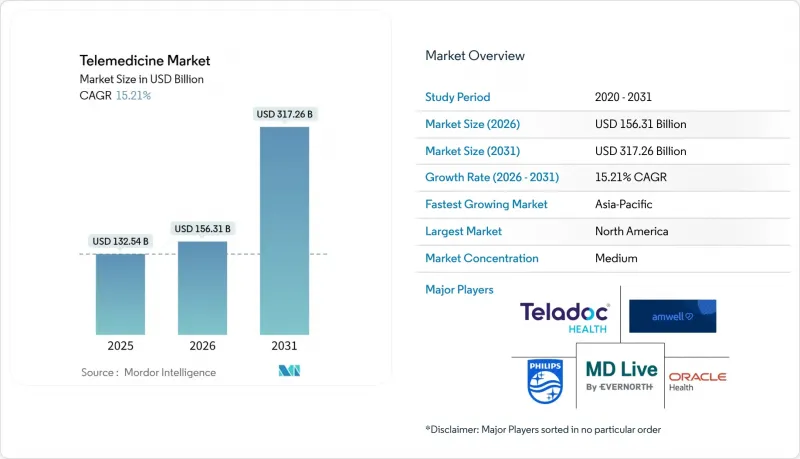
This report is Segmented by Modality (Synchronous, Asynchronous, Remote Patient Monitoring), Component (Software Platforms, Hardware & Peripherals, Services), End User (Healthcare Providers, Payers & Employers, Patients / Home Users, Government Agencies & NGOs), and Geography (North America, Europe, Asia-Pacific, Middle East & Africa, South America). The Market Forecasts are Provided in Terms of Value (USD).
Global Telemedicine Market Trends and Insights
Surging Chronic-Disease Burden And Aging Population
Estimates from the World Health Organization show that the global population aged 65 and older will surpass 1.5 billion by 2050, with more than 60% living with at least one chronic condition. Telehealth lowers mobility-related barriers for seniors by enabling remote follow-ups and continuous monitoring of vitals, resulting in earlier interventions that reduce hospital readmissions by 22% among Medicare Advantage enrollees in the United States. Payers favor these outcomes because chronic-disease care accounts for approximately 75% of health expenditures in high-income countries. The alignment of demographic pressure and value-based funding embeds telemedicine market solutions into baseline care workflows. Because these structural forces evolve over decades, demand remains resilient regardless of economic cycles.
Payer Reimbursement Parity Laws Expanding In OECD And BRICS Regions
By the end of 2025, 43 U.S. states mandated private-payer parity for virtual visits, and 24 states extended equivalent payments to Medicaid beneficiaries. Similar frameworks were introduced in France, Germany, India, and Brazil, effectively removing the financial barrier that had previously limited adoption to affluent patients. With tariffs aligned to in-person care, provider groups are confident about revenue continuity, while patients in price-sensitive segments enjoy lower out-of-pocket costs. This regulatory shift normalizes telehealth as a covered benefit, underpinning predictable utilization patterns across multiple insurance cohorts.
Data-Privacy And Cross-Border Licensure Regulations Remain Fragmented
The European Union's GDPR restricts cross-border data flows, and enforcement actions between 2024-2025 levied EUR 120 million in penalties on operators that stored patient records outside the bloc. In the United States, only 40 states had joined the Interstate Medical Licensure Compact by late 2025, leaving physicians to secure multiple licenses at fees surpassing USD 1,000 per jurisdiction. India's pending Digital Personal Data Protection Act requires domestic data residency, which increases infrastructure costs for multinational platforms. These inconsistencies elevate compliance overhead and compress the telemedicine market's cross-regional scalability.
Other drivers and restraints analyzed in the detailed report include:
- 5G And Edge-Computing Roll-Outs Enabling Low-Latency Video Consultations
- Employer-Sponsored Virtual Primary-Care Plans Scaling Rapidly
- Physician Reimbursement Cuts In Medicare Draft Rules
For complete list of drivers and restraints, kindly check the Table Of Contents.
Segment Analysis
Remote patient monitoring captured accelerating interest, notching a 17.09% CAGR forecast through 2031 as the U.S. FDA cleared successive waves of connected glucose, cardiac, and blood-pressure sensors that stream continuous data to cloud analytics engines. Synchronous video maintained the largest 2025 revenue share at 44.28%, particularly suited for primary-care, urgent-care, and behavioral-health sessions that require real-time interaction. Asynchronous workflows, including store-and-forward imaging and secure messaging, accounted for approximately 25% of spending. Medicare Advantage enrolled 32 million members in RPM programs by the end of 2025, reducing 30-day readmissions by 22% and confirming payer appetite for continuous-care models.
Synchronous utilization is stabilizing at one-quarter of outpatient encounters, down from pandemic highs, yet remains far above pre-COVID levels. Asynchronous modalities benefit from lower bandwidth demands and flexible scheduling, although payment rates tend to lag behind those for live visits. The incorporation of AI triage that prioritizes dermatology images or flags cardiac anomalies is expected to lift asynchronous adoption in bandwidth-constrained regions. Overall, RPM's always-on data model positions it to redefine chronic-care economics, securing the largest incremental share of telemedicine market revenue over the next decade.
Geography Analysis
North America contributed 38.06% of global revenue in 2025, driven by well-established reimbursement policies, high broadband penetration, and robust employer adoption. The Asia-Pacific region, however, is projected to deliver the fastest regional CAGR of 19.59% through 2031, driven by government-backed digital health initiatives. India's eSanjeevani recorded its 300 millionth consultation by mid-2025, while China's AI-enhanced provincial platforms cover more than 400 million rural residents.
In Europe, France reimburses 100% of chronic-care video follow-ups, Germany's DiGA program prescribes reimbursable health apps, and the United Kingdom has embedded virtual consults across National Health Service primary-care pathways. Despite structural regulatory support, fragmented EHR infrastructures and language diversity temper pan-European scalability, slowing the uptake compared with the Asia-Pacific region.
Gulf states are installing 5G kiosks in malls and public offices, whereas South Africa's private payers only recently began funding telepsychiatry. Latin America accounted for approximately 4% of global revenue, with Brazil expanding virtual mental health coverage and Argentina running rural remote monitoring pilots. Regional growth trajectories correlate strongly with broadband availability and government willingness to reimburse, confirming the telemedicine market's dependence on synchronized policy and infrastructure advances.
- Allscripts
- Amwell (American Well)
- Babylon Health
- Cerner / Oracle Health
- Cisco Systems
- Doctor On Demand
- eClinicalWorks
- Epic Systems
- GE Healthcare
- Honeywell International
- Koninklijke Philips
- MDLive (Cigna)
- Medtronic
- PlushCare
- Practo Technologies Pvt. Ltd.
- Resideo Technologies
- SHL Telemedicine Ltd.
- Siemens Healthineers
- Teladoc Health
- Zoom Video Communications
Additional Benefits:
- The market estimate (ME) sheet in Excel format
- 3 months of analyst support
TABLE OF CONTENTS
1 Introduction
- 1.1 Study Assumptions & Market Definition
- 1.2 Scope of the Study
2 Research Methodology
3 Executive Summary
4 Market Landscape
- 4.1 Market Overview
- 4.2 Market Drivers
- 4.2.1 Surging Chronic Disease Prevalence and Ageing Population
- 4.2.2 Payer Reimbursement Parity Laws Expanding in OECD & BRICS Regions
- 4.2.3 5G And Edge-Computing Roll-Outs Enabling Low-Latency Video Consultations
- 4.2.4 Employer-Sponsored Virtual Primary-Care Plans Scaling Rapidly
- 4.2.5 Pandemic-Driven Consumer Preference for Virtual Visits Sustaining Post-COVID
- 4.2.6 Integration of AI-Based Decision-Support Improving Clinical Acceptance
- 4.3 Market Restraints
- 4.3.1 Data-Privacy & Cross-Border Licensure Regulations Remain Fragmented
- 4.3.2 Physician Reimbursement Cuts in Medicare 2026+ Draft Rules
- 4.3.3 Digital-Divide Limiting Rural Patient Adoption in Low-Income Economies
- 4.3.4 Platform Fatigue Among Clinicians Due To EHR-Telehealth Integration Gaps
- 4.4 Regulatory Landscape
- 4.5 Technological Outlook
- 4.6 Porter's Five Forces Analysis
- 4.6.1 Threat of New Entrants
- 4.6.2 Bargaining Power of Buyers
- 4.6.3 Bargaining Power of Suppliers
- 4.6.4 Threat of Substitutes
- 4.6.5 Competitive Rivalry
5 Market Size & Growth Forecasts
- 5.1 By Modality
- 5.1.1 Synchronous
- 5.1.2 Asynchronous
- 5.1.3 Remote Patient Monitoring
- 5.2 By Component
- 5.2.1 Software Platforms
- 5.2.2 Hardware & Peripherals
- 5.2.3 Services
- 5.2.3.1 Telepathology
- 5.2.3.2 Telecardiology
- 5.2.3.3 Teleradiology
- 5.2.3.4 Teledermatology
- 5.2.3.5 Telepsychiatry
- 5.2.3.6 Telestroke
- 5.2.3.7 Other Services
- 5.3 By End User
- 5.3.1 Healthcare Providers
- 5.3.2 Payers & Employers
- 5.3.3 Patients / Home Users
- 5.3.4 Government Agencies & NGOs
- 5.4 By Geography
- 5.4.1 North America
- 5.4.1.1 United States
- 5.4.1.2 Canada
- 5.4.1.3 Mexico
- 5.4.2 Europe
- 5.4.2.1 Germany
- 5.4.2.2 United Kingdom
- 5.4.2.3 France
- 5.4.2.4 Italy
- 5.4.2.5 Spain
- 5.4.2.6 Rest of Europe
- 5.4.3 Asia-Pacific
- 5.4.3.1 China
- 5.4.3.2 Japan
- 5.4.3.3 India
- 5.4.3.4 Australia
- 5.4.3.5 South Korea
- 5.4.3.6 Rest of Asia-Pacific
- 5.4.4 Middle East & Africa
- 5.4.4.1 GCC
- 5.4.4.2 South Africa
- 5.4.4.3 Rest of Middle East & Africa
- 5.4.5 South America
- 5.4.5.1 Brazil
- 5.4.5.2 Argentina
- 5.4.5.3 Rest of South America
- 5.4.1 North America
6 Competitive Landscape
- 6.1 Market Concentration
- 6.2 Market Share Analysis
- 6.3 Company Profiles (includes Global level Overview, Market-level Overview, Core Segments, Financials, Strategic Information, Market Rank/Share, Products & Services, Recent Developments)
- 6.3.1 Allscripts Healthcare Solutions Inc.
- 6.3.2 Amwell (American Well)
- 6.3.3 Babylon Health
- 6.3.4 Cerner / Oracle Health
- 6.3.5 Cisco Systems
- 6.3.6 Doctor On Demand
- 6.3.7 eClinicalWorks
- 6.3.8 Epic Systems
- 6.3.9 GE Healthcare
- 6.3.10 Honeywell International Inc.
- 6.3.11 Koninklijke Philips N.V.
- 6.3.12 MDLive (Cigna)
- 6.3.13 Medtronic
- 6.3.14 PlushCare
- 6.3.15 Practo Technologies Pvt. Ltd.
- 6.3.16 Resideo Technologies Inc.
- 6.3.17 SHL Telemedicine Ltd.
- 6.3.18 Siemens Healthineers
- 6.3.19 Teladoc Health Inc.
- 6.3.20 Zoom Video Communications
7 Market Opportunities & Future Outlook
- 7.1 White-space & Unmet-need Assessment

