PUBLISHER: Mordor Intelligence | PRODUCT CODE: 2066443

PUBLISHER: Mordor Intelligence | PRODUCT CODE: 2066443
Europe Automated Storage And Retrieval Systems - Market Share Analysis, Industry Trends & Statistics, Growth Forecasts (2026 - 2031)
According to Mordor Intelligence, the europe automated storage and retrieval systems market size is expected to grow from USD 6.62 billion in 2025 to USD 7.34 billion in 2026 and is forecast to reach USD 11.44 billion by 2031 at 9.28% CAGR over 2026-2031.
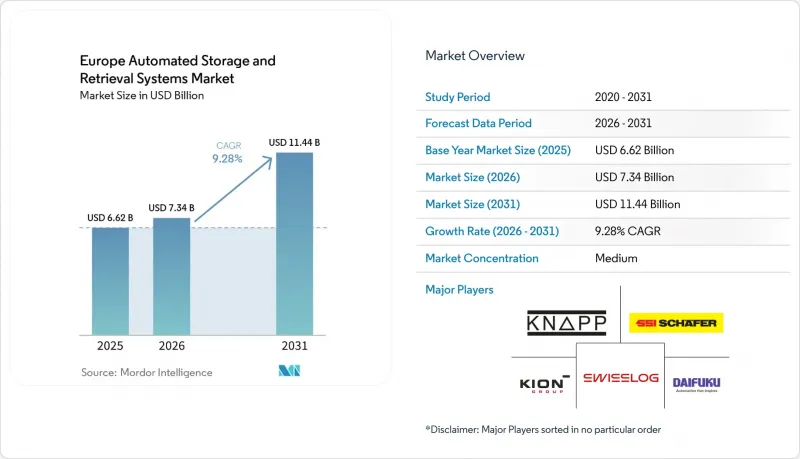
This report is Segmented by Product Type (Unit Load ASRS, Mini Load ASRS, and More), Load Capacity (Light Load (Below 100 Kg), Medium Load (100-500 Kg), Heavy Load (Above 500 Kg)), System Configuration (Moveable Aisle Crane, Cube-Based Storage, and More), End-User Vertical (Airports, Automotive, and More), and Geography. The Market Forecasts are Provided in Terms of Value (USD).
Europe Automated Storage And Retrieval Systems Market Trends and Insights
E-commerce Surge Requiring High Throughput Fulfillment
Order volumes now demand sub-two-hour delivery in large metropolitan areas, compelling operators to deploy automated storage and retrieval systems capable of 6,000 pallet movements per day. A brownfield retrofit in Rumst, Belgium, achieved this benchmark by operating 20 autonomous shuttles across four levels and reusing existing racking, resulting in EUR 680,000 in capital expenditure savings and a reduction of 680 t of carbon emissions. A United Kingdom facility, commissioned in December 2025, employs 200 robots across 3,000 m2 to quadruple picking efficiency. Micro-fulfillment modules inserted into grocery backrooms further decentralize inventory and reduce last-mile costs, positioning modular shuttles and cube grids as the preferred architecture.
Rising Labor Shortages and Wage Inflation Across Europe
Logistics wages in Germany and the Netherlands advanced by double digits in 2025, compressing payback periods on automation to under three years. A survey of European operators revealed a 90% adoption rate of AI tools as firms rushed to offset labor shortages. Third-party logistics leaders now operate thousands of autonomous mobile robots across multi-temperature zones, blending collaborative automation with human quality control. The dynamic strengthens demand for shuttle systems that can run 24/7 without shift changeovers while maintaining occupational safety standards.
High Upfront Capital Expenditure for SMEs
Entry-level installations cost EUR 1 million, while high-bay projects can exceed EUR 20 million, excluding civil works. Only 8% of European SMEs had adopted advanced digital tools by 2024, citing financing constraints. While leasing and automation-as-a-service models are available, their presence is largely confined to Western Europe. This limited availability has slowed the adoption of these models by logistics firms in other regions, as they face challenges such as lack of infrastructure, awareness, and tailored solutions to meet their specific operational needs.
Other drivers and restraints analyzed in the detailed report include:
- Shrinking Warehouse Space and Urban Land Costs
- Advancements in AI-Driven Warehouse Execution Software
- Integration Complexities with Legacy WMS and ERP
For complete list of drivers and restraints, kindly check the Table Of Contents.
Segment Analysis
Unit Load ASRS secured 35.24% of Europe Automated Storage and Retrieval Systems market share in 2025, reflecting the dominance of pallet-centric buffers at automotive and general manufacturing plants. The Europe Automated Storage and Retrieval Systems market size tied to Shuttle and Bot Systems is projected to rise at a 10.63% CAGR as omnichannel retailers add robots in small tranches without re-engineering racking, a capability proven by Knapp's OSR Shuttle Evo, which clears 1,000 bin picks per hour. Cube grids can disrupt space-constrained nodes, such as airport duty-free stores, where an AutoStore installation in Oslo increased capacity by 64% within the same 318 m2 footprint.
Second-generation shuttle projects have reduced civil costs by EUR 680,000 and 680 tonnes of carbon at a Belgian brownfield site, while maintaining 6,000 pallet moves per day. Grocers plan similar grids inside backrooms, as shown by Axfood's Kungsbacka project, to meet click-and-collect demand. Beverage producers favor hybrid layouts that merge pallet shuttles with cranes and conveyors under one SynQ layer, a model Ringnes will adopt from 2026.
Medium-load systems, ranging from 100 kg to 500 kg, captured 47.33% of the European Automated Storage and Retrieval System market share in 2025, driven by pallet flows in automotive and third-party logistics corridors. Light-load units below 100 kg are projected to expand at a 9.77% CAGR as grocers and pharmacies integrate tote grids that fulfill orders in under 30 minutes. Vaisala's 8,000-bin AutoStore grid, located within a 2,000 m2 site, exemplifies the compact design trend. Roche's Kaiseraugst hub demonstrates that tote automation also thrives in cooled drug warehouses, where 1,500 pallet moves occur daily at temperatures ranging from +2 °C to +8 °C.
Urban retailers require small payload speed, so Light Load modules now command a growing share of the European Automated Storage and Retrieval System market, especially in Spain and France, where click-and-collect volumes surge on weekends. Automotive plants still rely on Medium-Load tugger trains for sequenced parts, blending load classes under a single software stack. Heavy Load lanes remain a niche service, serving beverage kegs at Ringnes's forthcoming shuttle complex, which will transport 1,000 kg pallets within ambient and chilled zones.
List of Companies Covered in this Report:
- Daifuku Co. Ltd
- KION Group AG
- SSI Schaefer AG
- Knapp AG
- Swisslog AG
- Jungheinrich AG
- Toyota Industries Corporation
- Kardex Holding AG
- Mecalux SA
- Murata Machinery Ltd
- Viastore Systems GmbH
- Autostore Holdings Ltd
- Vanderlande Industries BV
- TGW Logistics Group GmbH
- System Logistics SpA
- Ocado Group plc
- Industore Ltd
- Honeywell Intelligrated Inc
Additional Benefits:
- The market estimate (ME) sheet in Excel format
- 3 months of analyst support
TABLE OF CONTENTS
1 INTRODUCTION
- 1.1 Study Assumptions and Market Definition
- 1.2 Scope of the Study
2 RESEARCH METHODOLOGY
3 EXECUTIVE SUMMARY
4 MARKET LANDSCAPE
- 4.1 Market Overview
- 4.2 Market Drivers
- 4.2.1 Shrinking Warehouse Space and Urban Land Costs
- 4.2.2 E-commerce Surge Requiring High Throughput Fulfilment
- 4.2.3 Rising Labor Shortages and Wage Inflation Across Europe
- 4.2.4 Advancements in AI-Driven Warehouse Execution Software
- 4.2.5 ESG Mandates Driving Energy-Efficient Warehouse Automation
- 4.2.6 EU Funding for Industry 4.0 and Digital Logistics Initiatives
- 4.3 Market Restraints
- 4.3.1 High Upfront Capital Expenditure for SMEs
- 4.3.2 Integration Complexities with Legacy WMS and ERP
- 4.3.3 Limited Skilled Technicians for Maintenance
- 4.3.4 Supply-Chain Disruptions Inflating Component Lead Times
- 4.4 Industry Value Chain Analysis
- 4.5 Regulatory Landscape
- 4.6 Impact of Macroeconomic Factors on the Market
- 4.7 Technological Outlook
- 4.8 Porter's Five Forces Analysis
- 4.8.1 Bargaining Power of Suppliers
- 4.8.2 Bargaining Power of Consumers
- 4.8.3 Threat of New Entrants
- 4.8.4 Intensity of Competitive Rivalry
- 4.8.5 Threat of Substitutes
- 4.9 Investment Analysis
- 4.10 Assessment of the Impact of COVID-19 on the Market
5 MARKET SIZE AND GROWTH FORECASTS (VALUE)
- 5.1 By Product Type
- 5.1.1 Unit Load ASRS
- 5.1.2 Mini Load ASRS
- 5.1.3 Shuttle and Bot Systems
- 5.1.4 Carousel Systems, Horizontal
- 5.1.5 Carousel Systems, Vertical
- 5.1.6 Vertical Lift Modules
- 5.1.7 Hybrid Integrated Systems
- 5.2 By Load Capacity
- 5.2.1 Light Load (Below 100 kg)
- 5.2.2 Medium Load (100-500 kg)
- 5.2.3 Heavy Load (Above 500 kg)
- 5.3 By System Configuration
- 5.3.1 Fixed Aisle Stacker Crane
- 5.3.2 Moveable Aisle Crane
- 5.3.3 Cube-Based Storage
- 5.3.4 Free-Roaming Robotic Shuttles
- 5.3.5 Micro-Fulfilment Modules
- 5.4 By End-User Vertical
- 5.4.1 Airports
- 5.4.2 Automotive
- 5.4.3 Retail and E-commerce
- 5.4.4 Third-Party Logistics Providers
- 5.4.5 General Manufacturing
- 5.4.6 Food and Beverage
- 5.4.7 Pharmaceuticals
- 5.4.8 Other End-User Verticals
- 5.5 By Country
- 5.5.1 United Kingdom
- 5.5.2 Germany
- 5.5.3 France
- 5.5.4 Italy
- 5.5.5 Spain
- 5.5.6 Central and Eastern Europe
- 5.5.7 Rest of Europe
6 COMPETITIVE LANDSCAPE
- 6.1 Market Concentration
- 6.2 Strategic Moves
- 6.3 Market Share Analysis
- 6.4 Company Profiles (includes Global Level Overview, Market Level Overview, Core Segments, Financials as Available, Strategic Information, Market Rank/Share for Key Companies, Products and Services, and Recent Developments)
- 6.4.1 Daifuku Co. Ltd
- 6.4.2 KION Group AG
- 6.4.3 SSI Schaefer AG
- 6.4.4 Knapp AG
- 6.4.5 Swisslog AG
- 6.4.6 Jungheinrich AG
- 6.4.7 Toyota Industries Corporation
- 6.4.8 Kardex Holding AG
- 6.4.9 Mecalux SA
- 6.4.10 Murata Machinery Ltd
- 6.4.11 Viastore Systems GmbH
- 6.4.12 Autostore Holdings Ltd
- 6.4.13 Vanderlande Industries BV
- 6.4.14 TGW Logistics Group GmbH
- 6.4.15 System Logistics SpA
- 6.4.16 Ocado Group plc
- 6.4.17 Industore Ltd
- 6.4.18 Honeywell Intelligrated Inc
7 MARKET OPPORTUNITIES AND FUTURE OUTLOOK
- 7.1 White-Space and Unmet-Need Assessment

