PUBLISHER: Mordor Intelligence | PRODUCT CODE: 2066447

PUBLISHER: Mordor Intelligence | PRODUCT CODE: 2066447
Graphene - Market Share Analysis, Industry Trends & Statistics, Growth Forecasts (2026 - 2031)
According to Mordor Intelligence, the graphene market size was valued at USD 2.09 billion in 2025 and is estimated to grow from USD 2.91 billion in 2026 to reach USD 15.20 billion by 2031, at a CAGR of 39.18% during the forecast period (2026-2031).
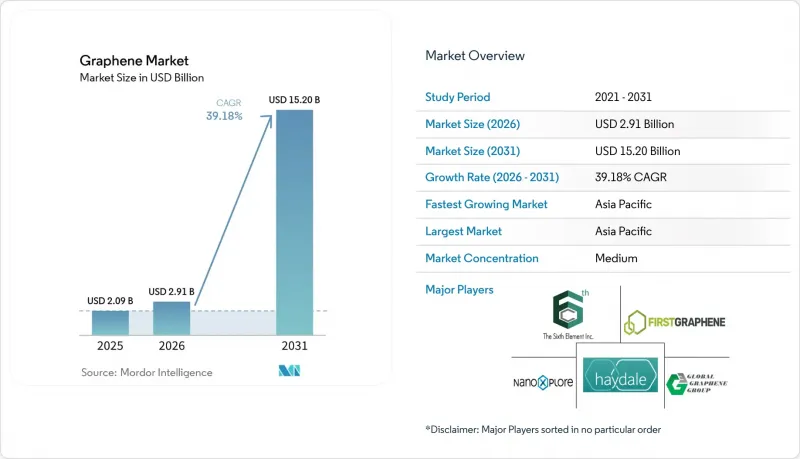
This report is Segmented by Product Type (Graphene Sheets and Films, Nanoplatelets, and Others), Application (Composites, Biomedical and Healthcare, and Others), End-User Industry (Electronics and Telecommunications, Biomedical and Healthcare, and Others), and Geography (Asia-Pacific, North America, Europe, South America, and the Middle-East and Africa). The Market Forecasts are Provided in Terms of Value (USD).
Global Graphene Market Trends and Insights
Increasing Usage of Graphene in the Aerospace Industry
Aircraft OEMs embed graphene nanoplatelets into carbon-fiber prepregs to secure 15-20% structural weight reductions, a threshold needed to reach 25% fuel-burn improvements over legacy wide-body fleets. Boeing's 2025 supplier documents mandate graphene composites in the 777X secondary structures, citing lightning-strike dissipation that exceeds aluminum honeycomb by 40%. Airbus is piloting graphene oxide surface coatings on A350 control panels to curb galvanic corrosion in humid coastal climates, a persistent maintenance driver for long-haul operators. Defense contracts reinforce the trend: the US Air Force Research Laboratory awarded USD 18 million in 2025 to develop radar-absorbing graphene laminates that lower X-band signatures on sixth-generation fighter prototypes. Qualification cycles, however, average 18-24 months under AS9100 protocols, delaying revenue recognition for smaller suppliers and sustaining premium pricing.
Expansion of Energy-Storage Applications Utilizing Graphene
Utilities are retrofitting lithium-ion arrays installed between 2018 and 2022 with graphene-enhanced anodes that raise charge acceptance by 35%, enabling lucrative frequency-regulation services in deregulated power pools. A USD 42 million supply deal inked by NanoXplore in March 2025 covers 500 MWh of such upgrades across five US states, the largest commercial deployment to date. Smartphone vendors pursue parallel gains: graphene supercapacitors paired with 100-watt chargers eliminate thermal-runaway risks at room temperature, a feature Samsung plans to commercialize in 2026 flagships. Longer-term research from the DOE's Battery500 Consortium targets 500 Wh/kg cells, double present benchmarks, positioning graphene as a vital bridge to post-lithium chemistries.
High Production Cost
Chemical-vapor-deposition sheets command USD 200-500 /kg, compared with USD 10-20 for carbon nanotubes and USD 2-5 for carbon black, keeping many high-volume uses financially out of reach. Liquid-phase exfoliation, the workhorse process for nanoplatelets, consumes 40-60 kWh/kg in solvent recovery alone, adding USD 80-120 in energy overheads at industrial tariffs. First Graphene's 2025 results revealed average 38% gross margins versus 55-65% for specialty chemicals, constraining reinvestment in capacity. Scaling offers partial relief-doubling throughput shaves merely 12-15% off cost per kilogram-far below learning-curve precedents set by lithium-ion or photovoltaics. Equipment suppliers, facing uncertain demand visibility, maintain 18-24 month lead times on reactors exceeding 500 tpa, delaying supply-side elasticity.
Other drivers and restraints analyzed in the detailed report include:
- Growing Demand in Electronics and Semiconductors
- Commercialisation of Graphene EMI-Shielding Foams for 5G Infrastructure
- Availability of Substitutes
For complete list of drivers and restraints, kindly check the Table Of Contents.
Segment Analysis
Graphene Nanoplatelets (GNP) captured 56.14% of 2025 revenue, reflecting their seamless integration into twin-screw extruders and three-roll mills long familiar to polymer compounders. This dominance anchors the graphene market size at the product level, with forecast penetration expanding at a 44.63% CAGR to 2031 as unit pricing slides below USD 80/kg in China. Nanoplatelets dispersed at 1-3 wt% lift tensile modulus by up to 300%, enabling automakers to shave 12-15% off underbody shield mass while meeting 2027 crash standards. Sixth Element (Changzhou) booked USD 85 million in nanoplatelet sales in 2025, up 62% year-over-year, underscoring China's cost leverage in the graphene market. Functionalized derivatives extend utility: carboxylated variants launched by Perpetuus strengthen epoxies by 35%, reducing delamination in aerospace honeycomb cores.
Films and sheets remain a premium niche, priced at USD 800-1,200/m2, yet their optical clarity (98%) and conductivity (more than 10^6 S/m) attract foldable display OEMs. LG Display expects to convert 100,000 m2 per year by 2027, adequate for 50 million 7-inch screens, positioning transparent conductors as a 10-figure sub-segment of the graphene market. Oxide flakes, though holding a smaller slice, anchor biomedical innovations where covalent bonding with antibodies underpins femtomolar biosensor sensitivity. Quantum dots and aerogels linger in R&D, but grant funding focuses on photocatalytic hydrogen production and gigahertz-wave absorption, hedging against future value-pool shifts.
Geography Analysis
Asia-Pacific anchored 45.23% of 2025 revenue and is on track for a 45.69% CAGR through 2031, ensuring it remains the largest regional node of the graphene market. China's cradle-to-gate integration, from natural-graphite mining in Heilongjiang to 3,000 tpa nanoplatelet dispersion in Changzhou, cuts delivered cost to USD 60-80/kg, half European averages, catalyzing commoditization in polymer compounding and battery additives. Taiwan's TSMC validated graphene interconnects that lower signal delay by 18% in 2 nm test wafers, demonstrating semiconductor pull that anchors regional investment. India earmarked INR 500 crore (USD 60 million) in 2025 for a National Graphene Mission focused on water purification membranes, illustrating policy alignment with climate-adaptation infrastructure.
North America's revenue is buoyed by DOE-funded anode lines and aerospace composite demand. The Bipartisan Infrastructure Law assigns USD 140 million to graphene-enhanced lithium-ion manufacturing, creating a protected corridor for domestic cell makers. NanoXplore's Montreal expansion to 4,000 tpa in Q3 2025 lowers logistics costs within a 500-mile EV-battery supply radius, while Canada's Strategic Innovation Fund injected CAD 30 million (USD 22 million) into Grafoid's biomedical-graphene oxide pilot, signaling Ottawa's tilt toward high-margin healthcare niches. Mexico gains traction as a printed-electronics hub, hosting Vorbeck's 2 million m2 ink plant that services cross-border automotive customers.
Europe's revenue in 2025 was retained with momentum in aerospace composites and desalination coatings supported by the Graphene Flagship's EUR 1 billion funding envelope. Versarien's UK pilot lines, backed by EUR 8 million of Flagship funds, target Airbus A350 control-surface resins to tame galvanic corrosion. Germany's Fraunhofer Institute co-develops graphene thermal interfaces that promise 20% inverter-junction-temperature cuts in battery electric vehicles, chasing extended drivetrain durability. REACH pre-registration triggered a mid-tier shakeout, prompting 15 exits or consolidations and nudging the regional graphene market size toward higher concentration. South America and the Middle East trail yet signal application-specific interest: Saudi Arabia's desalination plants logged 70% corrosion reductions using graphene coatings, and Brazil's Minas Gerais institute pilots graphene-reinforced tailings dams to mitigate collapse risk in mining regions.
- ACS Material
- Cabot Corporation
- Cheap Tubes
- Directa Plus S.p.A.
- First Graphene Ltd
- G6 Materials Corp.
- Global Graphene Group
- Grafoid Inc
- Graphene Manufacturing Group Ltd
- Graphenea
- Haydale Graphene Industries plc
- NanoXplore Inc.
- Perpetuus Advanced Materials
- Talga Group
- The Sixth Element (Changzhou) Materials Technology Co.,Ltd
- Thomas Swan & Co. Ltd
- Universal Matter Inc
- Versarien plc
- Vorbeck Materials Corp.
Additional Benefits:
- The market estimate (ME) sheet in Excel format
- 3 months of analyst support
TABLE OF CONTENTS
1 Introduction
- 1.1 Study Assumptions & Market Definition
- 1.2 Scope of the Study
2 Research Methodology
3 Executive Summary
4 Market Landscape
- 4.1 Market Overview
- 4.2 Market Drivers
- 4.2.1 Increasing usage of graphene in the aerospace industry
- 4.2.2 Adoption of graphene anti-corrosion coatings in desalination infrastructure
- 4.2.3 Expansion of energy-storage applicationsutilizing graphene
- 4.2.4 Growing demand in electronics and semiconductors
- 4.2.5 Commercialisation of graphene EMI-shielding foams for 5G infrastructure
- 4.3 Market Restraints
- 4.3.1 High production cost
- 4.3.2 Availability of substitutes
- 4.3.3 Nanotoxicology & regulatory uncertainty
- 4.4 Value Chain Analysis
- 4.5 Porter's Five Forces
- 4.5.1 Bargaining Power of Suppliers
- 4.5.2 Bargaining Power of Buyers
- 4.5.3 Threat of New Entrants
- 4.5.4 Threat of Substitutes
- 4.5.5 Degree of Competition
5 Market Size & Growth Forecasts (Value)
- 5.1 By Product Type
- 5.1.1 Graphene Sheets and Films
- 5.1.2 Graphene Nanoplatelets (GNP)
- 5.1.3 Graphene Oxide (GO)
- 5.1.4 Nanoplatelets
- 5.1.5 Others
- 5.2 By Application
- 5.2.1 Composites
- 5.2.2 Energy Storage and Harvesting
- 5.2.3 Printed and Flexible Electronics
- 5.2.4 Biomedical and Healthcare
- 5.2.5 Coatings and Paints
- 5.2.6 Others
- 5.3 By End-user Industry
- 5.3.1 Electronics and Telecommunications
- 5.3.2 Aerospace and Defense
- 5.3.3 Energy and Power
- 5.3.4 Biomedical and Healthcare
- 5.3.5 Others(automotive, Chemical and Coatings)
- 5.4 By Geography
- 5.4.1 Asia-Pacific
- 5.4.1.1 China
- 5.4.1.2 Japan
- 5.4.1.3 South Korea
- 5.4.1.4 India
- 5.4.1.5 ASEAN Countries
- 5.4.1.6 Rest of Asia-Pacific
- 5.4.2 North America
- 5.4.2.1 United States
- 5.4.2.2 Canada
- 5.4.2.3 Mexico
- 5.4.3 Europe
- 5.4.3.1 Germany
- 5.4.3.2 United Kingdom
- 5.4.3.3 France
- 5.4.3.4 Italy
- 5.4.3.5 Spain
- 5.4.3.6 NORDIC Countries
- 5.4.3.7 Rest of Europe
- 5.4.4 South America
- 5.4.4.1 Brazil
- 5.4.4.2 Argentina
- 5.4.4.3 Colombia
- 5.4.4.4 Rest of South America
- 5.4.5 Middle-East and Africa
- 5.4.5.1 Saudi Arabia
- 5.4.5.2 United Arab Emirates
- 5.4.5.3 South Africa
- 5.4.5.4 Egypt
- 5.4.5.5 Rest of Middle-East and Africa
- 5.4.1 Asia-Pacific
6 Competitive Landscape
- 6.1 Market Concentration
- 6.2 Strategic Moves
- 6.3 Market Share(%)/Ranking Analysis
- 6.4 Company Profiles (includes Global-level Overview, Market-level Overview, Core Segments, Financials as available, Strategic Information, Market Rank/Share for key companies, Products & Services, and Recent Developments)
- 6.4.1 ACS Material
- 6.4.2 Cabot Corporation
- 6.4.3 Cheap Tubes
- 6.4.4 Directa Plus S.p.A.
- 6.4.5 First Graphene Ltd
- 6.4.6 G6 Materials Corp.
- 6.4.7 Global Graphene Group
- 6.4.8 Grafoid Inc
- 6.4.9 Graphene Manufacturing Group Ltd
- 6.4.10 Graphenea
- 6.4.11 Haydale Graphene Industries plc
- 6.4.12 NanoXplore Inc.
- 6.4.13 Perpetuus Advanced Materials
- 6.4.14 Talga Group
- 6.4.15 The Sixth Element (Changzhou) Materials Technology Co.,Ltd
- 6.4.16 Thomas Swan & Co. Ltd
- 6.4.17 Universal Matter Inc
- 6.4.18 Versarien plc
- 6.4.19 Vorbeck Materials Corp.
7 Market Opportunities & Future Outlook
- 7.1 Development of graphene nanodevices for DNA sequencing
- 7.2 Adoption of graphene into photodetectors
- 7.3 White-space & Unmet-need Assessment

