PUBLISHER: Mordor Intelligence | PRODUCT CODE: 2066471

PUBLISHER: Mordor Intelligence | PRODUCT CODE: 2066471
Wood Pulp - Market Share Analysis, Industry Trends & Statistics, Growth Forecasts (2026 - 2031)
According to Mordor Intelligence, the wood pulp market size was valued at USD 168.4 billion in 2025 and is estimated to grow from USD 177.9 billion in 2026 to reach USD 219.7 billion by 2031, at a CAGR of 4.3% during the forecast period (2026-2031).
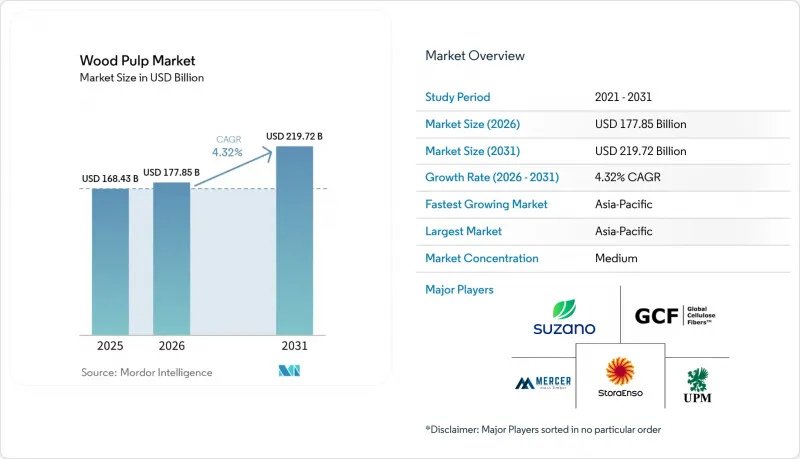
This report is Segmented by Fiber Source (Hardwood, Softwood, and Non-Wood Fibers), by End-Use Industry (Packaging and Cartonboard, Tissue and Hygiene, Printing and Writing, and More), by Process (Chemical, Mechanical, and More), and by Geography (North America, Europe, Asia-Pacific, South America, Middle East, and Africa). The Market Forecasts are Provided in Terms of Value (USD) and Volume.
Global Wood Pulp Market Trends and Insights
E-commerce-led corrugated packaging demand
The wood pulp market is directly influenced by parcel growth, as corrugated packaging remains a key fiber-consuming application in global trade and direct-to-consumer delivery. Packaging Corp. of America reported an 11.1% year-over-year increase in corrugated packaging shipments during Q3 2024, reflecting high containerboard system utilization despite elevated recovered fiber costs. In China, machine-made paper and paperboard output totaled 106.659 million metric tons from January to August 2025, underscoring sustained demand even amid concerns about domestic overcapacity. To meet the evolving needs of fulfillment centers, buyers are prioritizing stronger corrugating grades for higher compression performance at reduced package weights, enhancing the value of premium kraft pulp. Simultaneously, molded fiber packaging is gaining traction as a sustainable alternative to single-use plastics, further driving demand for wood pulp across diverse consumer categories. Together, these trends highlight the growing reliance on advanced packaging solutions to support e-commerce and global trade.
Tissue and hygiene demand expansion in emerging markets
The wood pulp market is driven by growing tissue and hygiene demand in regions with per-capita usage significantly below global averages. In India, tissue paper production capacity, at 238,000-248,000 metric tons per year in 2024, is projected to reach 417,000 metric tons per year by early 2026, while per-capita consumption remains under 0.5 kilograms compared to the global average of 5 kilograms. Similarly, Japan's tissue segment, with a per-capita consumption of 21.5 kilograms in 2024, continues to rely on imports due to cost advantages of supply from Indonesia and China over local production. Rising urbanization, sanitation investments, and disposable income growth in South Asia and parts of Africa further bolster demand for tissue and absorbent hygiene products, which are still developing from a low base. This expanding demand underscores the preference for short-fiber hardwood grades, valued for their softness, absorbency, and cost efficiency, aligning with the needs of both premium and mass-market products.
Tightening wastewater, air emissions, and bleaching compliance
Environmental compliance is becoming increasingly costly for wood pulp producers as governments enforce stricter regulations on industrial emissions and wastewater management. Upgrading aging production facilities to meet these evolving environmental standards often diverts capital from capacity expansion and operational improvements, particularly for older mills. This issue is notably pronounced in Europe, where regulatory demands are intensifying. The European Commission's revised Industrial Emissions Directive (EU) 2024/1785, which came into effect in August 2024, imposes more stringent environmental performance requirements on industrial facilities. Adhering to these updated standards is anticipated to necessitate additional investments in emissions control, wastewater treatment, and monitoring systems, thereby creating cost pressures that could limit growth and profitability within the wood pulp industry.
Other drivers and restraints analyzed in the detailed report include:
- Plastic-to-fiber substitution from packaging regulation
- Artificial intelligence, digital twins, and enzyme-assisted process optimization
- Fiber traceability and deforestation due diligence compliance burden
For complete list of drivers and restraints, kindly check the Table Of Contents.
Segment Analysis
Hardwood dominated the wood pulp market with a 57.3% share in 2025, driven by the cost efficiency of bleached eucalyptus kraft grades used in tissue, fine paper, and folding carton applications. Bleached hardwood kraft pulp remains the primary volume grade, while dissolving hardwood pulp is gaining traction as producers shift paper-grade capacity toward higher-value textile applications. Suzano S.A. estimated that up to 700,000 metric tons of tissue demand could transition annually from long fiber to short fiber in 2025, as eucalyptus demonstrated superior softness and absorption. Despite this shift, softwood remains critical for corrugated liner and specialty packaging due to its tensile strength, though cost pressures in Europe and Canada are limiting its supply flexibility.
Non-wood fibers are emerging as the fastest-growing segment, with a projected CAGR of 5.8% for 2026-2031, reflecting diversification in furnish options. In China, bamboo pulp projects in provinces such as Guizhou and Sichuan are expanding to support the production of tissue and specialty paper. Taison Group is developing a 600,000 metric ton per year integrated tissue paper and bamboo pulp project in Guizhou Province, reflecting increased investment in non-wood fiber supply chains. In India and Southeast Asia, agricultural residue pulp derived from bagasse and straw is gaining prominence as collection and processing systems improve. Although non-wood fibers currently represent a smaller portion of global pulp production compared to hardwood and softwood, they are increasingly being utilized to address raw material constraints and promote localized, sustainable fiber sourcing within the wood pulp market.
Geography Analysis
The Asia-Pacific region holds the largest share of the wood pulp market, accounting for 42.5% in 2025. It is also projected to be the fastest-growing market, with a CAGR of 5.4% from 2026 to 2031. China's production of 106.659 million metric tons of machine-made paper and paperboard during the first eight months of 2025, along with the approval of new projects in 2026, emphasizes its market leadership. Additionally, India's rapid growth in tissue production and Japan's stable demand of 8.4 million metric tons in 2024, primarily driven by hygiene and packaging grades, further illustrate the region's expanding significance in the market.
North America, while mature, remains strategically relevant with demand concentrated on packaging, tissue, and fluff pulp. Despite a 6 million metric ton capacity reduction in 2025 due to rationalization in a high-cost environment, investments such as Georgia-Pacific LLC's USD 800 million upgrade to its Alabama River Cellulose mill, targeting nearly 1 million metric tons by 2027, signal confidence in long-term demand. Canada faces cost pressures from reduced residual chip supply, while Europe adapts through specialty grades and biomaterials. Stora Enso Oyj's Oulu mill conversion to 750,000 metric tons of packaging board exemplifies Europe's shift away from graphic paper.
South America remains a critical supply hub, with Brazil producing 25.5 million metric tons of pulp in 2024. Russia's constrained role due to sanctions has redirected pulp flows from Europe to Asia. In the Middle East, Saudi Arabia's Middle East Paper Company (MEPCO) is expanding its production capacity by constructing a new paper mill. This facility is projected to double the annual paper production capacity from 450,000 metric tons to 900,000 metric tons upon completion, while Turkey emerges as a growing tissue supplier. Africa's rising hygiene awareness, urbanization, and sanitation programs drive long-term demand potential. Together, these regional shifts underline the interconnected evolution of the global wood pulp market, shaped by supply chain adjustments and changing consumption patterns.
- Suzano S.A. (Suzano Holding S.A.)
- Global Cellulose Fibers
- Mercer International Inc.
- Stora Enso Oyj
- UPM-Kymmene Oyj
- Celulosa Arauco y Constitucion S.A. (Empresas Copec S.A.)
- Domtar
- Canfor Corporation
- Metsaliitto Osuuskunta
- Empresas CMPC S.A.
- Klabin S.A.
- Oji Holdings Corporation
- Sappi Limited
- Nippon Paper Industries Co., Ltd.
- Sodra Skogsagarna ekonomisk forening
Additional Benefits:
- The market estimate (ME) sheet in Excel format
- 3 months of analyst support
TABLE OF CONTENTS
1 Introduction
- 1.1 Study Assumptions and Market Definition
- 1.2 Scope of the Study
2 Research Methodology
3 Executive Summary
4 Market Landscape
- 4.1 Market Overview
- 4.2 Market Drivers
- 4.2.1 E-commerce-led corrugated packaging demand
- 4.2.2 Tissue and hygiene demand expansion in emerging markets
- 4.2.3 Plastic-to-fiber substitution from packaging regulation
- 4.2.4 Low-cost hardwood kraft capacity ramp-up in South America and Asia-Pacific
- 4.2.5 Biorefinery co-product monetization and carbon-value capture
- 4.2.6 Artificial intelligence, digital twins, and enzyme-assisted process optimization
- 4.3 Market Restraints
- 4.3.1 Pulpwood, energy, and freight cost volatility
- 4.3.2 Tightening wastewater, air emissions, and bleaching compliance
- 4.3.3 Fiber traceability and deforestation due-diligence compliance burden
- 4.3.4 China-led capacity overhang and tariff-driven trade diversion
- 4.4 Regulatory Landscape
- 4.5 Technological Outlook
- 4.6 Porter's Five Forces Analysis
- 4.6.1 Bargaining Power of Suppliers
- 4.6.2 Bargaining Power of Buyers
- 4.6.3 Threat of New Entrants
- 4.6.4 Threat of Substitutes
- 4.6.5 Intensity of Competitive Rivalry
5 Market Size and Growth Forecasts (Value)
- 5.1 By Fiber Source
- 5.1.1 Hardwood
- 5.1.1.1 Bleached Hardwood Kraft Pulp
- 5.1.1.2 Unbleached Hardwood Kraft Pulp
- 5.1.1.3 Dissolving Hardwood Pulp
- 5.1.2 Softwood
- 5.1.2.1 Bleached Softwood Kraft Pulp
- 5.1.2.2 Unbleached Softwood Kraft Pulp
- 5.1.2.3 Fluff Pulp
- 5.1.3 Non-wood Fibers
- 5.1.3.1 Bamboo Pulp
- 5.1.3.2 Bagasse Pulp
- 5.1.3.3 Agricultural Residue Pulp
- 5.1.1 Hardwood
- 5.2 By End-use Industry
- 5.2.1 Packaging and Cartonboard
- 5.2.1.1 Corrugated Linerboard and Medium
- 5.2.1.2 Folding Cartons and Boxboard
- 5.2.1.3 Molded Fiber Packaging
- 5.2.2 Tissue and Hygiene
- 5.2.2.1 Bath Tissue
- 5.2.2.2 Paper Towels
- 5.2.2.3 Facial Tissue and Napkins
- 5.2.2.4 Feminine Hygiene and Adult Incontinence
- 5.2.3 Printing and Writing
- 5.2.3.1 Uncoated Freesheet
- 5.2.3.2 Coated Paper
- 5.2.3.3 Newsprint and Groundwood Grades
- 5.2.4 Specialty and Dissolving Pulp
- 5.2.4.1 Textile-grade Dissolving Pulp
- 5.2.4.2 Filter and Electrical Papers
- 5.2.4.3 Cellulose Derivatives and Specialty Applications
- 5.2.1 Packaging and Cartonboard
- 5.3 By Process
- 5.3.1 Chemical
- 5.3.1.1 Kraft
- 5.3.1.2 Sulfite
- 5.3.2 Mechanical
- 5.3.2.1 Thermomechanical Pulp
- 5.3.2.2 Chemi-thermomechanical Pulp
- 5.3.2.3 Groundwood Pulp
- 5.3.3 Recycled Fiber Pulp
- 5.3.3.1 Deinked Pulp
- 5.3.3.2 Old Corrugated Container Pulp
- 5.3.1 Chemical
- 5.4 By Geography
- 5.4.1 North America
- 5.4.1.1 United States
- 5.4.1.2 Canada
- 5.4.1.3 Rest of North America
- 5.4.2 Europe
- 5.4.2.1 Germany
- 5.4.2.2 Finland
- 5.4.2.3 Sweden
- 5.4.2.4 Russia
- 5.4.2.5 Rest of Europe
- 5.4.3 Asia-Pacific
- 5.4.3.1 China
- 5.4.3.2 India
- 5.4.3.3 Japan
- 5.4.3.4 Indonesia
- 5.4.3.5 Australia
- 5.4.3.6 South Korea
- 5.4.3.7 Rest of Asia-Pacific
- 5.4.4 South America
- 5.4.4.1 Brazil
- 5.4.4.2 Chile
- 5.4.4.3 Argentina
- 5.4.4.4 Rest of South America
- 5.4.5 Middle East
- 5.4.5.1 Saudi Arabia
- 5.4.5.2 United Arab Emirates
- 5.4.5.3 Turkey
- 5.4.5.4 Rest of Middle East
- 5.4.6 Africa
- 5.4.6.1 South Africa
- 5.4.6.2 Egypt
- 5.4.6.3 Rest of Africa
- 5.4.1 North America
6 Competitive Landscape
- 6.1 Market Concentration
- 6.2 Strategic Moves
- 6.3 Market Share Analysis
- 6.4 Company Profiles (Includes Global Level Overview, Market Level Overview, Core Segments, Financials as Available, Strategic Information, Market Rank/Share for Key Companies, Products and Services, and Recent Developments)
- 6.4.1 Suzano S.A. (Suzano Holding S.A.)
- 6.4.2 Global Cellulose Fibers
- 6.4.3 Mercer International Inc.
- 6.4.4 Stora Enso Oyj
- 6.4.5 UPM-Kymmene Oyj
- 6.4.6 Celulosa Arauco y Constitucion S.A. (Empresas Copec S.A.)
- 6.4.7 Domtar
- 6.4.8 Canfor Corporation
- 6.4.9 Metsaliitto Osuuskunta
- 6.4.10 Empresas CMPC S.A.
- 6.4.11 Klabin S.A.
- 6.4.12 Oji Holdings Corporation
- 6.4.13 Sappi Limited
- 6.4.14 Nippon Paper Industries Co., Ltd.
- 6.4.15 Sodra Skogsagarna ekonomisk forening
7 Market Opportunities and Future Outlook

