PUBLISHER: Mordor Intelligence | PRODUCT CODE: 2066544

PUBLISHER: Mordor Intelligence | PRODUCT CODE: 2066544
Sarcopenia Treatment - Market Share Analysis, Industry Trends & Statistics, Growth Forecasts (2026 - 2031)
According to Mordor Intelligence, the sarcopenia treatment market size was valued at USD 3.16 billion in 2025 and is estimated to grow from USD 3.74 billion in 2026 to reach USD 4.97 billion by 2031, at a CAGR of 5.85% during the forecast period (2026-2031).
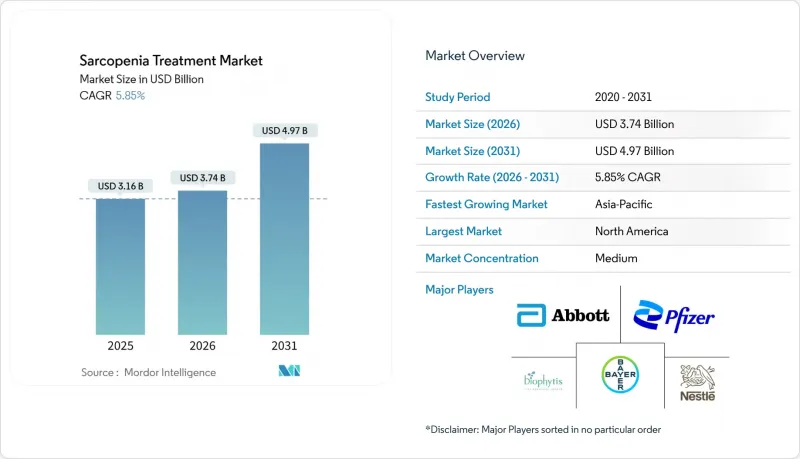
This report is Segmented by Treatment Type (Protein Supplements, and More), Route of Administration (Oral, and More), Distribution Channel (Hospital Pharmacies, and More), End User (Hospitals, Specialized Clinics and More), Patient Type (Primary Sarcopenia, and More), and Geography (North America, and More). The Market Forecasts are Provided in Terms of Value (USD).
Global Sarcopenia Treatment Market Trends and Insights
Accelerating Global Aging and Fall-Related Healthcare Costs
Japan's over-65 cohort reached 29.1% in 2023 and will likely touch 35% by 2040.China already counts 280 million people over 60, a figure expected to reach 400 million by 2035. In the United States, falls among older adults cost Medicare USD 50 billion each year, and sarcopenia is implicated in up to half of those incidents. The Society of Actuaries calculated that a 10% cut in sarcopenia prevalence could save USD 6.7 billion over five years. These facts underpin payer pilots that reimburse nutritional counseling and resistance training for patients documented with low muscle mass, directly boosting the sarcopenia treatment market.
Rising Adoption of Protein, Vitamin D, and Calcium Supplements
Protein supplementation has moved from sports aisles into geriatric wards. Whey isolates enriched with leucine are standard in post-fracture discharge packs, and vitamin D co-supplementation trims fall risk by 12% in institutional settings, according to a 2024 Cochrane review. Retail sales of combination protein-vitamin D-calcium formulas climbed 18% year-over-year in North America and Europe during 2024. Abbott and Nestle have repositioned Ensure and Boost as medical foods, reinforcing physician trust and keeping protein at the center of the sarcopenia treatment market.
Lack of FDA-Approved Drugs and Fragmented Diagnostic Criteria
Neither EWGSOP2 nor AWGS has won FDA endorsement, forcing U.S. trials to negotiate bespoke endpoints that delay filings and muddy cross-study comparisons. Scholar Rock's submission slipped 18 months while endpoints were finalized. Payers echo the uncertainty, with Medicare contractors differing on whether bioelectrical impedance or DXA is reimbursable. Regulatory clarity, expected in draft guidance by late 2026, remains a gating item for the sarcopenia treatment industry.
Other drivers and restraints analyzed in the detailed report include:
- Surging R&D Funding for First-in-Class Pharmacologics
- Government Healthy-Aging and Malnutrition Programs
- High Retail Prices of Premium Protein Supplements
For complete list of drivers and restraints, kindly check the Table Of Contents.
Segment Analysis
Protein supplements secured 55.27% of sarcopenia treatment market share in 2025, cementing their role in discharge bundles and retail aisles. However, myostatin and ActRII inhibitors are poised to grow 9.34% per year through 2031, propelled by late-stage trials and supportive cost-offset analyses. The sarcopenia treatment market size for these biologics is projected to reach USD 1.1 billion by 2031, underscoring payer willingness to fund muscle preservation that averts fall-related admissions.
Commodity vitamins hold mid-teens share but face saturation in developed economies. SARM candidates such as enobosarm could double their sliver of the market if 2026 approvals materialize. Combination sachets that fold protein, leucine, HMB, vitamin D, and calcium into single servings simplify adherence and sustain premium pricing, offering nutrition conglomerates a hedge as prescription entrants arrive.
Oral products represented 84.78% of the sarcopenia treatment market size in 2025, yet parenteral formats are climbing at an 8.46% CAGR as ERAS pathways embed intravenous amino acids before and after orthopedic surgery. A meta-analysis across 18 trials found perioperative parenteral nutrition reduced length of stay by 1.2 days, saving USD 3,000 per hip-fracture case.
Future approvals of subcutaneous biologics such as apitegromab would redistribute revenue toward parenteral channels and hospital pharmacies. Oral supplements remain convenient for community-dwelling seniors, but severe cases diagnosed in inpatient settings are gravitating to higher-bioavailability injections that deliver faster functional gains.
Geography Analysis
Asia-Pacific captured 36.89% of global sarcopenia treatment market share in 2025 and is pacing for a 6.83% CAGR through 2031. Japan, South Korea, and China are adding screening and nutritional benefits to national insurance, while India and Southeast Asia see urban middle-class uptake of premium supplements. Australia's Pharmaceutical Benefits Scheme started reimbursing sarcopenia nutritional products in 2024, reinforcing regional momentum.
North America held a mid-20s share, constrained by supplement saturation and the absence of FDA-approved drugs. Falls cost Medicare USD 50 billion each year, yet only one-third of at-risk seniors receive muscle-strength assessments. Approvals of apitegromab or enobosarm could reignite growth by shifting spending toward reimbursed biologics.
Europe accounted for the low-20s share in 2025. Germany and the UK now reimburse screening under statutory and NHS schemes. Southern Europe battles affordability issues, but Horizon Europe funding is catalyzing multicountry trials, keeping regional R&D robust.
- Abbott Laboratories
- Amway Corp.
- Bayer
- Biophytis SA
- Blackmores Ltd.
- BPGbio Inc.
- By-Health Co., Ltd.
- Epirium Bio
- Roche
- GlaxoSmithKline
- Keros Therapeutics
- Lipocine Inc.
- Nestl- Health Science
- Novartis
- Pfizer
- Rejuvenate Biomed
- Sanofi
- TNF Pharmaceuticals
- Zydus Lifesciences
Additional Benefits:
- The market estimate (ME) sheet in Excel format
- 3 months of analyst support
TABLE OF CONTENTS
1 Introduction
- 1.1 Study Assumptions & Market Definition
- 1.2 Scope of the Study
2 Research Methodology
3 Executive Summary
4 Market Landscape
- 4.1 Market Overview
- 4.2 Market Drivers
- 4.2.1 Accelerating Global Ageing & Fall-Related Healthcare Costs
- 4.2.2 Rising Adoption of Protein, Vitamin D & Calcium Supplements
- 4.2.3 Surging R&D Funding for First-In-Class Pharmacologic
- 4.2.4 Government Healthy-Ageing & Malnutrition Programs
- 4.2.5 GLP-1-Induced Muscle Wasting Creates Adjunct Demand
- 4.2.6 AI-Powered Early-Diagnosis Platforms Unlock New Patient Pools
- 4.3 Market Restraints
- 4.3.1 Lack of FDA-Approved Drugs & Fragmented Diagnostic Criteria
- 4.3.2 High Retail Prices of Premium Protein Supplements
- 4.3.3 Long-Term Safety Concerns Over Anabolic & Myostatin Blockers
- 4.3.4 Digital Divide Limits Reach of Tele-Rehabilitation in LMICs
- 4.4 Value / Supply-Chain Analysis
- 4.5 Regulatory Landscape
- 4.6 Technological Outlook
- 4.7 Porter?s Five Forces Analysis
- 4.7.1 Bargaining Power of Buyers
- 4.7.2 Bargaining Power of Suppliers
- 4.7.3 Threat of New Entrants
- 4.7.4 Threat of Substitutes
- 4.7.5 Competitive Rivalry
5 Market Size & Growth Forecasts (Value in USD)
- 5.1 By Treatment Type
- 5.1.1 Protein Supplements
- 5.1.2 Vitamin D & Calcium Supplements
- 5.1.3 Vitamin B12 Supplements
- 5.1.4 Anabolic Agents (SARMs & Hormonal Therapies)
- 5.1.5 Myostatin & ActRII Pathway Inhibitors
- 5.1.6 Ghrelin Receptor Agonists
- 5.1.7 Anti-inflammatory / Metabolic Modulators
- 5.1.8 Combination / Multi-nutrient Formulations
- 5.2 By Route of Administration
- 5.2.1 Oral
- 5.2.2 Parenteral
- 5.2.3 Enteral
- 5.3 By Distribution Channel
- 5.3.1 Hospital Pharmacies
- 5.3.2 Retail & Drug Stores
- 5.3.3 Online Pharmacies
- 5.4 By End User
- 5.4.1 Hospitals
- 5.4.2 Specialized Clinics & Rehabilitation Centers
- 5.4.3 Homecare Settings
- 5.5 By Patient Type
- 5.5.1 Primary (Age-related) Sarcopenia
- 5.5.2 Secondary Sarcopenia ? Chronic-disease
- 5.5.3 Sarcopenic Obesity
- 5.5.4 Post-Acute / Post-Surgical Sarcopenia
- 5.6 By Geography
- 5.6.1 North America
- 5.6.1.1 United States
- 5.6.1.2 Canada
- 5.6.1.3 Mexico
- 5.6.2 Europe
- 5.6.2.1 Germany
- 5.6.2.2 France
- 5.6.2.3 United Kingdom
- 5.6.2.4 Italy
- 5.6.2.5 Spain
- 5.6.2.6 Rest of Europe
- 5.6.3 Asia-Pacific
- 5.6.3.1 China
- 5.6.3.2 Japan
- 5.6.3.3 India
- 5.6.3.4 South Korea
- 5.6.3.5 Australia
- 5.6.3.6 Rest of Asia-Pacific
- 5.6.4 Middle East & Africa
- 5.6.4.1 GCC
- 5.6.4.2 South Africa
- 5.6.4.3 Rest of Middle East & Africa
- 5.6.5 South America
- 5.6.5.1 Brazil
- 5.6.5.2 Argentina
- 5.6.5.3 Rest of South America
- 5.6.1 North America
6 Competitive Landscape
- 6.1 Market Concentration
- 6.2 Market Share Analysis
- 6.3 Company Profiles (includes Global level Overview, Market level overview, Core Segments, Financials as available, Strategic Information, Market Rank/Share for key companies, Products and Services, and Recent Developments)
- 6.3.1 Abbott Laboratories
- 6.3.2 Amway Corp.
- 6.3.3 Bayer AG
- 6.3.4 Biophytis SA
- 6.3.5 Blackmores Ltd.
- 6.3.6 BPGbio Inc.
- 6.3.7 By-Health Co., Ltd.
- 6.3.8 Epirium Bio
- 6.3.9 F. Hoffmann-La Roche Ltd.
- 6.3.10 GlaxoSmithKline plc
- 6.3.11 Keros Therapeutics
- 6.3.12 Lipocine Inc.
- 6.3.13 Nestl- Health Science
- 6.3.14 Novartis AG
- 6.3.15 Pfizer Inc.
- 6.3.16 Rejuvenate Biomed
- 6.3.17 Sanofi SA
- 6.3.18 TNF Pharmaceuticals
- 6.3.19 Zydus Lifesciences
7 Market Opportunities & Future Outlook
- 7.1 White-space & Unmet-Need Assessment

