PUBLISHER: Mordor Intelligence | PRODUCT CODE: 2066555

PUBLISHER: Mordor Intelligence | PRODUCT CODE: 2066555
Cat Litter - Market Share Analysis, Industry Trends & Statistics, Growth Forecasts (2026 - 2031)
According to Mordor Intelligence, the cat litter market size is projected to be USD 6.01 billion in 2025, USD 6.26 billion in 2026, and reach USD 7.66 billion by 2031, growing at a CAGR of 4.14% from 2026 to 2031.
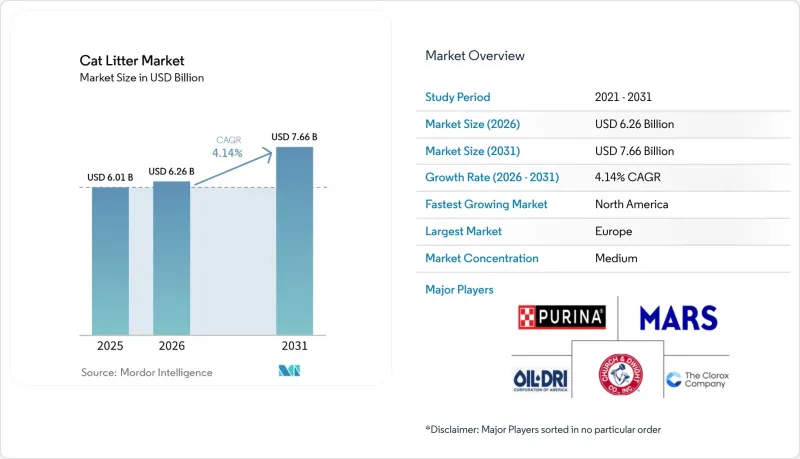
This report is Segmented by Product Type (Clumping and Non-Clumping), by Raw Material (Clay, Silica, and Plant-Based), by Distribution Channel (Specialized Pet Shops, Online Channel, Hypermarkets, and Other Distribution Channels), and by Geography (North America, Europe, Asia-Pacific, South America, Middle East, and Africa). The Market Forecasts are Provided in Terms of Value (USD).
Global Cat Litter Market Trends and Insights
Rising Indoor Cat Ownership and Premium Pet Care Spending
Indoor cat ownership remains one of the most dependable demand anchors in the cat litter market. Households that keep cats indoors purchase litter on a routine cycle, which makes demand steadier than many other pet care categories. Younger adult owners also tend to favor products that reduce dust, improve odor control, and support cleaner home environments. That preference is lifting average selling prices because buyers are choosing better-performing litter instead of only buying more volume. Premium spending is therefore becoming a bigger growth lever than simple unit expansion. This pattern supports continued investment in specialized inputs, cleaner formulations, and better product design across the cat litter market.
E-Commerce Subscriptions and Auto-Replenishment Deepen Recurring Purchasing
Digital replenishment is reducing the time when consumers reconsider brands, which is strengthening recurring demand in the cat litter market. Litter is bulky, heavy, and frequently repurchased, so subscription delivery solves a clear convenience problem for households.Church & Dwight Co., Inc. reported that global online sales accounted for 22.9% of total consumer sales in the first quarter of 2025, an increase from 21.4% for the full year of 2024. This highlights the growing importance of digital channels in routine replenishment decisions. Online purchasing also gives brands better visibility into reorder timing, pack preference, and retention. That data can be used to refine pack architecture, pricing, and product claims. The result is a cat litter market where logistics capability and digital shelf strength matter more each year.
Environmental Scrutiny of Clay Mining and Landfill Disposal
Environmental pressure on mined inputs is becoming a longer-term cost and reputation issue in the cat litter market. Clay remains central to category performance, but its sourcing and disposal profile draws more scrutiny than plant-derived alternatives. A March 2025 toxicology review by ToxStrategies evaluated potential non-occupational respiratory risks from airborne crystalline silica in bentonite cat litter, adding another layer of caution around dust exposure and product handling. Used bentonite litter also remains a landfill burden because it does not break down quickly after disposal. Retailers and regulators are therefore placing more attention on lifecycle impact, dust profile, and sourcing transparency. Brands without alternative raw material pathways could face rising pressure as the cat litter market moves through the forecast period.
Other drivers and restraints analyzed in the detailed report include:
- Clumping, Low-Dust, and Odor-Control Premiumization Expands Average Selling Price
- Plant-Based and Biodegradable Litter Adoption Broadens Category Appeal
- Premium Price Gaps Slow Adoption of Plant-Based and Smart Litter
For complete list of drivers and restraints, kindly check the Table Of Contents.
Segment Analysis
Market share remained concentrated in clumping litter, the largest product type in the cat litter market, with 59.5% in 2025. Clumping has held that lead because it aligns with long-established cleaning habits and supports quick waste removal in everyday use. It also fits many automatic litter systems, which reinforces repeat purchase through functional compatibility. This installed preference makes the segment hard to displace quickly, even when new materials enter the shelf. In practical terms, clumping still sets the baseline performance standard for much of the cat litter market.
Market size growth is stronger in non-clumping litter, the fastest product type, which is projected to expand at a 3.5% CAGR through 2031. Plant-based pellets, tofu-based formats, and crystal substrates are helping the segment reach consumers who want lower dust, lighter packs, or different waste handling characteristics. Health-monitoring functionality is also more naturally aligned with certain non-clumping crystal systems, which gives the segment a clear premium use case. Nestle Purina PetCare's Petivity platform supports the broader shift toward litter-linked monitoring and reinforces interest in performance beyond basic cleanup. The fastest growth, therefore, sits with formats that offer a new reason to switch rather than a small variation on clay.
Geography Analysis
Europe was the largest regional segment in the cat litter market with 37.6% share in 2025. Germany anchors that position because it combines high cat ownership with a broad pet retail reach across specialist chains, discounters, and online formats. Industrieverband Heimtierbedarf (IVH) reported that Germany's stationary retail cat litter market reached EUR 370 million (USD 400 million) in 2025, while the country's domestic cat population stood at 15.7 million. That scale gives Europe a stable demand base even when consumer spending becomes more selective. It also supports the faster rollout of plant-based, silica, and premium odor-control products across the cat litter market.
North America is the fastest regional segment in the cat litter market and is forecast to grow at a 4.44% CAGR through 2031. The region benefits from dense digital retail networks, strong premium acceptance, and a high pace of product refresh from established suppliers. North America also leads in smart litter adoption because hardware, subscription, and branded consumables are advancing together. Regulatory scrutiny of disposal and labeling may increase compliance requirements, but it is unlikely to diminish the region's importance in the cat litter market.
Asia-Pacific, South America, the Middle East, and Africa represent the longer-range expansion frontier for the cat litter market. In the Asia-Pacific region, urban cat ownership is rising among younger consumers who treat pet spending as part of their household routine rather than as an occasional discretionary purchase. Church & Dwight Co., Inc. identified Arm & Hammer as its largest international litter brand in China, suggesting ample room for premium and locally adapted formats in the region. South America, the Middle East, and Africa remain more price sensitive, so value products and local supply will shape adoption speed. Even so, the cat litter market in these regions should widen as distribution improves and awareness of indoor cat care becomes more established.
- Nestle SA (Purina)
- Church & Dwight Co. Inc.
- The Clorox Company
- Oil-Dri Corporation of America
- Mars Inc.
- Kent Pet Group (Kent Corporation)
- Healthy Pet (J. Rettenmaier & Sohne Group)
- Targeted PetCare
- Dr. Elsey's (Precious Cat Inc.)
- Zolux SAS
- Sanicat (Tolsa Group)
- Boxiecat LLC
- Pioneer Pet Products LLC
- Vitakraft pet care GmbH & Co. (Deuerer group)
- Weihai Pearl Silica Gel Co., Ltd.
Additional Benefits:
- The market estimate (ME) sheet in Excel format
- 3 months of analyst support
TABLE OF CONTENTS
1 Introduction
- 1.1 Study Assumptions and Market Definition
- 1.2 Scope of the Study
2 Research Methodology
3 Executive Summary
4 Market Landscape
- 4.1 Market Overview
- 4.2 Market Drivers
- 4.2.1 Rising indoor cat ownership and premium pet care spending
- 4.2.2 E-commerce subscriptions and auto-replenishment deepen recurring purchasing
- 4.2.3 Clumping, low-dust, and odor-control premiumization expands average selling price
- 4.2.4 Plant-based and biodegradable litter adoption broadens category appeal
- 4.2.5 Increased pet humanization
- 4.2.6 Smart litter boxes and health-monitoring systems pull demand for compatible premium litter
- 4.3 Market Restraints
- 4.3.1 Environmental scrutiny of clay mining and landfill disposal
- 4.3.2 Premium price gaps slow adoption of plant-based and smart litter
- 4.3.3 Private-label expansion compresses branded pricing power
- 4.3.4 Flushability claims face tighter wastewater and labeling scrutiny
- 4.4 Regulatory Landscape
- 4.5 Technological Outlook
- 4.6 Porter's Five Forces Analysis
- 4.6.1 Threat of New Entrants
- 4.6.2 Bargaining Power of Buyers
- 4.6.3 Bargaining Power of Suppliers
- 4.6.4 Threat of Substitute Products
- 4.6.5 Intensity of Competitive Rivalry
5 Market Size and Growth Forecasts (Value)
- 5.1 By Product Type
- 5.1.1 Clumping
- 5.1.2 Non-Clumping
- 5.2 By Raw Material
- 5.2.1 Clay
- 5.2.2 Silica
- 5.2.3 Plant-based
- 5.2.3.1 Corn
- 5.2.3.2 Wheat
- 5.2.3.3 Wood and bamboo
- 5.2.3.4 Paper
- 5.2.3.5 Soy
- 5.3 By Distribution Channel
- 5.3.1 Specialized Pet Shops
- 5.3.2 Online Channel
- 5.3.3 Hypermarkets
- 5.3.4 Other Distribution Channels
- 5.4 By Geography
- 5.4.1 North America
- 5.4.1.1 United States
- 5.4.1.2 Canada
- 5.4.1.3 Mexico
- 5.4.1.4 Rest of North America
- 5.4.2 Europe
- 5.4.2.1 Germany
- 5.4.2.2 United Kingdom
- 5.4.2.3 France
- 5.4.2.4 Russia
- 5.4.2.5 Spain
- 5.4.2.6 Rest of Europe
- 5.4.3 Asia-Pacific
- 5.4.3.1 India
- 5.4.3.2 China
- 5.4.3.3 Japan
- 5.4.3.4 Australia
- 5.4.3.5 Rest of Asia-Pacific
- 5.4.4 South America
- 5.4.4.1 Brazil
- 5.4.4.2 Argentina
- 5.4.4.3 Rest of South America
- 5.4.5 Middle East
- 5.4.5.1 United Arab Emirates
- 5.4.5.2 Saudi Arabia
- 5.4.5.3 Turkey
- 5.4.5.4 Rest of Middle East
- 5.4.6 Africa
- 5.4.6.1 South Africa
- 5.4.6.2 Egypt
- 5.4.6.3 Rest of Africa
- 5.4.1 North America
6 Competitive Landscape
- 6.1 Market Concentration
- 6.2 Strategic Moves
- 6.3 Market Share Analysis
- 6.4 Company Profiles (Includes Global Level Overview, Market Level Overview, Core Segments, Financials as Available, Strategic Information, Market Rank/Share for Key Companies, Products and Services, and Recent Developments)
- 6.4.1 Nestle SA (Purina)
- 6.4.2 Church & Dwight Co. Inc.
- 6.4.3 The Clorox Company
- 6.4.4 Oil-Dri Corporation of America
- 6.4.5 Mars Inc.
- 6.4.6 Kent Pet Group (Kent Corporation)
- 6.4.7 Healthy Pet (J. Rettenmaier & Sohne Group)
- 6.4.8 Targeted PetCare
- 6.4.9 Dr. Elsey's (Precious Cat Inc.)
- 6.4.10 Zolux SAS
- 6.4.11 Sanicat (Tolsa Group)
- 6.4.12 Boxiecat LLC
- 6.4.13 Pioneer Pet Products LLC
- 6.4.14 Vitakraft pet care GmbH & Co. (Deuerer group)
- 6.4.15 Weihai Pearl Silica Gel Co., Ltd.
7 Market Opportunities and Future Outlook

