PUBLISHER: Mordor Intelligence | PRODUCT CODE: 2066572

PUBLISHER: Mordor Intelligence | PRODUCT CODE: 2066572
Medical Packaging Films - Market Share Analysis, Industry Trends & Statistics, Growth Forecasts (2026 - 2031)
According to Mordor Intelligence, the medical packaging films market size is expected to grow from USD 8.13 billion in 2025 to USD 8.52 billion in 2026 and is forecast to reach USD 10.75 billion by 2031 at 4.76% CAGR over 2026-2031.
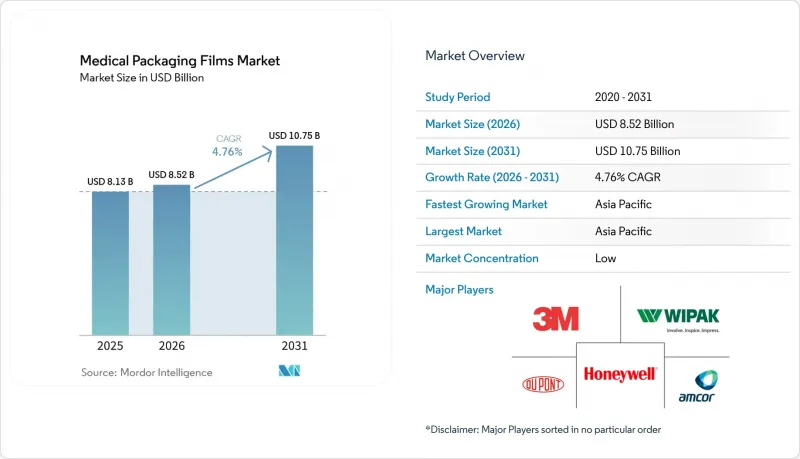
This report is Segmented by Material Type ( Plastic Films and Metallic and Aluminum Films), Product Type (Thermoformable Films, High-Barrier Films, and More), Application (Bags and Pouches, Blister Packs, and More), End-User (Pharmaceutical Manufacturing, Medical Device Manufacturers, and More), Technology(blown Film Extrusion, and More) and Geography (North America, Europe, Asia-Pacific, and More)
Global Medical Packaging Films Market Trends and Insights
Rising Prevalence of Chronic Diseases
Growing noncommunicable disease incidence is transforming packaging from passive containment into active adherence tools. Calendar blister designs lowered HbA1c by 0.95% versus standard packs in diabetes trials, underscoring packaging's clinical value. Aging demographics intensify polypharmacy, pushing drug makers to adopt unit-dose formats that synchronize with e-health platforms and smart pill reminders. Regulators now treat labeling and package configuration as integral to safe use, as reflected in successive FDA guidance updates. Consequently, film suppliers capable of certifying patient-centric designs secure long-term demand across the medical packaging films market.
Sustainability Push for Bioplastics and Recyclables
EU directives mandating minimum recycled content are accelerating biopolymer uptake. Avient's Mevopur bio-based series cuts carbon footprints by 25% while maintaining ISO 10993 compliance. Amcor's SureForm Pro ICE reduced overall plastic by 40% yet met drop-in recyclability thresholds across existing hospital streams. The challenge is sterilization resilience: autoclave and gamma cycles can degrade compostable resins, prompting alloyed formulations of PLA, PHA, and EVOH that preserve barrier integrity. Procurement teams in US health systems now assign environmental weighting in tenders, giving early movers in sustainable substrates a pricing premium within the medical packaging films market.
Volatile Petroleum-Based Polymer Prices
Resin costs climbed 3-5 cents per pound in 2024 amid energy spikes, compressing margins for converters locked into medical-grade supply contracts. Smaller firms, lacking hedging leverage, face pass-through lags of up to six months, risking account attrition or line shutdowns. Strict change-control rules in healthcare impede rapid resin substitution, amplifying exposure versus general packaging segments. Larger players respond by forward-buying and co-locating extrusion near cracker complexes, yet this capital intensity widens the competitive gap in the medical packaging films market.
Other drivers and restraints analyzed in the detailed report include:
- Pharmaceutical Manufacturing Expansion in Asia-Pacific
- Surge in Home-Based Care and POC Diagnostic Kits
- High Regulatory Validation Costs
For complete list of drivers and restraints, kindly check the Table Of Contents.
Segment Analysis
Plastic films retained 84.72% share in 2025, and their internal shift toward bio-derivatives is propelling a 7.12% CAGR. Polyethylene grades, valued for sealability and gamma stability, underpin high-volume pharma pouches. EVOH-lined co-extrusions meet oxygen barrier thresholds for biologic vials shipped on dry ice. Within this mix, PLA/PHA blends are capturing pilot-scale orders from hospitals that target a 40% waste-footprint reduction. Metallic foils hold isolated niches where sub-0.05 cc/m2/day OTR is non-negotiable, such as transdermal patch liners. Additionallyy, medical packaging films industry participants invest in compatibilizer chemistries so multilayer off-cuts enter mechanical recycling without delaminating.
Further gains hinge on validating hot-water disintegration paths for hospital sterilants and aligning with EN 13432 compostability standards. Suppliers promoting cradle-to-cradle certifications gain procurement preference, though they must still pass 121 °C steam sterilization and 60 kGy e-beam cycles without tensile loss. Consequently, the next wave of the medical packaging films market will likely derive from hybrid structures that fuse conventional resins with bio-derived tie layers, balancing processability with end-of-life compliance.
High-barrier films, currently 24.55% of revenue, will expand at 8.33% CAGR through 2031, outpacing the broader medical packaging films market. Demand tracks the proliferation of monoclonal antibodies that mandate oxygen transmission rates below 0.1 cc/m2/day. TekniPlex's cleanroom-produced, seven-layer blown structures integrate EVOH and cyclic olefin polymers, extending cold-chain stability from 72 hours to 120 hours. Co-extruded and laminated films remain the volume backbone, controlling 43.05% share in 2025 thanks to format versatility that spans IV bags to diagnostic pouching. Nevertheless, price premiums for vapor-barrier upgrades yield outsized profitability, encouraging incumbents to retrofit lines with bubble-cage systems for ultra-thin EVOH placement.
Co-extruders also embed NFC circuits and thermochromic inks, merging a physical barrier with digital authentication. Looking forward, hydrogen-peroxide-resistant coatings will be essential as aseptic fill-finish lines pivot from steam to vaporized-plasma sterilants.
Geography Analysis
Asia-Pacific dominates the medical packaging films market with 38.21% revenue share in 2025 and the highest 6.11% CAGR to 2031. China's biologics build-out and India's generics push intensify demand for high-barrier lidding and thermoform webs. Government incentives such as India's Production Linked Incentive scheme reimburse up to 5% of capital outlays on pharma-adjacent packaging plants, tilting fresh capacity toward Gujarat and Telangana. The Philippines' FDA-certified ecozone illustrates a regional blueprint where co-located film converters slash logistics costs and expedite validation cycles. Japan sustains premium demand for ultra-cleanroom extrusion, while South Korea's CDMO boom adds steady orders for serialized pouch laminate.
North America remains pivotal as DSCSA enforcement pushes universal serialization by November 2024. The region's biologics weightings lift cold-chain pouch uptake, especially post-Amcor-Berry consolidation that clusters 11 extrusion sites across the US-Mexico border. Hospitals accelerating "sustainable purchasing" prefer PCR-infused PE/PP mono-materials, shaping converter R&D priorities. Canada's national pharmacare plan, slated for 2027, is projected to widen access to chronic therapies, indirectly escalating blister demand and reinforcing the medical packaging films market trajectory.
Europe, although mature, enforces the world's strictest eco-design statutes. Germany anchors high-value orders for PVdC-free barrier films, as regulators scrutinize chlorine-based substrates. France's 2025 Extended Producer Responsibility amendment imposes escalating fees on unrecyclable formats, prompting a pivot to mono-material EVOH-PE. The UK's post-Brexit MHRA serialization divergence necessitates dual coding on packs servicing both EU and UK channels, complicating line configurations. Southern Europe enjoys near-shore outsourcing from Northern pharma giants; Spanish blistering plants recorded 5.4% shipment gains in 2025.
Latin America shows nascent but fast-rising requirements as Brazil's ANVISA finalizes RDC 680 for full aggregation by 2026. Multinational CDMOs invest in Mexico to service US demand under USMCA, blending cost savings with near-shoring resilience. The Gulf Cooperation Council is modernizing biologics fill-finish halls under Vision 2030, adding incremental high-barrier film imports until regional extrusion capacity scales. Collectively, these developments cement geography as a determinant of specification nuance across the medical packaging films market.
- Amcor Plc
- DuPont de Nemours Inc.
- 3M Company
- Honeywell International Inc.
- Klockner Pentaplast Group
- Wipak Oy
- Renolit Medical
- PolyCine GmbH
- Glenroy Inc.
- Toray Industries Inc.
- Dunmore Corporation
- Covestro AG
- Sealed Air Corporation
- Constantia Flexibles Group
- Tekni-Plex Inc.
- Mondi Group
- UFlex Ltd.
- Coveris Holding
- Aptar Group Inc.
- West Pharmaceutical Services
Additional Benefits:
- The market estimate (ME) sheet in Excel format
- 3 months of analyst support
TABLE OF CONTENTS
1 INTRODUCTION
- 1.1 Study Assumptions and Market Definition
- 1.2 Scope of the Study
2 RESEARCH METHODOLOGY
3 Executive Summary
4 Market Landscape
- 4.1 Market Overview
- 4.2 Market Drivers
- 4.2.1 Rising prevalence of chronic diseases
- 4.2.2 Sustainability push for bioplastics and recyclables
- 4.2.3 Pharmaceutical manufacturing expansion in APAC
- 4.2.4 Surge in home-based care and POC diagnostic kits
- 4.2.5 Digital serialization and smart anti-counterfeit films
- 4.2.6 Growth of 3D-printed personalized drug devices
- 4.3 Market Restraints
- 4.3.1 Volatile petroleum-based polymer prices
- 4.3.2 High regulatory validation costs
- 4.3.3 Competition from paper-based sterile packs
- 4.3.4 Weak recycling infra for multi-layer films
- 4.4 Supply-Chain Analysis
- 4.5 Regulatory Landscape
- 4.6 Technological Outlook
- 4.7 Porter's Five Forces Analysis
- 4.7.1 Threat of New Entrants
- 4.7.2 Bargaining Power of Buyers
- 4.7.3 Bargaining Power of Suppliers
- 4.7.4 Threat of Substitutes
- 4.7.5 Competitive Rivalry
5 MARKET SIZE AND GROWTH FORECASTS (VALUE)
- 5.1 By Material Type
- 5.1.1 Plastic Films
- 5.1.1.1 Polyethylene (LDPE, HDPE, LLDPE)
- 5.1.1.2 Polypropylene
- 5.1.1.3 Polyvinyl Chloride
- 5.1.1.4 Polycarbonate
- 5.1.1.5 Polyethylene Terephthalate
- 5.1.1.6 Polyamide
- 5.1.1.7 Ethylene Vinyl Alcohol Copolymer (EVOH)
- 5.1.1.8 Bioplastics
- 5.1.2 Metallic and Aluminum Films
- 5.1.1 Plastic Films
- 5.2 By Product Type
- 5.2.1 Thermoformable Films
- 5.2.2 Breathable and Porous Films
- 5.2.3 High-Barrier Films
- 5.2.4 Co-extruded and Laminated Films
- 5.3 By Application
- 5.3.1 Bags and Pouches
- 5.3.2 Blister Packs
- 5.3.3 Tubes and Form-Fill-Seal
- 5.3.4 Lidding and Sachets/Stick Packs
- 5.3.5 Diagnostic Strip and Pouch Laminates
- 5.4 By End-user
- 5.4.1 Pharmaceutical Manufacturing
- 5.4.2 Medical Device Manufacturers
- 5.4.3 Diagnostic Laboratories
- 5.4.4 Hospitals and Clinics
- 5.4.5 Home Healthcare Kit Assemblers
- 5.5 By Technology
- 5.5.1 Blown Film Extrusion
- 5.5.2 Cast Film Extrusion
- 5.5.3 Solvent / Extrusion Coating
- 5.6 By Geography
- 5.6.1 North America
- 5.6.1.1 United States
- 5.6.1.2 Canada
- 5.6.1.3 Mexico
- 5.6.2 Europe
- 5.6.2.1 Germany
- 5.6.2.2 United Kingdom
- 5.6.2.3 France
- 5.6.2.4 Italy
- 5.6.2.5 Spain
- 5.6.2.6 Russia
- 5.6.2.7 Rest of Europe
- 5.6.3 Asia-Pacific
- 5.6.3.1 China
- 5.6.3.2 India
- 5.6.3.3 Japan
- 5.6.3.4 South Korea
- 5.6.3.5 Australia and New Zealand
- 5.6.3.6 Rest of Asia-Pacific
- 5.6.4 Middle East and Africa
- 5.6.4.1 Middle East
- 5.6.4.1.1 GCC
- 5.6.4.1.2 Turkey
- 5.6.4.1.3 Rest of Middle East
- 5.6.4.2 Africa
- 5.6.4.2.1 South Africa
- 5.6.4.2.2 Egypt
- 5.6.4.2.3 Rest of Africa
- 5.6.4.1 Middle East
- 5.6.5 South America
- 5.6.5.1 Brazil
- 5.6.5.2 Argentina
- 5.6.5.3 Rest of South America
- 5.6.1 North America
6 COMPETITIVE LANDSCAPE
- 6.1 Market Concentration
- 6.2 Strategic Moves
- 6.3 Market Share Analysis
- 6.4 Company Profiles {(includes Global level Overview, Market level overview, Core Segments, Financials as available, Strategic Information, Market Rank/Share for key companies, Products and Services, and Recent Developments)}
- 6.4.1 Amcor Plc
- 6.4.2 DuPont de Nemours Inc.
- 6.4.3 3M Company
- 6.4.4 Honeywell International Inc.
- 6.4.5 Klockner Pentaplast Group
- 6.4.6 Wipak Oy
- 6.4.7 Renolit Medical
- 6.4.8 PolyCine GmbH
- 6.4.9 Glenroy Inc.
- 6.4.10 Toray Industries Inc.
- 6.4.11 Dunmore Corporation
- 6.4.12 Covestro AG
- 6.4.13 Sealed Air Corporation
- 6.4.14 Constantia Flexibles Group
- 6.4.15 Tekni-Plex Inc.
- 6.4.16 Mondi Group
- 6.4.17 UFlex Ltd.
- 6.4.18 Coveris Holding
- 6.4.19 Aptar Group Inc.
- 6.4.20 West Pharmaceutical Services
7 Market Opportunities and Future Outlook
- 7.1 White-space and Unmet-Need Assessment

