PUBLISHER: Mordor Intelligence | PRODUCT CODE: 2066574

PUBLISHER: Mordor Intelligence | PRODUCT CODE: 2066574
Agricultural Biologicals - Market Share Analysis, Industry Trends & Statistics, Growth Forecasts (2026 - 2031)
According to Mordor Intelligence, the agricultural biologicals market size is projected to grow from USD 29.80 billion in 2025 to USD 32.56 billion in 2026 and USD 51.12 billion by 2031, registering a CAGR of 9.44% from 2026 to 2031.
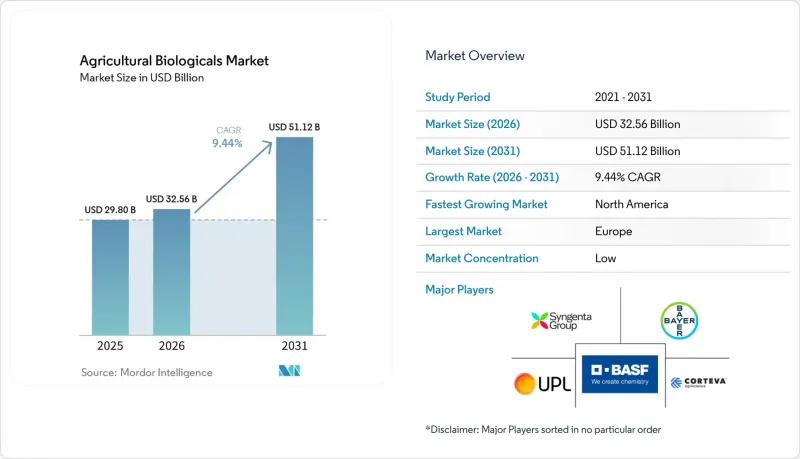
This report is Segmented by Function (Crop Nutrition and Crop Protection), by Crop Type (Row Crops, Horticultural Crops, and Cash Crops), and by Geography (North America, South America, Europe, Asia-Pacific, Middle East, and Africa). The Market Forecasts are Provided in Value (USD) and Volume (Metric Tons).
Global Agricultural Biologicals Market Trends and Insights
Rising Demand for Organic and Residue-Free Produce
The agricultural biologicals market is growing due to the rising adoption of organic and residue-sensitive farming systems in major production regions. According to the study published in "Growth of Organic Farming in India," the area under organic cultivation in India reached approximately 7.3 million hectares in 2024, compared to 0.5 million hectares two decades ago, and the country had over 2.3 million organic farmers in 2024, highlighting the rapid expansion of sustainable agricultural practices. This growth is driving demand for biological crop protection and soil enhancement products that facilitate residue-free farming. Furthermore, retailer and processor purchasing requirements are extending residue-free sourcing beyond certified organic channels, incorporating biological inputs into conventional farming practices, and broadening market demand.
Stricter Regulations on Synthetic Agrochemical Residues and Ingredients
The agricultural biologicals market is benefiting from stricter compliance regulations on conventional insecticide usage and streamlined approval processes for biological products. In Europe, the European Commission announced in December 2025 that provisional national authorizations for biocontrol products could save developers EUR 22 million (USD 23.5 million) annually in delayed marketing losses . This development enhances the economic feasibility of product launches in the agricultural biologicals market. As these regulatory processes become more efficient, investment decisions within the market are projected to increasingly favor biological pipelines that can be commercialized more rapidly and with reduced regulatory hurdles.
Short Shelf Life and Cold-Chain Dependence of Many Formulations
The agricultural biologicals market faces a notable distribution challenge, as many microbial and living-agent formulations lose effectiveness under suboptimal storage and transportation conditions. Research published in the 2025 Journal of Crop Health indicated that the emergence rates for Aphidius colemani dropped from 84.4% under controlled conditions to 34.8% after 96 hours of refrigeration. Similarly, Orius laevigatus populations declined from 83.97% to 22.12% after 168 hours, demonstrating a rapid loss of viability . This issue is particularly significant in regions such as South Asia, Southeast Asia, and Sub-Saharan Africa, where the agricultural biologicals market has strong adoption potential but is hindered by inadequate cold-chain infrastructure at the last mile.
Other drivers and restraints analyzed in the detailed report include:
- Growing Use of Biologicals in Integrated Pest Management
- Regenerative Agriculture Incentives and Carbon Insetting Programs
- Complex and Non-Harmonized Registration Pathways
For complete list of drivers and restraints, kindly check the Table Of Contents.
Segment Analysis
The agricultural biologicals market share for the crop nutrition segment held the largest 64.0% in 2025, supported by the rising adoption of biofertilizers, biostimulants, and organic nutrient management programs across commercial farming systems. Farmers are increasingly integrating biological nutrition inputs into conventional agronomy practices due to their ability to enhance nutrient uptake efficiency, soil microbial activity, and abiotic stress tolerance without requiring significant operational changes. Demand is particularly robust in row crops and horticultural production, where sustainable farming practices and residue management are key factors influencing purchasing decisions. Additionally, the compatibility of these products with existing fertilizer programs supports their broader acceptance in large-scale farming operations.
The agricultural biologicals market size for the crop protection segment recorded the fastest projected CAGR at 9.5% from 2026 to 2031. driven by expanding use of biological solutions in resistance management and residue-sensitive crop systems. Biological fungicides, bioinsecticides, and bionematicides are increasingly incorporated into integrated pest management programs as growers seek alternatives to synthetic chemistries facing tighter regulatory scrutiny. The overlap between crop nutrition and crop protection functions is also increasing, because several biological products support both plant defense responses and stress management. This convergence is influencing product development strategies, portfolio positioning, and commercial partnerships throughout the agricultural biologicals industry.
Geography Analysis
Europe accounted for the largest 34% share of global revenue in 2025 because stricter sustainability policies, residue standards, and regulatory pressure on conventional crop protection products continue encouraging biological adoption across farming systems. Regional demand is further supported by the alignment between sustainable agriculture objectives and food supply chain requirements. In November 2025, the European Parliament adopted a resolution to accelerate the registration and uptake of biological control agents, including streamlined authorization procedures and enhanced mutual recognition frameworks for biological products. This policy direction is bolstering commercialization opportunities for biological inputs across European agriculture.
North America is projected to achieve the fastest CAGR of 11.8% from 2026 to 2031, supported by expanding biological registrations, organic transition initiatives, and increasing integration of biological products into conventional crop programs. The United States remains the largest contributor in the region, as growers adopt biological inputs for resistance management, soil health improvement, and residue reduction strategies. Commercial demand is also increasing among specialty crop and row crop producers seeking compatibility with integrated pest management systems. Strong private-sector investments in fermentation infrastructure, formulation technologies, and large-scale biological manufacturing are further enhancing regional market competitiveness and product availability.
South America continues to solidify its position through the growing adoption of biological inputs in large-scale agricultural production systems, particularly in Brazil and Argentina. Brazil remains the regional growth hub, with biological inputs increasingly integrated into soybean, corn, sugarcane, and horticultural cultivation programs. In 2025, Brazil approved 162 bio-input products, marking the highest annual level recorded in the country and reinforcing the rapid commercialization of biological solutions in agriculture. The wider use of inoculants and biological crop protection products is further driving adoption across large-acre farming systems.
- Corteva Agriscience
- BASF SE
- Bayer AG
- Syngenta Group
- UPL Limited
- Novonesis A/S
- Koppert Biological Systems B.V.
- Valent BioSciences LLC
- FMC Corporation
- Rovensa S.A.
- Certis USA LLC
- Andermatt Biocontrol AG
- Yara International ASA
- Futureco Bioscience S.A.
- Verdesian Life Sciences LLC
Additional Benefits:
- The market estimate (ME) sheet in Excel format
- 3 months of analyst support
TABLE OF CONTENTS
1 INTRODUCTION
- 1.1 Study Assumptions and Market Definition
- 1.2 Scope of the Study
2 RESEARCH METHODOLOGY
3 EXECUTIVE SUMMARY
4 MARKET LANDSCAPE AND KEY INDUSTRY TRENDS
- 4.1 Area Under Organic Cultivation
- 4.2 Per Capita Spending On Organic Products
- 4.3 Regulatory Framework
- 4.3.1 Argentina
- 4.3.2 Australia
- 4.3.3 Brazil
- 4.3.4 Canada
- 4.3.5 China
- 4.3.6 Egypt
- 4.3.7 France
- 4.3.8 Germany
- 4.3.9 India
- 4.3.10 Indonesia
- 4.3.11 Italy
- 4.3.12 Japan
- 4.3.13 Mexico
- 4.3.14 Netherlands
- 4.3.15 Nigeria
- 4.3.16 Philippines
- 4.3.17 Russia
- 4.3.18 South Africa
- 4.3.19 Spain
- 4.3.20 Thailand
- 4.3.21 Turkey
- 4.3.22 United Kingdom
- 4.3.23 United States
- 4.3.24 Vietnam
- 4.4 Value Chain Analysis and Distribution Channel Analysis
- 4.5 Market Drivers
- 4.5.1 Rising demand for organic and residue-free produce
- 4.5.2 Stricter regulations on synthetic agrochemical residues and ingredients
- 4.5.3 Growing use of biologicals in integrated pest management
- 4.5.4 Regenerative agriculture incentives and carbon insetting programs
- 4.5.5 Artificial intelligence (AI)-enabled microbial strain discovery and formulation optimization
- 4.5.6 Localized fermentation and on-farm bio-input manufacturing models
- 4.6 Market Restraints
- 4.6.1 Short shelf life and cold-chain dependence of many formulations
- 4.6.2 Complex and non-harmonized registration pathways
- 4.6.3 Proliferation of counterfeit and sub-standard products
- 4.6.4 Volatile seaweed and other biological feedstock supply
- 4.7 Technological Outlook
- 4.8 Porter's Five Forces
- 4.8.1 Threat of New Entrants
- 4.8.2 Bargaining Power of Suppliers
- 4.8.3 Bargaining Power of Buyers
- 4.8.4 Threat of Substitutes
- 4.8.5 Intensity of Competitive Rivalry
5 MARKET SIZE AND GROWTH FORECASTS (VALUE AND VOLUME)
- 5.1 By Function
- 5.1.1 Crop Nutrition
- 5.1.1.1 Biofertilizers
- 5.1.1.1.1 Azospirillum
- 5.1.1.1.2 Azotobacter
- 5.1.1.1.3 Mycorrhiza
- 5.1.1.1.4 Phosphate Solubilizing Bacteria
- 5.1.1.1.5 Rhizobium
- 5.1.1.1.6 Other Biofertilizers
- 5.1.1.2 Biostimulants
- 5.1.1.2.1 Amino Acids
- 5.1.1.2.2 Fulvic Acid
- 5.1.1.2.3 Humic Acid
- 5.1.1.2.4 Protein Hydrolysates
- 5.1.1.2.5 Seaweed Extracts
- 5.1.1.2.6 Other Biostimulants
- 5.1.1.3 Organic Fertilizer
- 5.1.1.3.1 Manure
- 5.1.1.3.2 Meal Based Fertilizers
- 5.1.1.3.3 Oilcakes
- 5.1.1.3.4 Other Organic Fertilizers
- 5.1.1.1 Biofertilizers
- 5.1.2 Crop Protection
- 5.1.2.1 Biocontrol Agents
- 5.1.2.1.1 Macrobials
- 5.1.2.1.2 Microbials
- 5.1.2.2 Biopesticides
- 5.1.2.2.1 Biofungicides
- 5.1.2.2.2 Bioherbicides
- 5.1.2.2.3 Bioinsecticides
- 5.1.2.2.4 Other Biopesticides
- 5.1.2.1 Biocontrol Agents
- 5.1.1 Crop Nutrition
- 5.2 By Crop Type
- 5.2.1 Row Crops
- 5.2.2 Horticultural Crops
- 5.2.3 Cash Crops
- 5.3 By Geography
- 5.3.1 North America
- 5.3.1.1 United States
- 5.3.1.2 Canada
- 5.3.1.3 Mexico
- 5.3.1.4 Rest of North America
- 5.3.2 South America
- 5.3.2.1 Brazil
- 5.3.2.2 Argentina
- 5.3.2.3 Rest of South America
- 5.3.3 Europe
- 5.3.3.1 Germany
- 5.3.3.2 United Kingdom
- 5.3.3.3 France
- 5.3.3.4 Spain
- 5.3.3.5 Italy
- 5.3.3.6 Netherlands
- 5.3.3.7 Russia
- 5.3.3.8 Turkey
- 5.3.3.9 Rest of Europe
- 5.3.4 Asia-Pacific
- 5.3.4.1 China
- 5.3.4.2 India
- 5.3.4.3 Japan
- 5.3.4.4 Australia
- 5.3.4.5 Vietnam
- 5.3.4.6 Thailand
- 5.3.4.7 Indonesia
- 5.3.4.8 Philippines
- 5.3.4.9 Rest of Asia-Pacific
- 5.3.5 Middle East
- 5.3.5.1 Iran
- 5.3.5.2 Saudi Arabia
- 5.3.5.3 Rest of Middle East
- 5.3.6 Africa
- 5.3.6.1 South Africa
- 5.3.6.2 Nigeria
- 5.3.6.3 Egypt
- 5.3.6.4 Rest of Africa
- 5.3.1 North America
6 COMPETITIVE LANDSCAPE
- 6.1 Market Concentration
- 6.2 Strategic Moves
- 6.3 Market Share Analysis
- 6.4 Company Profiles (Includes Global Level Overview, Market Level Overview, Core Segments, Financials as Available, Strategic Information, Market Rank/Share for Key Companies, Products and Services, and Recent Developments)
- 6.4.1 Corteva Agriscience
- 6.4.2 BASF SE
- 6.4.3 Bayer AG
- 6.4.4 Syngenta Group
- 6.4.5 UPL Limited
- 6.4.6 Novonesis A/S
- 6.4.7 Koppert Biological Systems B.V.
- 6.4.8 Valent BioSciences LLC
- 6.4.9 FMC Corporation
- 6.4.10 Rovensa S.A.
- 6.4.11 Certis USA LLC
- 6.4.12 Andermatt Biocontrol AG
- 6.4.13 Yara International ASA
- 6.4.14 Futureco Bioscience S.A.
- 6.4.15 Verdesian Life Sciences LLC
7 MARKET OPPORTUNITIES AND FUTURE OUTLOOK

