PUBLISHER: Mordor Intelligence | PRODUCT CODE: 2066624

PUBLISHER: Mordor Intelligence | PRODUCT CODE: 2066624
Mosquito Repellent - Market Share Analysis, Industry Trends & Statistics, Growth Forecasts (2026 - 2031)
According to Mordor Intelligence, the mosquito repellent market size is valued at USD 4.88 billion in 2026, growing from the 2025 value of USD 4.21 billion, and is forecast to climb to USD 7.23 billion by 2031, advancing at a 8.11% CAGR, with accelerating disease prevalence, climate-driven vector expansion, and expanding product formats supporting demand.
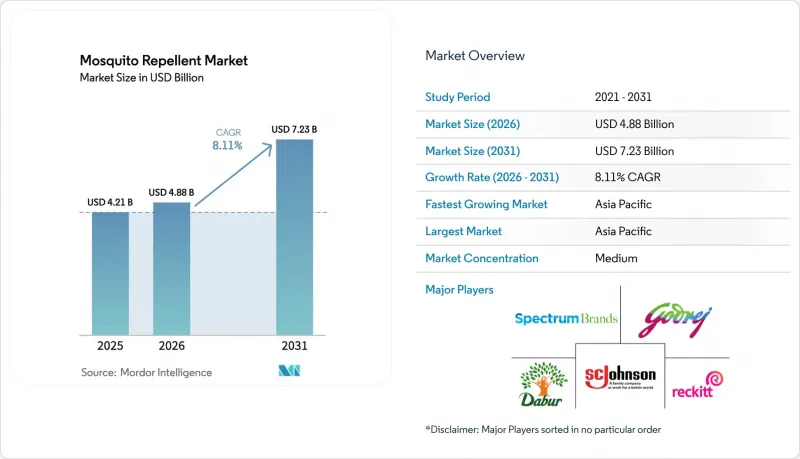
This report is Segmented by Product Type (Liquid Vaporizers, Coils, Sprays/Aerosols, and More), Ingredient Type (Natural and Conventional), End User (Adults and Kids/Children), Distribution Channel (Supermarkets/Hypermarkets, Convenience/Grocery Stores, and More), and Geography (North America, Europe, Asia-Pacific, South America, and More). The Market Forecasts are Provided in Terms of Value (USD).
Global Mosquito Repellent Market Trends and Insights
Increasing Prevalence of Mosquito-Borne Diseases
In 2024, global dengue cases surged to 14.6 million, leading to over 12,000 fatalities. The Centers for Disease Control and Prevention reported that in the first seven months of 2025, there were more than 4 million cases and 3,000 deaths. Meanwhile, malaria cases stood at 246 million in 2023, and vector-borne diseases accounted for over 700,000 annual deaths. Climate change is lengthening transmission seasons and relocating Aedes and Anopheles mosquitoes to once-temperate areas, turning sporadic outbreaks into persistent threats. In 2024, India recorded 285,296 dengue cases with 190 deaths, and in 2023, it logged 1.6 million malaria cases. Indonesia faced 143,266 dengue cases and 1,481 deaths, while Thailand had 134,784 cases with 141 fatalities. Rising temperatures and urbanization are creating breeding grounds in water storage containers, discarded tires, and construction sites, enabling year-round transmission in tropical megacities. As a result, personal protection through topical and spatial repellents in the mosquito repellent market has shifted from a seasonal precaution to a daily necessity, driving sustained demand growth in endemic regions.
Rising Preference for Natural, Organic, and Plant-Based Repellents
In the mosquito repellent market, consumers in North America and Europe are increasingly cautious about synthetic ingredients like DEET, citing concerns over skin irritation, neurotoxicity, and environmental persistence. Lafe's Baby Organic Mosquito Repellent, featuring USDA Certified Organic essential oils, is priced at USD 8.99 for a 4-ounce bottle. In comparison, Hello Bello's plant-based spray, priced at USD 10.99 for 6.7 ounces, is distributed through major retailers such as CVS, Kohl's, Target, and Walmart. Wondercide offers lab-tested, plant-based formulations priced between USD 12.99 and USD 44.99, catering to pet owners and families seeking DEET-free alternatives. The U.S. Environmental Protection Agency (EPA) has categorized certain botanical ingredients under its 25(b) exemptions, enabling quicker market entry without full registration. However, studies reveal that these ingredients provide shorter protection durations compared to established options like picaridin or IR3535. Brands must carefully balance their marketing claims with product performance. Consumer preferences also vary, with some willing to reapply repellents every two hours, while others prioritize products offering all-day protection. This diversity in demand is a primary driver of growth in the mosquito repellent market.
Health and Safety Concerns Over Synthetic Chemicals' Toxicity, Skin Irritation, and Long-Term Effects
Health concerns are slowing adoption among parents, pregnant women, and individuals with sensitive skin. DEET, the most widely used active ingredient, faces criticism for potential neurotoxicity and skin reactions, despite decades of regulatory approval from the US Environmental Protection Agency and the European Chemicals Agency. Picaridin and IR3535 provide similar efficacy with gentler sensory profiles, but limited consumer awareness keeps DEET as the default choice in many markets. Essential oils like citronella, lemongrass, and eucalyptus offer shorter protection durations-typically two hours or less-requiring frequent reapplication or reduced coverage during peak biting periods. The US Food and Drug Administration and the Centers for Disease Control and Prevention recommend EPA-registered repellents for reliable protection. However, anecdotal reports of adverse reactions, amplified by online forums and social media, are undermining confidence in synthetic formulations. Brands in the mosquito repellent market that focus on clinical trials, dermatological testing, and transparent ingredient labeling can stand out in a market increasingly driven by safety perceptions.
Other drivers and restraints analyzed in the detailed report include:
- Innovation in Product Formats, Including Wearables, Mats, Coils, and Long-Lasting Formulations
- Government Initiatives and Public Health Campaigns
- Stringent Regulations on Chemical Ingredients
For complete list of drivers and restraints, kindly check the Table Of Contents.
Segment Analysis
In 2025, spray and aerosol formats accounted for 46.25% of the mosquito repellent market, highlighting strong consumer demand for portable and instant solutions, particularly for outdoor activities, travel, and emergencies. Liquid vaporizers, preferred for their overnight protection without requiring skin contact or frequent reapplication, are projected to grow at the fastest rate, with a 9.14% CAGR through 2031, especially in dengue-prone regions. In India, Godrej Consumer Products' Goodknight liquid vaporizers dominate urban and semi-urban markets. Similarly, Reckitt Benckiser's Mortein brand holds a significant market share in Australia and Southeast Asia. Coils continue to be widely used in rural areas and outdoor settings where electricity access is limited.
However, concerns about smoke inhalation and shorter burn durations have reduced their popularity in urban areas. For parents, creams, lotions, and roll-ons provide a controlled application option for children, with Dabur's Odomos cream leading India's topical market. Although patches and wearables represent the smallest segment, they are attracting notable innovation efforts. Brands such as Wondercide and Hello Bello are developing DEET-free clip-on devices and adhesive patches aimed at hikers, festival-goers, and military personnel. The US Environmental Protection Agency's VERV program is expediting the review of these innovative delivery systems, motivating manufacturers to invest in spatial repellents and long-lasting formulations that reduce the need for frequent reapplication.
In 2025, conventional synthetic repellents accounted for 83.48% of the mosquito repellent market share, supported by DEET's proven efficacy over decades and approvals from the US Environmental Protection Agency and the European Chemicals Agency. Between 2026 and 2031, natural mosquito repellents are projected to grow at a 9.55% CAGR, driven by North American and European consumers increasingly examining ingredient labels and favoring botanical actives such as citronella, lemongrass, eucalyptus, and neem. Lafe's Baby Organic Mosquito Repellent, made with USDA Certified Organic essential oils, is priced at USD 8.99 for a 4-ounce bottle. In comparison, Hello Bello's plant-based spray, priced at USD 10.99 for 6.7 ounces, is available through major retailers like CVS, Kohl's, Target, and Walmart. Wondercide offers lab-tested, plant-based formulations priced between USD 12.99 and USD 44.99, catering to pet owners and families seeking DEET-free options.
However, a significant efficacy gap remains: essential oils typically provide around two hours of protection, whereas synthetics like picaridin or IR3535 offer eight to twelve hours. As a result, users of natural products must either reapply more frequently or accept reduced coverage during peak biting periods. The US Environmental Protection Agency classifies certain botanical ingredients under its 25(b) exemptions, enabling faster market entry without full registration. However, post-market surveillance has revealed varying performance across formulations. In the mosquito repellent market, brands focusing on innovations such as microencapsulation, controlled-release polymers, and synergistic blends can improve the efficacy of natural products, narrowing the performance gap with synthetic alternatives and attracting cost-conscious consumers who are reluctant to pay higher prices for minimal improvements.
Geography Analysis
In 2025, Asia-Pacific accounted for a significant 54.72% share of the mosquito repellent market and is expected to maintain its position as the fastest-growing region with a strong 9.58% CAGR through 2031. This growth is primarily driven by concerning dengue statistics: India reported 285,296 cases and 190 deaths in 2024, Indonesia recorded 143,266 cases with 1,481 fatalities, and Thailand reported 134,784 cases with 141 deaths. In China, the National Health Commission actively manages dengue through integrated vector management in southern provinces such as Guangdong, Yunnan, and Fujian, where annual cases range between 2,000 and 10,000. Rising disposable incomes in China, India, and Indonesia are driving demand for premium natural formulations and long-lasting vaporizers, with a shift from traditional coils to liquid vaporizers and aerosols. In the mature markets of Japan, South Korea, and Singapore, spatial repellents and wearable devices have achieved high penetration. Meanwhile, Australia's outdoor lifestyle continues to sustain demand for high-concentration DEET and picaridin sprays.
In the mosquito repellent market in North America and Europe, consumers are increasingly cautious about synthetic ingredients like DEET, driving a preference for natural and organic formulations. Regulatory frameworks in these regions further support this shift by promoting botanical alternatives. For example, the US Environmental Protection Agency's 25(b) exemptions facilitate quicker market entry for certain plant-based ingredients. Similarly, the European Chemicals Agency enforces strict regulations under the Biocidal Products Regulation (EU) 528/2012, requiring active substance approval and member-state authorization. Brands such as Lafe's, Hello Bello, and Wondercide are capitalizing on the premium market with USDA Certified Organic and plant-powered formulations priced between USD 8.99 and USD 44.99. These products are widely available at major retailers like CVS, Kohl's, Target, and Walmart, as well as through direct-to-consumer channels.
In South America, the ongoing threat of diseases like dengue and malaria sustains demand for effective and affordable mosquito repellents. SC Johnson took proactive measures by distributing 240,000 mosquito repellents during Argentina's 2024 dengue outbreak. The company also partnered with Brazilian influencer Tata Werneck in January 2023, using the #ViraOJogo social media campaign to reach over 25,000 individuals. Countries such as Brazil, Colombia, Chile, and Peru face endemic dengue transmission. Government contracts for schools, military bases, and public housing projects provide stable demand for repellents, but budget limitations and bureaucratic delays often disrupt supply chains within the mosquito repellent market. Regions like South Africa, Saudi Arabia, and the UAE, with higher per-capita incomes, are more likely to invest in premium natural formulations and long-lasting vaporizers. However, resource shortages and political instability, particularly in conflict-affected areas, continue to hinder effective implementation.
- S. C. Johnson and Son, Inc.
- Reckitt Benckiser Group plc
- Spectrum Brands Holdings Inc.
- Godrej Consumer Products Limited
- Dabur India Ltd
- PIC Corporation
- Tiger Brands Ltd
- Coghlan's Ltd.
- HonasaConsumer Pvt. Ltd.
- Henkel AG and Co. KGaA
- Natura and Co. Holding SA (Avon)
- 3M Company
- Newell Brands Inc.
- Sawyer Products, Inc.
- Jyothy Labs Limited
- PelGar International Limited
- Enesis Group
- Clariant AG
- Hello Bello LLC
- Mother Sparsh Baby Care Private Limite
Additional Benefits:
- The market estimate (ME) sheet in Excel format
- 3 months of analyst support
TABLE OF CONTENTS
1 INTRODUCTION
- 1.1 Study Assumptions and Market Definition
- 1.2 Scope of the Study
2 RESEARCH METHODOLOGY
3 EXECUTIVE SUMMARY
4 MARKET LANDSCAPE
- 4.1 Market Overview
- 4.2 Market Drivers
- 4.2.1 Increasing prevalence of mosquito-borne diseases
- 4.2.2 Rising preference for natural, organic, and plant-based repellents
- 4.2.3 Innovation in product formats, including wearables, mats, coils, and long-lasting formulations
- 4.2.4 Government initiatives and public health campaigns
- 4.2.5 Influence of Social Media Platforms and Celebrity Endorsements
- 4.2.6 Higher disposable incomes in developing markets enable spending on premium and eco-friendly products
- 4.3 Market Restraints
- 4.3.1 Proliferation of Counterfeit Products
- 4.3.2 Health and safety concerns over synthetic chemicals' toxicity, skin irritation, and long-term effects
- 4.3.3 Stringent regulations on chemical ingredients
- 4.3.4 Consumer shift toward Traditional products
- 4.4 Consumer Behaviour Analysis
- 4.5 Technology Outlook
- 4.6 Regulatory Outlook
- 4.7 Value Chain Analysis
- 4.8 Porter's Five Forces
- 4.8.1 Threat of New Entrants
- 4.8.2 Bargaining Power of Buyers/Consumers
- 4.8.3 Bargaining Power of Suppliers
- 4.8.4 Threat of Substitute Products
- 4.8.5 Intensity of Competitive Rivalry
5 MARKET SIZE AND GROWTH FORECASTS (VALUE)
- 5.1 Product Type
- 5.1.1 Liquid Vaporizer
- 5.1.2 Coils
- 5.1.3 Spray/Aerosol
- 5.1.4 Creams, Lotions, and Roll-ons
- 5.1.5 Patches and Wearables
- 5.1.6 Other Product Types
- 5.2 Ingredient Type
- 5.2.1 Natural Mosquito Repellent
- 5.2.2 Conventional Mosquito Repellent
- 5.3 Distribution Channels
- 5.3.1 Supermarkets/Hypermarkets
- 5.3.2 Convenience Stores
- 5.3.3 Pharmacies and Drug Stores
- 5.3.4 Online Retail Channels
- 5.3.5 Other Distrbution Channels
- 5.4 By Geography
- 5.4.1 North America
- 5.4.1.1 United States
- 5.4.1.2 Canada
- 5.4.1.3 Mexico
- 5.4.1.4 Rest of North America
- 5.4.2 Europe
- 5.4.2.1 Germany
- 5.4.2.2 United Kingdom
- 5.4.2.3 Italy
- 5.4.2.4 France
- 5.4.2.5 Spain
- 5.4.2.6 Netherlands
- 5.4.2.7 Poland
- 5.4.2.8 Belgium
- 5.4.2.9 Sweden
- 5.4.2.10 Rest of Europe
- 5.4.3 Asia-Pacific
- 5.4.3.1 China
- 5.4.3.2 India
- 5.4.3.3 Japan
- 5.4.3.4 Australia
- 5.4.3.5 Indonesia
- 5.4.3.6 South Korea
- 5.4.3.7 Thailand
- 5.4.3.8 Singapore
- 5.4.3.9 Rest of Asia-Pacific
- 5.4.4 South America
- 5.4.4.1 Brazil
- 5.4.4.2 Argentina
- 5.4.4.3 Colombia
- 5.4.4.4 Chile
- 5.4.4.5 Peru
- 5.4.5 Middle East and Africa
- 5.4.5.1 South Africa
- 5.4.5.2 Saudi Arabia
- 5.4.5.3 United Arab Emirates
- 5.4.5.4 Nigeria
- 5.4.5.5 Egypt
- 5.4.5.6 Morocco
- 5.4.5.7 Turkey
- 5.4.5.8 Rest of Middle East and Africa
- 5.4.1 North America
6 COMPETITIVE LANDSCAPE
- 6.1 Market Concentration
- 6.2 Strategic Moves
- 6.3 Market Ranking Analysis
- 6.4 Company Profiles (includes Global-level Overview, Market-level Overview, Core Segments, Financials (if available), Strategic Information, Market Rank/Share, Products and Services, Recent Developments)
- 6.4.1 S. C. Johnson and Son, Inc.
- 6.4.2 Reckitt Benckiser Group plc
- 6.4.3 Spectrum Brands Holdings Inc.
- 6.4.4 Godrej Consumer Products Limited
- 6.4.5 Dabur India Ltd
- 6.4.6 PIC Corporation
- 6.4.7 Tiger Brands Ltd
- 6.4.8 Coghlan's Ltd.
- 6.4.9 HonasaConsumer Pvt. Ltd.
- 6.4.10 Henkel AG and Co. KGaA
- 6.4.11 Natura and Co. Holding SA (Avon)
- 6.4.12 3M Company
- 6.4.13 Newell Brands Inc.
- 6.4.14 Sawyer Products, Inc.
- 6.4.15 Jyothy Labs Limited
- 6.4.16 PelGar International Limited
- 6.4.17 Enesis Group
- 6.4.18 Clariant AG
- 6.4.19 Hello Bello LLC
- 6.4.20 Mother Sparsh Baby Care Private Limite
7 MARKET OPPORTUNITIES AND FUTURE OUTLOOK

