PUBLISHER: Mordor Intelligence | PRODUCT CODE: 2066642

PUBLISHER: Mordor Intelligence | PRODUCT CODE: 2066642
Acceleration And Yaw Rate Sensors - Market Share Analysis, Industry Trends & Statistics, Growth Forecasts (2026 - 2031)
According to Mordor Intelligence, the acceleration and yaw rate sensors market size is expected to grow from USD 6.75 billion in 2025 to USD 7.38 billion in 2026 and is forecast to reach USD 11.76 billion by 2031 at 9.77% CAGR over 2026-2031.
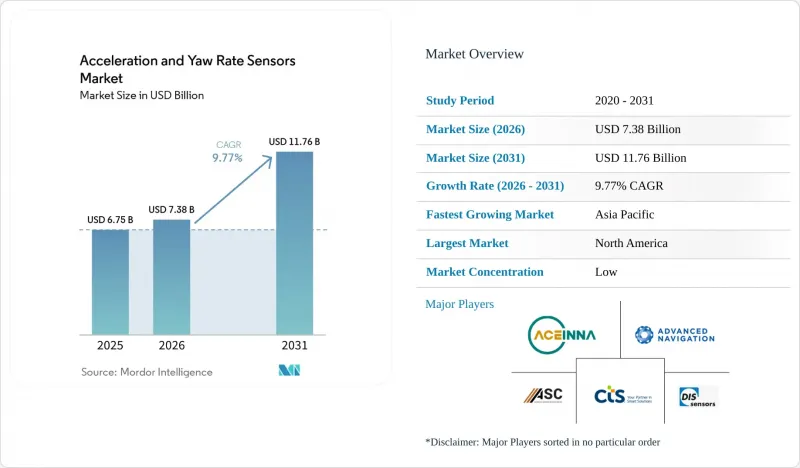
This report is Segmented by Sensor Type (Micromechanical Sensors, Piezoelectric Sensors, and More), Sales Channel (OEM Fitment, and Aftermarket Replacement), End-Use Application (Automotive [Passenger Cars, Light Commercial Vehicles, Heavy Commercial Vehicles, and Off-Highway Vehicles], Aerospace and Defense, and More), and Geography. The Market Forecasts are Provided in Terms of Value (USD).
Global Acceleration And Yaw Rate Sensors Market Trends and Insights
Rising Penetration of Electronic Stability Control and ADAS
Electronic stability control remains the base application for yaw rate sensors, and its wide fitment across vehicle classes still acts as a dependable volume floor for the acceleration and yaw rate sensors market. U.S. safety rules require ESC across light vehicles and extend related requirements to heavy vehicles, which keeps yaw sensing tied to core vehicle control functions rather than optional features. FMVSS No. 127 added mandatory AEB for light vehicles with a final compliance deadline in September 2029, which creates a multi-year sourcing cycle for sensors that support faster braking decisions. That matters because AEB calibration needs yaw rate and lateral acceleration signals with tighter fidelity than older ESC-only layouts. OEMs, therefore, move toward better-performing sensors instead of simply adding more low-cost units. This specification shift raises content value even in mature vehicle categories where unit penetration is already high.
Higher Sensor Content in Electric and Hybrid Vehicle Ride and Body Control
Electric and hybrid platforms add a second demand layer for the acceleration and yaw rate sensors market because ride, body, and torque control functions depend on fast inertial feedback. These vehicles often coordinate torque vectoring and suspension behavior in real time, and that raises the need for IMU update rates of 100Hz or more in production systems. A January 2026 study in Actuators showed that a road-preview semi-active suspension strategy using a body-mounted IMU, wheel acceleration sensors, and wheel-speed sensors maintained strong ride and handling performance under practical sensor limits. That result supports a wider pattern in which OEMs add multi-axis inertial sensing inside EV suspension ECUs instead of removing sensor nodes for cost control. Panasonic Industry's EWTS5G 6-in-1 device also shows how suppliers are combining 3-axis accelerometers and 3-axis gyroscopes in a compact MEMS package with support up to ASIL D. As EV packaging constraints tighten, suppliers that deliver more sensing functions in smaller footprints gain a clearer path into next-generation platforms.
Lengthy Automotive Qualification and ASIL Validation Cycles
Automotive-grade devices in the acceleration and yaw rate sensors market must pass both reliability qualification and functional safety review before OEMs accept them into a platform program. This process often runs for 18 to 36 months and requires evidence for each safety mechanism inside the sensor integrated circuit. The burden grows further at ASIL D, where suppliers must show fault detection coverage above 99% across operating temperatures from -40 °C to 125 °C. Bosch Semiconductors positions its SMI980 for ASIL D automotive applications, while TDK InvenSense positions the IAM-20685HP to ISO 26262:2018 ASIL B requirements, and both examples show how much pre-revenue development effort is needed before design-in can begin. Smaller specialist vendors face an added hurdle when they depend on outside foundries and must match customer design-freeze dates with long validation cycles. That timing mismatch slows the pace at which newer sensing architectures can convert technical readiness into booked revenue.
Other drivers and restraints analyzed in the detailed report include:
- Adoption of Inertial Sensing in Industrial Robotics and Autonomous Mobile Platforms
- Tighter 2026 Safety Assessment Protocols and Functional Safety Requirements
- Price Pressure from Sensor Commoditization in High-Volume Platforms
For complete list of drivers and restraints, kindly check the Table Of Contents.
Segment Analysis
Micromechanical sensors held 63.56% of the acceleration and yaw rate sensors market size in 2025, which keeps MEMS as the clear volume leader across automotive safety and control applications. That position rests on long-running wafer-level process gains, batch manufacturing scale, and deep integration into ESC, airbag, and ADAS control units. The product breadth of Bosch Semiconductors, STMicroelectronics, and TDK InvenSense reflects that installed base, with automotive-grade MEMS lines spanning ASIL B to ASIL D and accelerometer ranges from low-g comfort sensing to high-g crash detection. Capacitive sensors continue to hold a useful position where high resolution and low noise matter more than scale, especially in inertial navigation and structural testing tasks. Other architectures, including resonant MEMS and thermopile-based formats, serve narrower industrial measurement roles inside the acceleration and yaw rate sensors industry.
Piezoelectric sensors are the fastest-growing type in the acceleration and yaw rate sensors market, with a projected 10.13% CAGR from 2026 to 2031. Their main advantage is strong high-frequency vibration performance, an area where capacitive MEMS designs become less effective above the upper end of many standard bandwidth ranges. Kistler's KiVibe Miniature launch in July 2025 showed how PiezoStar crystal technology and custom ASIC electronics can fit triaxial IEPE sensing into a 6 X 6 mm package that weighs 0.9 g. That product direction fits satellite structural testing, PCB vibration analysis, and lightweight aerospace platforms where both mass and signal quality matter. The ISO 16063 family is increasingly visible in procurement language for this part of the acceleration and yaw rate sensors market, which supports demand for specialized piezoelectric solutions in advanced test environments.
Geography Analysis
North America held 40.45% of the acceleration and yaw rate sensors market share in 2025, supported by dense federal safety mandates and a defense procurement base that values tactical-grade inertial performance. The United States combines ESC requirements, future AEB compliance work, and defense programs that demand high dynamic range sensing, which keeps the regional mix weighted toward premium specifications. VectorNav reinforced that positioning in March 2026 by introducing 90G and 250G accelerometer ranges and 4000°/sec gyroscope capability across its Tactical Series for high-G mission profiles. Canada's autonomous vehicle testing activity and Mexico's role in automotive manufacturing add further support to the acceleration and yaw rate sensors market across the region.
Asia-Pacific is the fastest-growing region in the acceleration and yaw rate sensors market, with a 10.41% CAGR from 2026 to 2031. China's scale in EV production and its smart-vehicle homologation direction are pushing OEMs to source both local and imported inertial sensing solutions for intelligent connected vehicle programs. MEMSIC Semiconductor's portfolio for ESC, electronic parking brake, and active suspension shows that domestic supply depth is rising alongside vehicle production volume. Japan remains important for precision manufacturing, and Panasonic Industry's EWTS5G reflects how local suppliers pair compact integration with automotive safety requirements. South Korea, India, and ASEAN are adding incremental demand through tier-1 automotive manufacturing, two-wheeler expansion, commercial vehicle production, and electronics localization.
Europe remains structurally significant in the acceleration and yaw rate sensors market because Germany's OEM base continues to raise per-vehicle sensing content in response to evolving ADAS evaluation requirements. The United Kingdom, France, Italy, and Spain also support demand through product safety alignment, EV adoption, and rising logistics robot deployment across industrial settings. South America is smaller, but Brazil's automotive production and Argentina's agricultural machinery base still create a credible demand floor for inertial sensing adoption. The Middle East and Africa are the earliest-stage regional tier, and initial demand is centered on autonomous inspection and logistics robots tied to Gulf Cooperation Council investment in smart mobility and infrastructure. Compliance frameworks such as IEC 60812 and ISO 26262 are increasingly written into procurement language across Europe and GCC markets, which raises the minimum quality bar for all suppliers.
- ACEINNA Inc.
- Advanced Navigation Pty Ltd.
- ASC GmbH
- CTS Corporation
- DIS Sensors B.V.
- Diversified Technical Systems, Inc.
- Exail SAS
- Gladiator Technologies, Inc.
- InnaLabs Ltd
- Jewell Instruments LLC
- Kistler Instrumente AG
- MEMSIC Semiconductor Co., Ltd.
- OxTS Limited
- Safran Colibrys SA
- Safran Sensing Technologies Norway AS
- SBG Systems S.A.S.
- Silicon Sensing Systems Limited
- Tronics Microsystems SA
- VectorNav Technologies, LLC
- Xsens Technologies B.V.
Additional Benefits:
- The market estimate (ME) sheet in Excel format
- 3 months of analyst support
TABLE OF CONTENTS
1 INTRODUCTION
- 1.1 Study Assumptions and Market Definition
- 1.2 Scope of the Study
2 RESEARCH METHODOLOGY
3 EXECUTIVE SUMMARY
4 MARKET LANDSCAPE
- 4.1 Market Overview
- 4.2 Market Drivers
- 4.2.1 Rising Penetration of Electronic Stability Control and ADAS
- 4.2.2 Higher Sensor Content in Electric and Hybrid Vehicle Ride and Body Control
- 4.2.3 Tighter 2026 Safety Assessment Protocols and Functional Safety Requirements
- 4.2.4 Adoption of Inertial Sensing in Industrial Robotics and Autonomous Mobile Platforms
- 4.2.5 Growing Motion Sensing Content in Software-Defined Vehicle Chassis Architectures
- 4.2.6 Expansion of Combined IMU Use in GNSS-Denied Vehicle Localization
- 4.3 Market Restraints
- 4.3.1 Lengthy Automotive Qualification and ASIL Validation Cycles
- 4.3.2 Price Pressure From Sensor Commoditization in High-Volume Platforms
- 4.3.3 MEMS and ASIC Capacity Bottlenecks for Automotive-Grade Supply
- 4.3.4 Calibration, Cybersecurity, and Redundancy Burdens in Safety-Critical Integration
- 4.4 Industry Value Chain Analysis
- 4.5 Regulatory Landscape
- 4.6 Technological Outlook
- 4.7 Porter's Five Forces Analysis
- 4.7.1 Bargaining Power of Suppliers
- 4.7.2 Bargaining Power of Buyers
- 4.7.3 Threat of New Entrants
- 4.7.4 Threat of Substitutes
- 4.7.5 Intensity of Competitive Rivalry
- 4.8 Assessment of Macroeconomic Trends on the Market
5 MARKET SIZE AND GROWTH FORECASTS (VALUE)
- 5.1 By Sensor Type
- 5.1.1 Micromechanical Sensors
- 5.1.2 Piezoelectric Sensors
- 5.1.3 Capacitive Sensors
- 5.1.4 Other Sensor Types
- 5.2 By Sales Channel
- 5.2.1 OEM Fitment
- 5.2.2 Aftermarket Replacement
- 5.3 By End-Use Application
- 5.3.1 Automotive
- 5.3.1.1 Passenger Cars
- 5.3.1.2 Light Commercial Vehicles
- 5.3.1.3 Heavy Commercial Vehicles
- 5.3.1.4 Off-Highway Vehicles
- 5.3.2 Aerospace and Defense
- 5.3.3 Industrial and Robotics
- 5.3.4 Consumer Electronics
- 5.3.5 Other End-Use Applications
- 5.3.1 Automotive
- 5.4 By Geography
- 5.4.1 North America
- 5.4.1.1 United States
- 5.4.1.2 Canada
- 5.4.1.3 Mexico
- 5.4.2 South America
- 5.4.2.1 Brazil
- 5.4.2.2 Argentina
- 5.4.2.3 Rest of South America
- 5.4.3 Europe
- 5.4.3.1 Germany
- 5.4.3.2 United Kingdom
- 5.4.3.3 France
- 5.4.3.4 Italy
- 5.4.3.5 Spain
- 5.4.3.6 Rest of Europe
- 5.4.4 Asia-Pacific
- 5.4.4.1 China
- 5.4.4.2 Japan
- 5.4.4.3 India
- 5.4.4.4 South Korea
- 5.4.4.5 ASEAN
- 5.4.4.6 Rest of Asia-Pacific
- 5.4.5 Middle East and Africa
- 5.4.5.1 Middle East
- 5.4.5.1.1 Saudi Arabia
- 5.4.5.1.2 United Arab Emirates
- 5.4.5.1.3 Turkey
- 5.4.5.1.4 Rest of the Middle East
- 5.4.5.2 Africa
- 5.4.5.2.1 South Africa
- 5.4.5.2.2 Nigeria
- 5.4.5.2.3 Rest of Africa
- 5.4.5.1 Middle East
- 5.4.1 North America
6 COMPETITIVE LANDSCAPE
- 6.1 Market Concentration
- 6.2 Strategic Moves
- 6.3 Market Share Analysis
- 6.4 Company Profiles (includes Global level Overview, Market level overview, Core Segments, Financials as available, Strategic Information, Market Rank/Share for key companies, Products and Services, and Recent Developments)
- 6.4.1 ACEINNA Inc.
- 6.4.2 Advanced Navigation Pty Ltd.
- 6.4.3 ASC GmbH
- 6.4.4 CTS Corporation
- 6.4.5 DIS Sensors B.V.
- 6.4.6 Diversified Technical Systems, Inc.
- 6.4.7 Exail SAS
- 6.4.8 Gladiator Technologies, Inc.
- 6.4.9 InnaLabs Ltd
- 6.4.10 Jewell Instruments LLC
- 6.4.11 Kistler Instrumente AG
- 6.4.12 MEMSIC Semiconductor Co., Ltd.
- 6.4.13 OxTS Limited
- 6.4.14 Safran Colibrys SA
- 6.4.15 Safran Sensing Technologies Norway AS
- 6.4.16 SBG Systems S.A.S.
- 6.4.17 Silicon Sensing Systems Limited
- 6.4.18 Tronics Microsystems SA
- 6.4.19 VectorNav Technologies, LLC
- 6.4.20 Xsens Technologies B.V.
7 MARKET OPPORTUNITIES AND FUTURE OUTLOOK
- 7.1 White-space and Unmet-Need Assessment

