
PUBLISHER: Mordor Intelligence | PRODUCT CODE: 2066645

PUBLISHER: Mordor Intelligence | PRODUCT CODE: 2066645
United States Stair Lift - Market Share Analysis, Industry Trends & Statistics, Growth Forecasts (2026 - 2031)
According to Mordor Intelligence, the united states stair lift market size is projected to be USD 387.90 million in 2025, USD 411.5 million in 2026, and reach USD 556.90 million by 2031, growing at a CAGR of 6.24% from 2026 to 2031.
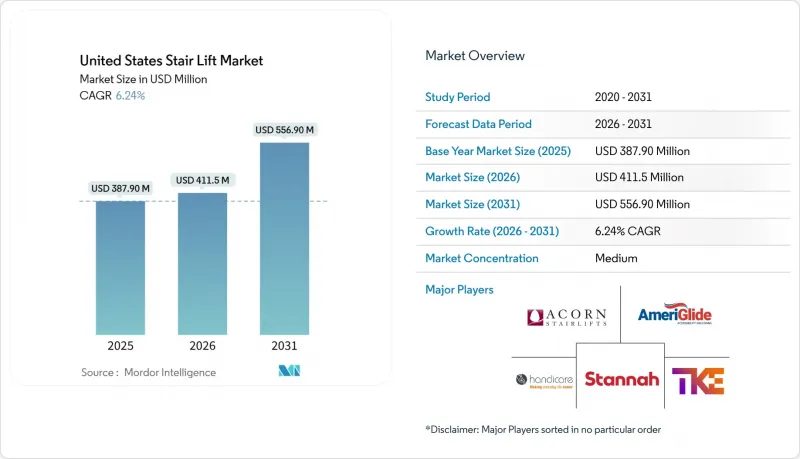
This report is Segmented by Rail Orientation (Straight, and Curved), User Orientation (Seated, Standing, and Integrated), Installation (Indoor, and Outdoor), Application (Residential, Healthcare Facilities, and More), and Geography. The Market Forecasts are Provided in Terms of Value (USD).
United States Stair Lift Market Trends and Insights
Surge in Ageing Population and Mobility Disability
Adults aged 65 plus are projected to represent 22.8% of the U.S. population by 2040, with Sun Belt states experiencing the sharpest rise. Over one-third of this cohort reports difficulty climbing stairs, positioning the US stair lift market as a core pillar of safe-home retrofits. Each avoided fall-related hospitalization saves the health system USD 30,000-50,000, reinforcing payer interest in preventive accessibility solutions. Mobility impairments already affect more than 20 million Americans, underscoring a steadily widening addressable base. Manufacturers that bundle fall-prevention education with product demonstrations have found higher conversion rates among older consumers informed about the financial and health costs of in-home injuries.
Rising Preference for Ageing-in-Place Home Modifications
An assisted-living apartment costs roughly USD 4,500 per month, compared with a one-time USD 2,000-15,000 stair lift installation. As 77% of adults aged 50 plus wish to remain in their own homes, spending on accessibility remodels continues to escalate. Medicare Advantage carriers are testing supplemental benefits that reimburse up to USD 5,000 for approved modifications, accelerating equipment orders when open-enrolment periods start each fall. Specialized contractors now market turnkey accessibility packages that include straight or curved stair lifts, grab bars, and widened doorways, simplifying the customer journey and compressing project timelines from weeks to days.
High Purchase and Installation Cost for Curved Systems
Curved rail projects command USD 7,500-15,000 because every rail is custom-bent, measured, and fitted onsite. The absence of economies of scale limits price compression, pushing many middle-income households to postpone or abandon purchases. Insurance exclusions compound the hurdle, as most policies treat stair lifts as non-medical home upgrades. Some manufacturers pursue FDA Class I device designation to secure durable medical equipment codes, yet additional compliance spending may negate pricing relief, keeping adoption uneven across income brackets.
Other drivers and restraints analyzed in the detailed report include:
- Federal Income-Tax Credits for Home Accessibility
- Rapid Penetration of Rental and Subscription-Based Models
- Limited Reimbursement Under Private Insurance Plans
For complete list of drivers and restraints, kindly check the Table Of Contents.
Segment Analysis
Straight rails retained 67.10% of 2025 revenue thanks to template-based fabrication that cuts installation to under four hours, assuring swift project completion for the US stair lift market. The segment's predictable cost profile attracts first-time buyers and rental customers who favor simplicity. Curved systems are projected to outpace straight installations with a 5.98% CAGR as modern architecture introduces switchbacks, landings, and sweeping staircases. Affluent seniors accept higher price points to maintain aesthetics and value seamless integration with smart-home dashboards that send maintenance alerts to dealers.
Smart sensors now log motor load, battery health, and rail vibration, enabling predictive maintenance calls before malfunctions. Curved platforms see faster adoption of these features because owners tend to invest in premium options to protect larger upfront investments. The US stair lift industry also notes rising demand for bespoke rail finishes - brushed nickel, bronze, and powder-coated hues that match banisters. Manufacturers report that offering design consultations raises close rates by 8-10%, turning style into a sales lever rather than a cost objection.
Seated units commanded 56.10% of 2025 sales, rooted in occupational-therapy protocols that prioritize stability during ascent. Clinicians still recommend seated lifts for users with vestibular disorders and muscle weakness, ensuring broad adoption across age and income segments. Standing and perch configurations, however, are gaining clinical acceptance, charting a 5.85% CAGR because they facilitate lower-body workouts for post-surgical patients. Physical therapists integrate step-through motions into rehabilitation exercises, citing improved joint flexibility.
The US stair lift market size for standing models remains smaller but benefits from ergonomic handlebars, fold-away platforms, and orthopedic cushioning that mitigate pressure on knee and hip joints. Early evidence shows standing lifts reduce time needed to regain stair-climbing independence by two weeks in knee-replacement cases, prompting some workers-compensation insurers to approve reimbursement. Manufacturers who bundle adjustable harnesses and remote monitoring are widening addressable demand beyond traditional senior demographics, capturing younger users recovering from sports injuries.
List of Companies Covered in this Report:
- TK Elevator Corporation (Thyssenkrupp AG)
- Bruno Independent Living Aids Inc.
- Handicare Group AB
- Stannah Lifts Holdings Ltd.
- Acorn Mobility Services Ltd.
- AmeriGlide Distributing 2019 Inc.
- Harmar Mobility LLC
- Bespoke Stairlifts Ltd.
- ACME Home Elevator (Accessible Systems Inc.)
- Ascent Mobility Company
- Les Escalateurs Atlas Inc.
- Lifeway Mobility Holdings LLC
- Garaventa Lift USA Inc.
- Prairie View Industries Inc.
- Savaria Corporation
- Otolift Stairlifts Inc.
- Nationwide Lifts Inc.
- Mobility123 Inc.
- EHLS-ToTheTop Home Accessibility LLC
- 101 Mobility LLC
Additional Benefits:
- The market estimate (ME) sheet in Excel format
- 3 months of analyst support
TABLE OF CONTENTS
1 INTRODUCTION
- 1.1 Study Assumptions and Market Definition
- 1.2 Scope of the Study
2 RESEARCH METHODOLOGY
3 EXECUTIVE SUMMARY
4 MARKET LANDSCAPE
- 4.1 Market Overview
- 4.2 Market Drivers
- 4.2.1 Surge in ageing population and mobility-related disability
- 4.2.2 Rising preference for ageing-in-place home modifications
- 4.2.3 Availability of federal income-tax credits for home accessibility
- 4.2.4 Rapid penetration of rental and subscription-based stair lift models
- 4.2.5 Insurance reimbursements expanding beyond Medicare Part B
- 4.2.6 Smart connected stair lifts enabling predictive maintenance
- 4.3 Market Restraints
- 4.3.1 High purchase and installation cost for curved rail systems
- 4.3.2 Limited reimbursement under most U.S. private insurance plans
- 4.3.3 Safety concerns over DIY online stair-lift kits
- 4.3.4 Post-installation servicing gaps in rural areas
- 4.4 Industry Ecosystem Analysis
- 4.5 Regulatory Landscape
- 4.6 Technological Outlook
- 4.7 Impact of Macroeconomic Factors
- 4.8 Porter's Five Forces Analysis
- 4.8.1 Threat of New Entrants
- 4.8.2 Bargaining Power of Buyers
- 4.8.3 Bargaining Power of Suppliers
- 4.8.4 Threat of Substitute Products
- 4.8.5 Intensity of Competitive Rivalry
5 MARKET SIZE AND GROWTH FORECASTS (VALUE)
- 5.1 By Rail Orientation
- 5.1.1 Straight
- 5.1.2 Curved
- 5.2 By User Orientation
- 5.2.1 Seated
- 5.2.2 Standing
- 5.2.3 Integrated (Perch)
- 5.3 By Installation
- 5.3.1 Indoor
- 5.3.2 Outdoor
- 5.4 By Application
- 5.4.1 Residential
- 5.4.2 Healthcare Facilities
- 5.4.3 Other Applications (Commercial, Public Buildings)
6 COMPETITIVE LANDSCAPE
- 6.1 Market Concentration
- 6.2 Strategic Moves
- 6.3 Market Share Analysis
- 6.4 Company Profiles (includes Global level Overview, Market level overview, Core Segments, Financials as available, Strategic Information, Market Rank/Share for key companies, Products and Services, and Recent Developments)
- 6.4.1 TK Elevator Corporation (Thyssenkrupp AG)
- 6.4.2 Bruno Independent Living Aids Inc.
- 6.4.3 Handicare Group AB
- 6.4.4 Stannah Lifts Holdings Ltd.
- 6.4.5 Acorn Mobility Services Ltd.
- 6.4.6 AmeriGlide Distributing 2019 Inc.
- 6.4.7 Harmar Mobility LLC
- 6.4.8 Bespoke Stairlifts Ltd.
- 6.4.9 ACME Home Elevator (Accessible Systems Inc.)
- 6.4.10 Ascent Mobility Company
- 6.4.11 Les Escalateurs Atlas Inc.
- 6.4.12 Lifeway Mobility Holdings LLC
- 6.4.13 Garaventa Lift USA Inc.
- 6.4.14 Prairie View Industries Inc.
- 6.4.15 Savaria Corporation
- 6.4.16 Otolift Stairlifts Inc.
- 6.4.17 Nationwide Lifts Inc.
- 6.4.18 Mobility123 Inc.
- 6.4.19 EHLS-ToTheTop Home Accessibility LLC
- 6.4.20 101 Mobility LLC
7 MARKET OPPORTUNITIES AND FUTURE OUTLOOK
- 7.1 White-space and unmet-need assessment

