
PUBLISHER: Mordor Intelligence | PRODUCT CODE: 2066705

PUBLISHER: Mordor Intelligence | PRODUCT CODE: 2066705
Automotive Garage Equipment - Market Share Analysis, Industry Trends & Statistics, Growth Forecasts (2026 - 2031)
According to Mordor Intelligence, the automotive garage equipment market size is projected to be USD 8.29 billion in 2025, USD 8.73 billion in 2026, and reach USD 11.25 billion by 2031, growing at a CAGR of 5.21% from 2026 to 2031.
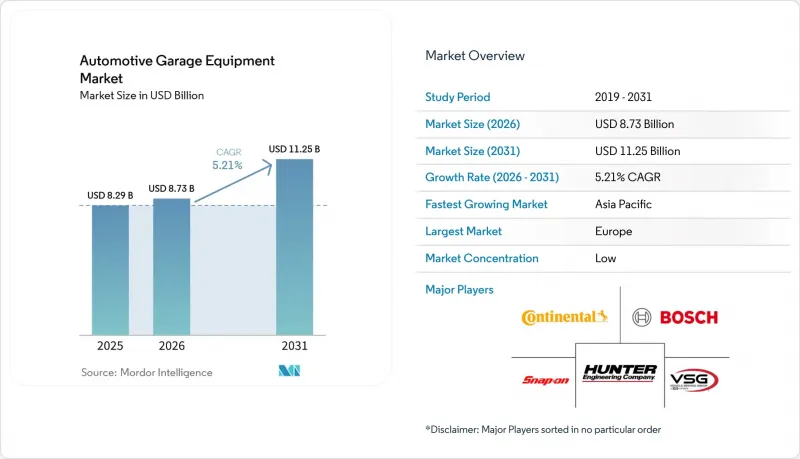
This report is Segmented by Equipment Type (Lifting and More), Vehicle Type (Passenger Cars and More), Garage Type (OEM and More), Ownership Model (Purchase and More), and Geography. Forecasts in Value (USD) and Volume (Units).
Global Automotive Garage Equipment Market Trends and Insights
Stringent Emission Regulations
Euro 7 rules coming in 2027 obligate workshops to measure real-world emissions, which is expected to drive new sales of portable analyzers and OBD-II scanners across 27 EU states . The U.S. EPA's Tier 4 heavy-duty mandate, finalized in 2024, requires commercial-vehicle bays to install NOx and PM sensors at a higher cost . China's National VI(b) curb on evaporative losses has already lifted orders for vapor-leak detectors, while India's forthcoming Bharat Stage VII scheme could grow the national testing park by 30%. Each tightening cycle turns equipment into consumables, creating repeat-purchase revenue tied to recalibration and firmware rights, strengthening long-term demand in the automotive garage equipment market.
Expansion of Independent Aftermarket Service Centres
In 2025, independents captured a significant share of the global service income, driven by a consumer shift towards price clarity and proximity. Rollups, supported by substantial private-equity inflows, successfully negotiated fleet-pricing deals with tool vendors. In a strategic move, franchise groups like Midas transitioned a considerable portion of their outlets to a subscription-based procurement model, leveraging Bosch contract data to significantly reduce upfront capital needs. Meanwhile, in India, GoMechanic and other players notably expanded their operations, standardizing lifts and scan tools across networks to enhance technician training. As consolidation progresses, demand increasingly favors suppliers offering bundled services like remote diagnostics and utilization analytics, reinforcing growth in the automotive garage equipment market.
High Capex of Advanced Equipment
Many emerging-market garages find themselves overshooting their annual equipment budgets, as ADAS calibration bays are significantly expensive. A recent survey conducted by a European federation found that a substantial proportion of respondents identified pricing as the primary obstacle to adopting EV tools. Multi-brand garages often inflate their inventory by purchasing separate scanners to access proprietary OEM codes. While Equipment-as-a-Service offers a way to spread cash flows, it can consume a notable share of gross revenue, introducing fixed charges that become burdensome during periods of reduced demand. The Asia-Pacific region grapples with a pronounced challenge: as vehicle numbers surge, the pace of workshop capital formation lags, resulting in stretched bay utilization and longer customer wait times, highlighting structural constraints in the automotive garage equipment market.
Other drivers and restraints analyzed in the detailed report include:
- Rising Passenger-Car Parc
- EV-Specific High-Voltage Workshop Tools Demand
- Shortage of Trained Diagnostic Technicians
For complete list of drivers and restraints, kindly check the Table Of Contents.
Segment Analysis
Emission analyzers and smoke meters are the fastest-growing line, rising at a 5.23% clip through 2031, outpacing the broader automotive garage equipment market, even though lifting systems accounted for a 35.17% revenue share in 2025. Real-time compliance reporting pilots in California and the EU force garages to install cloud-enabled testers that upload data directly to regulators, turning a periodic obligation into a continuous service call. Vendors see pull-through sales of calibration gases and software licenses that are renewed every 12 months. Lifting gear remains the essential workshop backbone because each repair still starts with vehicle elevation, yet its growth now trails test equipment as safety standards plateau. Suppliers that integrate lift platforms with wheel-alignment cameras are eking out differentiation by saving bay floor space.
Wheel and tire machines account for nearly a fifth of current turnover and benefit from mandatory TPMS checks at every tire change in the United States. The automotive garage equipment market share for diagnostic handhelds is set to climb as ECUs in modern cars top 150 units, making fault isolation impossible without multi-protocol coverage. Body-shop gear lags behind ADAS, which has reduced collision frequency; however, paint booths with energy-efficient airflow are gaining ground in regions where utility costs soar. Smaller categories such as fluid dispensers and compressors still move steady volumes through bundle sales that ride on larger lift or analyzer contracts.
Passenger-car bays absorbed 63.37% of industry revenue in 2025, and that slice inches higher as camera and radar recalibrations become routine after windshield or bumper service. OEM work instructions now mandate post-repair alignment on every sensor, pushing specialized target boards and laser tools into even small independents. Consequently, the passenger-car slice within the automotive garage equipment market size grows alongside a 5.31% segment CAGR. Software content already crosses 150 million lines in luxury cars, swelling demand for firmware-flash stations and secure gateway access kits.
Commercial-vehicle operators invest in heavier lifts and battery-pack cradles as California and EU zero-emission mandates accelerate fleet electrification. Automated lanes that process a dozen trucks each shift illustrate the labor-saving theme as technician scarcity bites. Two-wheeler workshops remain the least tool segment; sub-USD 500 devices that decode domestic OEM protocols, presenting a volume opportunity that could lift two-wheeler contributions to the automotive garage equipment market share over the next decade.
Geography Analysis
Europe accounted for 34.46% of 2025 revenue, as dense vehicle fleets and annual testing schemes drive steady equipment turnover. German workshops made substantial investments in new analyzers and scanners, ensuring compliance with the latest emission standards and preparing for upcoming regulations. The UK's MOT regime's demand for new brake testers last year led the Driver and Vehicle Standards Agency to accredit more suppliers. Meanwhile, independent workshops in France and Italy benefited from state subsidies, which reimbursed them for EV-tool purchases, helping them navigate broader economic challenges. However, with high bay density in Western Europe, the region faces limitations in expanding capacity, capping the long-term growth potential of its automotive garage equipment market.
Asia-Pacific is the fastest climber at 5.33% through 2031, anchored by China's equipment take in 2025. Provincial inspection mandates for older vehicles drove significant sales of analyzers and diagnostic units last year. In India, multi-brand chains inaugurated new locations, making notable investments in lifts, balancers, and scanners, marking a significant shift away from the informal sector. To counter dwindling owner demographics, Japan and South Korea are channeling investments into EV service lanes, ensuring their dealerships remain relevant. Southeast Asia, notably under-equipped, sees countries like Indonesia and Vietnam with a limited number of organized bays, despite a combined vehicle parc exceeding tens of millions, highlighting a significant opportunity for the automotive garage equipment market.
North America contributed a substantial portion to 2025 sales, driven by an aging vehicle fleet and a trend of consolidation among franchise chains. In the U.S., chains are standardizing tool sets across their stores, leading to bulk purchases of alignment systems and cloud-licensed diagnostics. Provincial inspection mandates in Canada bolster the demand for analyzers, while new workshops in British Columbia are opting for premium earthquake-rated lifts. Together, South America and the Middle East & Africa account for a smaller but notable share of the global revenue. Brazil's biennial emission checks ensure consistent demand, while Argentina's recent tariff relief on scanners might trigger a surge in purchases once currency fluctuations stabilize. In the Gulf states, legislation mandates annual inspections for older vehicles, driving brisk imports of brake and suspension testers, reinforcing steady demand in the automotive garage equipment market.
- Robert Bosch GmbH
- Continental AG
- Snap-on Incorporated
- Hunter Engineering Company
- Vehicle Service Group (Dover)
- MAHA GmbH & Co. KG
- Istobal S.A.
- Gray Manufacturing Company
- Launch Tech Co. Ltd
- Autel Intelligent Technology Corp.
- BendPak Inc.
- ATS ELGI
- Arex Test Systems B.V.
- Hofmann Megaplan
Additional Benefits:
- The market estimate (ME) sheet in Excel format
- 3 months of analyst support
TABLE OF CONTENTS
1 Introduction
- 1.1 Study Assumptions & Market Definition
- 1.2 Scope of the Study
2 Research Methodology
3 Executive Summary
4 Market Landscape
- 4.1 Market Overview
- 4.2 Market Drivers
- 4.2.1 Stringent Emission Regulations
- 4.2.2 Expansion of Independent Aftermarket Service Centres
- 4.2.3 Rising Passenger-Car Parc
- 4.2.4 Ageing Vehicle Fleet in OECD Economies
- 4.2.5 EV-Specific High-Voltage Workshop Tools Demand
- 4.2.6 Equipment-As-A-Service Subscription Models
- 4.3 Market Restraints
- 4.3.1 High Capex of Advanced Equipment
- 4.3.2 Shortage of Trained Diagnostic Technicians
- 4.3.3 Proliferation of Counterfeit Garage Tools
- 4.3.4 Downtime Due to Equipment Failure
- 4.4 Value / Supply-Chain Analysis
- 4.5 Regulatory Landscape
- 4.6 Technological Outlook
- 4.7 Porter's Five Forces
- 4.7.1 Threat of New Entrants
- 4.7.2 Bargaining Power of Suppliers
- 4.7.3 Bargaining Power of Buyers
- 4.7.4 Threat of Substitute Products
- 4.7.5 Competitive Rivalry
5 Market Size & Growth Forecasts (Value (USD) and Volume (Units))
- 5.1 By Equipment Type
- 5.1.1 Lifting Equipment
- 5.1.2 Emission Testing Equipment
- 5.1.3 Body-Shop Equipment
- 5.1.4 Wheel & Tire Service Equipment
- 5.1.5 Vehicle Diagnostic & Testing Equipment
- 5.1.6 Washing & Cleaning Equipment
- 5.1.7 Other Niche Garage Tools
- 5.2 By Vehicle Type
- 5.2.1 Passenger Cars
- 5.2.2 Commercial Vehicles
- 5.2.3 Two-Wheelers
- 5.3 By Garage Type
- 5.3.1 OEM Dealership Garages
- 5.3.2 Independent Garages
- 5.3.3 Franchise / Chain Workshops
- 5.4 By Ownership Model
- 5.4.1 Outright Purchase
- 5.4.2 Lease / Rental
- 5.4.3 Subscription (Equipment-as-a-Service)
- 5.5 By Geography
- 5.5.1 North America
- 5.5.1.1 United States
- 5.5.1.2 Canada
- 5.5.1.3 Rest of North America
- 5.5.2 South America
- 5.5.2.1 Brazil
- 5.5.2.2 Argentina
- 5.5.2.3 Rest of South America
- 5.5.3 Europe
- 5.5.3.1 Germany
- 5.5.3.2 United Kingdom
- 5.5.3.3 France
- 5.5.3.4 Italy
- 5.5.3.5 Rest of Europe
- 5.5.4 Asia-Pacific
- 5.5.4.1 China
- 5.5.4.2 Japan
- 5.5.4.3 India
- 5.5.4.4 South Korea
- 5.5.4.5 Rest of Asia-Pacific
- 5.5.5 Middle-East and Africa
- 5.5.5.1 United Arab Emirates
- 5.5.5.2 Saudi Arabia
- 5.5.5.3 Egypt
- 5.5.5.4 South Africa
- 5.5.5.5 Rest of Middle-East and Africa
- 5.5.1 North America
6 Competitive Landscape
- 6.1 Market Concentration
- 6.2 Strategic Moves
- 6.3 Market Share Analysis
- 6.4 Company Profiles (includes Global Level Overview, Market Level Overview, Core Segments, Financials as Available, Strategic Information, Market Rank/Share for Key Companies, Products and Services, SWOT Analysis, and Recent Developments)
- 6.4.1 Robert Bosch GmbH
- 6.4.2 Continental AG
- 6.4.3 Snap-on Incorporated
- 6.4.4 Hunter Engineering Company
- 6.4.5 Vehicle Service Group (Dover)
- 6.4.6 MAHA GmbH & Co. KG
- 6.4.7 Istobal S.A.
- 6.4.8 Gray Manufacturing Company
- 6.4.9 Launch Tech Co. Ltd
- 6.4.10 Autel Intelligent Technology Corp.
- 6.4.11 BendPak Inc.
- 6.4.12 ATS ELGI
- 6.4.13 Arex Test Systems B.V.
- 6.4.14 Hofmann Megaplan
7 Market Opportunities & Future Outlook
- 7.1 White-space & Unmet-Need Assessment

