
PUBLISHER: Mordor Intelligence | PRODUCT CODE: 2066721

PUBLISHER: Mordor Intelligence | PRODUCT CODE: 2066721
Aquaculture Products - Market Share Analysis, Industry Trends & Statistics, Growth Forecasts (2026 - 2031)
According to Mordor Intelligence, the aquaculture products market size was valued at USD 227 billion in 2025 and is projected to grow from USD 238.42 billion in 2026 to USD 304.64 billion by 2031, at a CAGR of 5.03% during 2026-2031.
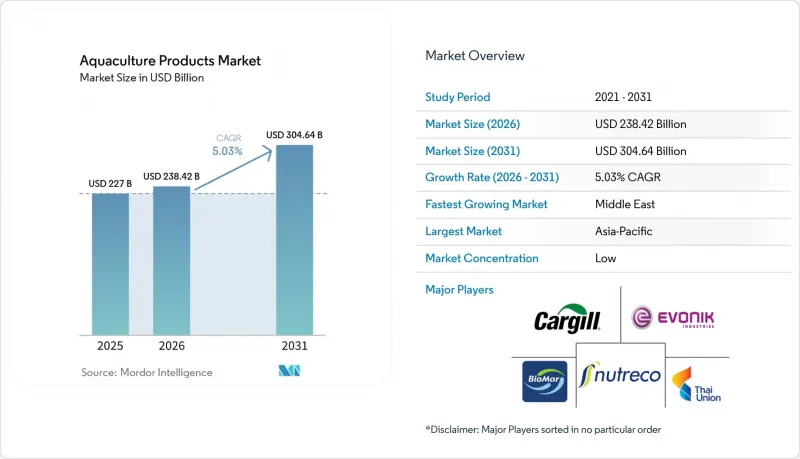
This report is Segmented by Product Type (Feed, Equipment, Fertilizers, and Chemicals and Additives), by Culture Environment (Freshwater, Marine, and Brackish Water), by Species (Carps, Salmonids, Tilapia, Shrimp and Prawn, Mollusks, and Other Species), and by Geography (North America, South America, Europe, Asia-Pacific, Middle East, and More). The Market Forecasts are Provided in Terms of Value (USD).
Global Aquaculture Products Market Trends and Insights
Rising Seafood Protein Demand
According to the Food and Agriculture Organization, global per capita fish consumption reached 21.3 kilograms annually in 2024, with aquaculture contributing 12.3 kilograms per capita. This underscores the increasing preference for farmed seafood. The Agricultural Outlook 2025-2034, published by the Food and Agriculture Organization and the Organization for Economic Co-operation and Development, forecasts a 13% rise in global aquatic food demand over the next decade, with Africa projected to experience the highest growth at 24%. In the aquaculture products market, this trend is driving demand for feed, health products, water-quality solutions, and monitoring technologies, particularly in salmon, shrimp, and tilapia farming systems. This is especially evident in Asia, where urbanization and the expanding middle class are fueling higher seafood consumption. Additionally, structured traceability systems and stricter food safety standards in export markets are boosting demand for certified aquaculture inputs and production technologies.
Declining Wild-Capture Fish Stocks
The aquaculture products market is experiencing growth driven by the decline in wild-capture fish stocks. According to the Food and Agriculture Organization (FAO), the Barents Sea cod quota for 2026 has been reduced to 269,440 metric tons, representing a 21% decrease compared to 2025. Similarly, Northeast Atlantic mackerel quotas have dropped by 48% to 299,010 metric tons. In 2025, the FAO reported that farmed cod constituted more than half of Norway's fresh cod exports, highlighting the ongoing shift from wild capture fisheries to aquaculture-based seafood supply. These trends are increasing the need for aquaculture expansion and boosting demand for related products, including feed, equipment, water treatment systems, and farm chemicals.
Disease Outbreaks and Rising Biosecurity Spending
Disease poses a significant operational risk in the aquaculture products market, as it can quickly destroy biomass and escalate costs related to prevention and treatment. Researchers from Universidad Andres Bello, Santiago, Chile, reported that a new vapA-absent strain of Aeromonas salmonicida accounted for 88% of polymerase chain reaction (PCR)-positive tissue samples during the first half of 2024. This has raised concerns about the efficacy of older pentavalent vaccines. These disease-related issues are driving up operational expenses for aquaculture producers, while major outbreaks continue to strain farm cash flow, disrupt stocking plans, and hinder overall market growth.
Other drivers and restraints analyzed in the detailed report include:
- Government Incentives for Sustainable Fish Farming
- Recirculating Aquaculture Systems and Automation Adoption
- Volatile Fishmeal and Soy Protein Costs
For complete list of drivers and restraints, kindly check the Table Of Contents.
Segment Analysis
The aquaculture products market share for the feed segment held the largest 40.0% in 2025. This dominance is attributed to the reliance of intensive fish and shrimp farming systems on nutritionally balanced formulations to sustain growth performance, feed conversion, and survival rates. Commercial aquaculture producers are increasingly adopting functional feed containing probiotics, immune-support ingredients, omega-3 enrichment, and alternative proteins to enhance production efficiency and disease resilience. Additionally, export-oriented farms demand traceable and certified feed products to meet retail and international seafood sourcing standards. These factors continue to reinforce the critical role of feed in commercial aquaculture operations worldwide.
The aquaculture products market size for the chemicals and additives segment is projected to grow the fastest at a 13.5% CAGR from 2026 to 2031. The rising demand for water-treatment compounds, disinfectants, probiotics, and health-support additives is driven by the need for stronger disease management and water-quality control in intensive aquaculture systems. The adoption of recirculating aquaculture systems and high-density pond farming has further increased the use of biosecurity products and monitoring solutions. Additionally, equipment is gaining importance as producers invest in automation, aeration systems, and feeding technologies. Fertilizers remain significant in freshwater pond farming, particularly in carp and tilapia production systems, where nutrient management supports productivity in large-scale inland aquaculture operations globally.
Geography Analysis
The aquaculture products market share for Asia-Pacific accounted for the largest 68.0% in 2025. This dominance is attributed to the extensive freshwater and marine farming systems in countries such as China, India, Vietnam, Indonesia, and Bangladesh. The region exhibits high demand for aquafeed, pond-management products, aeration systems, and aquatic animal health inputs. Additionally, large-scale production of shrimp, carp, and tilapia continues to drive the consumption of commercial aquaculture products. Factors such as public financing support, export-oriented seafood industries, and the increasing adoption of intensive farming systems are further promoting the use of advanced aquaculture technologies in the region's commercial fish and shrimp production infrastructure.
The aquaculture products market size for the Middle East is projected to grow the fastest at a 10.6% CAGR from 2026 to 2031. This growth is driven by food-security policies, hatchery expansion projects, and investments in recirculating aquaculture systems aimed at water-efficient fish production. In Europe, the focus remains on sustainable salmon farming, traceability standards, and environmental compliance. South America continues to play a significant role through its export-driven salmon and shrimp industries. Meanwhile, North America is investing in domestic aquaculture expansion through automation and controlled-environment farming systems. These advancements are boosting demand for feed, water-treatment products, monitoring technologies, and biosecurity solutions across global aquaculture production networks.
Europe and South America represent two distinct regional clusters in the aquaculture products market, both influenced by high-value species and stringent operational standards. According to the Food and Agriculture Organization, in Europe, Norway's salmon-focused system remains the largest contributor, with farmed cod gaining prominence in 2025, surpassing half of fresh cod exports. According to the European Commission's 2025 review of global marine fishery resources and the European Union's aquaculture policy, there is a continued emphasis on sustainable aquaculture growth. In South America, Chile faces ongoing disease risks in salmon farming, including the emergence of new Aeromonas salmonicida variants, which complicate health management efforts. Meanwhile, Ecuador's shrimp industry remains strategically significant, driving demand for premium feed, precision tools, and health inputs within its export-oriented production system.
- Cargill, Incorporated
- Nutreco N.V. (SHV Holdings N.V.)
- BioMar Group A/S (Schouw & Co.)
- Evonik Industries AG
- AKVA group ASA
- Xylem Inc.
- Pentair plc
- Cooke Aquaculture Inc.
- Cermaq Group AS (Mitsubishi Corporation)
- Aller Aqua A/S
- Ridley Corporation Limited
- Benchmark Holdings plc
- BASF SE
- DSM-Firmenich AG
- Thai Union Feedmill Public Company Limited
Additional Benefits:
- The market estimate (ME) sheet in Excel format
- 3 months of analyst support
TABLE OF CONTENTS
1 Introduction
- 1.1 Study Assumptions and Market Definition
- 1.2 Scope of the Study
2 Research Methodology
3 Executive Summary
4 Market Landscape
- 4.1 Market Overview
- 4.2 Market Drivers
- 4.2.1 Rising seafood protein demand
- 4.2.2 Declining wild-capture fish stocks
- 4.2.3 Government incentives for sustainable fish farming
- 4.2.4 Recirculating aquaculture systems and automation adoption
- 4.2.5 AI-enabled precision feeding and biomass analytics
- 4.2.6 Blue-carbon and nutrient-credit monetization for low-emission farms
- 4.3 Market Restraints
- 4.3.1 Disease outbreaks and rising biosecurity spending
- 4.3.2 Volatile fishmeal and soy protein costs
- 4.3.3 Social license pressure from coastal communities
- 4.3.4 Scarcity of marine drug regulatory approvals
- 4.4 Regulatory Landscape
- 4.5 Technological Outlook
- 4.6 Porter's Five Forces Analysis
- 4.6.1 Threat of New Entrants
- 4.6.2 Bargaining Power of Buyers
- 4.6.3 Bargaining Power of Suppliers
- 4.6.4 Threat of Substitutes
- 4.6.5 Intensity of Competitive Rivalry
5 Market Size and Growth Forecasts (Value)
- 5.1 By Product Type
- 5.1.1 Feed
- 5.1.2 Equipment
- 5.1.3 Fertilizers
- 5.1.4 Chemicals and Additives
- 5.2 By Culture Environment
- 5.2.1 Freshwater
- 5.2.2 Marine
- 5.2.3 Brackish Water
- 5.3 By Species
- 5.3.1 Carps
- 5.3.2 Salmonids
- 5.3.3 Tilapia
- 5.3.4 Shrimp and Prawn
- 5.3.5 Mollusks
- 5.3.6 Others
- 5.4 By Geography
- 5.4.1 North America
- 5.4.1.1 United States
- 5.4.1.2 Canada
- 5.4.1.3 Mexico
- 5.4.1.4 Rest of North America
- 5.4.2 South America
- 5.4.2.1 Brazil
- 5.4.2.2 Ecuador
- 5.4.2.3 Chile
- 5.4.2.4 Rest of South America
- 5.4.3 Europe
- 5.4.3.1 Norway
- 5.4.3.2 United Kingdom
- 5.4.3.3 Russia
- 5.4.3.4 Rest of Europe
- 5.4.4 Asia-Pacific
- 5.4.4.1 China
- 5.4.4.2 India
- 5.4.4.3 Vietnam
- 5.4.4.4 Indonesia
- 5.4.4.5 Rest of Asia-Pacific
- 5.4.5 Middle East
- 5.4.5.1 Saudi Arabia
- 5.4.5.2 United Arab Emirates
- 5.4.5.3 Turkey
- 5.4.5.4 Rest of Middle East
- 5.4.6 Africa
- 5.4.6.1 Egypt
- 5.4.6.2 South Africa
- 5.4.6.3 Nigeria
- 5.4.6.4 Rest of Africa
- 5.4.1 North America
6 Competitive Landscape
- 6.1 Market Concentration
- 6.2 Strategic Moves
- 6.3 Market Share Analysis
- 6.4 Company Profiles (Includes Global Level Overview, Market Level Overview, Core Segments, Financials as available, Strategic Information, Market Rank/Share for key companies, Products and Services, and Recent Developments)
- 6.4.1 Cargill, Incorporated
- 6.4.2 Nutreco N.V. (SHV Holdings N.V.)
- 6.4.3 BioMar Group A/S (Schouw & Co.)
- 6.4.4 Evonik Industries AG
- 6.4.5 AKVA group ASA
- 6.4.6 Xylem Inc.
- 6.4.7 Pentair plc
- 6.4.8 Cooke Aquaculture Inc.
- 6.4.9 Cermaq Group AS (Mitsubishi Corporation)
- 6.4.10 Aller Aqua A/S
- 6.4.11 Ridley Corporation Limited
- 6.4.12 Benchmark Holdings plc
- 6.4.13 BASF SE
- 6.4.14 DSM-Firmenich AG
- 6.4.15 Thai Union Feedmill Public Company Limited
7 Market Opportunities and Future Outlook

