PUBLISHER: Mordor Intelligence | PRODUCT CODE: 2066737

PUBLISHER: Mordor Intelligence | PRODUCT CODE: 2066737
United States Pharmaceutical Warehousing - Market Share Analysis, Industry Trends & Statistics, Growth Forecasts (2026 - 2031)
According to Mordor Intelligence, the united states pharmaceutical warehousing market size is projected to expand from USD 3.19 billion in 2025 and USD 3.35 billion in 2026 to USD 4.23 billion by 2031, registering a CAGR of 4.77% between 2026 and 2031.
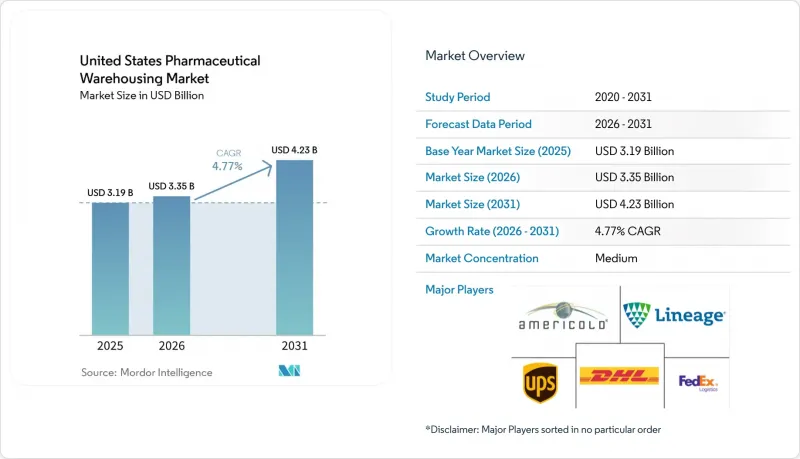
This report is Segmented by Service Type (Storage, Distribution and Inventory Management, and More), by Warehouse Type (Cold-Chain Warehouse [Chilled, Frozen, and More], Non-Cold-Chain Warehouse), by Product Type (Prescription, OTC Drugs, and More), and by End User (Pharmaceutical Manufacturers, Healthcare Providers, and More). The Market Forecasts are Provided in Terms of Value (USD).
United States Pharmaceutical Warehousing Market Trends and Insights
Outsourcing Surge to Healthcare-Focused 3PLs
The warehousing landscape is witnessing a clear shift toward outsourced and contract-based models as manufacturers focus their resources on innovation and product development instead of owning storage infrastructure. This transition is being accelerated by major logistics integrators, particularly those expanding in healthcare logistics, who are acquiring cold-chain specialists to build integrated, end-to-end supply solutions. Such consolidation allows them to manage temperature-sensitive pharmaceuticals and biologics more effectively while meeting stringent compliance requirements. Increasing regulatory demands, such as those related to facility validation and product traceability, have raised the cost of compliance to levels that smaller, niche warehouse operators often find difficult to sustain, further reinforcing the move toward large, well-capitalized logistics providers.
Ramp-up of Domestic Vaccine & Antibody Capacity Fueling DC Demand
Pharmaceutical companies in the United States are significantly expanding their production infrastructure, particularly in biologics manufacturing, which is now a key driver of logistics and warehousing demand. The rise of advanced biomanufacturing has intensified the need for specialized cold-chain facilities capable of managing temperature-sensitive materials throughout the production and distribution cycle. Ultra-low-temperature storage systems are essential for supporting mRNA and other biologic formulations, not only requiring higher energy capacity but also generating strong returns due to the premium pricing of such storage services. As a result, cold-chain warehousing has become a central component of the sector's capital strategy, linking biomanufacturing growth directly with logistics investment.
Escalating Liability & Product-Recall Insurance Premiums
The insurance environment for pharmaceutical logistics is tightening as underwriters respond to rising exposure risks, particularly in cell and gene therapy distribution. High product values and complex handling requirements have made recall insurance significantly more expensive, pushing logistics operators to strengthen quality and traceability measures. At the same time, enforcement of serialization and traceability regulations is exposing weaknesses in legacy warehouse systems. Facilities lacking interoperable, real-time tracking capabilities are facing steep premium surcharges, creating strong incentives for rapid digital modernization across the pharmaceutical supply chain.
Other drivers and restraints analyzed in the detailed report include:
- Automation & Robotics Deployments Improving GMP Accuracy
- Expansion of Specialty-Pharmacy Distribution Networks
- Construction-Material Shortages Delaying Warehouse Build-outs
For complete list of drivers and restraints, kindly check the Table Of Contents.
Segment Analysis
Storage retained 66.38% of the United States Pharmaceutical Warehousing market share in 2025, but value-added services are expanding at a 5.74% CAGR as serialization, kitting, and clinical-trial packaging deliver 40-60% higher revenue per ft2. These premium services rely on validated IT and quality-management infrastructures that smaller facilities cannot match, reinforcing consolidation trends. Warehouses offering real-time inventory visibility through cloud dashboards and seamless ERP integrations report 90% client adoption, cementing sticky long-term contracts. Returns processing tied to DSCSA has also emerged as a sustainable profit pool, given the industry's strict re-serialization requirements.
The United States pharmaceutical warehousing is evolving toward higher-value services, with custom patient packaging and regulatory consulting becoming key differentiators. Providers offering temperature mapping, validation, and audit-readiness support are building recurring revenue streams while reinforcing their role as partners in compliance and distribution excellence.
Non-cold-chain sites accounted for 75.06% of the United States Pharmaceutical Warehousing market size in 2025, benefiting from lower operating expenses of roughly USD 9/ft2. Cold-chain, however, is set to post a 5.91% CAGR through 2031, pulled by biologics, vaccines, and personalized therapies that require temperatures from 2 °C down to -196 °C. Ultra-low and cryogenic zones yield margins several times higher than ambient space but consume 79% of total warehouse electricity. Energy-efficiency retrofits and automated retrieval systems are therefore critical for profitability and sustainability compliance.
Integrated operators blend ambient and cold-chain zones inside the same campus to maximize asset turns, while IoT-enabled predictive maintenance slashes unplanned downtime by 60%. The United States Pharmaceutical Warehousing market share in ultra-low storage remains small but represents a disproportionate share of profits given per-pallet fees of USD 50-75.
List of Companies Covered in this Report:
- United Parcel Service Inc.
- DHL Group
- FedEx Corp.
- GEODIS SA
- CEVA Logistics
- Lineage Logistics
- Americold Logistics
- Cencora
- BioPharma Logistics
- Rhenus SE & Co. KG
- Kuehne + Nagel
- XPO Logistics
- KRC Logistics
- GXO Logistics
- MD Logistics
- Langham Logistics
- Crown LSP Group
- LifeScience Logistics
- Go Freight
- DSV
Additional Benefits:
- The market estimate (ME) sheet in Excel format
- 3 months of analyst support
TABLE OF CONTENTS
1 Introduction
- 1.1 Study Assumptions and Market Definition
- 1.2 Scope of the Study
2 Research Methodology
3 Executive Summary
4 Market Landscape
- 4.1 Market Overview
- 4.2 Market Drivers
- 4.2.1 Outsourcing Surge to Healthcare-Focused 3PLs
- 4.2.2 Ramp-Up of Domestic Vaccine & Antibody Capacity Fueling DC Demand
- 4.2.3 Automation & Robotics Deployments Improving GMP Accuracy
- 4.2.4 Expansion of Specialty-Pharmacy Distribution Networks
- 4.2.5 ESG-Driven Retrofits for Low-Carbon, Energy-Efficient Cold Stores
- 4.2.6 Drone/EV Last-Mile Pilots Requiring Forward-Staged Micro Cold Sites
- 4.3 Market Restraints
- 4.3.1 Escalating Liability & Product-Recall Insurance Premiums
- 4.3.2 Construction-Material Shortages Delaying Warehouse Buildouts
- 4.3.3 Patchwork of New State Data-Privacy Laws Limiting IoT Analytics
- 4.3.4 Extreme-Weather Volatility Raising HVAC Redundancy CAPEX
- 4.4 Value / Supply-Chain Analysis
- 4.5 Regulatory Landscape (FDA, DSCSA, DEA, OSHA)
- 4.6 Technological Outlook (WMS, IoT, Automation, Robotics)
- 4.7 Porter's Five Forces
- 4.7.1 Bargaining Power of Suppliers
- 4.7.2 Bargaining Power of Buyers
- 4.7.3 Threat of New Entrants
- 4.7.4 Threat of Substitutes
- 4.7.5 Intensity of Competitive Rivalry
- 4.8 Impact of Geopolitics and Pandemic on Warehousing
5 Market Size and Growth Forecasts (Value, USD)
- 5.1 By Service Type
- 5.1.1 Storage
- 5.1.2 Distribution and Inventory Management
- 5.1.3 Value-added Services and Others
- 5.2 By Warehouse Type
- 5.2.1 Cold-Chain Warehouse
- 5.2.1.1 Chilled (0-5°C)
- 5.2.1.2 Frozen (-18-0°C)
- 5.2.1.3 Ambient
- 5.2.1.4 Deep-Frozen / Ultra-Low (less than-20 °C)
- 5.2.2 Non-Cold-Chain Warehouse
- 5.2.1 Cold-Chain Warehouse
- 5.3 By Product Type
- 5.3.1 Prescription Drugs
- 5.3.2 OTC Drugs
- 5.3.3 Biologics and Biosimilars
- 5.3.4 Vaccines and Blood Products
- 5.3.5 Clinical Trail Materials
- 5.3.6 Cell and Gene Therapies
- 5.3.7 Specialty Medicine (non-biologic)
- 5.3.8 Veterinary Medicine
- 5.3.9 Others
- 5.4 By End User
- 5.4.1 Pharmaceutical Manufacturers
- 5.4.2 Healthcare Providers
- 5.4.3 Retail and Pharmacies
- 5.4.4 Distributors and Wholesalers
- 5.4.5 Others
6 Competitive Landscape
- 6.1 Market Concentration
- 6.2 Strategic Moves and Investments
- 6.3 Market Share Analysis
- 6.4 Company Profiles (includes Global Level Overview, Market Level Overview, Core Segments, Financials as available, Strategic Information, Market Rank/Share for key companies, Products and Services, and Recent Developments)
- 6.4.1 United Parcel Service Inc.
- 6.4.2 DHL Group
- 6.4.3 FedEx Corp.
- 6.4.4 GEODIS SA
- 6.4.5 CEVA Logistics
- 6.4.6 Lineage Logistics
- 6.4.7 Americold Logistics
- 6.4.8 Cencora
- 6.4.9 BioPharma Logistics
- 6.4.10 Rhenus SE & Co. KG
- 6.4.11 Kuehne + Nagel
- 6.4.12 XPO Logistics
- 6.4.13 KRC Logistics
- 6.4.14 GXO Logistics
- 6.4.15 MD Logistics
- 6.4.16 Langham Logistics
- 6.4.17 Crown LSP Group
- 6.4.18 LifeScience Logistics
- 6.4.19 Go Freight
- 6.4.20 DSV
7 Market Opportunities and Future Outlook
- 7.1 White-space and Unmet-need Assessment

