
PUBLISHER: Mordor Intelligence | PRODUCT CODE: 2066750

PUBLISHER: Mordor Intelligence | PRODUCT CODE: 2066750
North America Decorative And Illuminated Mirror - Market Share Analysis, Industry Trends & Statistics, Growth Forecasts (2026 - 2031)
According to Mordor Intelligence, the north america illuminated bathroom mirror market size is projected to expand from USD 450.72 million in 2025 and USD 465.50 million in 2026 to USD 547.02 million by 2031, registering a CAGR of 3.28% between 2026 and 2031.
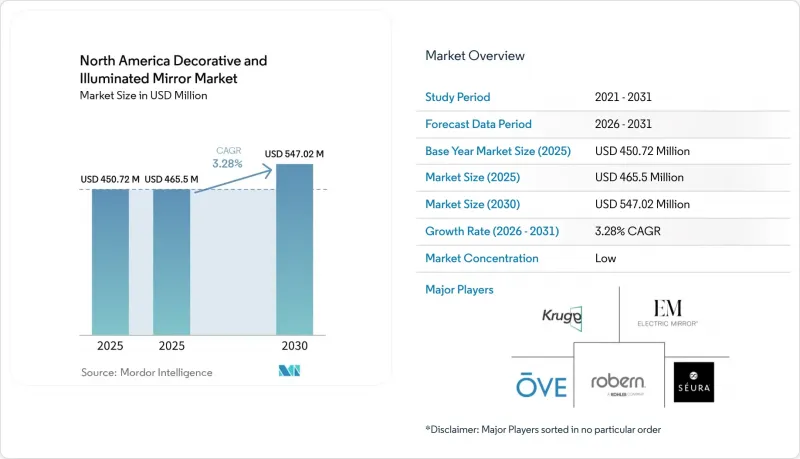
This report is Segmented by Product Type (LED, Fluorescent, Incandescent, and Hybrid Lighting Systems), Application (Residential and Commercial), Distribution Channel (B2C/Retail and B2B), and Geography. The Market Forecasts are Provided in Terms of Value.
North America Decorative And Illuminated Mirror Market Trends and Insights
LED Dominance In Homes Drives Illuminated Mirror Demand
Adoption of LED lighting in United States homes has reached mainstream levels, with 51% of renovating homeowners purchasing light fixtures in 2024 and 13% selecting smart variants, which are lifting attachment rates for integrated, high-CRI illuminated mirrors in bathroom upgrades. New launches are addressing fine-tuned grooming requirements and design control, illustrated by Robern's Instinct Mirror, which supports on-mirror color temperature and brightness control across a 2700K to 5600K range, auto-off timers, and integrated defoggers, while IKEA's FAXALVEN series targets mid-market buyers with smart-home pairing and value-led price points. California's Title 24 sets performance thresholds that make high-CRI, low-flicker LED sources the practical baseline for new construction and major remodels, lifting quality expectations within the North America illuminated bathroom mirror market. Seniors are also increasing spending on better task lighting, with median bathroom remodel outlays rising to USD 15,300 in 2024, further supporting integrated-mirror installations designed for consistent color rendering and safer daily routines. Electrical compliance is reinforcing this structural shift, as installers avoid non-NRTL-listed products and local authorities will not approve final occupancy without compliant labeling, factors that favor UL- or ETL-listed LED mirrors in both residential and commercial projects.
Remodeling Upturn Supports Bathroom Upgrades
Remodeling activity remains resilient in early 2026, supported by a record outlook for owner-occupied improvement spending and steady bathroom project demand, which keeps the North America illuminated bathroom mirror market on a growth track even as affordability weighs on mid-market buyers. The mix is bifurcating: high-end bathroom spending for large primary baths rose to USD 70,000 in 2024, while median spending trended lower, signaling that affluent cohorts are prioritizing specification-rich mirrors with dimming, defogging, and tunable-white features. New product families such as Robern's Presence Cabinet highlight how integrated storage and lighting can meet this specification standard by combining tunable task lighting, power access, and moisture resistance in a single assembly. Value-focused consumers continue to participate through direct-to-consumer options like IKEA's lighted mirrors that pair with smart-home hubs and align to budget ceilings, which sustains baseline unit sales even when big-ticket remodel interest softens. Installation methods are also responding to price sensitivity, with plug-and-play designs that reduce labor costs for DIY-friendly buyers. At the same time, hardwired units remain the standard for projects that must meet code or hospitality brand requirements.
Rising Input Costs in Flat Glass and Metals Pressure Pricing and Margins
Producer price data show sustained cost escalation across construction inputs, with flat glass manufacturing up 6.5% year-over-year in February 2026 and metal windows up 20.3%, which is putting pressure on finished goods pricing for mirror manufacturers and channel partners. Aluminum mill shapes rose 33% year-over-year in January 2026, and copper increased 15.7%, compounding the effect of tariffs on steel, aluminum, and copper products imposed in 2024 and pushing manufacturers to revisit bills of materials and pricing strategies. Broader market indicators point to persistent inflation in building inputs through 2025, adding difficulty for contractors who face shrinking windows for locked-in subcontractor pricing and pass-through clauses. Suppliers report that domestic glass producers raised prices in early 2026 and that import substitution offers limited relief due to similar tariff exposure, which puts further near-term pressure on margin profiles in the North America illuminated bathroom mirror market. Industry associations note that building material prices remain materially above pre-pandemic levels, reducing project affordability and increasing the risk of cancellation when budgets cannot absorb contingency buffers.
Other drivers and restraints analyzed in the detailed report include:
- Hospitality Wellness Design: Adopting Backlit/Front-Lit Mirrors
- Strong E-Commerce Penetration In Home & Living Boosts Online Mirror Sales
- Installation And Electrical Compliance Complexity for Hardwired Mirrors Raise TCO
For complete list of drivers and restraints, kindly check the Table Of Contents.
Segment Analysis
LED held 48.52% of the North America illuminated bathroom mirror market share in 2025 as the default choice for new builds and renovations that seek energy savings, tunable color, and higher CRI for everyday grooming tasks. Hybrid lighting systems that combine ambient LED with dedicated task sources are projected to expand at a 4.25% CAGR between 2026 and 2031 as buyers in professional grooming and medical aesthetics demand very high color accuracy and modality switching within the same mirror assembly. This performance tier is evolving with cross-over products like Seura's Smart TV Mirrors that integrate 4K displays with illuminated grooming functions for premium suites and spa environments. Regulatory standards are also shifting product mix as Title 24 and ENERGY STAR benchmarks eliminate low-efficacy solutions and promote JA8-compliant LED implementations that meet flicker and CRI thresholds, reinforcing the LED baseline for most home upgrades. For buyers that value installation speed and intuitive control, configurable LED mirrors with on-device dimming, selectable CCT, and defoggers are filling the gap between basic commodity mirrors and the premium custom segment in the North America illuminated bathroom mirror market.
Manufacturers continue to refine efficacy and control to balance cost and performance at each price tier in the North America illuminated bathroom mirror industry. Kohler's Verdera line illustrates the cost-per-lumen advantage that keeps LED in the lead for residential adoption, while ENERGY STAR-certified downlights showcase how standardized performance targets improve whole-bathroom lighting coordination with mirrors. Hybrid configurations are gaining traction where project specifications require elevated CRI and multiple lighting modes, and they can be priced at a premium due to the added engineering and control complexity. Brands are integrating tunable color and task lighting zones that operate independently, giving users the ability to switch from warm ambient light to cool, high-output task light for grooming accuracy without adding extra fixtures. As code and buyer expectations converge around LED's efficiency, niche commercial applications and top-of-market residential projects are likely to sustain hybrid growth while most households continue to select integrated LED units for practical value in the North America illuminated bathroom mirror market.
List of Companies Covered in this Report:
- Electric Mirror
- Robern
- KOHLER
- Seura
- Kichler Lighting
- Krugg Reflections
- Paris Mirror
- OVE Decors
- IBMirror
- WarmlyYours
- Majestic Mirror & Frame
- Renwil
- Howard Elliott
- Roca USA
- Duravit (US Pro)
- KEUCO
- Geberit
- IKEA (US)
- Zadro
Additional Benefits:
- The market estimate (ME) sheet in Excel format
- 3 months of analyst support
TABLE OF CONTENTS
1 Introduction
- 1.1 Study Assumptions & Market Definition
- 1.2 Scope of the Study
2 Research Methodology
3 Executive Summary
4 Market Landscape
- 4.1 Market Drivers
- 4.1.1 Remodeling Upturn Supports Bathroom Upgrades
- 4.1.2 Led Dominance in Homes Drives Illuminated Mirror Demand
- 4.1.3 Hospitality Wellness Design Adopting Backlit/Front-Lit Mirrors
- 4.1.4 Strong E-Commerce Penetration In Home & Living Boosts Online Mirror Sales
- 4.1.5 Customization & Personalization Demand
- 4.1.6 Multifunctional Space Optimization in Modern Homes
- 4.2 Market Restraints
- 4.2.1 Rising Input Costs in Flat Glass and Metals Pressure Pricing and Margins
- 4.2.2 Installation and Electrical Compliance Complexity for Hardwired Mirrors Raises Tco
- 4.2.3 Supply-Chain Reliability and Warranty-Return Risks in Hospitality Projects
- 4.2.4 Remodeling Softness/Uncertainty can Delay Discretionary Purchases
- 4.3 Value / Supply-Chain Analysis
- 4.4 Regulatory Landscape
- 4.5 Technological Outlook
- 4.6 Porter's Five Forces
- 4.6.1 Threat of New Entrants
- 4.6.2 Bargaining Power of Suppliers
- 4.6.3 Bargaining Power of Buyers
- 4.6.4 Threat of Substitutes
5 Market Size & Growth Forecasts (Value)
- 5.1 By Product Type
- 5.1.1 LED
- 5.1.2 Fluorescent
- 5.1.3 Incandescent
- 5.1.4 Hybrid Lighting Systems
- 5.2 By Application
- 5.2.1 Residential
- 5.2.2 Commercial
- 5.3 By Distribution Channel
- 5.3.1 B2C/Retail
- 5.3.1.1 Multi-brand Stores
- 5.3.1.2 Exclusive Brand Outlets
- 5.3.1.3 Online
- 5.3.1.4 Other Distribution Channels
- 5.3.2 B2B (Directly from the Manufacturers)
- 5.3.1 B2C/Retail
- 5.4 By Geography
- 5.4.1 United States
- 5.4.2 Canada
6 Competitive Landscape
- 6.1 Strategic Moves
- 6.2 Market Share Analysis
- 6.3 Company Profiles {(includes Global level Overview, Market level overview, Core Segments, Financials as available, Strategic Information, Market Rank/Share for key companies, Products & Services, and Recent Developments)}
- 6.3.1 Electric Mirror
- 6.3.2 Robern
- 6.3.3 KOHLER
- 6.3.4 Seura
- 6.3.5 Kichler Lighting
- 6.3.6 Krugg Reflections
- 6.3.7 Paris Mirror
- 6.3.8 OVE Decors
- 6.3.9 IBMirror
- 6.3.10 WarmlyYours
- 6.3.11 Majestic Mirror & Frame
- 6.3.12 Renwil
- 6.3.13 Howard Elliott
- 6.3.14 Roca USA
- 6.3.15 Duravit (US Pro)
- 6.3.16 KEUCO
- 6.3.17 Geberit
- 6.3.18 IKEA (US)
- 6.3.19 Zadro
7 Market Opportunities & Future Outlook
- 7.1 White-space & unmet-need assessment
- 7.2 Code-Compliant, Tunable, 90+ Cri Front-Lit Grooming Mirrors (Residential And Hospitality)
- 7.3 Na-Made Or Quick-Ship Dtc Configurable Mirrors With Virtual Design And E-Commerce Bundles

