
PUBLISHER: Mordor Intelligence | PRODUCT CODE: 2066761

PUBLISHER: Mordor Intelligence | PRODUCT CODE: 2066761
Europe Wire And Cable - Market Share Analysis, Industry Trends & Statistics, Growth Forecasts (2026 - 2031)
According to Mordor Intelligence, the europe wire and cable market size is expected to grow from USD 47.01 billion in 2025 to USD 49.38 billion in 2026 and is forecast to reach USD 63.16 billion by 2031 at 5.05% CAGR over 2026-2031.
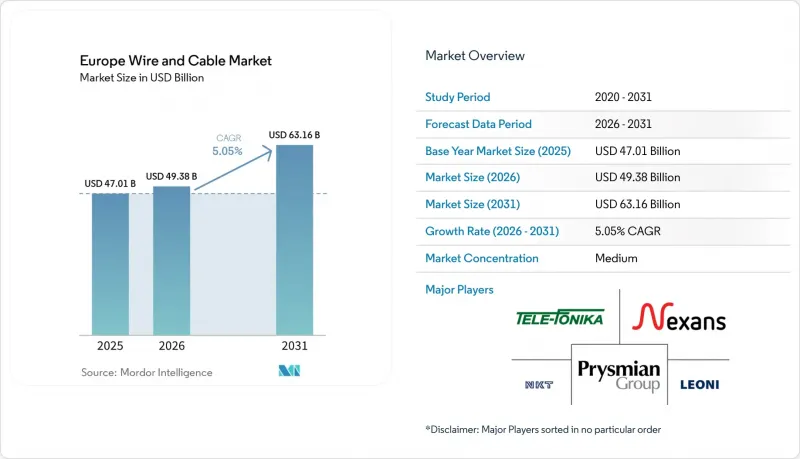
This report is Segmented by Cable Type (Low-Voltage Energy Cables, Medium-Voltage Cables, and More), Voltage Rating (<=1 KV, 1-35 KV, and More), Installation Type (Overhead, Underground, and Submarine), Conductor Material (Copper, Aluminium, and Aluminium-Alloy), End-User Industry (Construction, Power Infrastructure and Utilities, and More), and Country. The Market Forecasts are Provided in Terms of Value (USD).
Europe Wire And Cable Market Trends and Insights
Surging Renewable-Power Cable Demand
Offshore-wind targets such as Germany's 70 GW objective by 2045 are creating unprecedented demand for export and array cables, with single awards like the EUR 5 billion Amprion package covering 4,400 km of +-525 kV HVDC lines. Ultra-deep installations demonstrated by a 2,150-meter record lay on the Tyrrhenian Link illustrate rising technical complexity and reinforce premium pricing power for specialized suppliers. The Biscay Gulf interconnector plus multiple Connecting-Europe-Facility projects require an estimated EUR 584 billion (USD 687 billion) in grid capital outlays, sustaining multi-voltage demand pipelines. National renewable-integration laws and EU Grid Codes mandate tighter loss limits and real-time monitoring, driving adoption of composite power-plus-fiber solutions. Vendors offering ECO-certified designs with recycled content gain procurement preference as utilities align with Scope 3 carbon-reduction targets.
Grid-Modernization and HV Upgrade Programmes
European TSOs are replacing ageing 1970s-era assets while preparing for bidirectional flows stemming from distributed generation. Highlights include the Third Interconnector linking Eisenhuttenstadt and Plewiska, categorized as EU priority infrastructure and co-funded under Decision 1364/2006. Manufacturers are expanding to meet the surge; NKT is investing EUR 100 million (USD 118 million) in Cologne and EUR 50 million (USD 59 million) in Esposende to support 225 kV-plus orders. Medium-voltage replacements in industrial corridors are gaining urgency as digital factories demand tighter power-quality tolerances. Smart-sensor embedded cores allowing distributed temperature and partial-discharge analytics are graduating from pilot to scaled roll-out, embedding long-term service opportunities for cable OEMs. ENTSO-E's ten-year plan is standardizing specs, enabling multi-country bulk tenders that reward scale economies.
Volatile Copper and Aluminium Prices
Copper hit USD 5.20 per lb in May 2024, eroding fixed-price project margins and prompting a pivot toward aluminum-alloy conductors that deliver 15% weight savings and up to 25% material-cost relief. European manufacturers intensify hedging with LME futures and dynamic-index clauses in public tenders to mitigate exposure. Grid operators evaluate life-cycle equivalence analyses, validating alloy usage for 132 kV-plus applications under updated IEC-60228 revisions. Concurrently, EU Critical Raw Materials legislation is spurring domestic smelter expansions to dilute import reliance. Recycled-metal content is rising, with Prysmian reporting 15.7% secondary copper usage in 2025, aligning with circular-economy procurement scoring.
Other drivers and restraints analyzed in the detailed report include:
- 5G and Fibre-to-the-Home Rollout
- EU Recovery Fund-Fuelled Undergrounding
- High Installation and Labour Cost (UG/Undersea)
For complete list of drivers and restraints, kindly check the Table Of Contents.
Segment Analysis
Low-voltage energy products remained the workhorse segment in 2025, supplying residential wiring and commercial projects that still form the backbone of the European wire and cable market. However, fiber-optic solutions are accelerating at a 6.6% clip thanks to relentless broadband targets and 5G densification. Hybrid power-and-data constructions are gaining favor in electric-vehicle charging corridors to consolidate trenching efforts. Specialty fire-resistant products are soaring in metro-tunnel refurbishments as new Construction Products Regulation (CPR) classes drive adoption of low-smoke, zero-halogen sheaths. Over the outlook, multi-core composite cables embedding optical fibers will progressively cannibalize single-purpose signal lines, bolstering average selling prices (ASPs).
In parallel, high-voltage and extra-high-voltage (EHV) lines are benefiting from marquee transmission corridors such as the Tyrrhenian Link and Biscay Gulf, underpinning a robust backlog for 400 kV-plus systems. Medium-voltage offerings are receiving a lift from Industry 4.0 retrofits that require enhanced power quality, galvanizing demand for cross-linked polyethylene insulation paired with online temperature sensing. Signal and control cables, though smaller in revenue share, remain indispensable to automation upgrades and will ride the 5.85% CAGR wave tethered to the industrial IoT build-out.
The <=1 kV bracket captured 39.30% of 2025 outlays, mirroring Europe's dense residential stock and ongoing electrification of light-commercial premises. Medium-voltage (1-35 kV) funnels are widening as cities favor underground feeders that boost resilience against extreme weather. Europe wire and cable market size for the 36-150 kV tier is forecast to expand at a 6.1% CAGR, driven by municipal sub-station roll-outs and localized renewable hookups.
Above 150 kV, HVDC expansions such as BalWin1 and BalWin2 keep the order pipeline flush, though project timing can be lumpy due to lengthy permits. Cross-border synchronization under ENTSO-E rules is catalyzing spec harmonization, thereby lowering per-unit production costs and enhancing vendor margin stability.
List of Companies Covered in this Report:
- Prysmian S.p.A.
- Nexans S.A.
- NKT A/S
- Leoni AG
- TELE-FONIKA Kable S.A.
- TE Connectivity Ltd.
- British Cables Company Ltd.
- Habia Cable AB
- Waskonig + Walter Kabel-Werke GmbH and Co. KG
- Tratos Cavi S.p.A. Giancarlo De Nardis and C.
- Hellenic Cables S.A.
- La Triveneta Cavi S.p.A.
- HELUKABEL GmbH
- Silec Cable SAS
- Brugg Kabel AG
- Eland Cables Ltd.
- Reka Kaapeli Oy
- TKF B.V. (Twentsche Kabelfabriek)
- Top Cable S.A.
- Cabelte - Cabos Electricos e Telefonicos S.A.
- Elcowire Rail GmbH
Additional Benefits:
- The market estimate (ME) sheet in Excel format
- 3 months of analyst support
TABLE OF CONTENTS
1 INTRODUCTION
- 1.1 Study Assumptions and Market Definition
- 1.2 Scope of the Study
2 RESEARCH METHODOLOGY
3 EXECUTIVE SUMMARY
4 MARKET LANDSCAPE
- 4.1 Market Overview
- 4.2 Market Drivers
- 4.2.1 Surging renewable-power cable demand
- 4.2.2 Grid-modernisation and HV upgrade programmes
- 4.2.3 5G and fibre-to-the-home rollout
- 4.2.4 EU Recovery Fund-fuelled undergrounding
- 4.2.5 EV-charging-infrastructure fire-safety cables
- 4.2.6 Smart-sensor cables for Industry 4.0 plants
- 4.3 Market Restraints
- 4.3.1 Volatile copper and aluminium prices
- 4.3.2 High installation and labour cost (UG/undersea)
- 4.3.3 Environmental-permitting delays on subsea links
- 4.3.4 Polymer-compound supply bottlenecks
- 4.4 Industry Value Chain Analysis
- 4.5 Regulatory Landscape
- 4.6 Technological Outlook
- 4.7 Porter's Five Forces Analysis
- 4.7.1 Threat of New Entrants
- 4.7.2 Bargaining Power of Suppliers
- 4.7.3 Bargaining Power of Buyers
- 4.7.4 Threat of Substitutes
- 4.7.5 Intensity of Competitive Rivalry
- 4.8 Impact of Key Macroeconomic Trends on Market
5 MARKET SIZE AND GROWTH FORECASTS (VALUES)
- 5.1 By Cable Type
- 5.1.1 Low-Voltage Energy Cables
- 5.1.2 Medium-Voltage Cables
- 5.1.3 High-Voltage and EHV Cables
- 5.1.4 Fibre-Optic Cables
- 5.1.5 Signal and Control Cables
- 5.1.6 Specialty/Fire-Resistant Cables
- 5.2 By Voltage Rating
- 5.2.1 <=1 kV
- 5.2.2 1-35 kV
- 5.2.3 36-150 kV
- 5.2.4 >150 kV
- 5.3 By Installation Type
- 5.3.1 Overhead
- 5.3.2 Underground
- 5.3.3 Submarine
- 5.4 By Conductor Material
- 5.4.1 Copper
- 5.4.2 Aluminium
- 5.4.3 Aluminium-Alloy
- 5.5 By End-user Industry
- 5.5.1 Construction (Residential and Communication)
- 5.5.2 Power Infrastructure and Utilities
- 5.5.3 Telecommunications and Data Centres
- 5.5.4 Industrial Manufacturing
- 5.5.5 Transportation (Rail, EV, Marine)
- 5.5.6 Other End-user Industries
- 5.6 By Country
- 5.6.1 United Kingdom
- 5.6.2 Germany
- 5.6.3 France
- 5.6.4 Italy
- 5.6.5 Spain
- 5.6.6 Switzerland
- 5.6.7 Belgium
- 5.6.8 Netherlands
- 5.6.9 Poland
- 5.6.10 Rest of Europe
6 COMPETITIVE LANDSCAPE
- 6.1 Market Concentration
- 6.2 Strategic Moves
- 6.3 Market Share Analysis
- 6.4 Company Profiles (includes Global-level Overview, Market-level Overview, Core Segments, Financials, Strategic Information, Market Rank/Share, Products and Services, Recent Developments)
- 6.4.1 Prysmian S.p.A.
- 6.4.2 Nexans S.A.
- 6.4.3 NKT A/S
- 6.4.4 Leoni AG
- 6.4.5 TELE-FONIKA Kable S.A.
- 6.4.6 TE Connectivity Ltd.
- 6.4.7 British Cables Company Ltd.
- 6.4.8 Habia Cable AB
- 6.4.9 Waskonig + Walter Kabel-Werke GmbH and Co. KG
- 6.4.10 Tratos Cavi S.p.A. Giancarlo De Nardis and C.
- 6.4.11 Hellenic Cables S.A.
- 6.4.12 La Triveneta Cavi S.p.A.
- 6.4.13 HELUKABEL GmbH
- 6.4.14 Silec Cable SAS
- 6.4.15 Brugg Kabel AG
- 6.4.16 Eland Cables Ltd.
- 6.4.17 Reka Kaapeli Oy
- 6.4.18 TKF B.V. (Twentsche Kabelfabriek)
- 6.4.19 Top Cable S.A.
- 6.4.20 Cabelte - Cabos Electricos e Telefonicos S.A.
- 6.4.21 Elcowire Rail GmbH
7 MARKET OPPORTUNITIES AND FUTURE OUTLOOK
- 7.1 White-space and Unmet-Need Assessment

