
PUBLISHER: Mordor Intelligence | PRODUCT CODE: 2072469

PUBLISHER: Mordor Intelligence | PRODUCT CODE: 2072469
Neuromodulation - Market Share Analysis, Industry Trends & Statistics, Growth Forecasts (2026 - 2031)
According to Mordor Intelligence, the neuromodulation market size is projected to expand from USD 6.67 billion in 2025 and USD 7.22 billion in 2026 to USD 10.93 billion by 2031, registering a CAGR of 8.65% between 2026 to 2031.
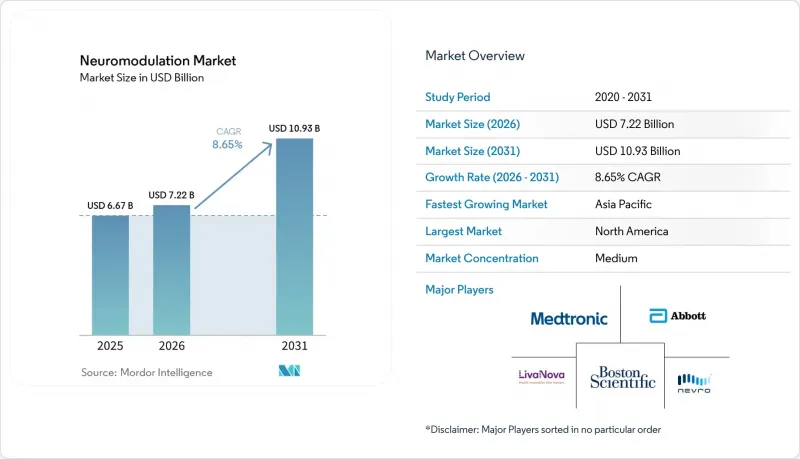
This report is Segmented by Technology (Internal Neuromodulation and External Neuromodulation), Application (Pain Management, Parkinson's Disease, and More), End-User (Hospitals & Ambulatory Surgical Centers, and More), and Geography (North America, Europe, Asia-Pacific, Middle East and Africa, and South America). The Market Forecasts are Provided in Terms of Value (USD).
Global Neuromodulation Market Trends and Insights
Rising Global Burden of Chronic Pain and Neurological Disorders
Chronic pain affects 1.5 billion people, and drug-resistant cases represent up to 30%, establishing a durable treatment pool. Disability-adjusted life years attributable to neuropathic pain and migraine climbed 12% between 2020 and 2024, partly from post-COVID neuropathies. Parkinson's prevalence could double to 17 million by 2040 as populations age across Asia, where access to levodopa is uneven. Epilepsy remains refractory in 30% of 50 million global patients; 2024 FDA clearance of responsive neurostimulation for adolescents widened the U.S. eligible pool by roughly 200,000 candidates. Health-system moves toward bundled payments heighten interest in one-time device expenditures that offset recurring costs of drugs and emergency visits within five years.
Continuous Advancements in Closed-Loop and High-Frequency Stimulation Technologies
FDA clearance of Medtronic's Percept RC in 2024 introduced adaptive deep brain stimulation, which titrates therapy against real-time beta-band biomarkers, reducing daily "off" time by 2.6 hours in Parkinson's patients. Ten-kilohertz spinal cord stimulation, pioneered by Nevro and adopted by Abbott and Boston Scientific, avoids paresthesia and delivers 70% responder rates in failed-back-surgery syndrome trials. Neuros Medical's high-frequency peripheral device received 2024 clearance for phantom-limb pain, signaling broader use in diabetic neuropathy. Such innovations shorten product life cycles and push manufacturers toward modular hardware capable of software upgrades over the air.
High Capital and Maintenance Costs of Implantable Systems
Implantable stimulators range from USD 20,000 to USD 50,000, outpacing total annual per-capita health spending in most countries. Non-rechargeable battery replacements add USD 8,000-12,000 every 3-5 years and carry 2-5% infection risk[1]. Medicare's flat diagnosis-related payments since 2020 have squeezed hospital margins, while China reimburses only 70% of the DBS device cost, leaving sizable co-pays. Manufacturers are responding with lower-priced "value" systems; however, thinner margins may slow the development of next-generation features.
Other drivers and restraints analyzed in the detailed report include:
- Expansion of Approved Clinical Indications and Reimbursement Coverage
- Increasing Investments, M&A Activity, and Strategic Partnerships
- Stringent and Divergent Global Regulatory Approval Requirements
For complete list of drivers and restraints, kindly check the Table Of Contents.
Segment Analysis
Internal platforms accounted for a 70.12% neuromodulation market share in 2025, supported by decades of evidence in spinal cord and deep brain applications. Medtronic's sensing-enabled Percept RC shortens symptom "off" periods by up to 30% compared with open-loop predecessors. Abbott's Eterna generator utilizes a 10-year rechargeable cell, alleviating patient concerns about frequent recharges. Dorsal root ganglion systems gained momentum after U.S. national coverage in 2024, broadening pain-care options for Medicare beneficiaries.
External, non-invasive modalities are projected to post a 10.23% CAGR through 2031, driven by home-use clearances and consumer adoption of wellness products. Neurovalens launched a USD 500 vestibular-nerve headset that delivers physician-grade therapy without the need for surgery. FDA cleared at-home transcranial magnetic stimulators in 2024, reducing the access hurdle posed by 36-session clinic regimens. Evidence remains mixed - Cochrane reviews show only modest pain reduction for transcutaneous electrical nerve stimulators - but bundling devices with telehealth coaching is improving adherence and outcomes[3].
Complete Report Scope:
- By Technology
- Internal Neuromodulation
- Spinal Cord Stimulation (SCS)
- Deep Brain Stimulation (DBS)
- Vagus Nerve Stimulation (VNS)
- Sacral Nerve Stimulation (SNS)
- Gastric Electrical Stimulation (GES)
- Other Internal Neuromodulation
- External Neuromodulation (Non-Invasive)
- Transcutaneous Electrical Nerve Stimulation (TENS)
- Transcranial Magnetic Stimulation (TMS)
- Other External Neuromodulations
- Internal Neuromodulation
- By Application
- Pain Management
- Parkinson's Disease
- Epilepsy
- Depression
- Dystonia
- Other Applications
- By End-User
- Hospitals & Ambulatory Surgical Centers
- Clinics & Physiotherapy Centers
- Other End Users
- Geography
- North America
- United States
- Canada
- Mexico
- Europe
- Germany
- United Kingdom
- France
- Italy
- Spain
- Rest Of Europe
- Asia-Pacific
- China
- Japan
- India
- South Korea
- Australia
- Rest of Asia-Pacific
- Middle East And Africa
- GCC
- South Africa
- Rest of Middle East And Africa
- South America
- Brazil
- Argentina
- Rest of South America
- North America
Geography Analysis
North America contributed 45.21% of 2025 revenues, driven by established reimbursement pathways, a concentrated clinical-trial infrastructure, and FDA programs that accept single-arm data for breakthrough devices. CMS's national determination for dorsal root ganglion stimulation immediately opened coverage to roughly 40,000 Medicare lives, while private insurers removed prior authorization hurdles for candidates with documented opioid use disorder. Canada has added NeuroPace to its roster of assistive devices, supporting expected double-digit implant growth through 2027.
Europe delivered roughly one-third of global sales, led by Germany, the United Kingdom, and France. Germany's registry-linked funding model for closed-loop DBS sets a template for value-based adoption, even as EU MDR rules lengthen device approval cycles. In 2024, NICE guidance affirmed the cost-effectiveness of spinal cord stimulation within accepted thresholds, thereby cementing its place as a standard intervention for failed-back-surgery syndrome. Uptake in Southern and Eastern Europe remains limited by budget and staffing shortages.
The Asia-Pacific region is the fastest-growing, with a projected 9.90% CAGR to 2031. China cleared Medtronic's closed-loop DBS in 2024, but 30% patient cost-sharing still restricts implants to wealthier urban areas. Japan approved Boston Scientific's latest DBS platform, yet maintains price caps 20% below U.S. levels; such margins discourage premium launches. India saw fewer than 500 spinal cord stimulators placed in 2024 because private insurance penetration is still low.
The Middle East, Africa, and South America collectively accounted for less than 7% of 2025 sales, but exhibit isolated hotspots. The United Arab Emirates has added spinal cord stimulation to its list of essential benefits, and Brazil's private insurers reimburse neuromodulation at rates comparable to those in Southern Europe, although public-sector access remains limited.
- Abbott Laboratories
- Boston Scientific
- Inspire Medical Systems
- LivaNova
- Medtronic
- MicroTransponder Inc.
- NeuroPace
- Neuronetics
- NeuroSigma
- Nevro
- Nuvectra
- Soterix Medical
- Synapse Biomedical
Additional Benefits:
- The market estimate (ME) sheet in Excel format
- 3 months of analyst support
TABLE OF CONTENTS
1 Introduction
- 1.1 Study Assumptions & Market Definition
- 1.2 Scope of the Study
2 Research Methodology
3 Executive Summary
4 Market Landscape
- 4.1 Market Overview
- 4.2 Market Drivers
- 4.2.1 Rising Global Burden of Chronic Pain and Neurological Disorders
- 4.2.2 Continuous Advancements in Closed-Loop and High-Frequency Stimulation Technologies
- 4.2.3 Expansion of Approved Clinical Indications and Reimbursement Coverage
- 4.2.4 Increasing Investments, M&A Activity, and Strategic Partnerships Across Neurotechnology Ecosystem
- 4.2.5 Emergence of AI-Powered Personalized Neuromodulation Algorithms
- 4.2.6 Growth of Wearable, Non-Invasive Neuromodulation for Home-Based Care
- 4.3 Market Restraints
- 4.3.1 High Capital and Maintenance Costs of Implantable Systems
- 4.3.2 Stringent and Divergent Global Regulatory Approval Requirements
- 4.3.3 Cybersecurity and Data-Privacy Risks In Connected Neurostimulators
- 4.3.4 Limited Long-Term Clinical Evidence For Novel Indications
- 4.4 Regulatory & Technological Outlook
- 4.5 Porter's Five Forces Analysis
- 4.5.1 Threat Of New Entrants
- 4.5.2 Bargaining Power Of Buyers
- 4.5.3 Bargaining Power Of Suppliers
- 4.5.4 Threat Of Substitute Products
- 4.5.5 Intensity Of Competitive Rivalry
5 Market Size & Growth Forecasts (Value, USD)
- 5.1 By Technology
- 5.1.1 Internal Neuromodulation
- 5.1.1.1 Spinal Cord Stimulation (SCS)
- 5.1.1.2 Deep Brain Stimulation (DBS)
- 5.1.1.3 Vagus Nerve Stimulation (VNS)
- 5.1.1.4 Sacral Nerve Stimulation (SNS)
- 5.1.1.5 Gastric Electrical Stimulation (GES)
- 5.1.1.6 Other Internal Neuromodulation
- 5.1.2 External Neuromodulation (Non-Invasive)
- 5.1.2.1 Transcutaneous Electrical Nerve Stimulation (TENS)
- 5.1.2.2 Transcranial Magnetic Stimulation (TMS)
- 5.1.2.3 Other External Neuromodulations
- 5.1.1 Internal Neuromodulation
- 5.2 By Application
- 5.2.1 Pain Management
- 5.2.2 Parkinson's Disease
- 5.2.3 Epilepsy
- 5.2.4 Depression
- 5.2.5 Dystonia
- 5.2.6 Other Applications
- 5.3 By End-User
- 5.3.1 Hospitals & Ambulatory Surgical Centers
- 5.3.2 Clinics & Physiotherapy Centers
- 5.3.3 Other End Users
- 5.4 Geography
- 5.4.1 North America
- 5.4.1.1 United States
- 5.4.1.2 Canada
- 5.4.1.3 Mexico
- 5.4.2 Europe
- 5.4.2.1 Germany
- 5.4.2.2 United Kingdom
- 5.4.2.3 France
- 5.4.2.4 Italy
- 5.4.2.5 Spain
- 5.4.2.6 Rest Of Europe
- 5.4.3 Asia-Pacific
- 5.4.3.1 China
- 5.4.3.2 Japan
- 5.4.3.3 India
- 5.4.3.4 South Korea
- 5.4.3.5 Australia
- 5.4.3.6 Rest of Asia-Pacific
- 5.4.4 Middle East And Africa
- 5.4.4.1 GCC
- 5.4.4.2 South Africa
- 5.4.4.3 Rest of Middle East And Africa
- 5.4.5 South America
- 5.4.5.1 Brazil
- 5.4.5.2 Argentina
- 5.4.5.3 Rest of South America
- 5.4.1 North America
6 Competitive Landscape
- 6.1 Market Concentration
- 6.2 Market Share Analysis
- 6.3 Company Profiles (Includes Global Level Overview, Market Level Overview, Core Business Segments, Financials, Headcount, Key Information, Market Rank, Market Share, Products And Services, And Analysis Of Recent Developments)
- 6.3.1 Abbott
- 6.3.2 Boston Scientific Corporation
- 6.3.3 Inspire Medical Systems
- 6.3.4 LivaNova PLC
- 6.3.5 Medtronic PLC
- 6.3.6 MicroTransponder Inc.
- 6.3.7 Neuropace Inc.
- 6.3.8 Neuronetics Inc.
- 6.3.9 Neurosigma Inc.
- 6.3.10 Nevro Corporation
- 6.3.11 Nuvectra
- 6.3.12 Soterix Medical
- 6.3.13 Synapse Biomedical Inc.
7 Market Opportunities & Future Outlook
- 7.1 White-Space & Unmet-Need Assessment

