PUBLISHER: Mordor Intelligence | PRODUCT CODE: 2072486

PUBLISHER: Mordor Intelligence | PRODUCT CODE: 2072486
Europe Premium Chocolate - Market Share Analysis, Industry Trends & Statistics, Growth Forecasts (2026 - 2031)
According to Mordor Intelligence, the europe premium chocolate market size is expected to grow from USD 13.10 billion in 2025 to USD 13.79 billion in 2026 and is forecast to reach USD 17.84 billion by 2031 at 5.29% CAGR over 2026-2031.
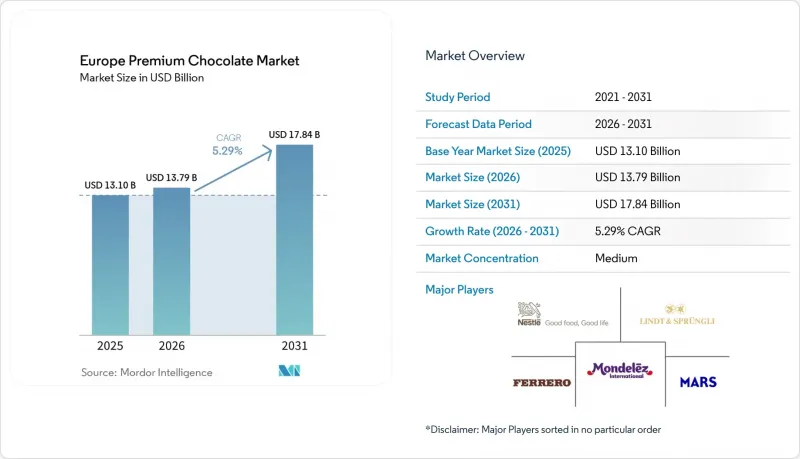
This report is Segmented by Product Type (Premium Dark Chocolate, Premium Milk/White Chocolate), Category (Dairy Chocolates, Non-Dairy or Vegan Chocolates), Distribution Channel (Supermarkets/Hypermarkets, Specialty and Gourmet Store, Online Retail Stores, Other Distribution Channels), and Geography (Germany, United Kingdom, France, and More). The Market Forecasts are Provided in Terms of Value (USD).
Europe Premium Chocolate Market Trends and Insights
Health-Conscious Consumers Prefer Dark and Low-Sugar Premium Chocolates as "Better-for-You" Indulgences
Barry Callebaut's 2024 consumer survey reveals that most European chocolate consumers expect chocolate brands to offer wellness-focused innovations, with younger buyers favoring plant-based or reduced-sugar options. This demand drives the Premium Dark Chocolate segment's 5.98% CAGR, surpassing the category average. Manufacturers are reformulating products with over 70% cocoa and natural sweeteners like stevia and monk fruit. Germany and the Netherlands lead this trend, with Germany's per-capita dark-chocolate consumption rising 12% from 2023 to 2025, driven by urban millennials seeking guilt-free indulgences rich in polyphenols. In 2024, Lindt launched a 90% cocoa Excellence line, achieving double-digit volume growth in its first year across German and Swiss retail channels. The "better-for-you" trend also emphasizes portion control, with single-serve 20-gram dark-chocolate squares now making up 18% of premium SKU launches in Western Europe, meeting demand for mindful snacking while enabling higher per-gram pricing.
Functional Chocolates with Nuts, Seeds, Superfoods, or Added Nutrients Enhance Premium Appeal
In 2025, Puratos reported that 65% of European consumers seek "mood food" in confectionery, while 68% believe botanical ingredients offer health benefits. Manufacturers are responding by adding adaptogens, probiotics, and plant-based proteins to chocolate. Barry Callebaut's survey showed 61% of respondents value chocolate's mental health benefits, leading to launches like ashwagandha truffles and magnesium-enriched dark bars. A 2024 Nature Food study introduced whole-fruit chocolate, made with cocoa pulp and endocarp, as a sucrose-free option that boosts fiber by 20%. Swiss and Belgian artisans are piloting this innovation. France and Belgium lead in functional SKUs, with Valrhona launching its "Wellness Collection" in early 2025, featuring quinoa crisps and chia seeds for premium retailers. This mix of indulgence and nutrition allows brands to charge 30-40% higher prices, protecting margins despite rising cocoa costs.
Supply-Chain Traceability Compliance Costs
Effective December 30, 2024, the EU Deforestation Regulation requires importers to submit due-diligence statements with geolocation data for every cocoa shipment. Small and midsize chocolatiers, lacking compliance teams, face upfront costs of EUR 50,000 to EUR 150,000 for satellite monitoring, blockchain platforms, and audits. Belgian and Italian artisans, sourcing cocoa through complex intermediaries, struggle to trace farm-level origins, risking shipment rejections at EU ports. Larger companies like Lindt and Ferrero manage these costs through scale, but smaller operators either raise prices-hurting competitiveness-or exit the market. Non-compliance penalties of up to 4% of annual EU turnover further increase risks, pushing supply chains toward certified cooperatives. These challenges slow SKU innovation as manufacturers focus on compliance, while new brands face delays due to high costs of traceable cocoa.
Other drivers and restraints analyzed in the detailed report include:
- Ethically Sourced, Fair-Trade, and Rainforest Alliance/Organic Cocoa Drive Consumer Loyalty
- E-Commerce, Subscription Boxes, and Direct-to-Consumer Platforms Expand Access to Premium Chocolates
- Cocoa-Price Volatility
For complete list of drivers and restraints, kindly check the Table Of Contents.
Segment Analysis
In 2025, Premium Milk/White Chocolate dominated 54.78% of Europe's Premium Chocolate Market, driven by consumer preference for its creamy texture and mild flavor. Germany, Switzerland, and the UK lead in milk chocolate consumption, exceeding 5 kilograms per capita annually, supported by brands like Lindt's Lindor and Milka's Alpine Milk bars. Milk chocolate's versatility in products like pralines, biscuits, and seasonal figures ensures its popularity, especially during Easter and Christmas, which account for 40% of annual sales. White chocolate, though smaller in market share, benefits from premium offerings like Valrhona's Ivoire 35 percent, favored in French patisseries. However, rising cocoa-butter costs, which make up 30-35% of white chocolate, have led manufacturers to adopt shrinkflation-reducing bar sizes while maintaining prices-risking consumer dissatisfaction if not communicated clearly.
Premium Dark Chocolate, while holding a smaller market share in 2025, is growing at a 5.98% CAGR through 2031, outpacing milk and white chocolate. Health-conscious consumers prefer dark chocolate for its high cocoa content and perceived health benefits, such as flavonoids and antioxidants. Lindt's Excellence range (70%, 85%, and 90% cocoa) saw an 18% volume increase in Germany and the Netherlands in 2024, driven by urban millennials. A 2024 Barry Callebaut survey found 67% of European consumers seek innovative chocolate products, with 61% of younger buyers favoring reduced-sugar options, boosting demand for dark chocolate. Ritter Sport's 2024 "Cacao Selection," featuring 74% and 81% dark chocolate with sea salt and almond, gained traction in German discounters and premium grocers. Dark chocolate's growth is further supported by its vegan and organic certifications and ethical sourcing from Rainforest Alliance or Fairtrade cooperatives, contributing 0.9 percentage points to the market's CAGR.
Complete Report Scope:
- By Product Type
- Premium Dark Chocolate
- Premium Milk/ White Chocolate
- By Category
- Dairy Chocolates
- Non-Dairy or Vegan Chocolates
- By Distribution Channel
- Supermarkets/Hypermarkets
- Specialty and Gourmet Stores
- Online Retail Stores
- Other Distribution Channels
- By Country
- Germany
- United Kingdom
- France
- Italy
- Spain
- Netherlands
- Sweden
- Poland
- Belgium
- Rest of Europe
List of Companies Covered in this Report:
- Chocoladefabriken Lindt & Sprungli AG
- Ferrero Group
- Mondelez International
- Nestle SA
- Mars Inc.
- Yildiz Holding (Pladis / Godiva)
- Valrhona SAS
- Neuhaus NV
- Pierre Marcolini Group
- Cemoi Group
- Venchi S.p.A
- Hotel Chocolat Group plc
- Ritter Sport (Alfred Ritter GmbH)
- Fazer Confectionery Oy
- Leonidas SA
- Amedei Tuscany
- Laderach AG
- Guylian NV
- Zotter Schokoladen Manufaktur
- Charbonnel et Walker
Additional Benefits:
- The market estimate (ME) sheet in Excel format
- 3 months of analyst support
TABLE OF CONTENTS
1 INTRODUCTION
- 1.1 Study Assumptions and Market Definition
- 1.2 Scope of the Study
2 RESEARCH METHODOLOGY
3 EXECUTIVE SUMMARY
4 MARKET LANDSCAPE
- 4.1 Market Overview
- 4.2 Market Drivers
- 4.2.1 Health-conscious consumers prefer dark, and low-sugar premium chocolates as "better-for-you" indulgences.
- 4.2.2 Functional chocolates with nuts, seeds, superfoods, or added nutrients enhance premium appeal.
- 4.2.3 Ethically sourced, fair-trade, and Rainforest Alliance/organic cocoa drive consumer loyalty.
- 4.2.4 E-commerce, subscription boxes, and direct-to-consumer platforms expand access to premium chocolates.
- 4.2.5 Novel flavors and textural innovations fuel premium product growth.
- 4.2.6 Specialty chocolatiers and cafe-boutiques thrive with tastings, pairing events, and cocoa education.
- 4.3 Market Restraints
- 4.3.1 Supply-chain traceability compliance costs
- 4.3.2 Cocoa-price volatility
- 4.3.3 Alternative indulgences fragment the premium treat category
- 4.3.4 EU food safety standards force costly reformulations and compliance investments
- 4.4 Supply Chain Analysis
- 4.5 Regulatory Landscape
- 4.6 Technological Outlook
- 4.7 Porter's Five Forces Analysis
- 4.7.1 Threat of New Entrants
- 4.7.2 Bargaining Power of Buyers
- 4.7.3 Bargaining Power of Suppliers
- 4.7.4 Threat of Substitutes
- 4.7.5 Intensity of Competitive Rivalry
5 MARKET SIZE AND GROWTH FORECASTS (VALUE)
- 5.1 By Product Type
- 5.1.1 Premium Dark Chocolate
- 5.1.2 Premium Milk/ White Chocolate
- 5.2 By Category
- 5.2.1 Dairy Chocolates
- 5.2.2 Non-Dairy or Vegan Chocolates
- 5.3 By Distribution Channel
- 5.3.1 Supermarkets/Hypermarkets
- 5.3.2 Specialty and Gourmet Stores
- 5.3.3 Online Retail Stores
- 5.3.4 Other Distribution Channels
- 5.4 By Country
- 5.4.1 Germany
- 5.4.2 United Kingdom
- 5.4.3 France
- 5.4.4 Italy
- 5.4.5 Spain
- 5.4.6 Netherlands
- 5.4.7 Sweden
- 5.4.8 Poland
- 5.4.9 Belgium
- 5.4.10 Rest of Europe
6 COMPETITIVE LANDSCAPE
- 6.1 Market Concentration
- 6.2 Strategic Moves
- 6.3 Market Share Analysis
- 6.4 Company Profiles (includes Global level Overview, Market level overview, Core Segments, Financials as available, Strategic Information, Market Rank/Share for key companies, Products and Services, and Recent Developments)
- 6.4.1 Chocoladefabriken Lindt & Sprungli AG
- 6.4.2 Ferrero Group
- 6.4.3 Mondelez International
- 6.4.4 Nestle SA
- 6.4.5 Mars Inc.
- 6.4.6 Yildiz Holding (Pladis / Godiva)
- 6.4.7 Valrhona SAS
- 6.4.8 Neuhaus NV
- 6.4.9 Pierre Marcolini Group
- 6.4.10 Cemoi Group
- 6.4.11 Venchi S.p.A
- 6.4.12 Hotel Chocolat Group plc
- 6.4.13 Ritter Sport (Alfred Ritter GmbH)
- 6.4.14 Fazer Confectionery Oy
- 6.4.15 Leonidas SA
- 6.4.16 Amedei Tuscany
- 6.4.17 Laderach AG
- 6.4.18 Guylian NV
- 6.4.19 Zotter Schokoladen Manufaktur
- 6.4.20 Charbonnel et Walker
7 MARKET OPPORTUNITIES AND FUTURE OUTLOOK

