
PUBLISHER: Mordor Intelligence | PRODUCT CODE: 2072504

PUBLISHER: Mordor Intelligence | PRODUCT CODE: 2072504
China Crustaceans - Market Share Analysis, Industry Trends & Statistics, Growth Forecasts (2026 - 2031)
According to Mordor Intelligence, the china crustaceans market size is projected to grow from USD 2.12 billion in 2025 to USD 2.25 billion in 2026, and to USD 3.06 billion by 2031, at a CAGR of 6.3% from 2026 to 2031.
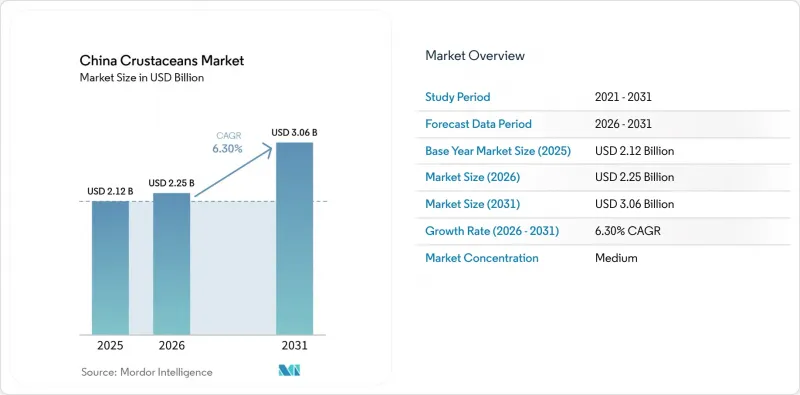
This report is Segmented by Type (Shrimp and Prawn, Crab, Lobster, and More). The Report Also Offers Production Analysis (Volume), Consumption Analysis (Value and Volume), Trade Analysis (Value and Volume), Import Market Analysis (Import Value and Volume and Key Supplying Markets), and More. The Market Forecasts are Provided in Terms of Value (USD) and Volume (Metric Tons).
China Crustaceans Market Trends and Insights
Rising Incomes Boost Crustacean Consumption
Increasing disposable income and changing urban consumption patterns are driving the demand for premium crustaceans, such as shrimp and crayfish. According to China's National Bureau of Statistics, per capita disposable income reached CNY 41,314 (USD 5,807) in 2024, reflecting a 5.3% increase compared to the previous year. The rise in household purchasing power is encouraging consumers to allocate more of their spending to premium protein sources, including high-quality seafood products. Consequently, higher expenditure on fresh, value-added, and traceable crustacean products is contributing to stronger consumption growth and enhancing value realization in the China crustaceans market.
Government Incentives for Modern Aquaculture Clusters
Government support is driving the advancement of modern aquaculture systems in China through initiatives promoting technological upgrades and large-scale production. According to the Ministry of Agriculture and Rural Affairs of China, the country's aquatic product output reached 73.66 million metric tons in 2024, representing a 3.5% year-on-year increase. This growth highlights ongoing investments in aquaculture modernization and production efficiency. The adoption of advanced farming systems and improved infrastructure is contributing to supply stability and enabling higher-output crustacean farming. Consequently, government-backed development programs are enhancing production capacity and fostering long-term growth in the Chinese crustaceans market.
Recurring Disease Outbreaks
Disease outbreaks pose significant challenges to crustacean farming in China, disrupting production cycles and decreasing farm-level efficiency. A 2025 review published in Viruses journal highlights that White Spot Syndrome Virus (WSSV) can lead to cumulative mortality rates of up to 100% in infected shrimp populations within 3-10 days, making it one of the most destructive pathogens in crustacean aquaculture. These severe disease risks compel farmers to invest in biosecurity measures, health monitoring, and water treatment systems, thereby increasing operating costs. Recurring outbreaks undermine production predictability and create supply uncertainties, hindering sustainable growth in the Chinese crustaceans market.
Other drivers and restraints analyzed in the detailed report include:
- Rapid Adoption of Recirculating Aquaculture Systems (RAS)
- Expansion of Cold-Chain Logistics and E-Commerce Seafood Platforms
- Volatile Feed Costs Tied to Soybean and Fishmeal Prices
For complete list of drivers and restraints, kindly check the Table Of Contents.
Segment Analysis
Shrimp and prawn accounted for the largest share, 46.0%, of the China crustaceans market in 2025. Shrimp remains the leading crustacean category due to its widespread consumption, well-established farming infrastructure, and strong presence across retail, foodservice, and processing channels. The species benefits from extensive aquaculture expertise, efficient feed systems, and year-round availability, making it a preferred choice for both domestic consumers and export-oriented producers. Crab, on the other hand, maintains a significant role in premium seafood consumption, driven by seasonal demand and cultural importance. Additionally, crayfish and other niche crustaceans are gaining traction through online retail platforms and diversified dining formats.
Lobster market size is forecast to grow at the fastest CAGR of 8.8% during 2026-2031. This growth is fueled by increasing consumer spending on premium seafood, rising demand from high-end restaurants, and greater acceptance of imported live lobster products in urban markets. Consumers are increasingly seeking unique seafood experiences, driving demand for higher-value crustacean species. Concurrently, advancements in aquaculture technology, cold-chain logistics, and distribution networks are enhancing product availability and quality. Emerging crustacean categories are also benefiting from the expansion of digital sales channels and modern retail formats, contributing to the diversification of the overall market landscape.
Complete Report Scope:
- By Type
- Shrimp and Prawn
- Crab
- Lobster
- Others
- China
- Production Analysis
- Production Volume
- Consumption Analysis (Value and Volume)
- Trade Analysis (Value and Volume)
- Import Market Analysis
- Import Value and Volume
- Key Supplying Markets
- Export Market Analysis
- Export Value and Volume
- Key Destinations Markets
- Import Market Analysis
- Wholesale Price Trend Analysis and Forecast
- Regulatory Framework
- Logistics and Infrastructure
- Seasonality Analysis
- Production Analysis
Additional Benefits:
- The market estimate (ME) sheet in Excel format
- 3 months of analyst support
TABLE OF CONTENTS
1 Introduction
- 1.1 Study Assumptions and Market Definition
- 1.2 Scope of the Study
2 Research Methodology
3 Executive Summary
4 Market Landscape
- 4.1 Market Overview
- 4.2 Market Drivers
- 4.2.1 Rising incomes boost crustacean consumption
- 4.2.2 Government incentives for modern aquaculture clusters
- 4.2.3 Rapid adoption of recirculating aquaculture systems (RAS)
- 4.2.4 Expansion of cold-chain logistics and e-commerce seafood platforms
- 4.2.5 Emergence of probiotic-enriched and functional crustacean products
- 4.2.6 Rising demand for sustainably certified seafood
- 4.3 Market Restraints
- 4.3.1 Recurring disease outbreaks
- 4.3.2 Volatile feed costs tied to soybean and fishmeal prices
- 4.3.3 Stricter effluent discharge and environmental compliance costs
- 4.3.4 Uncertain trade policies in key export destinations
- 4.4 Opportunities
- 4.5 Challenges
- 4.6 Value Chain Analysis
- 4.7 Technologies and usage of AI in the Industry
- 4.8 Distribution Channel Analysis
- 4.9 Market Sentiment Analysis
- 4.10 PESTLE Analysis
5 Market Size and Growth Forecasts (Value)
- 5.1 By Type
- 5.1.1 Shrimp and Prawn
- 5.1.2 Crab
- 5.1.3 Lobster
- 5.1.4 Others
- 5.2 China
- 5.2.1 Production Analysis
- 5.2.1.1 Production Volume
- 5.2.2 Consumption Analysis (Value and Volume)
- 5.2.3 Trade Analysis (Value and Volume)
- 5.2.3.1 Import Market Analysis
- 5.2.3.1.1 Import Value and Volume
- 5.2.3.1.2 Key Supplying Markets
- 5.2.3.2 Export Market Analysis
- 5.2.3.2.1 Export Value and Volume
- 5.2.3.2.2 Key Destinations Markets
- 5.2.3.1 Import Market Analysis
- 5.2.4 Wholesale Price Trend Analysis and Forecast
- 5.2.5 Regulatory Framework
- 5.2.6 Logistics and Infrastructure
- 5.2.7 Seasonality Analysis
- 5.2.1 Production Analysis
6 End Use and Application
- 6.1 Primary Applications and Emerging Applications
- 6.2 Consumption Breakdown by Industries
7 Competitive Landscape
- 7.1 Overview of the Competition
- 7.2 Recent Developments
- 7.3 Market Concentration Analysis
- 7.4 List of Key Players
- 7.4.1 Zhanjiang Guolian Aquatic Products Co., Ltd.
- 7.4.2 Shandong Haidu Ocean Product Co., Ltd.
- 7.4.3 Shandong Homey Aquatic Development Co., Ltd.
- 7.4.4 Fujian Yuehai Aquatic Products Co., Ltd.
- 7.4.5 Dandong Huayi Foodstuff Co., Ltd.
- 7.4.6 Ocean Treasure World Foods Limited
- 7.4.7 Zhuhai Zhongda Aquatic Products Co., Ltd.
- 7.4.8 Guangdong Jinlong Aquatic Products Co., Ltd.
- 7.4.9 Hainan Xiangtai Fishery Co., Ltd.
- 7.4.10 Guangzhou Blueshrimp Seafood Co., Ltd.
- 7.4.11 Oceanus Group Holdings Limited
8 Market Opportunities and Future Outlook

