PUBLISHER: Mordor Intelligence | PRODUCT CODE: 2072533

PUBLISHER: Mordor Intelligence | PRODUCT CODE: 2072533
Europe Ready-to-Drink Beverages - Market Share Analysis, Industry Trends & Statistics, Growth Forecasts (2026 - 2031)
According to Mordor Intelligence, europe ready-to-Drink beverages market size in 2026 is estimated at USD 166.24 billion, growing from 2025 value of USD 156.76 billion with 2031 projections showing USD 222.93 billion, growing at 6.05% CAGR over 2026-2031.
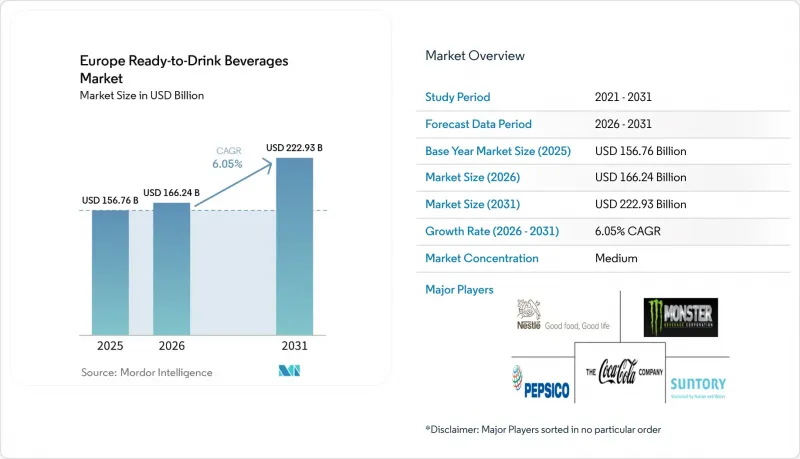
This report is Segmented by Product Type (Tea, Coffee, Energy Drinks, Fruit and Vegetable Juice, and More), Packaging Type (PET/Glass Bottles and Cans), Nature (Conventional and Organic), Distribution Channel (Supermarkets/Hypermarkets, and More), and Geography (United Kingdom, and More). The Market Forecasts are Provided in Terms of Value (USD) and Volume (Liters).
Europe Ready-to-Drink Beverages Market Trends and Insights
Growing Consumer Preference for Convenient, On-The-Go Beverages
European consumers increasingly prioritize convenience over traditional beverage preparation methods, driving fundamental changes in consumption patterns across demographic segments. The convenience channel is growing rapidly, with European markets showing particularly strong adoption. France exemplifies this trend with convenience stores recording 48% sales increases, while major retailers like Asda, Waitrose, and Marks & Spencer expand convenience formats to capture shifting shopping behaviors. This transformation reflects urbanization patterns where time-pressed consumers seek immediate gratification solutions, particularly among younger demographics who view convenience as a premium service worth paying for. The trend accelerates in metropolitan areas where commuting patterns and extended working hours create demand for portable nutrition solutions. Mobile consumption occasions now represent the fastest-growing segment within the broader RTD category, suggesting that convenience transcends mere product availability to encompass consumption context optimization.
Increasing Demand for Functional and Wellness-Based RTD Drinks
Functional beverage adoption reaches critical mass across European markets, with 39% of British consumers regularly consuming functional drinks, indicating mainstream acceptance beyond niche health segments. The European functional beverage market, demonstrates sustained momentum with energy drinks commanding a significant market share while RTD coffees and teas grow at a substantial CAGR. Consumer motivations center on health and wellness priorities, with 58% prioritizing natural ingredients over synthetic alternatives, reflecting post-pandemic consciousness shifts toward preventive health measures. The meal replacement segment projects exceptional growth, driven by integration with weight-loss medications like GLP-1 and demand for plant-based, high-protein formulations. Regulatory frameworks like EFSA's nutrition application guidelines ensure product safety while enabling innovation in functional ingredient incorporation. The trend extends beyond traditional sports nutrition into cognitive enhancement, digestive health, and immunity support, creating opportunities for brands to differentiate through targeted health benefits.
Supply Chain Disruptions Impacting Availability of Raw Materials and Packaging
Supply chain vulnerabilities intensify across European RTD beverage manufacturing, with aluminum can costs increasing 15-20% due to tariff implementations effective April 2025. Coffee bean prices face potential increases up to 46% under new tariff structures, directly impacting RTD coffee segment profitability and forcing manufacturers to consider reformulation or price adjustments. Mid-single-digit food inflation projections create consumer price sensitivity, leading to increased private-label preference and demand for value justification from premium brands. Supply chain complexities extend beyond cost pressures to include longer lead times and quality inconsistencies, particularly affecting smaller manufacturers with limited supplier diversification capabilities. The European beverage industry responds through supply chain fortification strategies, including ingredient localization, supplier diversification, and strategic inventory management to mitigate disruption impacts. Raw material availability challenges intensify during peak demand periods, creating potential stockout situations that benefit competitors with more resilient supply networks.
Other drivers and restraints analyzed in the detailed report include:
- Product Innovation with New Flavors and Ingredients
- Growing Popularity of Organic and Natural Beverages
- Strict Regulatory Requirements on Ingredients, Labeling, And Advertising Limiting Product Formulations
For complete list of drivers and restraints, kindly check the Table Of Contents.
Segment Analysis
Tea maintains commanding market leadership with 29.74% share in 2025, reflecting European consumers' historical preference for traditional beverage categories and growing appreciation for functional tea formulations. Protein and meal-replacement shakes emerge as the fastest-growing segment at 7.05% CAGR for 2026-2031, driven by mainstream adoption beyond traditional sports nutrition demographics and integration with weight management programs. Coffee products capture significant market presence through RTD innovations. Energy and sports drinks maintain steady performance despite regulatory scrutiny over caffeine content and marketing practices targeting younger consumers. Fruit and vegetable juice segments face pressure from sugar reduction initiatives while benefiting from clean label trends and premium positioning strategies.
The tea segment undergoes significant transformation through functional ingredient incorporation and innovative packaging formats, with brands like Twinings launching sparkling tea lines that deliver vitamins and minerals while maintaining under 50 calories per serving. Dairy-based RTD products benefit from protein trend convergence, while others category including functional waters and isotonics captures growth through specialized hydration solutions. The protein segment's exceptional growth trajectory reflects consumer shift toward convenient nutrition solutions, with Starbucks partnering with Arla to launch high-protein iced coffee containing 20 grams of protein per 330ml serving. Market dynamics suggest continued premiumization across all product categories, with innovation focusing on functional benefits rather than traditional taste differentiation.
PET and glass bottles command 49.62% market share in 2025, benefiting from consumer familiarity and premium positioning advantages, yet face increasing pressure from sustainability regulations and environmental consciousness. Aseptic cartons and Tetra Packs record the fastest growth at 7.92% CAGR for 2026-2031, driven by the EU's Packaging and Packaging Waste Regulation requiring recyclability standards and consumer preference for environmentally sound packaging options. Tetra Pak advocates for carton adoption over traditional tin cans, emphasizing sustainability benefits while majority of food and beverage companies accept cost-related trade-offs for sustainable practices. Cans maintain market presence through aluminum's recyclability advantages, though face cost pressures from 15-20% price increases due to tariff implementations. Others category including pouches and paperboard packaging gains traction through innovative formats that address convenience and sustainability simultaneously.
The packaging landscape transformation accelerates through regulatory mandates requiring 30% recycled content for PET food packaging by 2030, rising to 50% by 2040, fundamentally altering supply chain economics and material sourcing strategies. Consumer research indicates cartons receive the most favorable environmental perception compared to plastic alternatives, with 42% willing to pay premium prices for environmentally sound packaging. The regulation's requirement for 10% reusable beverage packaging creates opportunities for innovative packaging solutions while challenging traditional single-use models. Deposit return systems become mandatory by 2029, targeting 90% collection rates and fundamentally altering consumer interaction with packaging across all formats.
Complete Report Scope:
- By Product Type
- Tea
- Coffee
- Energy/Sports Drinks
- Fruit and Vegetable Juice
- Dairy-based RTD
- Protein and Meal-Replacement Shakes
- Others
- By Packaging Type
- PET/Glass Bottles
- Cans
- Aseptic Cartons/Tetra Packs
- Others
- By Nature
- Conventional
- Organic
- By Distribution Channel
- Supermarkets/Hypermarkets
- Convenience/Grocery Stores
- Online Retail Stores
- Other Distribution Channels
- By Geography
- Germany
- United Kingdom
- Italy
- France
- Spain
- Netherlands
- Poland
- Belgium
- Sweden
- Rest of Europe
List of Companies Covered in this Report:
- Monster Beverage Corporation
- Nestle S.A.
- The Coca-Cola Company
- SUNTORY HOLDINGS LIMITED
- PepsiCO
- Red Bull GmbH
- Starbucks Corp.
- Suntory Beverage & Food Ltd.
- Danone SA
- Eckes-Granini Group GmbH
- Hell Energy Ltd.
- Carabao Group PLC
- Britvic PLC
- Lucozade Ribena Suntory Ltd.
- Unilever PLC (Lipton)
- Innocent Drinks
- Alpro (Nutrition)
- Arla Foods amba
- Rauch Fruchtsafte GmbH
- A B InBev (Natural Energy)
Additional Benefits:
- The market estimate (ME) sheet in Excel format
- 3 months of analyst support
TABLE OF CONTENTS
1 INTRODUCTION
- 1.1 Study Assumptions and Market Definition
- 1.2 Scope of the Study
2 RESEARCH METHODOLOGY
3 EXECUTIVE SUMMARY
4 MARKET LANDSCAPE
- 4.1 Market Overview
- 4.2 Market Drivers
- 4.2.1 Growing Consumer Preference for Convenient, On-The-Go Beverages
- 4.2.2 Increasing Demand for Functional and Wellness-Based RTD Drinks
- 4.2.3 Product Innovation with New Flavors and Ingredients
- 4.2.4 Growing Popularity of Organic and Natural Beverages
- 4.2.5 Sustainability Trends Driving Eco-Friendly Packaging Adoption
- 4.2.6 Expansion of Modern Retail and E-commerce
- 4.3 Market Restraints
- 4.3.1 Supply Chain Disruptions Impacting Availability of Raw Materials and Packaging
- 4.3.2 Strict Regulatory Requirements on Ingredients, Labeling, And Advertising Limiting Product Formulations
- 4.3.3 Consumer Skepticism Around Additives and Preservatives Deterring Some Buyers
- 4.3.4 Challenges In Preserving Product Freshness and Shelf-Life Without Compromising Quality
- 4.4 Supply Chain Analysis
- 4.5 Regulatory Landscape
- 4.6 Porter's Five Forces
- 4.6.1 Threat of New Entrants
- 4.6.2 Bargaining Power of Buyers
- 4.6.3 Bargaining Power of Suppliers
- 4.6.4 Threat of Substitutes
- 4.6.5 Competitive Rivalry
5 MARKET SIZE AND GROWTH FORECASTS (VALUE and VOLUME)
- 5.1 By Product Type
- 5.1.1 Tea
- 5.1.2 Coffee
- 5.1.3 Energy/Sports Drinks
- 5.1.4 Fruit and Vegetable Juice
- 5.1.5 Dairy-based RTD
- 5.1.6 Protein and Meal-Replacement Shakes
- 5.1.7 Others
- 5.2 By Packaging Type
- 5.2.1 PET/Glass Bottles
- 5.2.2 Cans
- 5.2.3 Aseptic Cartons/Tetra Packs
- 5.2.4 Others
- 5.3 By Nature
- 5.3.1 Conventional
- 5.3.2 Organic
- 5.4 By Distribution Channel
- 5.4.1 Supermarkets/Hypermarkets
- 5.4.2 Convenience/Grocery Stores
- 5.4.3 Online Retail Stores
- 5.4.4 Other Distribution Channels
- 5.5 By Geography
- 5.5.1 Germany
- 5.5.2 United Kingdom
- 5.5.3 Italy
- 5.5.4 France
- 5.5.5 Spain
- 5.5.6 Netherlands
- 5.5.7 Poland
- 5.5.8 Belgium
- 5.5.9 Sweden
- 5.5.10 Rest of Europe
6 COMPETITIVE LANDSCAPE
- 6.1 Market Concentration
- 6.2 Strategic Moves
- 6.3 Market Share Analysis
- 6.4 Company Profiles (includes Global level Overview, Market level overview, Core Segments, Financials as available, Strategic Information, Market Rank/Share for key companies, Products and Services, and Recent Developments)
- 6.4.1
Monster Beverage Corporation
- 6.4.2 Nestle S.A.
- 6.4.3 The Coca-Cola Company
- 6.4.4 SUNTORY HOLDINGS LIMITED
- 6.4.5 PepsiCO
- 6.4.6 Red Bull GmbH
- 6.4.7 Starbucks Corp.
- 6.4.8 Suntory Beverage & Food Ltd.
- 6.4.9 Danone SA
- 6.4.10 Eckes-Granini Group GmbH
- 6.4.11 Hell Energy Ltd.
- 6.4.12 Carabao Group PLC
- 6.4.13 Britvic PLC
- 6.4.14 Lucozade Ribena Suntory Ltd.
- 6.4.15 Unilever PLC (Lipton)
- 6.4.16 Innocent Drinks
- 6.4.17 Alpro (Nutrition)
- 6.4.18 Arla Foods amba
- 6.4.19 Rauch Fruchtsafte GmbH
- 6.4.20 A B InBev (Natural Energy)
7 MARKET OPPORTUNITIES AND FUTURE OUTLOOK

