PUBLISHER: Mordor Intelligence | PRODUCT CODE: 2072542

PUBLISHER: Mordor Intelligence | PRODUCT CODE: 2072542
Dental Insurance - Market Share Analysis, Industry Trends & Statistics, Growth Forecasts (2026 - 2031)
According to Mordor Intelligence, the dental insurance market size in terms of premium value is projected to expand from USD 237.30 billion in 2025 and USD 251.11 billion in 2026 to USD 333.23 billion by 2031, registering a CAGR of 5.82% between 2026 to 2031.
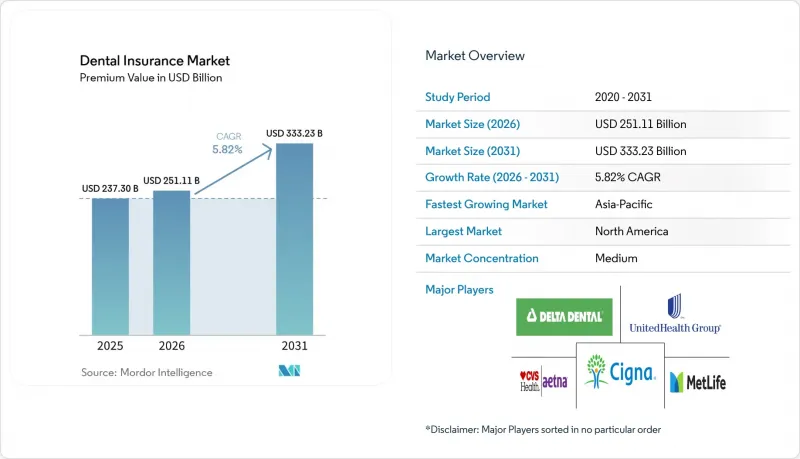
This report is Segmented by Insurance Type (Preferred Provider Organization (PPO) Plans, Health Maintenance Organization (DHMO) Plans, Dental Indemnity, Discount Dental Plans), Coverage (Preventive, Basic Restorative, Major Prosthodontic, and Others), End-Users (Group, Individual, and Family), and Region. The Market Forecasts are Provided in Terms of Value (USD).
Global Dental Insurance Market Trends and Insights
Growing Adoption of Preventive Dental Care Under Value-Based Insurance Models
Value-based plan designs waive cost-sharing for routine cleanings, examinations, and fluoride treatments, encouraging members to seek care earlier and avoid expensive restorative work. Delta Dental reports that 65% of U.S. adults now maintain dental coverage, while 91% view oral check-ups as vital as annual physicals. Preventive visits rise and emergency visits decline, trimming claim costs and boosting satisfaction. Employers highlight dental benefits to win talent, and regulators in nine American states now apply medical-loss-ratio-style rules to dental plans to ensure consumers receive value. The emphasis on prevention underpins sustained expansion of the dental insurance market.
Employer-Sponsored Dental Benefits Expansion Among SMEs in Asia
More small and medium enterprises in Asia-Pacific add dental insurance to retain skilled workers amid tight labor conditions. Flexible benefit menus, digital enrollment portals, and premium subsidies encourage take-up in countries such as India, Vietnam, and Indonesia. Insurers capitalize on relaxed foreign-ownership caps to launch co-branded products that bundle dental with health or accident cover, unlocking scale across fragmented employer groups. Advanced data analytics assist carriers in tailoring premiums to each firm's risk profile, reducing adverse selection and stimulating broader coverage penetration.
Limited Dental Service Provider Networks in Rural Africa & MEA Reducing Claim Utilization
Average dentist density across 27 low-income countries remains well below World Health Organization benchmarks, and only nine have formal oral health policies. Sparse provider networks lower claim utilization and weaken the value proposition of the dental insurance market in these regions. In Saudi Arabia, only 11.5% of adults undertake routine check-ups, and non-insured populations visit even less often. Low penetration deters investment in new clinics, perpetuating a cycle of limited supply and muted demand.
Other drivers and restraints analyzed in the detailed report include:
- Integration of Teledentistry Services into Dental Plans
- Aging Population Driving Prosthodontic Procedure Coverage Demand
- High Loss Ratios from Inflation in Restorative Procedure Costs in the United States
For complete list of drivers and restraints, kindly check the Table Of Contents.
Segment Analysis
The dental insurance market size for PPO policies totaled 42.90% of global revenue. Discount dental plans expanded briskly at a 9.02% CAGR, signaling an appetite for predictable flat-fee memberships that sidestep complex claim forms. PPOs outperform alternatives by locking in negotiated fees and still letting policyholders choose among thousands of dentists. Providers tolerate lower reimbursement because high patient volumes remain attractive. Meanwhile, Health Maintenance Organization (DHMO) and indemnity formats maintain niche roles, appealing to members who prefer capitation or unrestricted access, respectively. Competitive tension among plan types widens the overall dental insurance market by catering to diverse affordability thresholds and care preferences.
PPO network depth provides negotiating leverage that restrains fee inflation for basic procedures, favorably affecting overall dental insurance market share distribution. Discount plans thrive among younger workers and gig-economy participants whose employers rarely subsidize coverage. Many insurers bundle discount cards with telehealth for virtual triage and prescription refills, enhancing perceived value. As inflation continues, employers may tilt toward lower-premium designs, but regulatory focus on transparency will ensure consumer awareness of service limitations particularly on major restorative benefits.
Complete Report Scope:
- By Insurance Type
- Preferred Provider Organization (PPO) Plans
- Health Maintenance Organization (DHMO) Plans
- Dental Indemnity / Fee-for-Service Plans
- Discount Dental Plans
- By Coverage
- Preventive Coverage
- Basic (Restorative) Coverage
- Major (Prosthodontic) Coverage
- Orthodontic & Cosmetic Coverage
- By End-User
- Group (Employer-Sponsored)
- Individual
- Family
- By Region
- North America
- United States
- Canada
- Mexico
- South America
- Brazil
- Argentina
- Chile
- Rest of South America
- Europe
- Germany
- United Kingdom
- France
- Italy
- Spain
- Netherlands
- Switzerland
- Rest of Europe
- Asia-Pacific
- China
- Japan
- India
- South Korea
- Australia
- Southeast Asia
- Rest of Asia-Pacific
- Middle East and Africa
- Saudi Arabia
- United Arab Emirates
- South Africa
- Rest of Middle East & Africa
- North America
Geography Analysis
North America accounts for 35.10% of global revenue contributed by entrenched private insurance, robust employer participation, and public-sector mandates that guarantee pediatric coverage. Nine U.S. states limit administrative spending via dental loss ratio rules, protecting consumers and sustaining trust in the dental insurance market. Canada's National Dental Care Plan now covers 2.1 million seniors and extends benefits to 1.2 million additional children and disabled adults, creating spill-over opportunities for supplemental private policies.
Asia-Pacific records the fastest CAGR at 10.20% through 2031 as disposable incomes rise and governments liberalize foreign ownership. Regional regulators introduce IFRS-17-aligned solvency rules, pressing carriers to refine risk pricing. Japan integrates dental care into universal health care for seniors, while China caps premium increases and subsidizes rural clinic construction. These dynamics expand the dental insurance market without compromising affordability.
Europe presents steady but varied growth. Universal systems in Denmark and Germany offer free school-age dentistry, limiting private demand, whereas targeted systems in Spain or Ireland leave gaps that insurers fill. Pandemic-era tele dentistry adoption remains high; insurers reimburse video assessments and mail-in aligner programs that cut travel for rural residents.
Latin American insurers capture new voluntary buyers as annual household incomes surpass USD 10,000. Odontoprev's debt-free model and 23% net-income CAGR reflect this momentum, and rivals emulate its nationwide dentist network to achieve scale. Government subsidies remain limited, but public awareness campaigns stress oral health links to cardiovascular disease, boosting policy uptake.
Middle East and Africa lag due to sparse dentist density-often below one dentist per 10,000 inhabitants-and limited public funding. Ghana and Kenya pilot mobile-clinic programs and micro-insurance, yet premium volume stays modest. Market expansion hinges on training more professionals, subsidizing rural clinics, and forming public-private partnerships that guarantee baseline preventive services.
- Delta Dental
- UnitedHealth Group
- Cigna Group
- CVS Health / Aetna
- MetLife Inc.
- Humana Inc.
- Guardian Life Insurance Company of America
- Sun Life Financial Inc.
- AXA SA
- Allianz SE
- Zurich Insurance Group
- Bupa
- Anthem Blue Cross Blue Shield
- Assicurazioni Generali S.p.A.
- DentaQuest (Elevance Health)
- Renaissance Dental
- Nippon Life Insurance
- Dai-ichi Life Holdings
- Ping An Insurance
- Discovery Health (South Africa)
- Medibank Private (Australia)
- Pacific Blue Cross (Canada)
- Liberty Dental Plan
Additional Benefits:
- The market estimate (ME) sheet in Excel format
- 3 months of analyst support
TABLE OF CONTENTS
1 Introduction
- 1.1 Study Assumptions & Market Definition
- 1.2 Scope of the Study
2 Research Methodology
3 Executive Summary
4 Market Landscape
- 4.1 Market Overview
- 4.2 Market Drivers
- 4.2.1 Growing Adoption of Preventive Dental Care Under Value-Based Insurance Models in North America
- 4.2.2 Employer-Sponsored Dental Benefits Expansion Among SMEs in Asia
- 4.2.3 Integration of Teledentistry Services into Dental Plans Enhancing Attractiveness in Europe
- 4.2.4 Aging Population Driving Prosthodontic Procedure Coverage Demand in Japan & Western Europe
- 4.2.5 Rising Disposable Income Enabling Voluntary Dental Coverage Uptake in Latin America
- 4.2.6 Government Mandates for Pediatric Dental Coverage Under Public Schemes (e.g., ACA)
- 4.3 Market Restraints
- 4.3.1 Limited Dental Service Provider Networks in Rural Africa & MEA Reducing Claim Utilization
- 4.3.2 High Loss Ratios from Inflation in Restorative Procedure Costs in the United States
- 4.3.3 Consumer Perception of Low Value vs. Out-of-Pocket Costs in Europe
- 4.3.4 Regulatory Caps on Premium Increases in Select APAC Markets (e.g., China)
- 4.4 Value / Supply-Chain Analysis
- 4.5 Regulatory & Technological Outlook
- 4.6 Porter's Five Forces
- 4.6.1 Threat of New Entrants
- 4.6.2 Bargaining Power of Suppliers (Dentists & DSOs)
- 4.6.3 Bargaining Power of Buyers (Policyholders & Employers)
- 4.6.4 Threat of Substitutes (Self-Pay, Discount Cards)
- 4.6.5 Competitive Rivalry
5 Market Size & Growth Forecasts
- 5.1 By Insurance Type
- 5.1.1 Preferred Provider Organization (PPO) Plans
- 5.1.2 Health Maintenance Organization (DHMO) Plans
- 5.1.3 Dental Indemnity / Fee-for-Service Plans
- 5.1.4 Discount Dental Plans
- 5.2 By Coverage
- 5.2.1 Preventive Coverage
- 5.2.2 Basic (Restorative) Coverage
- 5.2.3 Major (Prosthodontic) Coverage
- 5.2.4 Orthodontic & Cosmetic Coverage
- 5.3 By End-User
- 5.3.1 Group (Employer-Sponsored)
- 5.3.2 Individual
- 5.3.3 Family
- 5.4 By Region
- 5.4.1 North America
- 5.4.1.1 United States
- 5.4.1.2 Canada
- 5.4.1.3 Mexico
- 5.4.2 South America
- 5.4.2.1 Brazil
- 5.4.2.2 Argentina
- 5.4.2.3 Chile
- 5.4.2.4 Rest of South America
- 5.4.3 Europe
- 5.4.3.1 Germany
- 5.4.3.2 United Kingdom
- 5.4.3.3 France
- 5.4.3.4 Italy
- 5.4.3.5 Spain
- 5.4.3.6 Netherlands
- 5.4.3.7 Switzerland
- 5.4.3.8 Rest of Europe
- 5.4.4 Asia-Pacific
- 5.4.4.1 China
- 5.4.4.2 Japan
- 5.4.4.3 India
- 5.4.4.4 South Korea
- 5.4.4.5 Australia
- 5.4.4.6 Southeast Asia
- 5.4.4.7 Rest of Asia-Pacific
- 5.4.5 Middle East and Africa
- 5.4.5.1 Saudi Arabia
- 5.4.5.2 United Arab Emirates
- 5.4.5.3 South Africa
- 5.4.5.4 Rest of Middle East & Africa
- 5.4.1 North America
6 Competitive Landscape
- 6.1 Market Concentration
- 6.2 Strategic Moves
- 6.3 Market Share Analysis
- 6.4 Company Profiles {(includes Global level Overview, Market level overview, Core Segments, Financials as available, Strategic Information, Market Rank/Share for key companies, Products & Services, and Recent Developments)}
- 6.4.1 Delta Dental
- 6.4.2 UnitedHealth Group
- 6.4.3 Cigna Group
- 6.4.4 CVS Health / Aetna
- 6.4.5 MetLife Inc.
- 6.4.6 Humana Inc.
- 6.4.7 Guardian Life Insurance Company of America
- 6.4.8 Sun Life Financial Inc.
- 6.4.9 AXA SA
- 6.4.10 Allianz SE
- 6.4.11 Zurich Insurance Group
- 6.4.12 Bupa
- 6.4.13 Anthem Blue Cross Blue Shield
- 6.4.14 Assicurazioni Generali S.p.A.
- 6.4.15 DentaQuest (Elevance Health)
- 6.4.16 Renaissance Dental
- 6.4.17 Nippon Life Insurance
- 6.4.18 Dai-ichi Life Holdings
- 6.4.19 Ping An Insurance
- 6.4.20 Discovery Health (South Africa)
- 6.4.21 Medibank Private (Australia)
- 6.4.22 Pacific Blue Cross (Canada)
- 6.4.23 Liberty Dental Plan
7 Market Opportunities & Future Outlook
- 7.1 White-Space & Unmet-Need Assessment

