PUBLISHER: Mordor Intelligence | PRODUCT CODE: 2072562

PUBLISHER: Mordor Intelligence | PRODUCT CODE: 2072562
Food Service - Market Share Analysis, Industry Trends & Statistics, Growth Forecasts (2025 - 2030)
According to Mordor Intelligence, the global foodservice market size is estimated to be USD 4.34 trillion in 2025 and is forecast to touch USD 7.61 trillion by 2030, advancing at an 11.89% CAGR during the period (2025-2030).
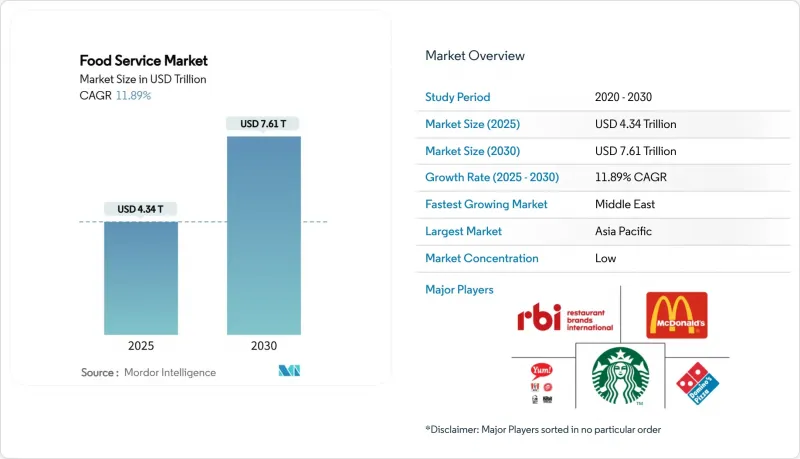
This report is Segmented by Foodservice Type (Cafes and Bars, Full-Service Restaurants, and More), Service Model (Dine-In, Take-away/Drive-thru, and Delivery), Outlet (Chained Outlets, and Independent Outlets), Location (Standalone, Leisure, Retail, and More), and Geography (North America, Europe, Asia-Pacific, South America, and More). The Market Forecasts are Provided in Terms of Value (USD).
Global Food Service Market Trends and Insights
Rising Demand for Convenience
The global food service market continues to expand as consumers increasingly prioritize convenient and on-the-go food options. People's busy schedules, city living, and modern work environments have created a need for easily accessible meals that fit into their daily lives. Companies have responded by enhancing their service offerings, with businesses like Panera Bread establishing widespread curbside pickup locations to serve their customers better. Restaurants like Sweetgreen and Chipotle have successfully adapted by offering quick, personalized meals with fresh ingredients, meeting the needs of health-conscious customers, particularly younger generations. Moreover, food delivery services saw remarkable growth in 2024 and 2025, as customers embraced the simplicity of ordering meals from home or work. Restaurants have invested in customer-friendly technology, such as easy-to-use mobile apps and smart ordering systems, to improve service quality and efficiency. For instance, in 2024, Chick-fil-A enhanced its customer service by dedicating specific staff members to curbside and delivery operations, while implementing mobile updates to keep customers informed. Restaurants that focus on providing convenient, adaptable, and technology-supported services continue to thrive in the food service market.
Surge in Health and Wellness Trends
The global food service market is undergoing substantial transformation due to rising consumer demand for health and wellness options, with customers requiring nutritious alternatives and ingredient transparency. Food service businesses are modifying their menus through the integration of plant-based proteins, reduced-sugar items, and nutrient-dense ingredients. For instance, in November 2024, Starbucks eliminated additional charges for non-dairy milk alternatives, enhancing market accessibility for customers requiring dairy substitutes. Similarly, McDonald's expanded its product portfolio in May 2025 by implementing McPlant products with Beyond Meat in Germany and France. Moreover, the market transformation encompasses supply chain modifications, with businesses prioritizing organic, local, and minimally processed ingredients. Besides, companies implementing these operational changes are capturing new market segments while reinforcing their market position and maintaining regulatory compliance. Food service operators offering health-oriented menu items are positioned to maintain market growth and increase customer retention rates.
Food-Commodity Price Volatility and Shrink-Flation Risk
Food commodity price volatility continues to impact the global food service market's performance. Extreme weather conditions, geopolitical tensions, and supply chain disruptions result in fluctuating input costs. In 2025, commodity prices demonstrated significant increases - cocoa by 163%, coffee by 103%, and sunflower oil by 56%. These increases stemmed from reduced crop yields, climate events, and regional conflicts in key production regions. The volatility impacts operating margins, requiring businesses to implement menu modifications, supplier contract revisions, or cost adjustments. This frequently results in portion size reductions instead of price increases. The U.S. market recorded substantial increases in egg and beef prices due to avian flu outbreaks and supply chain constraints, impacting breakfast-oriented restaurants and quick-service operations. Food service operations must maintain adaptable business strategies to manage procurement and menu offerings while optimizing profitability and customer retention. Given the persistent risks from tariffs, trade disputes, and climate-related incidents, price fluctuations and portion adjustments will continue to impact market operations through 2025.
Other drivers and restraints analyzed in the detailed report include:
- Rapid QSR Footprint Expansion in Emerging Asia-Pacific and GCC
- Surge in Digital Ordering, Delivery and "Omni-Channel" Service
- Stringent Regulatory Compliance
For complete list of drivers and restraints, kindly check the Table Of Contents.
Segment Analysis
Full-service restaurants (FSRs) represent 43.13% of the food service market revenue in 2024, as customers continue to value dining experiences. These restaurants sustain their margins through premium pricing, personalized service, and wine selections, even as delivery becomes more popular. FSRs invest in creating welcoming environments and distinctive menus to build customer loyalty. Whereas, cloud kitchens market are growing at 18.17% annually through 2030, operating efficiently without dining rooms. These businesses run several restaurant brands from one kitchen, making the most of their equipment and testing new menu items. Qatar's introduction of Cloud Kitchen Regulation in 2025 set clear guidelines for food safety and labeling, helping businesses plan with confidence. This regulatory framework helps new companies use customer data to predict orders and design efficient delivery systems, helping them gain market share.
Moreover, FSRs are creating delivery-only brands that work with food delivery apps during quiet periods to keep their kitchens busy and protect their customer base. Cafes and bars continue to grow by offering specialty drinks in welcoming social spaces, but they grow more slowly than cloud kitchens because they need more staff. Quick-service restaurants use their franchise structure and consistent menus to grow, especially in the Asian and Gulf regions. Contract catering companies now offer small food service locations in industrial areas to serve workers, showing how food service is moving beyond traditional restaurants. These different business approaches give customers more choices and encourage people to eat out more often.
Restaurants continue to see most customers choosing to dine in, accounting for 55.17% of total spending in 2024, as people seek social dining experiences. Many restaurants have upgraded their facilities with better sound control and air monitoring systems to make guests feel more comfortable and secure. Food delivery is growing rapidly at 14.85% annually, as more customers use their phones to order and restaurants connect with delivery services. Besides, restaurants are carefully designing their menus with special attention to packaging to ensure food stays at the right temperature and arrives in good condition. While working with delivery platforms helps restaurants reach more customers, the high fees have led many restaurants to create their delivery apps to increase profits and better understand their customers. To meet customer expectations, restaurants now need to manage both their in-store sales systems and delivery operations effectively.
Take-away and drive-thru options offer a practical solution between dining in and delivery, with simpler technology requirements than full delivery services. For example, Chipotle has successfully added pickup windows to its restaurants without needing larger dining areas. In busy city areas, restaurants now offer curbside pickup spots and pickup lockers to help customers save on delivery costs. By offering these different ways to serve customers, restaurants can better handle economic changes compared to businesses that only sell through one channel.
Complete Report Scope:
- By Foodservice Type
- Cafes and Bars
- Cloud Kitchens
- Full-Service Restaurants (FSR)
- Quick-Service Restaurants (QSR)
- By Service Model
- Dine-in
- Take-away/Drive-thru
- Delivery
- Food Aggregators
- Company Owned Platforms/App
- By Outlet
- Chained Outlets
- Independent Outlets
- By Location
- Standalone
- Leisure
- Retail
- Lodging
- Travel
- By Geography
- North America
- United States
- Canada
- Mexico
- Rest of North America
- Europe
- Germany
- United Kingdom
- Italy
- France
- Spain
- Netherlands
- Poland
- Belgium
- Sweden
- Rest of Europe
- Asia-Pacific
- China
- India
- Japan
- Australia
- Indonesia
- South Korea
- Thailand
- Singapore
- Rest of Asia-Pacific
- South America
- Brazil
- Argentina
- Colombia
- Chile
- Peru
- Rest of South America
- Middle East
- United Arab Emirates
- Saudi Arabia
- Qatar
- Kuwait
- Bahrain
- Oman
- Rest of Middle East
- Africa
- Egypt
- South Africa
- Algeria
- Nigeria
- Morocco
- Kenya
- Rest of Africa
- North America
Geography Analysis
Asia-Pacific controls a 43.81% market share in 2024, benefiting from its young population, rapid urban development, and strong government support for food security and economic growth. The region's success comes from its expanding consumer base, rising household incomes, and business-friendly regulations that attract foodservice investments. The Middle East shows remarkable progress with a 14.94% growth rate, backed by Vision 2030 programs, new infrastructure projects, and its strategic role in global trade. The United Arab Emirates's food security plan for 2051 seeks to make the country a top 10 global leader, opening new opportunities for foodservice businesses.
North America and Europe continue to deliver reliable growth in their established markets, backed by well-developed systems, wealthy consumers, and sophisticated dining preferences. The United States remains a key player in food production and trade, with agricultural exports increased by USD 1.8 billion in 2024, showing a 1% improvement from the previous year . South America offers new business prospects through its growing cities and economic progress, though businesses must navigate infrastructure gaps and complex regulations.
Moreover, the African food service market demonstrates strong growth as businesses adapt to serve an increasingly urban, tech-savvy population. Quick-service restaurants (QSRs) maintain a strong presence in metropolitan areas, while traditional restaurants and cloud kitchens respond to customers seeking both convenience and culinary variety. Local entrepreneurs and multinational companies operate side by side in this market, leveraging widespread mobile adoption to connect with customers through digital ordering platforms. Although businesses face operational challenges from limited infrastructure and unstable ingredient costs, companies continue to succeed by understanding local preferences and implementing practical solutions.
- McDonald's Corporation
- Starbucks Corporation
- Yum Brands, Inc. (KFC, Pizza Hut, Taco Bell)
- Restaurant Brands International Inc. (Burger King, Popeyes, Tim Hortons)
- Roark Capital Management, LLC (Subway)
- Domino's Pizza, Inc.
- Chipotle Mexican Grill, Inc.
- Darden Restaurants
- Compass Group PLC
- Jollibee Foods Corporation (JFC)
- Chick-fil-A, Inc.
- The Cheesecake Factory I
- TheWendy's Company
- SSP Group Plc
- Whitbread PLC (Costa Coffee)
- Marco's Franchising, LLC
- MTY Food Group Inc.
- Coffee Day Enterprises Limited
- Rebel Foods,
- Nestle S.A (Blue Bottle Coffee)
Additional Benefits:
- The market estimate (ME) sheet in Excel format
- 3 months of analyst support
TABLE OF CONTENTS
1 INTRODUCTION
- 1.1 Study Assumptions and Market Definition
- 1.2 Scope of the Study
2 RESEARCH METHODOLOGY
3 EXECUTIVE SUMMARY
4 MARKET DYNAMICS
- 4.1 Market Overview
- 4.2 Market Drivers
- 4.2.1 Rising demand for convenience
- 4.2.2 Surge in health and wellness trends
- 4.2.3 Rapid QSR footprint expansion in emerging Asia-Pacific and GCC
- 4.2.4 Surge in digital ordering, delivery and "omni-channel" service
- 4.2.5 Culinary globalization
- 4.2.6 Growth of contract-fed micro-canteens inside logistics hubs
- 4.3 Market Restraints
- 4.3.1 Food-commodity price volatility and shrink-flation risk
- 4.3.2 Stringent regulatory compliance
- 4.3.3 Global labour shortages and mandated wage hikes
- 4.3.4 High operational costs
- 4.4 Value Chain Analysis
- 4.5 Regulatory Landscape
- 4.6 Technological Outlook
- 4.7 Porter's Five Forces Analysis
- 4.7.1 Threat of New Entrants
- 4.7.2 Bargaining Power of Buyers/Consumers
- 4.7.3 Bargaining Power of Suppliers
- 4.7.4 Threat of Substitute Products
- 4.7.5 Intensity of Competitive Rivalry
5 MARKET SIZE AND GROWTH FORECASTS (VALUE)
- 5.1 By Foodservice Type
- 5.1.1 Cafes and Bars
- 5.1.2 Cloud Kitchens
- 5.1.3 Full-Service Restaurants (FSR)
- 5.1.4 Quick-Service Restaurants (QSR)
- 5.2 By Service Model
- 5.2.1 Dine-in
- 5.2.2 Take-away/Drive-thru
- 5.2.3 Delivery
- 5.2.3.1 Food Aggregators
- 5.2.3.2 Company Owned Platforms/App
- 5.3 By Outlet
- 5.3.1 Chained Outlets
- 5.3.2 Independent Outlets
- 5.4 By Location
- 5.4.1 Standalone
- 5.4.2 Leisure
- 5.4.3 Retail
- 5.4.4 Lodging
- 5.4.5 Travel
- 5.5 By Geography
- 5.5.1 North America
- 5.5.1.1 United States
- 5.5.1.2 Canada
- 5.5.1.3 Mexico
- 5.5.1.4 Rest of North America
- 5.5.2 Europe
- 5.5.2.1 Germany
- 5.5.2.2 United Kingdom
- 5.5.2.3 Italy
- 5.5.2.4 France
- 5.5.2.5 Spain
- 5.5.2.6 Netherlands
- 5.5.2.7 Poland
- 5.5.2.8 Belgium
- 5.5.2.9 Sweden
- 5.5.2.10 Rest of Europe
- 5.5.3 Asia-Pacific
- 5.5.3.1 China
- 5.5.3.2 India
- 5.5.3.3 Japan
- 5.5.3.4 Australia
- 5.5.3.5 Indonesia
- 5.5.3.6 South Korea
- 5.5.3.7 Thailand
- 5.5.3.8 Singapore
- 5.5.3.9 Rest of Asia-Pacific
- 5.5.4 South America
- 5.5.4.1 Brazil
- 5.5.4.2 Argentina
- 5.5.4.3 Colombia
- 5.5.4.4 Chile
- 5.5.4.5 Peru
- 5.5.4.6 Rest of South America
- 5.5.5 Middle East
- 5.5.5.1 United Arab Emirates
- 5.5.5.2 Saudi Arabia
- 5.5.5.3 Qatar
- 5.5.5.4 Kuwait
- 5.5.5.5 Bahrain
- 5.5.5.6 Oman
- 5.5.5.7 Rest of Middle East
- 5.5.6 Africa
- 5.5.6.1 Egypt
- 5.5.6.2 South Africa
- 5.5.6.3 Algeria
- 5.5.6.4 Nigeria
- 5.5.6.5 Morocco
- 5.5.6.6 Kenya
- 5.5.6.7 Rest of Africa
- 5.5.1 North America
6 COMPETITIVE LANDSCAPE
- 6.1 Market Concentration
- 6.2 Strategic Moves
- 6.3 Market Share Analysis
- 6.4 Company Profiles (includes Global level Overview, Market level overview, Core Segments, Financials as available, Strategic Information, Market Rank/Share for key companies, Products & Services, and Recent Developments)
- 6.4.1 McDonald's Corporation
- 6.4.2 Starbucks Corporation
- 6.4.3 Yum Brands, Inc. (KFC, Pizza Hut, Taco Bell)
- 6.4.4 Restaurant Brands International Inc. (Burger King, Popeyes, Tim Hortons)
- 6.4.5 Roark Capital Management, LLC (Subway)
- 6.4.6 Domino's Pizza, Inc.
- 6.4.7 Chipotle Mexican Grill, Inc.
- 6.4.8 Darden Restaurants
- 6.4.9 Compass Group PLC
- 6.4.10 Jollibee Foods Corporation (JFC)
- 6.4.11 Chick-fil-A, Inc.
- 6.4.12 The Cheesecake Factory I
- 6.4.13 TheWendy's Company
- 6.4.14 SSP Group Plc
- 6.4.15 Whitbread PLC (Costa Coffee)
- 6.4.16 Marco's Franchising, LLC
- 6.4.17 MTY Food Group Inc.
- 6.4.18 Coffee Day Enterprises Limited
- 6.4.19 Rebel Foods,
- 6.4.20 Nestle S.A (Blue Bottle Coffee)
7 MARKET OPPORTUNITIES AND FUTURE OUTLOOK

