PUBLISHER: Mordor Intelligence | PRODUCT CODE: 2072563

PUBLISHER: Mordor Intelligence | PRODUCT CODE: 2072563
Catering Services - Market Share Analysis, Industry Trends & Statistics, Growth Forecasts (2025 - 2030)
According to Mordor Intelligence, the catering services market size reached USD 313.28 billion in 2025 and is forecast to touch USD 432.76 billion by 2030, delivering a 6.43% CAGR over the period; this line-up of figures positions the catering services market size for a solid multi-year expansion.
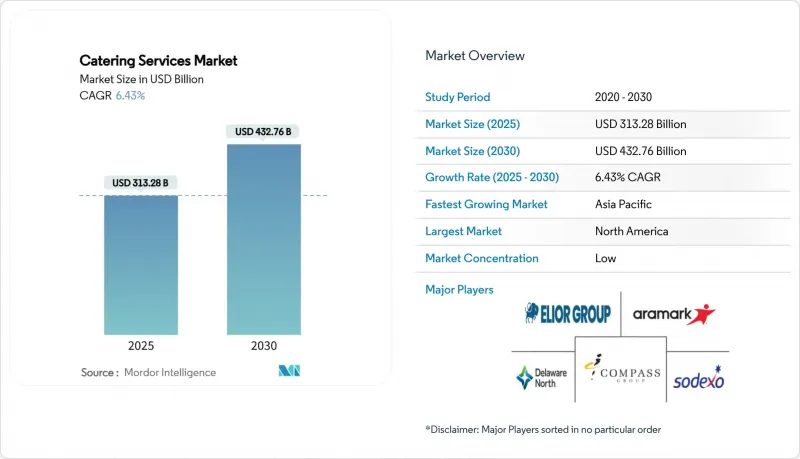
This report is Segmented by Service Provider Type (Contract Catering, Non-Contract/Occasional Catering), Catering Type (Corporate, Industrial, Event Catering), Category Type (Full-Service, Self-Service, Drop-Off Catering), and Geography (North America, Europe, Asia-Pacific, South America, Middle East and Africa). The Market Forecasts are Provided in Terms of Value (USD).
Global Catering Services Market Trends and Insights
Corporate Wellness and Workplace Dining Initiatives
Corporate wellness programs now include comprehensive workplace dining strategies that influence employee retention and productivity. According to McKinsey's 2024 healthcare analysis, organizations with employee wellness infrastructure report 23% higher profit margins than those offering basic benefits. Companies now view on-site dining as a strategic tool for talent acquisition rather than a cost center. Corporate catering contracts increasingly include nutritional analytics and personalized meal planning, moving away from traditional volume-based models. Modern workplace dining programs use biometric screening data to tailor menu offerings, establishing a connection between food service and measurable health outcomes to support higher pricing.
Growth of Cloud Kitchens and Hybrid Catering Models
The integration of cloud kitchens into traditional catering operations has transformed service delivery economics. This model enables providers to serve multiple client locations from centralized production facilities without full-service infrastructure costs. Cloud kitchens are particularly effective for drop-off catering, where food quality and delivery efficiency take precedence over on-site presentation, contributing to the segment's 7.34% CAGR. Companies implementing hybrid models that combine cloud kitchen production with strategic full-service locations can optimize costs while maintaining service flexibility. The technology supports real-time demand forecasting and inventory optimization, reducing food waste by up to 30% compared to traditional on-site preparation. These operational efficiencies create pricing advantages, especially for corporate clients aiming to reduce facilities management costs while maintaining food service quality.
Labour Shortages and Rising Wage Floors
The catering industry faces significant staffing challenges, with more than 50% of hospitality workers hesitant to return to service roles, according to Bloomberg's workforce surveys. Labor shortages have compelled catering companies to offer enhanced compensation packages, including paid time off, benefits, and team-building programs, increasing operational costs by 15-25% compared to pre-pandemic levels. The shortage affects skilled positions, particularly chefs and food safety specialists, where training requirements constrain the available talent pool. Companies are adopting automation and technology to maintain service levels with fewer staff, though initial investments strain smaller operators' cash flow. While the industry has established partnerships with culinary schools and apprenticeship programs, these initiatives require 2-3 years to substantially increase the workforce.
Other drivers and restraints analyzed in the detailed report include:
- Technological Integration in Operations
- Rise in Outsourcing by Healthcare and Institutional Sectors
- Stricter Food-Safety Traceability Mandates
For complete list of drivers and restraints, kindly check the Table Of Contents.
Segment Analysis
Despite contract catering holding a dominant 61.91% market share in 2024, the non-contract catering sector is projected to grow at a 7.01% CAGR through 2030. This growth signals a shift towards more flexible service models, catering to the demands of hybrid work patterns and event-driven needs. The rise in occasional catering services is largely driven by corporate clients seeking scalable solutions, aligning costs with actual usage rather than being tied to fixed capacities. In response, contract catering providers are adopting flexible pricing tiers and hybrid service models, blending guaranteed base services with variable capacity options. This shift in segmentation highlights a move away from traditional long-term contracts towards performance-based agreements, prioritizing service quality and adaptability over mere volume commitments.
Within the realm of contract catering, providers boasting technology-driven service delivery and expertise across multiple locations are gaining a competitive edge. A testament to this trend is Compass Group's USD 600 million acquisition of CH&CO, underscoring how industry leaders are consolidating specialized capabilities to cater to a diverse array of client needs across various business sectors. While non-contract providers enjoy the advantages of lower capital demands and enhanced pricing flexibility, they grapple with the challenge of scaling operations to compete effectively in food procurement and deliver standardized services. Given the segment's growth trajectory, it's evident that successful catering companies will need to forge hybrid business models, marrying the reliability of contract services with the nimbleness of occasional catering.
Complete Report Scope:
- By Service Provider Type
- Contract Catering
- Non-Contract/Occasional Catering
- By Catering Type
- Corporate Catering
- Industrial Catering
- Event Catering
- Corporate Events
- Sports Events
- Government Events
- Education Events
- Social Events
- Entertainment Events
- By Category Type
- Full-Service Catering
- Self-Service Catering
- Drop-Off Catering
- By Geography
- North America
- United States
- Canada
- Mexico
- Rest of North America
- Europe
- Germany
- United Kingdom
- Italy
- France
- Spain
- Netherlands
- Poland
- Belgium
- Sweden
- Rest of Europe
- Asia-Pacific
- China
- India
- Japan
- Australia
- Indonesia
- South Korea
- Thailand
- Singapore
- Rest of Asia-Pacific
- South America
- Brazil
- Argentina
- Colombia
- Chile
- Peru
- Rest of South America
- Middle East and Africa
- South Africa
- Saudi Arabia
- United Arab Emirates
- Nigeria
- Egypt
- Morocco
- Turkey
- Rest of Middle East and Africa
- North America
Geography Analysis
In 2024, North America commands a 36.25% share of the market, underscoring its entrenched outsourcing culture and significant corporate investments in employee wellness. However, this dominance also signals a saturation point in traditional service categories. Growth in the region is pivoting from mere market expansion to a focus on service innovation and tech adoption. Notably, companies like Compass Group have harnessed strategic acquisitions and operational efficiencies to post a commendable 10.6% organic revenue growth. While outsourcing in healthcare and education ensures a steady demand, corporate wellness initiatives pave the way for premium service offerings. Furthermore, the regulatory landscape, shaped by FDA food safety updates and USDA compliance mandates, tends to favor established players adept at navigating these complexities.
Asia-Pacific stands out as the region with the most rapid growth, boasting a 7.79% CAGR, largely fueled by the expansion of China's catering industry. This growth trajectory is bolstered by urbanization, rising disposable incomes, and a growing embrace of Western-style corporate dining. Companies are heavily investing in technology infrastructure, recognizing the importance of digital transformation and supply chain optimization for their multi-location operations. Notably, markets in India, Japan, and Southeast Asia are poised for a surge in first-time outsourcing, especially in healthcare and education.
Europe experiences consistent growth, with a pronounced focus on sustainability and regulatory compliance shaping service differentiation. This emphasis on environmental stewardship offers a competitive edge to catering firms that prioritize sustainable sourcing and waste reduction. For instance, Aramark's ambitious goals of halving food waste by 2030 and achieving net-zero greenhouse gas emissions by 2050 highlight the strategic advantage of sustainability in Europe. Meanwhile, South America and the Middle East/Africa regions, though exhibiting moderate growth, are witnessing new opportunities in institutional catering, spurred by infrastructure development and economic diversification.
- Compass Group PLC
- Sodexo SA
- Aramark Corporation
- Elior Group
- ISS A/S
- Delaware North Companies, Inc.
- Dakota Butcher
- The Buffalo Catering Company
- Dine Contract Catering
- DO & CO Aktiengesellschaft
- Gate Gourmet
- LSG Group (LSG Sky Chefs)
- The Emirates Group (Emirates Flight Catering)
- Royal Catering Services
- SATS Ltd.
- Thompson Hospitality
- Cater Link Limited
- Gulf Mahmal Support Services Co. Ltd.
- Unique Catering Services (KSA)
- Ridgewells Catering
Additional Benefits:
- The market estimate (ME) sheet in Excel format
- 3 months of analyst support
TABLE OF CONTENTS
1 INTRODUCTION
- 1.1 Study Assumptions and Market Definition
- 1.2 Scope of the Study
2 RESEARCH METHODOLOGY
3 EXECUTIVE SUMMARY
4 MARKET DYNAMICS
- 4.1 Market Overview
- 4.2 Market Drivers
- 4.2.1 Corporate Wellness and Workplace Dining Initiatives
- 4.2.2 Growth of Cloud Kitchens and Hybrid Catering Models
- 4.2.3 Technological Integration in Operations
- 4.2.4 Rise in Outsourcing by Healthcare and Institutional Sectors
- 4.2.5 Menu Innovation and Culinary Diversity
- 4.2.6 Shift to healthier, plant-forward menus
- 4.3 Market Restraints
- 4.3.1 Labour Shortages and Rising Wage Floors
- 4.3.2 Fluctuating Food Prices and Supply Chain Disruptions
- 4.3.3 Seasonal Demand Fluctuations
- 4.3.4 Stricter Food-safety Traceability Mandates
- 4.4 Supply Chain Analysis
- 4.5 Regulatory Landscape
- 4.6 Porter's Five Forces
- 4.6.1 Threat of New Entrants
- 4.6.2 Bargaining Power of Buyers/Consumers
- 4.6.3 Bargaining Power of Suppliers
- 4.6.4 Threat of Substitute Products
- 4.6.5 Intensity of Competitive Rivalry
5 MARKET SIZE AND GROWTH FORECASTS (VALUE)
- 5.1 By Service Provider Type
- 5.1.1 Contract Catering
- 5.1.2 Non-Contract/Occasional Catering
- 5.2 By Catering Type
- 5.2.1 Corporate Catering
- 5.2.2 Industrial Catering
- 5.2.3 Event Catering
- 5.2.3.1 Corporate Events
- 5.2.3.2 Sports Events
- 5.2.3.3 Government Events
- 5.2.3.4 Education Events
- 5.2.3.5 Social Events
- 5.2.3.6 Entertainment Events
- 5.3 By Category Type
- 5.3.1 Full-Service Catering
- 5.3.2 Self-Service Catering
- 5.3.3 Drop-Off Catering
- 5.4 By Geography
- 5.4.1 North America
- 5.4.1.1 United States
- 5.4.1.2 Canada
- 5.4.1.3 Mexico
- 5.4.1.4 Rest of North America
- 5.4.2 Europe
- 5.4.2.1 Germany
- 5.4.2.2 United Kingdom
- 5.4.2.3 Italy
- 5.4.2.4 France
- 5.4.2.5 Spain
- 5.4.2.6 Netherlands
- 5.4.2.7 Poland
- 5.4.2.8 Belgium
- 5.4.2.9 Sweden
- 5.4.2.10 Rest of Europe
- 5.4.3 Asia-Pacific
- 5.4.3.1 China
- 5.4.3.2 India
- 5.4.3.3 Japan
- 5.4.3.4 Australia
- 5.4.3.5 Indonesia
- 5.4.3.6 South Korea
- 5.4.3.7 Thailand
- 5.4.3.8 Singapore
- 5.4.3.9 Rest of Asia-Pacific
- 5.4.4 South America
- 5.4.4.1 Brazil
- 5.4.4.2 Argentina
- 5.4.4.3 Colombia
- 5.4.4.4 Chile
- 5.4.4.5 Peru
- 5.4.4.6 Rest of South America
- 5.4.5 Middle East and Africa
- 5.4.5.1 South Africa
- 5.4.5.2 Saudi Arabia
- 5.4.5.3 United Arab Emirates
- 5.4.5.4 Nigeria
- 5.4.5.5 Egypt
- 5.4.5.6 Morocco
- 5.4.5.7 Turkey
- 5.4.5.8 Rest of Middle East and Africa
- 5.4.1 North America
6 COMPETITIVE LANDSCAPE
- 6.1 Market Concentration
- 6.2 Strategic Moves
- 6.3 Market Share Analysis
- 6.4 Company Profiles (includes Global level Overview, Market level overview, Core Segments, Financials, Strategic Information, Market Rank/Share, Products and Services, Recent Developments)
- 6.4.1 Compass Group PLC
- 6.4.2 Sodexo SA
- 6.4.3 Aramark Corporation
- 6.4.4 Elior Group
- 6.4.5 ISS A/S
- 6.4.6 Delaware North Companies, Inc.
- 6.4.7 Dakota Butcher
- 6.4.8 The Buffalo Catering Company
- 6.4.9 Dine Contract Catering
- 6.4.10 DO & CO Aktiengesellschaft
- 6.4.11 Gate Gourmet
- 6.4.12 LSG Group (LSG Sky Chefs)
- 6.4.13 The Emirates Group (Emirates Flight Catering)
- 6.4.14 Royal Catering Services
- 6.4.15 SATS Ltd.
- 6.4.16 Thompson Hospitality
- 6.4.17 Cater Link Limited
- 6.4.18 Gulf Mahmal Support Services Co. Ltd.
- 6.4.19 Unique Catering Services (KSA)
- 6.4.20 Ridgewells Catering
7 MARKET OPPORTUNITIES AND FUTURE TRENDS

