PUBLISHER: Mordor Intelligence | PRODUCT CODE: 2072569

PUBLISHER: Mordor Intelligence | PRODUCT CODE: 2072569
Consumer Drones - Market Share Analysis, Industry Trends & Statistics, Growth Forecasts (2026 - 2031)
According to Mordor Intelligence, the consumer drones market size was valued at USD 6.23 billion in 2025, and is projected to grow from USD 7.08 billion in 2026 to USD 13.10 billion by 2031, growing at a CAGR of 13.11% from 2026 to 2031.
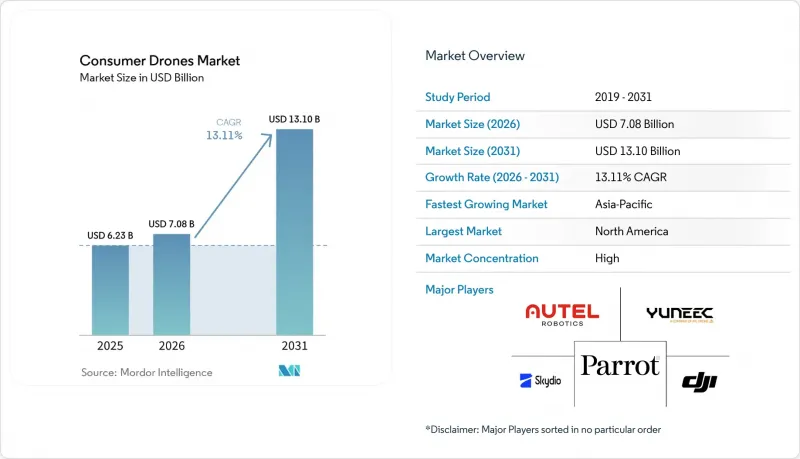
This report is Segmented by Product Type (Multi-Rotor, Fixed-Wing, and Hybrid), Flight Range (Less Than 4 Km, and More), Weight Class (Nano/Micro, Mini, Small, and Medium), Application (Photography and Videography, Racing and Sports, and More), and Geography (North America, Europe, Asia-Pacific, and More). The Market Forecasts are Provided in Terms of Value (USD).
Global Consumer Drones Market Trends and Insights
Rapid Fall in Li-ion Battery Cost Redefines Drone Economics
Battery cost deflation is making the consumer drones market easier to enter for both brands and buyers. Lower battery costs reduce the bill of materials and create room for longer flight times, better cooling, and safer power management without forcing higher shelf prices, which matters most in entry and mid-range devices, where a small hardware cost change can decide whether a product reaches a first-time buyer. It also changes how brands think about accessories, because upgraded battery packs can become repeat purchases rather than bundled one-time items. DJI demonstrated that battery design can shape the value proposition by promoting an Intelligent Flight Battery Plus option for its new Lito series and tying it to extended flight time. As that pattern spreads, the market will continue to expand across a wider range of price points without sacrificing feature depth.
Camera Modules as Commodity Components Widen the Mass Market
Camera hardware has moved much faster into the mass market than it did a few years ago, changing how the consumer drones market is priced and packaged. DJI introduced the Mini 5 Pro in September 2025 with a 1-inch CMOS sensor in a near-249 g body, demonstrating how advanced imaging could be packed into a lightweight consumer form factor. That shift reduces the old gap between premium and mainstream products and makes image quality feel like a starting requirement rather than a premium add-on. Once buyers expect strong video quality at lower prices, brands have less room to defend margins with camera hardware alone. SkyRover reinforced this direction in March 2026 by introducing a sub-249 g model priced below USD 300 with forward obstacle avoidance, 4K/60fps video, and 12 km HD transmission. The result is that the consumer drones market now rewards software ease, automated shooting, and reliable transmission more than raw sensor bragging rights.
Spectrum Congestion Constrains Reliability in Dense Deployments
The consumer drones market still relies heavily on crowded spectrum bands shared with Wi-Fi, Bluetooth, and an ever-growing set of connected devices. That creates a practical problem for users in cities, parks, and event settings, where signal noise can affect control confidence and video stability. The FCC adopted initial rules in July 2024 for drone operations in the 5030 to 5091 MHz band, but that framework is aimed at licensed advanced operations rather than everyday recreational flying. As a result, the core consumer segment remains exposed to the limits of the open ISM environment, even as the policy discussion moves forward, which matters because buyers do not judge a drone solely by its listed range; they judge it by how stable the connection feels in ordinary use. Until spectrum access improves for a broader user base, the consumer drones market will continue to face a reliability ceiling in dense environments.
Other drivers and restraints analyzed in the detailed report include:
- FPV Drone Racing Leagues Institutionalize a New Consumer Demand Category
- Social-Media Influencer Culture Accelerates Aspirational Drone Consumption
- IATA Battery Shipping Rules Add Cross-Border Logistics Complexity
For complete list of drivers and restraints, kindly check the Table Of Contents.
Segment Analysis
Multi-rotor drones accounted for 70.11% of revenue in 2025, keeping them firmly at the center of the consumer drones market. Their strength comes from vertical takeoff, easy hovering, compact folding designs, and a flight style that matches photography and everyday recreational use. They also fit well with the lightweight product direction that now defines much of the mainstream category. For most buyers, a multi-rotor platform remains the simplest path to stable video and low learning friction.
Fixed-wing drones are forecast to grow at a 15.22% CAGR through 2031, indicating that a smaller share of the consumer drones market is seeking greater range and endurance. These products appeal more to prosumer users who care about area coverage and longer flight paths than to those who care about stationary hovering. Hybrid designs sit between the two camps and are slowly building relevance because they combine transit efficiency with hover capability. The main challenge is that the fixed-wing and hybrid side still has a thinner product pipeline than the multi-rotor base. Even so, the consumer drones market is likely to see greater differentiation as autonomous navigation improves and higher-skilled users seek aircraft that do more than capture short, local footage.
Drones with flight ranges below 4 km accounted for 57.62% of revenue in 2025, underscoring how strongly the consumer drones market still depends on neighborhood- and travel-scale use. This part of the category fits the needs of casual users who want portability, easy setup, and less regulatory friction. It also fits the weight profile of the lightest and most widely sold consumer aircraft. For mainstream buyers, practical use matters more than extreme distance, so short-range products keep the broadest volume base.
The segment above 8 km is forecast to expand at a 14.11% CAGR through 2031, providing the consumer drones market with a clear premium growth lane. What buyers are really paying for here is stable live video and stronger link confidence, not only the maximum distance shown on a box. DJI highlighted that premium direction in March 2026 when it launched the Avata 360 with O4+ transmission capable of 1080p/60fps video at up to 20 km. That kind of feature set pulls long-range performance closer to the enthusiast mainstream. As the consumer drone industry moves forward, transmission reliability is likely to matter more than raw range escalation alone.
Complete Report Scope:
- By Product Type
- Multi-Rotor
- Fixed-Wing
- Hybrid
- By Flight Range
- Less than 4 km
- 4 to 8 km
- More than 8 km
- By Weight Class
- Nano/Micro (Less than 250 g)
- Mini (250 g to Less than 2 kg)
- Small (2 to Less than 5 kg)
- Medium (More than 5 kg)
- By Application
- Photography and Videography
- Racing and Sports
- Recreational
- Environmental and Wildlife Observation
- Education and Training
- By Geography
- North America
- United States
- Canada
- Mexico
- Europe
- United Kingdom
- France
- Germany
- Russia
- Rest of Europe
- Asia-Pacific
- China
- Japan
- India
- Australia
- Rest of Asia-Pacific
- South America
- Brazil
- Rest of South America
- Middle East and Africa
- Middle East
- United Arab Emirates
- Saudi Arabia
- Rest of Middle East
- Africa
- South Africa
- Rest of Africa
- Middle East
- North America
Geography Analysis
North America accounted for 37.65% of global revenue in 2025, making it the largest regional market for consumer drones. The region benefits from a large installed base of recreational users and a culture that readily blends travel, outdoor activities, and digital content creation. The FAA said there were more than 860,000 registered UAS as of August 2024 in its Drone Integration Concept of Operations, which shows the scale of the underlying user base.[5] That same document also points toward a future operating framework that could widen drone use cases over time. In the near term, the consumer drones market in North America remains shaped by compliance requirements, upgrade cycles, and strong demand from creator households.
Asia-Pacific is forecast to grow at a 15.01% CAGR through 2031, making it the fastest-growing regional market for consumer drones. China remains the central manufacturing and product development base for consumer drones, providing the region with strong supply depth and rapid product refresh cycles. India is also becoming more relevant as policy attention increases, and the user base expands, with the Ministry of Civil Aviation releasing the Draft Civil Drone Bill 2025 in September 2025. Japan and Australia add support through enthusiastic demand, outdoor recreation, and higher acceptance of premium electronics.
Europe remains a mature yet steadily growing part of the consumer drones market because buyers benefit from clearer cross-border operating rules and a larger pool of compliant products. France, Germany, and the UK anchor demand, while Eastern Europe is more uneven because trade conditions and purchasing power differ by country. South America is still smaller in revenue terms, but falling import prices and wider access to affordable models are improving entry conditions. The Middle East and Africa remain the earliest-stage region, with Gulf markets and South Africa as the clearest demand pockets in the broader consumer drones market.
- SZ DJI Technology Co., Ltd.
- Parrot Drones SAS
- Autel Robotics Co., Ltd.
- Skydio, Inc.
- Yuneec (ATL Drone)
- Holy Stone
- RYZE Tech Co., Ltd.
- Freefly Systems Inc.
- Zero Zero Robotics
- WALKERA (Guangzhou Huake Technology Co., Ltd.)
- FIMI Technology Ltd.
- Shenzhen Potensic Intelligent Co., Ltd.
- BETAFPV
- Jianjian Technology Co., Ltd.
- Guangdong Syma Model Aircraft Industrial Co., Ltd.
Additional Benefits:
- The market estimate (ME) sheet in Excel format
- 3 months of analyst support
TABLE OF CONTENTS
1 INTRODUCTION
- 1.1 Study Assumptions and Market Definition
- 1.2 Scope of the Study
2 RESEARCH METHODOLOGY
3 EXECUTIVE SUMMARY
4 MARKET LANDSCAPE
- 4.1 Market Overview
- 4.2 Market Drivers
- 4.2.1 Rapid fall in Li-ion battery cost and energy density gains
- 4.2.2 High quality camera modules becoming commodity components
- 4.2.3 Growing popularity of FPV drone racing leagues
- 4.2.4 Smartphone-like replacement cycles emerging
- 4.2.5 Youth-driven influencer culture on social-media platforms
- 4.2.6 Increased availability of affordable, user-friendly drones
- 4.3 Market Restraints
- 4.3.1 Spectrum congestion in 2.4 GHz and 5 GHz ISM bands
- 4.3.2 Lithium-battery shipping restrictions tighten
- 4.3.3 Consumer-privacy litigation risk
- 4.3.4 Shortage of drone-qualified repair technicians
- 4.4 Value Chain Analysis
- 4.5 Regulatory Landscape
- 4.6 Technological Outlook
- 4.7 Porter's Five Forces Analysis
- 4.7.1 Bargaining Power of Suppliers
- 4.7.2 Bargaining Power of Buyers
- 4.7.3 Threat of New Entrants
- 4.7.4 Threat of Substitutes
- 4.7.5 Intensity of Competitive Rivalry
5 MARKET SIZE AND GROWTH FORECASTS (VALUE)
- 5.1 By Product Type
- 5.1.1 Multi-Rotor
- 5.1.2 Fixed-Wing
- 5.1.3 Hybrid
- 5.2 By Flight Range
- 5.2.1 Less than 4 km
- 5.2.2 4 to 8 km
- 5.2.3 More than 8 km
- 5.3 By Weight Class
- 5.3.1 Nano/Micro (Less than 250 g)
- 5.3.2 Mini (250 g to Less than 2 kg)
- 5.3.3 Small (2 to Less than 5 kg)
- 5.3.4 Medium (More than 5 kg)
- 5.4 By Application
- 5.4.1 Photography and Videography
- 5.4.2 Racing and Sports
- 5.4.3 Recreational
- 5.4.4 Environmental and Wildlife Observation
- 5.4.5 Education and Training
- 5.5 By Geography
- 5.5.1 North America
- 5.5.1.1 United States
- 5.5.1.2 Canada
- 5.5.1.3 Mexico
- 5.5.2 Europe
- 5.5.2.1 United Kingdom
- 5.5.2.2 France
- 5.5.2.3 Germany
- 5.5.2.4 Russia
- 5.5.2.5 Rest of Europe
- 5.5.3 Asia-Pacific
- 5.5.3.1 China
- 5.5.3.2 Japan
- 5.5.3.3 India
- 5.5.3.4 Australia
- 5.5.3.5 Rest of Asia-Pacific
- 5.5.4 South America
- 5.5.4.1 Brazil
- 5.5.4.2 Rest of South America
- 5.5.5 Middle East and Africa
- 5.5.5.1 Middle East
- 5.5.5.1.1 United Arab Emirates
- 5.5.5.1.2 Saudi Arabia
- 5.5.5.1.3 Rest of Middle East
- 5.5.5.2 Africa
- 5.5.5.2.1 South Africa
- 5.5.5.2.2 Rest of Africa
- 5.5.5.1 Middle East
- 5.5.1 North America
6 COMPETITIVE LANDSCAPE
- 6.1 Market Concentration
- 6.2 Strategic Moves
- 6.3 Market Share Analysis
- 6.4 Company Profiles (includes Global level Overview, Market level overview, Core Segments, Financials as available, Strategic Information, Market Rank/Share for key companies, Products and Services, and Recent Developments)
- 6.4.1 SZ DJI Technology Co., Ltd.
- 6.4.2 Parrot Drones SAS
- 6.4.3 Autel Robotics Co., Ltd.
- 6.4.4 Skydio, Inc.
- 6.4.5 Yuneec (ATL Drone)
- 6.4.6 Holy Stone
- 6.4.7 RYZE Tech Co., Ltd.
- 6.4.8 Freefly Systems Inc.
- 6.4.9 Zero Zero Robotics
- 6.4.10 WALKERA (Guangzhou Huake Technology Co., Ltd.)
- 6.4.11 FIMI Technology Ltd.
- 6.4.12 Shenzhen Potensic Intelligent Co., Ltd.
- 6.4.13 BETAFPV
- 6.4.14 Jianjian Technology Co., Ltd.
- 6.4.15 Guangdong Syma Model Aircraft Industrial Co., Ltd.
7 MARKET OPPORTUNITIES AND FUTURE OUTLOOK
- 7.1 White-space and Unmet-Need Assessment

