PUBLISHER: Mordor Intelligence | PRODUCT CODE: 2072572

PUBLISHER: Mordor Intelligence | PRODUCT CODE: 2072572
Alpha Mannosidosis - Market Share Analysis, Industry Trends & Statistics, Growth Forecasts (2025 - 2030)
According to Mordor Intelligence, the alpha mannosidosis market size is estimated at USD 433.10 million in 2025 and is expected to reach USD 938.50 million by 2030, at a CAGR of 16.40% during the forecast period (2025-2030).
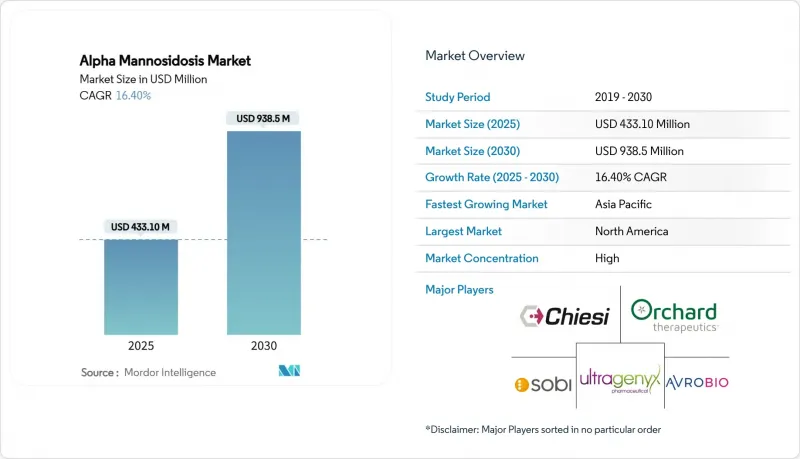
This report is Segmented by Therapy Type (Enzyme Replacement Therapy, Hematopoietic Stem-Cell Transplantation, and More), Route of Administration (Intravenous Infusion, Surgical Transplant Administration, Intrathecal/CNS-direct Delivery, and More), and Geography (North America, Europe, Asia Pacific, Middle East & Africa, South America). The Market Forecasts are Provided in Terms of Value (USD).
Global Alpha Mannosidosis Market Trends and Insights
Post-Approval Uptake of Velmanase Alfa ERT
Lamzede's June 2024 FDA approval unlocked commercial access for US patients who had relied on importation or compassionate use. Trial data showed a 77.6% reduction in serum oligosaccharides at 52 weeks, and the SPARKLE registry will track outcomes over 15 years, reinforcing prescriber confidence. Earlier pediatric initiation correlates with improved hearing and immune profiles, prompting guideline updates that advocate treatment soon after diagnosis.Weekly infusions require specialized centers, but growing home-care programs mitigate logistical burden for stable patients. Rapid US uptake thus adds meaningful near-term volume to the alpha-mannosidosis market.
Increasing Newborn-Screening Pilots for Lysosomal Storage Disorders
Large-scale pilots in China uncovered lysosomal storage disorders in 1 in 1,512 births, validating next-generation sequencing coupled with tandem-mass-spectrometry reflex testing. New Jersey's experience covering 438,515 newborns demonstrates operational feasibility in a US setting. Tuscany's inclusion of metachromatic leukodystrophy proves European payers' willingness to broaden rare-disease panels. Earlier detection shifts treatment to pre-symptomatic stages, maximizing therapeutic benefit and curbing long-term costs, arguments now resonating with policymakers. As more jurisdictions legislate universal screening, the alpha-mannosidosis market captures incremental patients who would previously have remained undiagnosed.
High Annual Treatment Cost & Pricing Pushback
Weekly velmanase alfa infusions translate into yearly drug spend above USD 650,000, a burden that challenges single-payer and emerging-market budgets. Gene-therapy benchmarks, such as Lenmeldy's USD 4.25 million launch price, heighten affordability concerns for one-time cures. Central and Eastern Europe report fewer than 20 reimbursed orphan medicines, underscoring access gaps within the very region that originally adopted Lamzede. Insurers increasingly demand outcome-based contracts linking payment to long-term functional benefits, shifting financial risk back to manufacturers. Without innovative financing, sticker shock will limit near-term uptake, slowing growth in the alpha-mannosidosis market.
Other drivers and restraints analyzed in the detailed report include:
- Gene-Therapy Pipeline Breakthroughs
- Expansion of Compassionate-Use & Early-Access Programs
- Limited Blood-Brain-Barrier Penetration of Current ERT
For complete list of drivers and restraints, kindly check the Table Of Contents.
Segment Analysis
The enzyme-replacement segment represented 82.4% of the alpha-mannosidosis market in 2024, anchored by velmanase alfa's first-to-market advantage. Gene therapies, buoyed by six pediatric-disease designations and venture-capital inflows, are forecast to post an 18.4% CAGR through 2030, setting a disruptive tone. Hematopoietic stem-cell transplants secure clinical relevance for severe neurologic phenotypes, with post-2000 survival at 86% versus 64% pre-2000. Supportive multidisciplinary care-including audiology, immunology, and physiotherapy-expands as standard protocols mature. Pharmacological-chaperone candidates seek to correct misfolded lysosomal enzymes, though none have yet reached pivotal trials.
Robust real-world registry data underscore velmanase alfa durability, convincing payers of sustained clinical return. However, single-dose AAV vectors threaten recurring-revenue models, compelling Chiesi to diversify via grants that fund next-generation research. SmartPharm's gene-encoded-enzyme platform illustrates hybrid approaches that could lengthen expression without permanent genome integration. As these modalities converge, the alpha-mannosidosis market will increasingly reward therapies that pair CNS reach with simplified administration schedules.
Complete Report Scope:
- By Therapy Type
- Enzyme Replacement Therapy
- Hematopoietic Stem-Cell Transplantation
- Gene Therapy
- Supportive & Adjunctive Care
- Investigational Pharmacological Chaperones
- By Route of Administration
- Intravenous Infusion
- Surgical Transplant Administration
- Intrathecal / CNS-direct Delivery
- Systemic Viral Vector Delivery
- Other Routes
- By Geography
- North America
- United States
- Canada
- Mexico
- Europe
- Germany
- United Kingdom
- France
- Italy
- Spain
- Rest of Europe
- Asia-Pacific
- China
- Japan
- India
- South Korea
- Australia
- Rest of Asia-Pacific
- Middle East & Africa
- GCC
- South Africa
- Rest of Middle East & Africa
- South America
- Brazil
- Argentina
- Rest of South America
- North America
Geography Analysis
Europe, with a 41.3% revenue share in 2024, benefits from EMA's 2018 approval of velmanase alfa and well-established orphan-drug reimbursement mechanisms. Germany and France each reimburse more than 100 rare-disease medicines, fostering early and sustained uptake. In contrast, Central and Eastern Europe still struggle with limited reimbursement pathways, perpetuating unequal access gaps. MetabERN harmonizes clinical pathways across member states, easing cross-border knowledge transfer and bolstering adoption rates.
North America now represents the fastest-growing region, projected at a 15.7% CAGR through 2030, following the FDA's landmark 2024 green light. The United States leverages orphan-drug incentives and an expanding newborn-screening infrastructure exemplified by New Jersey's operational rollout. Canada and Mexico are aligning regulatory review procedures with US precedents, though differential pricing hurdles remain. Public debate over ultra-high-cost medicines intensifies pressure for outcome-based funding models, yet payer appetite for transformative rare-disease therapies persists.
Asia-Pacific and Latin America offer long-term upside, tempered by reimbursement constraints and limited infusion-center capacity. China's genomic newborn-screening pilot demonstrates technological readiness, recording lysosomal disorder detection at population scale. Japan participates actively in pivotal gene-therapy trials, which may accelerate domestic approval once global filings commence. Regional governments weigh the economic rationale of early detection against per-patient therapy costs, suggesting phased adoption as prices normalize. Collectively, geographic heterogeneity shapes a multi-speed growth pattern for the alpha-mannosidosis market.
- Chiesi Farmaceutici
- Sobi (Swedish Orphan Biovitrum)
- Orchard Therapeutics plc
- Avrobio
- Ultragenyx Pharmaceutical Inc.
- Regenxbio Inc.
- Rocket Pharmaceuticals Inc.
- M6P Therapeutics
- SmartPharm Therapeutics
- CSL Behring
- Takeda Pharmaceuticals
- JCR Pharmaceuticals
- Leadiant Biosciences
- ArmaGen Inc.
- Sangamo Therapeutics
- Astellas Gene Therapies
- Bluebird Bio
- Genethon
- Passage Bio
- Denali Therapeutics
Additional Benefits:
- The market estimate (ME) sheet in Excel format
- 3 months of analyst support
TABLE OF CONTENTS
1 Introduction
- 1.1 Study Assumptions & Market Definition
- 1.2 Scope of the Study
2 Research Methodology
3 Executive Summary
4 Market Landscape
- 4.1 Market Overview
- 4.2 Market Drivers
- 4.2.1 Rise In Post-Approval Uptake Of Lamzede (Velmanase Alfa) ERT
- 4.2.2 Increasing Newborn-Screening Pilots For Lysosomal Storage Disorders
- 4.2.3 Expansion Of Compassionate-Use & Early-Access Programs
- 4.2.4 Gene-Therapy Pipeline Breakthroughs (AAV & LNP Platforms)
- 4.2.5 Multi-Country Orphan-Drug Reimbursement Harmonization In EU
- 4.2.6 AI-Enabled Ultra-Rare-Disease Patient-Finding Algorithms
- 4.3 Market Restraints
- 4.3.1 High Annual Treatment Cost & Pricing Pushback
- 4.3.2 Limited Blood-Brain-Barrier Penetration of Current ERT
- 4.3.3 Scarce Long-Term Real-World Safety Data
- 4.3.4 Competition For Bone-Marrow Donor Matches Limiting HSCT Uptake
- 4.4 Supply-Chain Analysis
- 4.5 Regulatory Landscape
- 4.6 Technological Outlook
- 4.7 Porter's Five Forces Analysis
- 4.7.1 Bargaining Power of Suppliers
- 4.7.2 Bargaining Power of Buyers
- 4.7.3 Threat of New Entrants
- 4.7.4 Threat of Substitutes
- 4.7.5 Competitive Rivalry
5 Market Size & Growth Forecasts (Value, USD)
- 5.1 By Therapy Type
- 5.1.1 Enzyme Replacement Therapy
- 5.1.2 Hematopoietic Stem-Cell Transplantation
- 5.1.3 Gene Therapy
- 5.1.4 Supportive & Adjunctive Care
- 5.1.5 Investigational Pharmacological Chaperones
- 5.2 By Route of Administration
- 5.2.1 Intravenous Infusion
- 5.2.2 Surgical Transplant Administration
- 5.2.3 Intrathecal / CNS-direct Delivery
- 5.2.4 Systemic Viral Vector Delivery
- 5.2.5 Other Routes
- 5.3 By Geography
- 5.3.1 North America
- 5.3.1.1 United States
- 5.3.1.2 Canada
- 5.3.1.3 Mexico
- 5.3.2 Europe
- 5.3.2.1 Germany
- 5.3.2.2 United Kingdom
- 5.3.2.3 France
- 5.3.2.4 Italy
- 5.3.2.5 Spain
- 5.3.2.6 Rest of Europe
- 5.3.3 Asia-Pacific
- 5.3.3.1 China
- 5.3.3.2 Japan
- 5.3.3.3 India
- 5.3.3.4 South Korea
- 5.3.3.5 Australia
- 5.3.3.6 Rest of Asia-Pacific
- 5.3.4 Middle East & Africa
- 5.3.4.1 GCC
- 5.3.4.2 South Africa
- 5.3.4.3 Rest of Middle East & Africa
- 5.3.5 South America
- 5.3.5.1 Brazil
- 5.3.5.2 Argentina
- 5.3.5.3 Rest of South America
- 5.3.1 North America
6 Competitive Landscape
- 6.1 Market Concentration
- 6.2 Market Share Analysis
- 6.3 Company Profiles (includes Global level Overview, Market level overview, Core Segments, Financials as available, Strategic Information, Market Rank/Share for key companies, Products & Services, and Recent Developments)
- 6.3.1 Chiesi Farmaceutici S.p.A.
- 6.3.2 Sobi (Swedish Orphan Biovitrum)
- 6.3.3 Orchard Therapeutics plc
- 6.3.4 Avrobio Inc.
- 6.3.5 Ultragenyx Pharmaceutical Inc.
- 6.3.6 Regenxbio Inc.
- 6.3.7 Rocket Pharmaceuticals Inc.
- 6.3.8 M6P Therapeutics
- 6.3.9 SmartPharm Therapeutics
- 6.3.10 CSL Behring LLC
- 6.3.11 Takeda Pharmaceutical Company Ltd.
- 6.3.12 JCR Pharmaceuticals Co., Ltd.
- 6.3.13 Leadiant Biosciences Inc.
- 6.3.14 ArmaGen Inc.
- 6.3.15 Sangamo Therapeutics
- 6.3.16 Astellas Gene Therapies
- 6.3.17 Bluebird Bio Inc.
- 6.3.18 Genethon
- 6.3.19 Passage Bio
- 6.3.20 Denali Therapeutics
7 Market Opportunities & Future Outlook
- 7.1 White-space & Unmet-Need Assessment

