PUBLISHER: Mordor Intelligence | PRODUCT CODE: 2072631

PUBLISHER: Mordor Intelligence | PRODUCT CODE: 2072631
Europe Electronic Contract Manufacturing and Design Services - Market Share Analysis, Industry Trends & Statistics, Growth Forecasts (2025 - 2030)
According to Mordor Intelligence, the europe electronic contract manufacturing and design services market size stands at USD 70.18 billion in 2025 and is on track to reach USD 98.78 billion by 2030, reflecting a 7.08% CAGR through the forecast period.
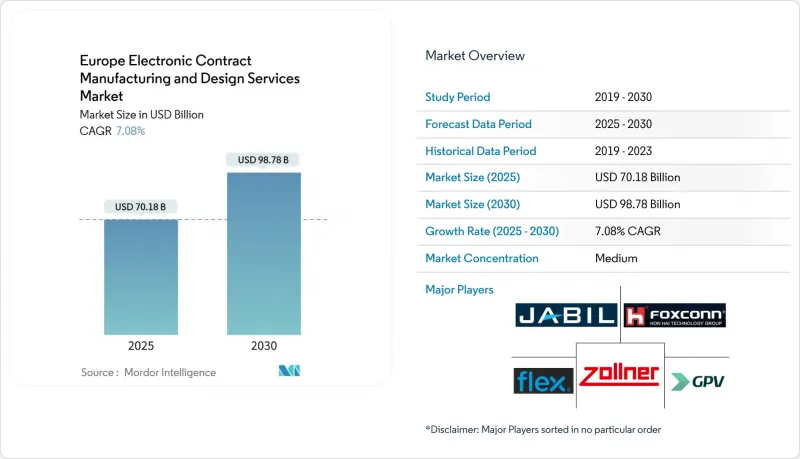
This report is Segmented by Service Type (Engineering Design, and More), End-Use Industry (ICT and Telecom, Consumer Electronics, and More), Contract Model (Turnkey EMS, Partial EMS, and More), Company Size (Large >=USD 500m, Mid-Tier USD 100-500m, and More), and Country (Germany, France, and More). The Market Forecasts are Provided in Terms of Value (USD).
Europe Electronic Contract Manufacturing and Design Services Market Trends and Insights
Accelerating Outsourcing of Complex Electronics by European OEMs
Automotive tier-ones and industrial automation leaders are expanding EMS partnerships to offload advanced driver-assistance, high-density powertrain, and edge-AI modules, thereby avoiding fresh CAPEX while accessing state-of-the-art process equipment. Bosch, Continental, and ZF signed multi-year agreements with regional EMS houses for next-generation inverter boards in 2024. Infineon's packaging and test alliance with Amkor in Porto highlights the shift from in-house to external specialists for once-in-house steps. Stronger collaboration now spans life-cycle testing and field-failure analytics, pushing EMS providers into roles traditionally reserved for OEM engineering teams.
Demand Spike from E-Mobility Power Electronics and Battery Management Systems
EV penetration surpassed 22% of regional light-vehicle sales in 2025, catalyzing call-offs for high-current boards, SiC inverter stacks, and battery management controllers. Semikron-Danaher and Infineon expanded the outsourcing of press-fit assembly to support Bosch's rollout of the ninth-generation e-axle. Automotive functional-safety constraints anchor this work in established European sites where ASIL-D certification experience exists.
Skilled Labour Shortage and Rising Wage Inflation in Manufacturing Hubs
Germany alone is expected to enter 2025 short of 13,000 SMT technicians, press-fit specialists, and test engineers needed for planned semiconductor fabs. Wage rates in Bavaria and Baden-Wurttemberg increased by 6-8% year-on-year in 2024, narrowing the landed-cost gap with select Asian locations. Policymakers responded by funding dual-education pathways; however, the talent deficit remains acute for high-mix, low-volume lines that require process-capability expertise.
Other drivers and restraints analyzed in the detailed report include:
- Expansion of Smart-MedTech and Wearable Device Manufacturing
- Near-Term Inventory Rightsizing After 2022-2023 Bullwhip Distortion
- Persistent Component Lead-Time Volatility and Allocation Risk
For complete list of drivers and restraints, kindly check the Table Of Contents.
Segment Analysis
Engineering design captured renewed priority, expanding at a 7.81% CAGR through 2030 as OEMs seek collaborative ideation frameworks that compress time-to-market. Electronics assembly still supplied 46.12% of the Europe electronic contract manufacturing and design services market share in 2024, anchored by steady consumer and industrial volumes. System integration rose on the back of turnkey edge-AI gateways, while aftermarket services monetized circular economy mandates.
The Europe electronic contract manufacturing and design services market size for engineering design is projected to climb further as ASIC design houses such as IC'Alps formalize foundry alliances that cover tape-out to final test, shortening prototype cycles by up to 30 days. Joint design-manufacturing arrangements likewise grow at an 8.56% CAGR, underscoring the competitive weight of unified DFM, regulatory validation, and volume transfer capabilities.
Electronic manufacturing services for healthcare and medical devices are expected to register an 8.12% CAGR, driven by surgical robotics, connected drug-delivery platforms, and Class III implantables that require ISO 13485 traceability. Industrial and robotics maintained the largest slice, equal to 28.36% of the Europe electronic contract manufacturing and design services market size in 2024, thanks to sustained automation spending across EU factories.
The Europe electronic contract manufacturing and design services industry benefits where medical OEMs outsource PCB-As requiring stringent biocompatibility and 100% electronic lot history. Polish EMS entities such as Assel invested in bio-cleanroom upgrades to capture this premium segment. Automotive electrification, meanwhile, anchors mid-term volume through inverter boards and thermal-management controllers.
Complete Report Scope:
- By Service Type
- Engineering Design
- Electronics Assembly
- System Integration
- After-Market Services
- By End-Use Industry
- Automotive And Mobility
- Industrial And Robotics
- Healthcare And Medical Devices
- Aerospace And Defence
- ICT And Telecom
- Consumer Electronics
- By Contract Model
- Turnkey EMS
- Consignment/Build-to-Print
- Joint Design-Manufacturing
- Partial EMS
- By Company Size Of EMS Provider
- Large (>=USD 500 m)
- Mid-Tier (USD 100-500 m)
- Small (USD 20-100 m)
List of Companies Covered in this Report:
- Hon Hai Precision Industry Co. Ltd. (Foxconn)
- Flex Ltd.
- Jabil Inc.
- Zollner Elektronik AG
- GPV International A/S
- Scanfil Oyj
- Asteelflash SAS
- Videoton Holding Zrt.
- Katek SE
- Kitron ASA
- Celestica Inc.
- Cicor Group AG
- Neways Electronics International N.V.
- LACROIX Group SA
- TQ-Systems GmbH
- Bitron SPA
- Melecs EWS GmbH
- Plexus Services Corp.
- NOTE AB
- Fideltronik Poland Sp. z o.o.
Additional Benefits:
- The market estimate (ME) sheet in Excel format
- 3 months of analyst support
TABLE OF CONTENTS
1 INTRODUCTION
- 1.1 Study Assumptions and Market Definition
- 1.2 Scope of the Study
2 RESEARCH METHODOLOGY
3 EXECUTIVE SUMMARY
4 MARKET LANDSCAPE
- 4.1 Market Overview
- 4.2 Market Drivers
- 4.2.1 Accelerating Outsourcing Of Complex Electronics By European OEMs
- 4.2.2 Reshoring Incentives And Supply-Chain Nationalisation Programs
- 4.2.3 Growing Adoption Of Industry 4.0 And Digital Twins Across EMS Plants
- 4.2.4 Demand Spike From E-Mobility Power Electronics And Battery Management Systems
- 4.2.5 Expansion Of Smart-MedTech And Wearable Device Manufacturing
- 4.2.6 Near-Term Inventory Rightsizing After 2022-2023 Bullwhip Distortion
- 4.3 Market Restraints
- 4.3.1 Skilled Labour Shortage And Rising Wage Inflation In Manufacturing Hubs
- 4.3.2 Persistent Component Lead-Time Volatility And Allocation Risk
- 4.3.3 High Capex Barrier For Advanced Assembly And Testing Lines
- 4.3.4 Intensifying Energy-Price Volatility Impacting Cost Structures
- 4.4 Industry Value Chain Analysis
- 4.5 Regulatory Landscape
- 4.6 Technological Outlook
- 4.7 Porter's Five Forces Analysis
- 4.7.1 Threat of New Entrants
- 4.7.2 Bargaining Power of Suppliers
- 4.7.3 Bargaining Power of Buyers
- 4.7.4 Threat of Substitutes
- 4.7.5 Intensity Competitive Rivalry
- 4.8 Impact of Macroeconomic Factors on the Market
5 MARKET SIZE AND GROWTH FORECASTS
- 5.1 By Service Type
- 5.1.1 Engineering Design
- 5.1.2 Electronics Assembly
- 5.1.3 System Integration
- 5.1.4 After-Market Services
- 5.2 By End-Use Industry
- 5.2.1 Automotive And Mobility
- 5.2.2 Industrial And Robotics
- 5.2.3 Healthcare And Medical Devices
- 5.2.4 Aerospace And Defence
- 5.2.5 ICT And Telecom
- 5.2.6 Consumer Electronics
- 5.3 By Contract Model
- 5.3.1 Turnkey EMS
- 5.3.2 Consignment/Build-to-Print
- 5.3.3 Joint Design-Manufacturing
- 5.3.4 Partial EMS
- 5.4 By Company Size Of EMS Provider
- 5.4.1 Large (>=USD 500 m)
- 5.4.2 Mid-Tier (USD 100-500 m)
- 5.4.3 Small (USD 20-100 m)
- 5.4.4 Micro (<USD 20 m)
- 5.5 By Country
- 5.5.1 Germany
- 5.5.2 United Kingdom
- 5.5.3 France
- 5.5.4 Italy
- 5.5.5 Spain
- 5.5.6 Russia
- 5.5.7 Rest of Europe
6 COMPETITIVE LANDSCAPE
- 6.1 Market Concentration
- 6.2 Strategic Moves
- 6.3 Market Share Analysis
- 6.4 Company Profiles (includes Global Level Overview, Market Level Overview, Core Segments, Financials as available, Strategic Information, Market Rank/Share for key companies, Products and Services, and Recent Developments)
- 6.4.1 Hon Hai Precision Industry Co. Ltd. (Foxconn)
- 6.4.2 Flex Ltd.
- 6.4.3 Jabil Inc.
- 6.4.4 Zollner Elektronik AG
- 6.4.5 GPV International A/S
- 6.4.6 Scanfil Oyj
- 6.4.7 Asteelflash SAS
- 6.4.8 Videoton Holding Zrt.
- 6.4.9 Katek SE
- 6.4.10 Kitron ASA
- 6.4.11 Celestica Inc.
- 6.4.12 Cicor Group AG
- 6.4.13 Neways Electronics International N.V.
- 6.4.14 LACROIX Group SA
- 6.4.15 TQ-Systems GmbH
- 6.4.16 Bitron SPA
- 6.4.17 Melecs EWS GmbH
- 6.4.18 Plexus Services Corp.
- 6.4.19 NOTE AB
- 6.4.20 Fideltronik Poland Sp. z o.o.
7 MARKET OPPORTUNITIES AND FUTURE OUTLOOK
- 7.1 White-Space and Unmet-Need Assessment

