PUBLISHER: Mordor Intelligence | PRODUCT CODE: 2072635

PUBLISHER: Mordor Intelligence | PRODUCT CODE: 2072635
Intracranial Aneurysm Treatment Devices - Market Share Analysis, Industry Trends & Statistics, Growth Forecasts (2026 - 2031)
According to Mordor Intelligence, the intracranial aneurysm treatment devices market size was valued at USD 1.72 billion in 2025 and is estimated to grow from USD 1.89 billion in 2026 to reach USD 3.03 billion by 2031, at a CAGR of 9.90% during the forecast period (2026-2031).
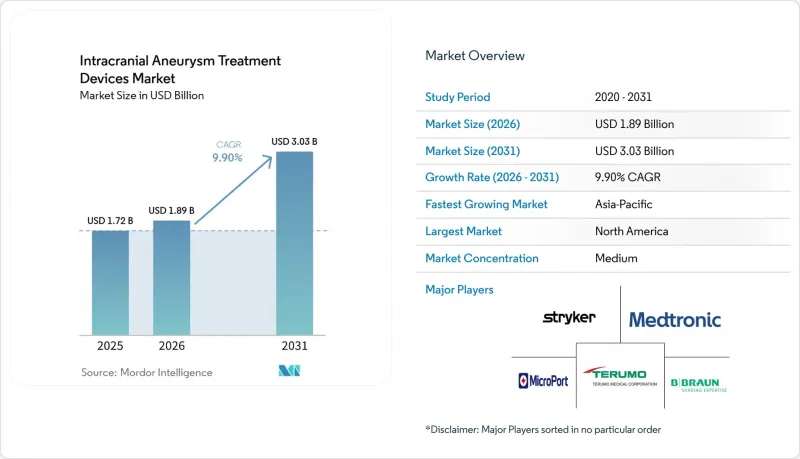
This report is Segmented by Device Type (Embolization Coils, Flow Diverters, Intrasaccular Flow Disruptors, Intracranial Stents & Balloons, and More), End User (Hospitals, Ambulatory Surgical Centers, Specialty Neurosurgical Centers), and Geography (North America, Europe, Asia-Pacific, Middle East and Africa, South America). The Market Forecasts are Provided in Terms of Value (USD).
Global Intracranial Aneurysm Treatment Devices Market Trends and Insights
Rising Demand for Minimally Invasive Endovascular Procedures
Outpatient-ready flow diverters and AI-guided robotic systems have made complex neurovascular work feasible in ambulatory environments. In 2024, US ambulatory surgical centers treated 3.3 million Medicare beneficiaries, signaling a decisive swing away from inpatient neurosurgery. Robotic deployments such as the CorPath GRX platform secured 100% technical success and lower radiation exposure, encouraging health systems to open dedicated outpatient neuro-intervention suites.
Growing Prevalence of Unruptured Aneurysm Detection Through Incidental Brain Imaging
High-resolution MRI and CT angiography now uncover countless asymptomatic lesions, expanding the treatable population. AI algorithms like Viz ANEURYSM, cleared by the FDA in 2024, standardize reading protocols and reduce inter-observer variability. The surge strains risk-stratification workflows and stimulates demand for decision-support tools bundled with next-generation devices.
High Device & Procedural Costs With Limited Reimbursement
US CMS pass-through codes remain restrictive for cutting-edge implants, while Korea reimburses flow diverters only for large aneurysms, capping penetration. Manufacturers now pair launches with health-economic dossiers and risk-sharing contracts to prove lifetime value to payers.
Other drivers and restraints analyzed in the detailed report include:
- Age-Linked Hypertension & Smoking Prevalence in Developing Economies
- FDA Breakthrough-Device Designations Accelerating Device Approvals
- Shortage Of Dual-Trained Endovascular Neurosurgeons in Emerging Markets
For complete list of drivers and restraints, kindly check the Table Of Contents.
Segment Analysis
Flow diverters occupy the fastest lane, expanding at a 14.0% CAGR through 2031 and steadily eroding coil dominance. The Pipeline Vantage recorded 81.7% six-month occlusion in pivotal studies, while hydrophilic-coated variants cut thrombotic events to 4.7% and achieved 92.3% long-term closure. Platinum remains central, forming 30-40% of material content for its radiopacity and biocompatibility.
The segment's outlook is strengthened by intrasaccular disruptors such as WEB 17 that produce 86.5% complete occlusion in ruptured aneurysms after one year. As a result, global purchasers are reallocating capital budgets toward devices promising fewer retreatments and shorter learning curves, uplifting the intracranial aneurysm treatment devices market.
Complete Report Scope:
- By Device Type
- Embolization Coils
- Flow Diverters
- Intrasaccular Flow Disruptors
- Intracranial Stents & Balloons
- Aneurysm Clips
- Others
- By End-user
- Hospitals
- Ambulatory Surgical Centers
- Specialty Neurosurgical Centers
- By Geography
- North America
- United States
- Canada
- Mexico
- Europe
- Germany
- United Kingdom
- France
- Italy
- Spain
- Rest of Europe
- Asia-Pacific
- China
- Japan
- India
- South Korea
- Australia
- Rest of Asia-Pacific
- Middle East and Africa
- GCC
- South Africa
- Rest of Middle East and Africa
- South America
- Brazil
- Argentina
- Rest of South America
- North America
Geography Analysis
North America sustained a 41.3% revenue share in 2025, aided by FDA breakthrough pathways and payer openness to premium implants. Corporate M&A remains brisk, exemplified by Stryker's USD 4.9 billion Inari acquisition that broadens access to venous and neurovascular segments. Nonetheless, device review staffing cuts at the FDA risk stretching approval queues, tempering near-term acceleration.
Asia-Pacific is the fastest-growing region with an 11.2% CAGR through 2031. China's NMPA reforms and the "Healthy China 2030" mandate increase funding for cerebrovascular care, whereas Japan's PMDA provides predictable, science-based approvals. Growing middle-class demand, combined with policy support, expands the intracranial aneurysm treatment devices market, though heterogeneous reimbursement keeps price tiers wide.
Europe's MDR environment remains rigorous, emphasizing long-term safety data. Penumbra's 2024 CE marks for aspiration and coil systems show that novel devices can still navigate the pathway when supported by robust clinical evidence. Brexit-related divergence obliges firms to budget separately for UK conformity, nudging some smaller entrants to prioritize EU27 first.
- Stryker
- Medtronic
- Johnson & Johnson (CERENOVUS)
- Terumo Neuro
- MicroPort
- Penumbra
- Balt Extrusion S.A.
- Phenox
- B. Braun
- Integra LifeSciences
- Adeor Medical
- Sequent Medical
- Wallaby Medical
- Rapid Medical
- Evasc Neurovascular
- Kaneka Medix
- Cerus Endovascular
- Ceremedix (Boston Scientific spin-out)
- Route 92 Medical
- MicroVasx
- Codman Neuro
Additional Benefits:
- The market estimate (ME) sheet in Excel format
- 3 months of analyst support
TABLE OF CONTENTS
1 Introduction
- 1.1 Study Assumptions & Market Definition
- 1.2 Scope of the Study
2 Research Methodology
3 Executive Summary
4 Market Landscape
- 4.1 Market Overview
- 4.2 Market Drivers
- 4.2.1 Rising Demand for Minimally-Invasive Endovascular Procedures
- 4.2.2 Growing Prevalence of Unruptured Aneurysm Detection Through Incidental Brain Imaging
- 4.2.3 Age-Linked Hypertension & Smoking Prevalence in Developing Economies
- 4.2.4 FDA Breakthrough-Device Designations Accelerating Device Approvals
- 4.2.5 Emergence of AI-Guided Robotic Neuro-Intervention Platforms
- 4.2.6 Venture Funding Surge into Nano-Coil Surface Engineering Start-Ups
- 4.3 Market Restraints
- 4.3.1 High Device & Procedural Costs with Limited Reimbursement
- 4.3.2 Shortage of Dual-Trained Endovascular Neurosurgeons in Emerging Markets
- 4.3.3 Device-Related Thrombo-Embolic Complications Requiring Lifelong DAPT
- 4.3.4 Supply-Chain Dependence on Platinum & Cobalt Price Volatility Exposure
- 4.4 Supply Chain Analysis
- 4.5 Regulatory Landscape
- 4.6 Technological Outlook
- 4.7 Porter's Five Forces Analysis
- 4.7.1 Threat of New Entrants
- 4.7.2 Bargaining Power of Buyers/Consumers
- 4.7.3 Bargaining Power of Suppliers
- 4.7.4 Threat of Substitute Products
- 4.7.5 Intensity of Competitive Rivalry
5 Market Size & Growth Forecasts (Value, in USD)
- 5.1 By Device Type
- 5.1.1 Embolization Coils
- 5.1.2 Flow Diverters
- 5.1.3 Intrasaccular Flow Disruptors
- 5.1.4 Intracranial Stents & Balloons
- 5.1.5 Aneurysm Clips
- 5.1.6 Others
- 5.2 By End-user
- 5.2.1 Hospitals
- 5.2.2 Ambulatory Surgical Centers
- 5.2.3 Specialty Neurosurgical Centers
- 5.3 By Geography
- 5.3.1 North America
- 5.3.1.1 United States
- 5.3.1.2 Canada
- 5.3.1.3 Mexico
- 5.3.2 Europe
- 5.3.2.1 Germany
- 5.3.2.2 United Kingdom
- 5.3.2.3 France
- 5.3.2.4 Italy
- 5.3.2.5 Spain
- 5.3.2.6 Rest of Europe
- 5.3.3 Asia-Pacific
- 5.3.3.1 China
- 5.3.3.2 Japan
- 5.3.3.3 India
- 5.3.3.4 South Korea
- 5.3.3.5 Australia
- 5.3.3.6 Rest of Asia-Pacific
- 5.3.4 Middle East and Africa
- 5.3.4.1 GCC
- 5.3.4.2 South Africa
- 5.3.4.3 Rest of Middle East and Africa
- 5.3.5 South America
- 5.3.5.1 Brazil
- 5.3.5.2 Argentina
- 5.3.5.3 Rest of South America
- 5.3.1 North America
6 Competitive Landscape
- 6.1 Market Concentration
- 6.2 Market Share Analysis
- 6.3 Company Profiles {(includes Global level Overview, Market level overview, Core Segments, Financials as available, Strategic Information, Market Rank/Share for key companies, Products & Services, and Recent Developments)}
- 6.3.1 Stryker
- 6.3.2 Medtronic
- 6.3.3 Johnson & Johnson (CERENOVUS)
- 6.3.4 Terumo Neuro
- 6.3.5 MicroPort Scientific
- 6.3.6 Penumbra Inc.
- 6.3.7 Balt Extrusion S.A.
- 6.3.8 Phenox GmbH
- 6.3.9 B. Braun Melsungen
- 6.3.10 Integra LifeSciences
- 6.3.11 Adeor Medical
- 6.3.12 Sequent Medical
- 6.3.13 Wallaby Medical
- 6.3.14 Rapid Medical
- 6.3.15 Evasc Neurovascular
- 6.3.16 Kaneka Medix
- 6.3.17 Cerus Endovascular
- 6.3.18 Ceremedix (Boston Scientific spin-out)
- 6.3.19 Route 92 Medical
- 6.3.20 MicroVasx
- 6.3.21 Codman Neuro
7 Market Opportunities & Future Outlook
- 7.1 White-space & Unmet-need Assessment

