PUBLISHER: Mordor Intelligence | PRODUCT CODE: 2072643

PUBLISHER: Mordor Intelligence | PRODUCT CODE: 2072643
North America Stone Plastic Composite Flooring - Market Share Analysis, Industry Trends & Statistics, Growth Forecasts (2026 - 2031)
According to Mordor Intelligence, the north america stone plastic composite flooring market size stood at USD 6.10 billion in 2026, up from USD 5.72 billion in 2025, and is projected to reach USD 8.49 billion by 2031 at a 6.84% CAGR.
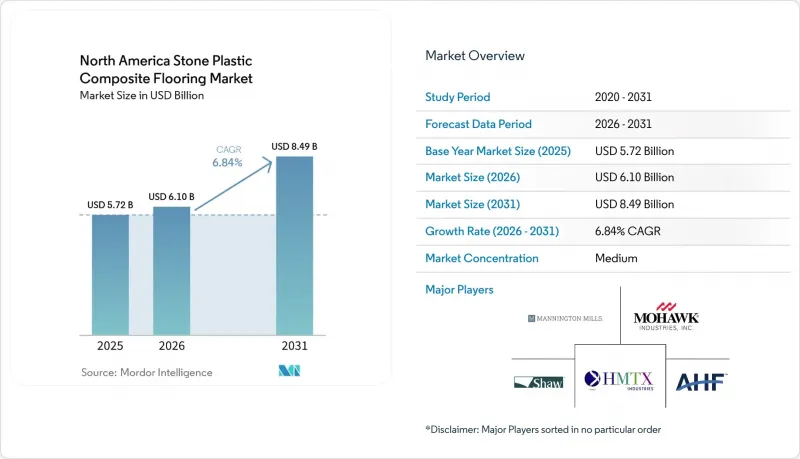
This report is Segmented by Product Type (SPC Tiles, SPC Planks), Product Thickness (4. 0-5. 0 Mm, 5. 1-6. 0 Mm, 6. 1-6. 5 Mm, and More), Installation Method (Self-Adhesive, and More), End User (Residential, Commercial), Distribution Channel (B2C/Retail, and B2B/Contractors/Builders), and Geography (United States, Canada, Mexico). Forecasts are Provided in Terms of Value (USD).
North America Stone Plastic Composite Flooring Market Trends and Insights
Renovation and DIY Preference for Waterproof Rigid Core
SPC addresses a practical problem in wet or variable-temperature interior spaces because its stone-plastic core does not swell like wood-based products under moisture exposure. Homeowners value click-lock floating installation that avoids adhesives, shortens project duration, and lowers labor costs compared with glue-down jobs, helping the North American SPC flooring market capture a larger share of renovation budgets. SPC adoption is supported by measurable shifts in renovation behavior and material performance needs. According to the National Association of Realtors, existing homes account for roughly 85-90% of annual housing transactions, sustaining a large renovation base. The Home Improvement Research Institute notes that over 60% of homeowners undertake at least one DIY project annually, with flooring among the most common upgrades. SPC also maintains structural stability over a temperature range of approximately -20°C to 60°C, minimizing expansion gaps in sunlit or semi-conditioned spaces. These performance characteristics translate into lower maintenance frequency and reduced lifecycle costs, reinforcing repeat purchases among landlords and owner-occupiers.
Shift from Flexible LVT/WPC to SPC on Performance to Price
SPC's higher core density and compression tolerance improve resistance to rolling loads and furniture legs compared to softer WPC or flexible LVT, supporting wider use in high-traffic zones at accessible price points. Property owners who switch from carpet or flexible LVT to SPC in busy corridors and living areas report fewer expansion and contraction issues, which cuts callbacks for replacements and repairs. The North American SPC flooring market also benefits from the perception that rigid core formats deliver greater value per dollar due to their durability, scratch resistance, and water tolerance in daily use. The transition toward SPC is driven by quantifiable improvements in mechanical performance relative to flexible LVT and WPC. According to ASTM International, SPC's rigid core density typically exceeds 1,900-2,100 kg/m3, compared with 800-1,200 kg/m3 for WPC, resulting in significantly higher resistance to indentation and rolling loads.
Tariffs, UFLPA Scrutiny, and PVC Input Price Volatility
Importers adjust sourcing and documentation to show clean supply chains because enforcement tools now require higher confidence evidence and end-to-end traceability. According to U.S. Customs and Border Protection, enforcement under the Uyghur Forced Labor Prevention Act led to over 3,500 shipment detentions valued at over USD 900 million in its first year, increasing compliance costs and clearance times. Buyers weigh landed cost scenarios that include tariff exposure, Section 301 tariffs on Chinese vinyl flooring products remain at up to 25%, and potential detentions, which can extend port dwell times by 2-4 weeks and add storage and demurrage costs of USD 100-USD 300 per container per day. PVC resin remains a significant share of SPC cost, and swings in resin pricing create margin pressure when retail price points are tightly managed. Some brands diversify production footprints to Southeast Asia or North America to balance tariff grids and streamline audits, which shifts how volumes are allocated to the United States and Canada . These cross-currents make planning more complex and temper near-term growth for the North American SPC flooring market.
Other drivers and restraints analyzed in the detailed report include:
- Retail Push: Home Centers and Specialty Expanding SPC Access
- Commercial Uptake in Hospitality and Multifamily Retrofits
- Quality Issues from Ultra Thin SPC Eroding Category Trust
For complete list of drivers and restraints, kindly check the Table Of Contents.
Segment Analysis
SPC planks held 72.10% in 2025, and SPC tiles are projected to post a 7.10% CAGR through 2031 as design-driven projects gain scale in the North America SPC flooring market. Planks benefit from realistic wood visuals, embossed textures, and familiar room layouts that align with residential preferences and DIY installation flows. Tile formats expand use cases in hospitality and mixed-use spaces where geometric layouts or larger modules reduce grout lines and speed maintenance routines. Installers cite consistent click lock performance and flatness as critical for large format tiles, which supports the selection of certified systems in higher traffic locations. This balance of aesthetics and practicality positions both formats to contribute to steady growth in the North America SPC flooring market.
SPC tiles improve differentiation against laminate and flexible vinyl because tiles enable visual narratives not easily created with plank-only assortments. Product teams add slip-resistant finishes and thicker wear layers to tile SKUs aimed at public spaces, which helps preserve appearance under daily cleaning and rolling traffic. As home centers and specialty stores adjust planograms to include more statement tile options, tiles can capture incremental share without displacing core plank volume in the North America SPC flooring market. Visualizer tools also help household buyers evaluate tile looks at home, which lowers decision friction for pattern rich spaces.
The 5.1-6.0 mm class accounted for 34.80% of the North America SPC flooring market share in 2025, while planks thicker than 6.5 mm are projected to post a 7.45% CAGR through 2031. Mid-range constructions balance rigid core stability with competitive cost, making them a good fit for most residential rooms and many light commercial spaces. Thicker builds integrate attached pads that support impact sound reduction, helping satisfy building code targets in many assemblies when paired with appropriate subfloors. Contractors highlight edge strength and profile precision as keys to long-term performance across all thicknesses, a claim reinforced by the fracture resistance test adopted in the ASSURE standard. These attributes inform fit-for-purpose selections across projects in the North America SPC flooring market.
Thin, entry-level products can work for quick cosmetic refreshes, yet they are more sensitive to subfloor flatness and heavy point loads, which increases the risk in high-traffic spaces. Premium >6.5 mm products suit hospitality corridors and multifamily units above grade because acoustics and indentation resistance carry more weight in those applications. Installers who standardize on a thickness band reduce training complexity and minimize profile transition issues at doorways, which improves job outcomes in the North America SPC flooring industry . Buyers weigh total installed cost and code alignment, which keeps mid range SKUs central to the North America SPC flooring market.
Complete Report Scope:
- By Product Type
- SPC Tiles
- SPC Planks
- By Product Thickness
- 4.0-5.0 mm
- 5.1-6.0 mm
- 6.1-6.5 mm
- Above 6.5 mm
- By Installation Method
- Self-Adhesive
- Glue-Down
- Interlocking/Click-lock
- Others
- By End User
- Residential
- Commercial
- By Distribution Channel
- B2C / Retail
- Home Centers
- Specialty Flooring Stores
- Online
- Local Hardware Shops (unorganized market)
- Other Distribution Channels
- B2B / Contractors
- B2C / Retail
- By Geography
- United States
- Canada
- Mexico
List of Companies Covered in this Report:
- Shaw Industries
- Mohawk Industries
- Mannington Mills
- AHF Products
- Tarkett North America
- CFL Flooring
- Novalis Innovative Flooring (NovaFloor)
- Wellmade Performance Floors
- Nox Corporation
- Huali Floors
- Gerflor
- Beaulieu International Group (Beauflor)
- LX Hausys (formerly LG Hausys)
- United Surface Solutions
- Republic Floor (manufacturing)
- Zhejiang Kingdom Flooring Plastic Co., Ltd.
- Zhejiang Walrus New Material Co., Ltd.
- Zhangjiagang Yihua Plastics Co., Ltd.
- Jiangsu Lejia Plastic Co., Ltd.
- Changzhou Runchang Wood Co., Ltd.
Additional Benefits:
- The market estimate (ME) sheet in Excel format
- 3 months of analyst support
TABLE OF CONTENTS
1 Introduction
- 1.1 Study Assumptions & Market Definition
- 1.2 Scope of the Study
2 Research Methodology
3 Executive Summary
4 Market Landscape
- 4.1 Market Overview
- 4.2 Market Drivers
- 4.2.1 Renovation and DIY preference for waterproof rigid core
- 4.2.2 Shift from flexible LVT/WPC to SPC on performance-to-price
- 4.2.3 Retail push: home centers and specialty expanding SPC access
- 4.2.4 Commercial uptake in hospitality and multifamily retrofits
- 4.2.5 Locking-system advances (5G/Unilin) cut install time/recalls
- 4.2.6 Nearshoring/domestic SPC capacity reduces lead-times/compliance risk
- 4.3 Market Restraints
- 4.3.1 Tariffs/UFLPA detentions and PVC input volatility
- 4.3.2 Quality issues from ultra-thin SPC eroding category trust
- 4.3.3 IP enforcement (USITC GEO on interlocking LVT/SPC) raises costs
- 4.3.4 Tightening standards (ASSURE v2.0 fracture test) add retooling burden
- 4.4 Industry Value Chain Analysis
- 4.5 Porter's Five Forces Analysis
- 4.5.1 Threat of New Entrants
- 4.5.2 Bargaining Power of Suppliers
- 4.5.3 Bargaining Power of Buyers
- 4.5.4 Threat of Substitutes
- 4.5.5 Competitive Rivalry
- 4.6 Insights into the Latest Trends and Innovations in the Industry
- 4.7 Insights on Recent Developments (New Product Launches, Strategic Initiatives, Investments, Partnerships, JVs, Expansion, M&As, etc.) in the Industry
5 Market Size & Growth Forecasts (Value in USD Billion)
- 5.1 By Product Type
- 5.1.1 SPC Tiles
- 5.1.2 SPC Planks
- 5.2 By Product Thickness
- 5.2.1 4.0-5.0 mm
- 5.2.2 5.1-6.0 mm
- 5.2.3 6.1-6.5 mm
- 5.2.4 Above 6.5 mm
- 5.3 By Installation Method
- 5.3.1 Self-Adhesive
- 5.3.2 Glue-Down
- 5.3.3 Interlocking/Click-lock
- 5.3.4 Others
- 5.4 By End User
- 5.4.1 Residential
- 5.4.2 Commercial
- 5.5 By Distribution Channel
- 5.5.1 B2C / Retail
- 5.5.1.1 Home Centers
- 5.5.1.2 Specialty Flooring Stores
- 5.5.1.3 Online
- 5.5.1.4 Local Hardware Shops (unorganized market)
- 5.5.1.5 Other Distribution Channels
- 5.5.2 B2B / Contractors
- 5.5.1 B2C / Retail
- 5.6 By Geography
- 5.6.1 United States
- 5.6.2 Canada
- 5.6.3 Mexico
6 Competitive Landscape
- 6.1 Market Concentration
- 6.2 Strategic Moves
- 6.3 Market Share Analysis
- 6.4 Company Profiles (includes Global level Overview, Market level overview, Core Segments, Financials as available, Strategic Information, Market Rank/Share for key companies, Products & Services, and Recent Developments)
- 6.4.1 Shaw Industries
- 6.4.2 Mohawk Industries
- 6.4.3 Mannington Mills
- 6.4.4 AHF Products
- 6.4.5 Tarkett North America
- 6.4.6 CFL Flooring
- 6.4.7 Novalis Innovative Flooring (NovaFloor)
- 6.4.8 Wellmade Performance Floors
- 6.4.9 Nox Corporation
- 6.4.10 Huali Floors
- 6.4.11 Gerflor
- 6.4.12 Beaulieu International Group (Beauflor)
- 6.4.13 LX Hausys (formerly LG Hausys)
- 6.4.14 United Surface Solutions
- 6.4.15 Republic Floor (manufacturing)
- 6.4.16 Zhejiang Kingdom Flooring Plastic Co., Ltd.
- 6.4.17 Zhejiang Walrus New Material Co., Ltd.
- 6.4.18 Zhangjiagang Yihua Plastics Co., Ltd.
- 6.4.19 Jiangsu Lejia Plastic Co., Ltd.
- 6.4.20 Changzhou Runchang Wood Co., Ltd.
7 Market Opportunities & Future Outlook
- 7.1 Performance-led premiumization: thicker SPC (> 6.5 mm) for IIC/STC code compliance in multifamily/hospitality
- 7.2 Domestic/nearshore SPC programs for tariff/UFLPA-sensitive RFPs with faster lead-times

