PUBLISHER: Mordor Intelligence | PRODUCT CODE: 2072676

PUBLISHER: Mordor Intelligence | PRODUCT CODE: 2072676
U.S. Orthopedic Braces And Supports - Market Share Analysis, Industry Trends & Statistics, Growth Forecasts (2026 - 2031)
According to Mordor Intelligence, the u.S. orthopedic braces and supports market size is projected to expand from USD 1.60 billion in 2025 and USD 1.68 billion in 2026 to USD 2.15 billion by 2031, registering a CAGR of 5.05% between 2026 to 2031.
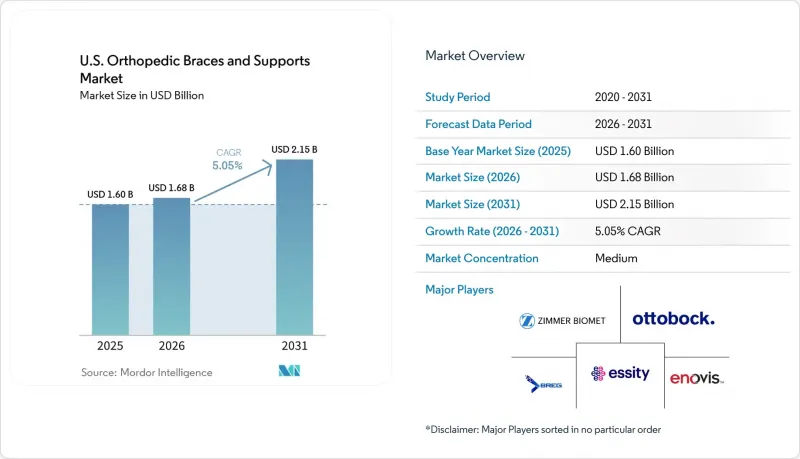
This report is Segmented by Product (Knee Braces, Ankle & Foot, Back & Spine, and More), Application (Ligament Injury, Preventive Care, Post-Operative Rehabilitation, Osteoarthritis, Other Chronic Conditions), End User (Hospitals & Surgical Centers, Orthopedic Clinics, Homecare, and More), and Geography. Forecasts are Provided in Value (USD).
U.S. Orthopedic Braces And Supports Market Trends and Insights
Aging US Population and Osteoarthritis Burden
The United States faces a significant osteoarthritis burden among older adults, driving long-term brace usage for knee, hip, and back conditions. In 2025, osteoarthritis incidence among adults aged 55 and older was 1,973.19 per 100,000, surpassing other major markets. With 53.9% of adults aged 75 and older diagnosed with arthritis and 88% of cases in those aged 45 and above, demand for clinician-directed devices that alleviate pain and maintain mobility is rising. As Baby Boomers age into the 75-plus bracket by 2030, the orthopedic braces and supports market will see sustained growth, particularly for unloader knee braces and hip offloading products.
High Sports and Musculoskeletal Injury Incidence
Sports participation in the United States continues to drive ligament, ankle, knee, and shoulder injuries. Emergency department visits for sports-related injuries reached 4.4 million in 2024, a 17% increase from 2023. High school programs reported 5,921 injuries during the 2024/25 academic year, with knee and ankle ligament injuries being most common. Adult recreational activities, especially among those aged 35 to 60, further contribute to demand for prescription-grade braces, ensuring steady market growth.
Reimbursement Gaps and Patient Out-of-Pocket Burden
Reimbursement challenges remain a significant barrier to converting clinical recommendations into product adoption. Medicare and Medicaid cover a substantial portion of patients using orthopedic braces, particularly those with osteoarthritis, chronic musculoskeletal conditions, or post-surgical recovery needs. The 2026 DMEPOS fee schedule update reflected a 2.0% increase for non-competitive-bidding orthotic items, while orthotic labor code L4205 rose by 2.7%, both trailing the rising costs faced by brace manufacturers. Co-insurance and deductibles often delay adoption for fixed-income patients, especially for premium devices like unloader knee and OA hip braces. This issue is more pronounced in dual-eligible and lower-income regions, where limited coverage and tight provider economics reduce addressable demand.
Other drivers and restraints analyzed in the detailed report include:
- Shift Toward Non-Invasive Care and Post-Operative Rehabilitation
- 2026 Lower-Extremity Orthosis Code Expansion
- Commoditization Pressure in Soft Goods and OTC Channels
For complete list of drivers and restraints, kindly check the Table Of Contents.
Segment Analysis
Knee Braces & Supports accounted for 36.11% of the market share in 2025, making them the primary revenue driver in the United States orthopedic braces and supports market. Their broad application in osteoarthritis management, ligament injury recovery, and preventive use among active adults ensures frequent prescriptions. The segment benefits from a wide price range, from low-cost OTC sleeves to custom unloader devices exceeding USD 1,000, capturing both volume and value.
Back & Spine Braces remain a key segment due to their use in chronic lumbar pain, post-surgical stabilization, and work-related strain. Ankle & Foot Braces hold a significant position, driven by demand for sprain management and recovery from calcaneal and tibial procedures. Upper-extremity Braces are projected to grow at a 6.06% CAGR through 2031, supported by structured outpatient care for shoulder, wrist, and elbow conditions. Smith+Nephew's acquisition of Integrity Orthopaedics in January 2026 and Bauerfeind's launch of the GenuTrain P3 patella tracking brace in 2026 highlight the strategic focus on expanding product offerings.
Complete Report Scope:
- By Product
- Knee Braces & Supports
- Ankle & Foot Braces
- Back & Spine Braces
- Upper-extremity Braces
- Hip & Pelvic Braces
- Others
- By Application
- Ligament Injury
- Preventive Care
- Post-operative Rehabilitation
- Osteoarthritis
- Other Chronic Conditions
- By End User
- Hospitals & Surgical Centers
- Orthopedic Clinics
- Homecare Settings
- Sports & Rehabilitation Centers
List of Companies Covered in this Report:
- 3M Company (Solventum)
- Aspen Medical Products, LLC
- Bauerfeind USA Inc.
- Becker Orthopedic, Inc.
- Bird & Cronin, LLC
- Breg
- DeRoyal Industries
- Embla Medical hf.
- Enovis Corporation
- Essity
- Fillauer
- Frank Stubbs Company, Inc.
- Hanger, Inc.
- McDavid, Inc.
- medi
- Mueller Sports Medicine, Inc.
- Orthofix
- Ottobock
- Weber Orthopedic LP. DBA Hely & Weber
- Zimmer Biomet
Additional Benefits:
- The market estimate (ME) sheet in Excel format
- 3 months of analyst support
TABLE OF CONTENTS
1 Introduction
- 1.1 Study Assumptions & Market Definition
- 1.2 Scope of the Study
2 Research Methodology
3 Executive Summary
4 Market Landscape
- 4.1 Market Overview
- 4.2 Market Drivers
- 4.2.1 Aging U.S. Population and Osteoarthritis Burden
- 4.2.2 High Sports and Musculoskeletal Injury Incidence
- 4.2.3 Shift Toward Non-Invasive Care and Post-Operative Rehabilitation
- 4.2.4 Product Innovation in Lightweight, Breathable, Low-Profile Bracing
- 4.2.5 2026 Lower-Extremity Orthosis Code Expansion Supports Premiumization
- 4.2.6 Digital Ordering, Scanning, and DMEPOS Workflow Tools Improve Clean-Claim Conversion
- 4.3 Market Restraints
- 4.3.1 Reimbursement Gaps and Patient Out-of-Pocket Burden
- 4.3.2 Commoditization Pressure in Soft Goods and OTC Channels
- 4.3.3 Tight Custom-Fabricated Eligibility and Documentation Burden
- 4.3.4 Non-Rigid Supports Can Fall Outside Medicare Brace Benefit
- 4.4 Value / Supply-Chain Analysis
- 4.5 Regulatory and Reimbursement Landscape
- 4.6 Technological Outlook
- 4.7 Porter's Five Forces Analysis
- 4.7.1 Threat of New Entrants
- 4.7.2 Bargaining Power of Suppliers
- 4.7.3 Bargaining Power of Buyers
- 4.7.4 Threat of Substitutes
- 4.7.5 Competitive Rivalry
5 Market Size & Growth Forecasts (Value, USD)
- 5.1 By Product
- 5.1.1 Knee Braces & Supports
- 5.1.2 Ankle & Foot Braces
- 5.1.3 Back & Spine Braces
- 5.1.4 Upper-extremity Braces
- 5.1.5 Hip & Pelvic Braces
- 5.1.6 Others
- 5.2 By Application
- 5.2.1 Ligament Injury
- 5.2.2 Preventive Care
- 5.2.3 Post-operative Rehabilitation
- 5.2.4 Osteoarthritis
- 5.2.5 Other Chronic Conditions
- 5.3 By End User
- 5.3.1 Hospitals & Surgical Centers
- 5.3.2 Orthopedic Clinics
- 5.3.3 Homecare Settings
- 5.3.4 Sports & Rehabilitation Centers
6 Competitive Landscape
- 6.1 Market Concentration
- 6.2 Market Share Analysis
- 6.3 Company Profiles (includes Global level Overview, Market level overview, Core Segments, Financials as available, Strategic Information, Market Rank/Share for key companies, Products & Services, and Recent Developments)
- 6.3.1 3M Company (Solventum)
- 6.3.2 Aspen Medical Products, LLC
- 6.3.3 Bauerfeind USA Inc.
- 6.3.4 Becker Orthopedic, Inc.
- 6.3.5 Bird & Cronin, LLC
- 6.3.6 Breg, Inc.
- 6.3.7 DeRoyal Industries, Inc.
- 6.3.8 Embla Medical hf.
- 6.3.9 Enovis Corporation
- 6.3.10 Essity Aktiebolag
- 6.3.11 Fillauer LLC
- 6.3.12 Frank Stubbs Company, Inc.
- 6.3.13 Hanger, Inc.
- 6.3.14 McDavid, Inc.
- 6.3.15 medi GmbH & Co. KG
- 6.3.16 Mueller Sports Medicine, Inc.
- 6.3.17 Orthofix Medical Inc.
- 6.3.18 Ottobock SE & Co. KGaA
- 6.3.19 Weber Orthopedic LP. DBA Hely & Weber
- 6.3.20 Zimmer Biomet Holdings, Inc.
7 Market Opportunities & Future Outlook
- 7.1 White-space & Unmet-need Assessment

