PUBLISHER: Mordor Intelligence | PRODUCT CODE: 2072701

PUBLISHER: Mordor Intelligence | PRODUCT CODE: 2072701
U.S. Acne Treatment - Market Share Analysis, Industry Trends & Statistics, Growth Forecasts (2026 - 2031)
According to Mordor Intelligence, the u.S. acne treatment market size is expected to grow from USD 3.62 billion in 2025 to USD 3.79 billion in 2026 and is forecast to reach USD 4.78 billion by 2031 at 4.75% CAGR over 2026-2031.
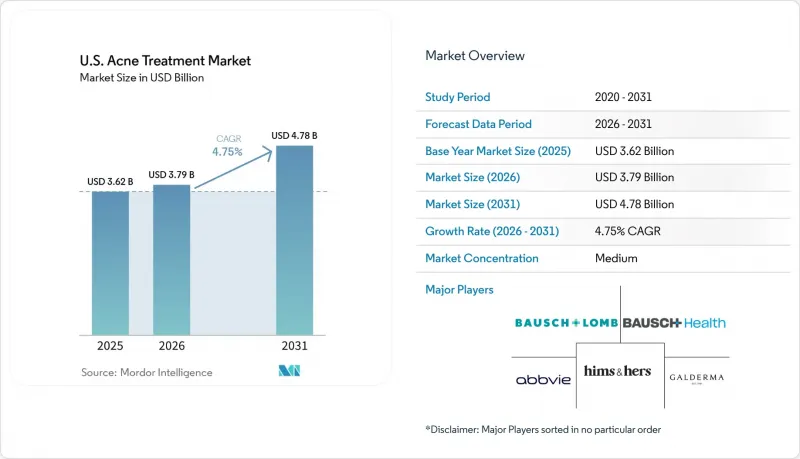
This report is Segmented by Product Type (Topical Retinoids, Benzoyl Peroxide, Topical/Oral Antibiotics, Isotretinoin, Hormonal Therapies, Combination Products, Others), Route of Administration (Topical, Oral), Gender (Female, Male), and Distribution Channel (Retail, Hospital, Online Pharmacies, Dermatology Clinics and Med Spas). The Market Forecasts are Provided in Terms of Value (USD).
U.S. Acne Treatment Market Trends and Insights
High Prevalence Across Adolescents and Adults
Acne, the most common skin condition in the United States, affects approximately 50 million Americans annually, anchoring the acne treatment market to a broad recurring treatment base. While acne typically begins in adolescence, treatment demand now extends into adulthood, driven by repeat physician visits and long-term maintenance routines. This diverse patient base sustains demand for OTC products, prescription topicals, oral therapies, and maintenance regimens. The focus on quality-of-life improvements and newer formulations further strengthens market resilience, even amid generic competition.
Rising Demand for Combination Therapy Regimens
The United States acne treatment market is shifting toward combination therapies as clinicians seek regimens addressing multiple disease pathways in a single prescription. CABTREO's FDA approval and launch validated this trend, setting a benchmark for innovation. The 2024 AAD guidelines favor complementary mechanisms over antibiotic monotherapy, enhancing the appeal of fixed-dose combinations. The FDA's OTC approval for adapalene and benzoyl peroxide further expands access to dual-mechanism care, intensifying competition with single-agent products.
Antibiotic Stewardship Pressure on Oral and Topical Antibiotics
The American Academy of Dermatology (AAD) in 2024 introduced stricter guidelines for acne treatment, capping systemic antibiotic use at 3 to 4 months and eliminating antibiotic monotherapy. These measures limit the growth of older oral and topical antibiotics in the United States acne treatment market. While doxycycline, minocycline, and clindamycin remain part of care pathways, their restricted use reduces repeat prescriptions and long-term revenue. The market is shifting toward combination therapies and non-antibiotic alternatives, driving value growth but constraining unit expansion in the antibiotic segment.
Other drivers and restraints analyzed in the detailed report include:
- Growth in Female Hormonal Acne Diagnosis
- Expanding OTC Access to Acne Therapies
- Irritation, Dryness, and Photosensitivity Limitations
For complete list of drivers and restraints, kindly check the Table Of Contents.
Segment Analysis
Combination products are expected to grow at a 5.67% CAGR in the United States acne treatment market from 2026 to 2031, while topical retinoids held a 28.35% market share in 2025. This indicates a shift in the product mix, though retinoids remain central as first-line acne care and key ingredients in combination formulations. Topical retinoids maintain a strong position compared to older single-agent categories facing commoditization due to generics and OTC competition.
The shift toward combination products has been driven by CABTREO's prescription adoption and the Differin Epiduo OTC switch, increasing visibility of multi-ingredient care. Benzoyl peroxide retains volume presence but is now more valuable in premium combination products. Antibiotics remain relevant but face limited long-term roles as guidelines favor pairing and shorter usage. Innovation continues with Galderma's trifarotene expansion and Pfizer's Phase 1 acne study in 2025, targeting higher-value niches beyond mature topical categories.
Topical formulations accounted for 63.76% of the United States acne treatment market in 2025, while oral therapies are projected to grow at a 5.55% CAGR through 2031. Topicals dominate due to their role in first-line care for mild-to-moderate cases, ensuring a durable volume base. However, growth is slowing as complex cases and adult patients shift to longer-duration oral management.
Oral therapies are gaining traction with high-value treatments requiring extended courses or greater clinical intensity, especially for patients unresponsive to topicals. The 2026 REMS update is expected to ease isotretinoin access by reducing testing barriers, benefiting patients reliant on systemic treatments and telehealth pathways. Oral growth is driven by patient value and continuity of use rather than broad volume expansion in older antibiotic categories.
Complete Report Scope:
- By Product Type
- Topical Retinoids
- Benzoyl Peroxide
- Topical Antibiotics
- Oral Antibiotics
- Isotretinoin
- Hormonal Therapies
- Combination Products
- Other Acne Therapies
- By Route of Administration
- Topical
- Oral
- By Gender
- Female
- Male
- By Distribution Channel
- Retail Pharmacies
- Hospital Pharmacies
- Online Pharmacies
- Dermatology Clinics and Med Spas
List of Companies Covered in this Report:
- Abbvie
- Acella Pharmaceuticals
- Almirall
- Amneal Pharmaceuticals
- Bausch + Lomb Corporation
- Bausch Health
- Cosette Pharmaceuticals, Inc.
- Dermavant Sciences, Inc.
- Galderma Group AG
- Hims & Hers Health, Inc.
- Journey Medical
- Leo Pharma
- Ortho Dermatologics
- Perrigo Company
- Pfizer
- Reckitt Benckiser Group
- Sun Pharmaceuticals Industries
- Taro Pharmaceutical Industries Ltd.
- Teva Pharmaceutical Industries
- Viatris
Additional Benefits:
- The market estimate (ME) sheet in Excel format
- 3 months of analyst support
TABLE OF CONTENTS
1 INTRODUCTION
- 1.1 Study Assumptions and Market Definition
- 1.2 Scope of the Study
2 RESEARCH METHODOLOGY
3 EXECUTIVE SUMMARY
4 MARKET LANDSCAPE
- 4.1 Market Overview
- 4.2 Market Drivers
- 4.2.1 High Prevalence Across Adolescents and Adults
- 4.2.2 Rising Demand for Combination Therapy Regimens
- 4.2.3 Growth in Female Hormonal Acne Diagnosis and Treatment
- 4.2.4 Expanding OTC Access to Acne Therapies
- 4.2.5 Digital Dermatology and Tele-dermatology Prescription Enablement
- 4.2.6 Strong Clinical Preference for Long-term Maintenance Therapy
- 4.3 Market Restraints
- 4.3.1 Antibiotic Stewardship Pressure on Oral and Topical Antibiotics
- 4.3.2 Irritation, Dryness, and Photosensitivity Limiting Adherence
- 4.3.3 iPLEDGE and Pregnancy-prevention Compliance Burden for Isotretinoin
- 4.3.4 High Out-of-pocket Sensitivity for Brand-name Dermatology Therapies
- 4.4 Value/Supply Chain Analysis
- 4.5 Regulatory Landscape
- 4.6 Technological Outlook
- 4.7 Porter's Five Forces Analysis
- 4.7.1 Bargaining Power of Suppliers
- 4.7.2 Bargaining Power of Buyers
- 4.7.3 Threat of New Entrants
- 4.7.4 Threat of Substitutes
- 4.7.5 Industry Rivalry
5 MARKET SIZE AND GROWTH FORECASTS (VALUE USD)
- 5.1 By Product Type
- 5.1.1 Topical Retinoids
- 5.1.2 Benzoyl Peroxide
- 5.1.3 Topical Antibiotics
- 5.1.4 Oral Antibiotics
- 5.1.5 Isotretinoin
- 5.1.6 Hormonal Therapies
- 5.1.7 Combination Products
- 5.1.8 Other Acne Therapies
- 5.2 By Route of Administration
- 5.2.1 Topical
- 5.2.2 Oral
- 5.3 By Gender
- 5.3.1 Female
- 5.3.2 Male
- 5.4 By Distribution Channel
- 5.4.1 Retail Pharmacies
- 5.4.2 Hospital Pharmacies
- 5.4.3 Online Pharmacies
- 5.4.4 Dermatology Clinics and Med Spas
6 COMPETITIVE LANDSCAPE
- 6.1 Market Concentration
- 6.2 Market Share Analysis
- 6.3 Company Profiles (includes Global Level Overview, Market Level Overview, Core Segments, Financials as available, Strategic Information, Market Rank/Share, Products and Services, Recent Developments)
- 6.3.1 AbbVie Inc.
- 6.3.2 Acella Pharmaceuticals, LLC
- 6.3.3 Almirall, S.A.
- 6.3.4 Amneal Pharmaceuticals, Inc.
- 6.3.5 Bausch + Lomb Corporation
- 6.3.6 Bausch Health Companies Inc.
- 6.3.7 Cosette Pharmaceuticals, Inc.
- 6.3.8 Dermavant Sciences, Inc.
- 6.3.9 Galderma Group AG
- 6.3.10 Hims & Hers Health, Inc.
- 6.3.11 Journey Medical Corporation
- 6.3.12 LEO Pharma A/S
- 6.3.13 Ortho Dermatologics
- 6.3.14 Perrigo Company plc
- 6.3.15 Pfizer Inc.
- 6.3.16 Reckitt Benckiser Group plc
- 6.3.17 Sun Pharmaceutical Industries Limited
- 6.3.18 Taro Pharmaceutical Industries Ltd.
- 6.3.19 Teva Pharmaceutical Industries Limited
- 6.3.20 Viatris Inc.
7 MARKET OPPORTUNITIES AND FUTURE OUTLOOK
- 7.1 White-space and Unmet-need Assessment

